Does this sound familiar? You're juggling dozens of keywords, manually updating spreadsheets, and spending countless hours on repetitive checks. A rank tracking API is the solution to these challenges: this programmatic interface automates your position checks, streams real-time SERP data directly into your dashboards, and liberates you from tedious manual work. In this guide, you'll discover how a rank tracking API functions, why it's essential for any SEO strategy, and the straightforward steps to integrate it into your workflow.
What is a rank tracking API and how does it work
A rank tracker creates a direct connection between your optimization efforts and live search engine results. Instead of manually checking Google yourself, the tracking API queries search engines like Google or Bing, collects SERP data, and delivers your keyword ranking data in seconds. It's genuine automation—not just empty promises.
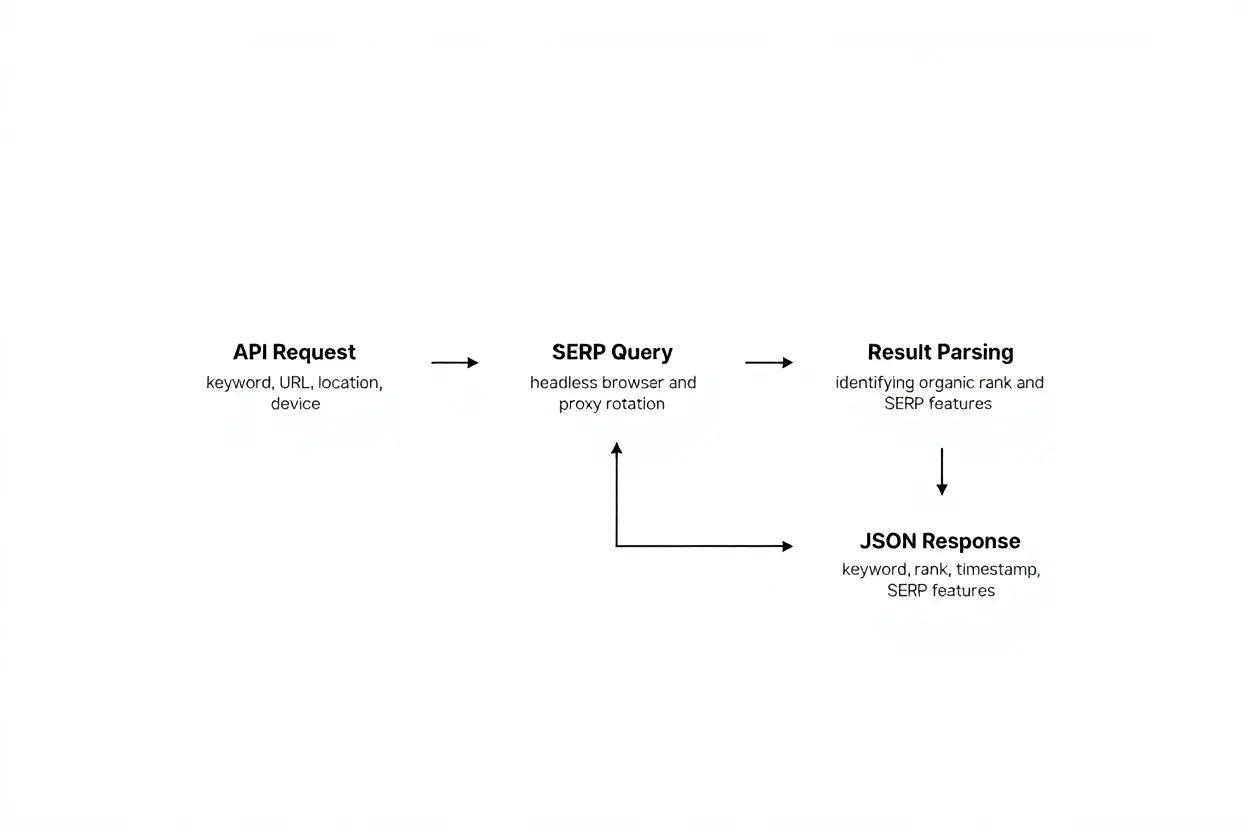
Core components of a rank tracking API request
Every request to a rank tracking API begins with specific parameters that define exactly what to measure. You specify the keyword, domain, precise location and device targeting, and the search engine. Automated keyword monitoring then handles the rest, allowing you to effortlessly scale from tracking five phrases to five thousand.
- Keyword parameter: The exact search term you want to monitor (e.g., "organic coffee beans"); the API returns where your URL appears in the organic search results.
- Target URL or domain: The specific webpage or website you're tracking; the service identifies its position among all organic results.
- Location and device targeting: Defines the country, city, and device type (mobile or desktop); this eliminates personalization bias and accurately reflects a real user's perspective.
- Search engine identifier: Selects the search engine, such as Google or Bing; tracking across multiple platforms highlights visibility gaps you can address.
After you submit your request, the API processes it almost instantly and returns your current rank, the ranking URL, and any detected SERP features—no spreadsheets, screenshots, or guesswork needed.
Technical process behind SERP data retrieval
Behind the scenes, the rank tracker uses headless browsers or bots that simulate real users, ensuring JavaScript-rendered content is captured accurately. Requests are routed through proxy networks to replicate the exact location you specify, neutralizing personalization and delivering precise search engine results.
The system captures the search results page, distinguishes ads from organic links, identifies featured snippets, local packs, and other SERP features, and then records your URL's numerical rank. Built-in CAPTCHA handling and automatic retries ensure reliable performance, so temporary issues never interrupt your tracking.
Results are briefly cached to minimize redundant queries and speed up response times. Each snapshot is timestamped, building a historical archive that helps you track algorithm changes, seasonal trends, and the impact of content updates.
Response formats and data fields returned by the API
The API typically delivers keyword ranking data in JSON format by default, with options for XML or CSV to suit spreadsheet applications. Common data fields include the searched keyword, current rank, ranking URL, detected SERP features, estimated search volume, and a timestamp. Some services also provide device-specific rankings, click-through rate projections, or competitor ranks, offering a comprehensive view for deeper visibility insights.
Benefits of using a tracker API in SEO workflows
Working in SEO can feel isolated without the right tools, which severely limits visibility. However, integrating a tracker API allows data to flow seamlessly, transforming scattered reports into a unified, ongoing narrative. Rather than relying on static monthly PDFs, your dashboards can display live rank movements that refresh automatically via a rank tracking API. This shift from reactive reporting to proactive optimization fundamentally reshapes your broader SEO strategy—especially when real-time alerts notify you of potential threats before they impact your traffic.
Automating rank monitoring to save time and reduce errors
Manual rank checks are incredibly time-consuming: you open incognito windows, type in keywords, scroll through results, and then copy numbers into spreadsheets. With a tracker API integration, you can eliminate these repetitive tasks. By scheduling the tracking API to automatically capture hundreds of keyword positions each morning and stream them directly into your database, automated keyword monitoring can reclaim up to ten hours per week. This frees you up to focus on strategic efforts like content planning, link building, and technical optimizations that truly drive revenue.
- Batch processing efficiency: Submit thousands of keywords in a single API call and receive complete results far faster than manually searching each one.
- Error elimination: Automation prevents human errors like typos, omissions, and formatting inconsistencies, enabling your rank tracker software to maintain clean, comparable datasets.
- Continuous monitoring without fatigue: Schedule API calls daily, hourly, or even every 30 minutes—the system never sleeps, so you never miss an update.
- Data consistency across teams: Agencies managing multiple clients can share one standardized data feed, eliminating disputes over logging methods.
The benefits are clear: fewer errors, faster insights, and significantly less manual work. By embracing automated keyword monitoring, rank tracking evolves from a chore into a reliable system that continuously informs smarter SEO strategy decisions.
Real-time alerts for rapid response to ranking changes
Search algorithm updates, competitor actions, or site errors can cause rankings to drop overnight. Without real-time oversight, you could lose traffic for days without even realizing it. SEO workflow automation enables your rank tracker to send instant notifications via Slack, email, or webhooks the moment a keyword moves significantly—allowing you to react within hours rather than weeks.
Early warning systems help you tackle a variety of scenarios. Sudden drops after core updates prompt immediate audits; competitor gains become instantly visible, allowing for quick strategic responses; and technical issues detected through rank tracking API alerts can often be resolved before analytics even reflects a traffic decline.
Merging rank data with analytics for holistic insights
Ranking position alone doesn't tell the full story—after all, a #1 ranking that doesn't convert is ultimately meaningless. When your rank tracker feeds data into business intelligence dashboards alongside metrics like traffic, conversions, and backlinks, you gain a comprehensive view of which keywords actually drive revenue, which attract low-value visitors, and which ranking improvements contribute to real business growth.
This integrated approach shifts the focus from vanity metrics to measurable outcomes. Modern tracker API integrations seamlessly connect with platforms like Tableau, Data Studio (formerly Looker Studio), and Power BI, blending ranking data with metrics such as average order value, customer acquisition cost, and lifetime value to demonstrate SEO ROI with tangible numbers.
- Correlation analysis: Overlay ranking improvements with traffic and sales data to identify which movements actually contribute to growth.
- Share of voice calculation: Compare your rankings against competitors to assess market visibility and dominance.
- Content performance scoring: Combine ranking data with on-page engagement metrics to identify which content attributes lead to higher conversions.
In summary, a well-executed rank tracking API does more than save time—it enhances measurement, deepens analysis, and refines optimization, effectively turning SEO into a predictable and profitable revenue channel.
Key features to look for in a rank tracker
As your campaigns expand and face real-world challenges, not every rank tracker software performs equally. Some tools struggle at scale, while others miss critical details like device-specific results, location nuances, or essential SERP features. It's vital to choose a platform with rank tracker features that match your keyword volume, target regions, and insight requirements so it can grow alongside your needs.
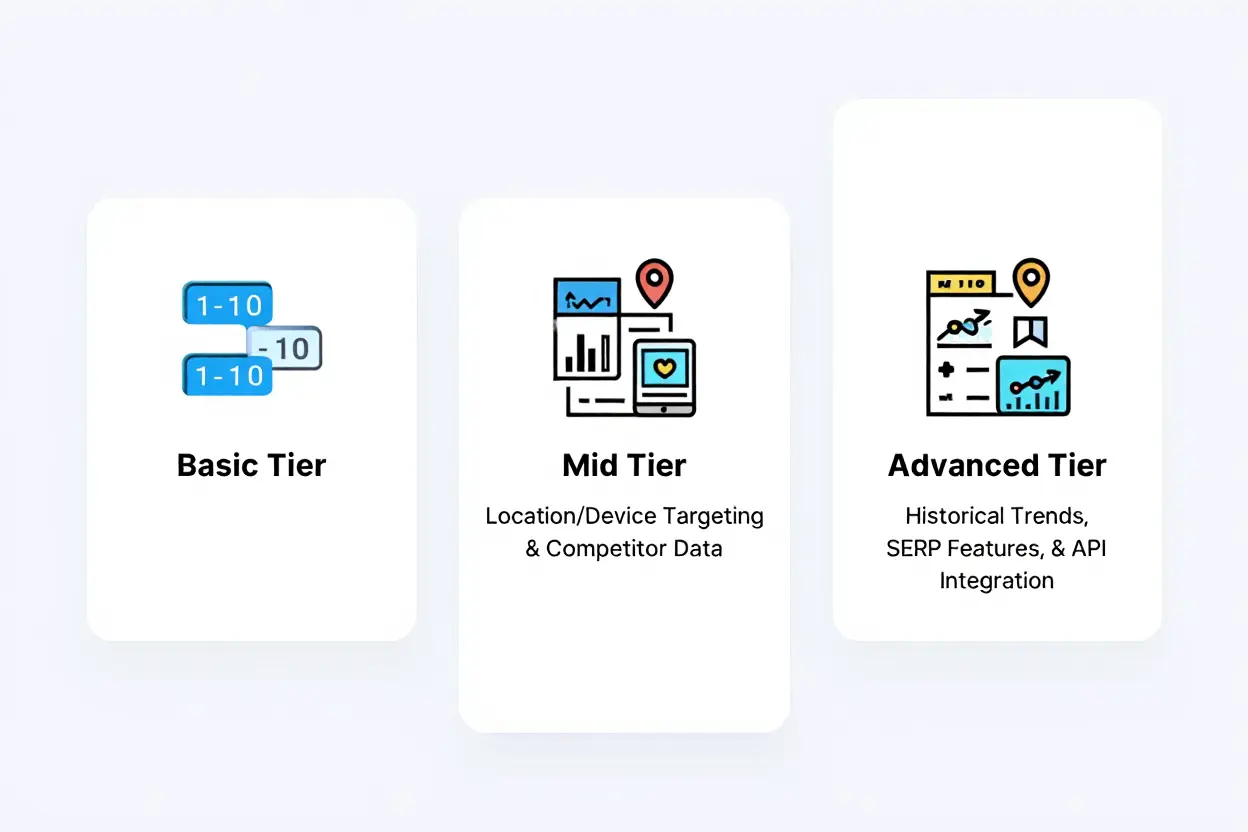
Bulk keyword support and location targeting capabilities
Effective scaling for accurate rank tracking relies on two core capabilities: efficiently monitoring thousands of keywords and executing precise location and device targeting. Bulk query support enables you to submit hundreds of keywords in a single tracking API call, reducing latency and streamlining monitoring for larger operations. For example, e-commerce businesses can track terms like "organic coffee beans" across multiple countries and devices all at once.
Using location and device targeting ensures data accuracy by simulating searches from the exact locations and devices your audience uses. Since Google serves different results in London compared to San Francisco—and mobile SERPs differ from desktop—a dependable rank checker needs to reflect those variations accurately.
| Feature | Benefit for e-commerce | Benefit for agencies |
| Bulk keyword queries (100s per request) | Easily monitor entire product catalogs without hitting API limits and track high-volume SKUs across multiple regions. | Pull rankings for dozens of client sites daily and consolidate data into unified reports automatically. |
| Location targeting (city/country/region) | Validate local SEO for regional warehouses and tailor product pages for specific geographic audiences. | Monitor client visibility in target markets and pinpoint regions where competitors are outperforming. |
| Device targeting (mobile/desktop) | Identify mobile-first indexing issues and optimize product pages for mobile users, where conversion intent is highest. | Demonstrate ROI from mobile optimizations and show clients how improved mobile visibility leads to better conversions. |
Historical data and competitor rank tracking options
A rank checker that only shows current rankings is just a snapshot—but a true rank tracker with historical data provides a complete story. Long-term data archives, accessible via the tracking API, help you understand algorithm updates, seasonal trends, and the long-term impact of content changes. Paired with location and device targeting, you can compare mobile and desktop visibility over time to clearly demonstrate ROI.
Competitor analysis features in your rank tracker software turn raw ranking numbers into actionable strategy. APIs that reveal competitor rankings for your keywords help measure share of voice, identify content gaps, and track progress against key rivals. Real-time alerts notify you as soon as a competitor gains traction, allowing you to respond before they build a lasting advantage.
Advanced rank tracker features also highlight which SERP features—such as featured snippets, local packs, or video carousels—appear for each query. Knowing a keyword triggers a featured snippet, for example, shifts your optimization focus toward snippet formatting, while a local pack result emphasizes the need for local signals and reviews. These detailed insights transform accurate rank tracking from a generic task into precise actions that drive real revenue growth.
How to implement and use a tracking API effectively
Integrating an API might seem daunting at first, but the process becomes straightforward once you divide it into manageable steps. Begin by generating your credentials, set your parameters, schedule automated data retrieval, and configure alerts—these actions transform manual checks into a continuous rank tracker that monitors search visibility around the clock. With intuitive no-code platforms and comprehensive documentation available, both marketers and developers can complete a tracking API implementation in just a few hours.
Setting up API authentication and request parameters
Every tracking API project begins with creating a secure API key or OAuth token through the provider's dashboard. Store these credentials in environment variables or a dedicated secrets manager, and refresh them regularly—just as you would update critical passwords—because robust API authentication and security protect against quota misuse and unexpected expenses. Guard each key as carefully as your bank account PIN; if it falls into the wrong hands, someone else gains control over your ranking API budget.
- API key generation: Obtain a unique key or temporary OAuth token; using granular scopes minimizes risk if credentials are compromised.
- Environment variables: Store credentials in.env files or a cloud-based secrets vault—never commit them to public repositories or expose them in your codebase.
- Rate-limit handling: Queue your requests and apply exponential backoff strategies, ensuring the tracking API respects provider limits and avoids triggering blocks.
Define your parameters with precision: include project ID, keyword list, target domain, geographic location, device type, and competitor domains when necessary. Focused queries conserve your budget—for instance, requesting only U.S. mobile rankings when that segment drives the majority of your revenue. Clear parameter scoping also reduces response times and keeps your rank tracking software operating smoothly within agreed service levels.
Scheduling pulls and configuring real-time alert workflows
Automate data retrieval using cron jobs, serverless functions, or your rank tracking software's built-in scheduler. Daily pulls suit most scenarios, while hourly intervals capture rapid fluctuations. Store the responses in a time-series database or data warehouse, enabling analysts to track search visibility trends over extended periods. Each scheduled run reuses the same credentials, maintaining consistent API authentication and security without additional overhead.
Real-time alerts accelerate your response capabilities. Establish thresholds such as "drop by five positions" or "visibility declines ten percent week-over-week," then route notifications to Slack, email, or custom webhooks. An early-morning alert about a critical keyword slipping from the top five allows your team to investigate and respond before customers even notice the change.
Common use cases and provider operations best practices
E-commerce businesses monitor mobile rankings for high-value product pages across different regions, identifying SKUs that require content optimization or technical fixes. Marketing agencies merge ranking API exports with crawl data to generate automated KPI reports, offering clients clear evidence of campaign performance. Link-building teams track position changes before and after acquiring new backlinks, using concrete data to validate outreach investments.
Top-tier SEO ranking API providers deploy proxy rotation, headless browsers, and geo-IP routing to deliver local results; note that Google's robots.txt disallows /search and its spam policies forbid automated queries without express permission. Their infrastructure handles temporary blocks, solves CAPTCHAs, and automatically retries failed requests, ensuring your rank tracker maintains uninterrupted data continuity. Investing in this level of reliability allows you to focus on strategy development rather than troubleshooting tracking API implementation challenges.