Building topical authority goes far beyond a trendy SEO term—it's a concrete strategy for becoming the leading voice in your specific field on Google. This guide will show you precisely how to build topical authority by organizing your content into strategic clusters and performing intelligent keyword mapping. You'll learn what search engines genuinely reward, empowering you to establish your expertise and attract significantly more organic traffic.
What topical authority means for Google rankings
Let's be clear: Google doesn’t just want more webpages; it seeks out trusted experts. Topical authority is the confidence Google has that your website possesses genuine expertise on a particular subject, which you earn by publishing comprehensive, in-depth content. It’s the fundamental difference between being a generalist and a true specialist, and search engines consistently recognize and reward genuine specialists with higher rankings.

How topical authority differs from domain authority
The core topical authority definition is quite specific: it measures the depth of your expertise within a well-defined niche, rather than your website's overall strength or age. While domain authority evaluates general site-wide credibility, topical authority evaluates your credibility on a single, focused topic. This means a newer, highly-focused blog can often outrank an older, more established corporate site if it demonstrates clearly superior expertise and coverage.
- Niche focus over brand age: Websites that are newer but have deep topical expertise can achieve higher rankings than older, generalist sites, effectively creating a more level playing field.
- Semantic clustering matters: Google interprets interconnected content as a cohesive semantic map, and it recognizes your site as an authority when your pages work together thematically.
- Long-term ranking stability: A well-built foundation of topical authority leads to rankings that are far more stable and enduring than those from scattered content, providing sustainable, long-term organic growth for your business.
You could say domain authority is often a vanity metric, whereas topical authority represents true, tangible power. You effectively build topical authority by proving your mastery through exhaustive topic coverage, not just by claiming to be an expert. Every supporting satellite page you create reinforces your main pillar page, and strategic internal linking sends strong signals of deep expertise to Google's algorithms.
Why search engines reward topic expertise
Google's algorithm has undergone significant evolution and now places a heavy emphasis on evaluating topic relevance in SEO. It actively assesses whether your content comprehensively covers all facets of a subject with clear semantic coherence. If you create a unified content cluster that thoroughly addresses all aspects of keyword research and optimization, Google will recognize your site as the go-to authority.
The rewards for this are substantial: you gain significantly higher rankings, win more featured snippets, and unlock valuable opportunities for AI-generated citations. When a visitor sees a central pillar page that seamlessly links out to numerous detailed supporting articles, they immediately perceive your deep expertise. This inherent credibility leads to longer user sessions, lower bounce rates, and, ultimately, higher conversion rates.
Search engines prioritize topical authority because it directly addresses their core mission: ensuring ultimate user satisfaction. When Google ranks true topical experts at the top of its results, searchers find high-quality answers more quickly, creating a mutually beneficial ecosystem. Therefore, the process of building topical authority pays continuous dividends because you are consistently delivering authoritative, relevant answers to users'most pressing questions.
E-E-A-T signals that strengthen authority perception
E-E-A-T—which stands for Experience, Expertise, Authoritativeness, and Trustworthiness, is not a ranking factor in itself, but Google's systems use a mix of signals that help identify content showing these qualities. You should weave these crucial signals into every piece of content through clear author bios, industry citations, and verified case studies. When readers see a byline like "Written by Sarah, with 12 years of experience," their perception of your authority instantly solidifies.
Establishing clear authorship and earning mentions from recognized industry leaders dramatically amplifies these vital signals. If influential figures or other authoritative websites cite your content, Google’s algorithm directly associates your site with high topical credibility. Furthermore, as your pages accumulate high-quality backlinks from relevant domains, the authority of your entire content cluster becomes exponentially stronger.
How to Build Topical Authority with Content Clusters
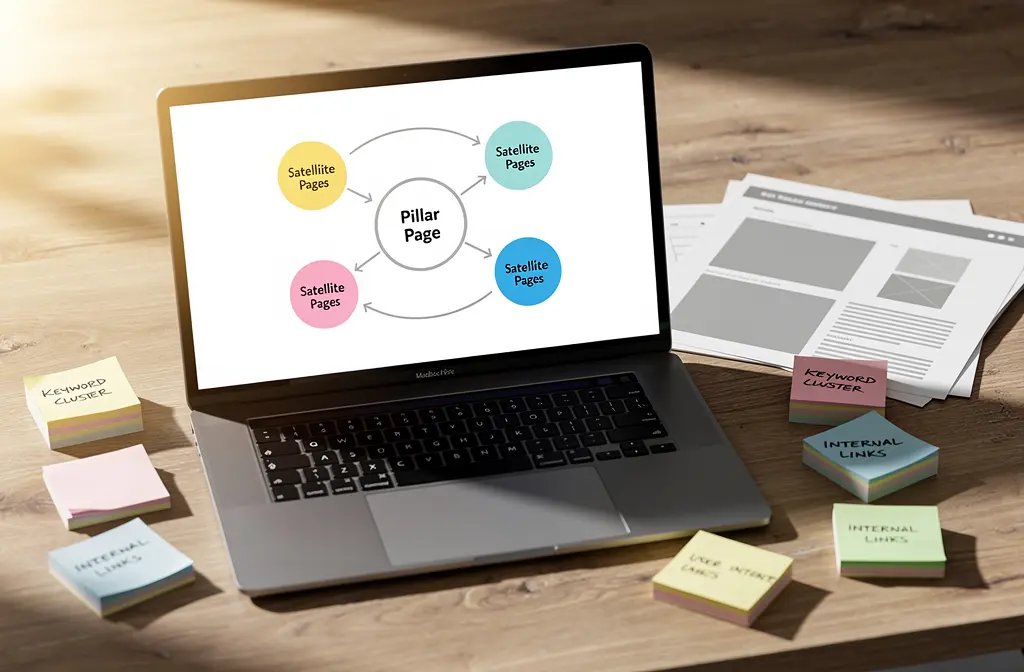
This is where your strategy comes to life. To successfully build topical authority, you need to craft a network of topic clusters structured like a hub-and-spoke system. Start with a central pillar page that covers a broad subject in-depth, then create supporting pages that answer specific, related questions. This clear structure helps demonstrate to Google and other search engines that your site possesses a complete and authoritative grasp of your chosen niche.
Creating Comprehensive Pillar Pages That Rank
Your pillar page should be the definitive guide on its topic for your target audience. It must target a high-volume, broad keyword with a moderate level of competition and be thoroughly comprehensive, typically spanning 1,500 to 3,000 words. Incorporate a detailed table of contents, engaging multimedia elements, and contextual links to all your supporting satellite content. When you build your topic clusters this way, it sends a powerful signal of your expertise to search engine crawlers.
- Target broad, high-intent keywords: Focus on terms that attract substantial, relevant search traffic. This lays the essential groundwork for building your authority.
- Structure with clear hierarchy: A clear content structure using H1 tags for the main topic and H2s for sub-sections makes it easier for search engines to understand your content.
- Link to every satellite strategically: Weave natural, descriptive links into your body text. This is far more effective than just listing links in a menu or a footer.
You can even publish your pillar page with links pointing to satellite articles you plan to write in the future. Google will crawl these links, which can help get your new, contextually relevant content indexed more quickly. In essence, the pillar page acts as a central command center for your entire related content library.
Developing Supporting Satellite Articles Strategically
Your satellite pages should hone in on specific long-tail keywords and address particular user queries. For example, instead of a general article on SEO, you would create a focused piece on how to build topical authority. These articles should be substantial (1,200–2,500 words) and packed with specific, actionable advice. A great strategy is publishing these satellite pieces first, allowing them to gain traction and value before the main pillar page goes live.
Every single satellite article must link back to the main pillar page, ideally using the pillar's primary keyword as the anchor text. This internal linking strategy reinforces the pillar page's importance and clearly communicates the content hierarchy to Google. Always place these links contextually within the content to provide genuine value to the reader.
You should also link related satellite pages to each other wherever their topics naturally intersect. If one article covers implementation strategies and another covers analysis tools, connect them. This creates a dense, interconnected web of content that guides users deeper into your site, showcasing your expertise and keeping them engaged.
Interlinking Clusters for Maximum SEO Impact
Think of internal linking as the central nervous system of your website's topical authority. The core principle is straightforward: the pillar links to its satellites, the satellites link back to the pillar, and related satellites link to each other. A good rule of thumb is to include three to five relevant internal links per 1,000 words to guide users without creating clutter.
- Contextual anchor text matters: Use descriptive, keyword-rich phrases like "our guide to topical authority strategy" instead of generic "click here" links. This significantly boosts relevance signals for search engines.
- Link equity flows strategically: Direct your most powerful external backlinks toward your main pillar pages first. This amplifies their authority, which then trickles down to the satellite pages.
- Breadcrumb navigation reinforces hierarchy: Implement breadcrumb trails to visually show the path from the homepage to the specific article. This helps both users and search bots understand your site's structure.
Keep an eye on your internal link counts to maintain balanced and effective clusters. A healthy cluster often has the pillar page receiving links from dozens of internal pages, while satellites are cross-linked from other relevant articles. Visualizing this helps ensure that authority is concentrated at the hub and distributes effectively to the supporting content.
Here is the practical payoff for your content strategy: Discover how AI can boost your topical authority by automating the mapping process and suggesting anchors. This ensures your link equity flows efficiently while keeping the text natural for your readers.
Strategic Keyword Research for Authority Building
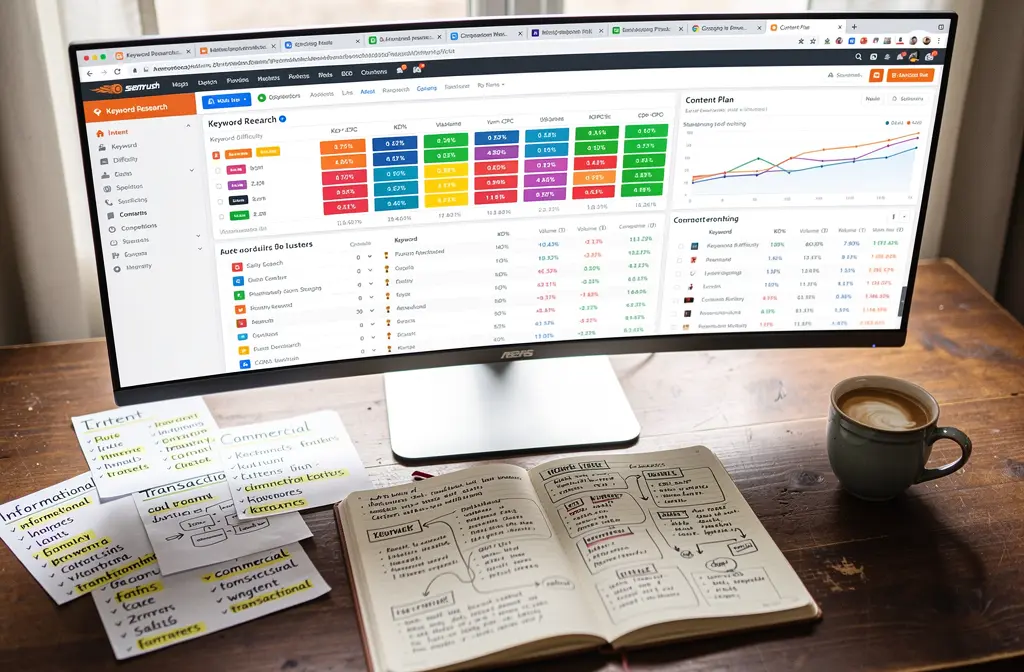
Creating a robust online presence requires a clear understanding of your content landscape. Comprehensive keyword research reveals the semantic relationships in your niche, showing you the exact questions your target audience is asking. This foundational phase dictates the structure of every topic cluster you will ultimately build for SEO success. Use advanced tools to collect pertinent terms, ensuring substantial depth and aligning them precisely with user search intent.
Using AI Tools to Discover Keyword Clusters
Kick off the process by choosing a core seed term directly related to your niche. Simply input a phrase such as "e-commerce SEO" into a modern AI tool, and it will instantly produce dozens of relevant keyword suggestions. These automated platforms accelerate your keyword research by delivering crucial data on search volume and difficulty. They also examine Google features and competitor tactics to pinpoint exactly what your audience is looking to learn.
After that, you need to systematically organize these keywords based on their semantic similarity and the underlying user intent. Although terms like "best SEO tools" and "cheapest software" both indicate a commercial intent, educational questions demand a different approach. By grouping keywords with this level of precision, you ensure that each satellite page fulfills a distinct user need within your topic clusters. This strategy helps you avoid keyword cannibalization while simultaneously building strong topical authority.
Aim to prioritize keywords that offer clear commercial value but also feature manageable difficulty scores for your website. Trying to rank for overly broad terms like "SEO" is often impractical, whereas more specific search phrases present better opportunities to gradually build authority. AI tools are invaluable for spotting these "golden" opportunities—keywords where you can realistically compete and gain visibility. Concentrating on these achievable targets lets you attract qualified traffic more rapidly.
Mapping Keywords to Pillar and Satellite Pages
Structure your findings in a spreadsheet that tracks essential metrics like search volume, difficulty, funnel stage, and the intended target page. This organized map of semantic relationships guarantees that no valuable keyword is overlooked in your content planning. When Google's crawlers encounter this well-defined structure, they immediately recognize your site's depth of expertise instead of a random assortment of articles. This level of clarity signals to both users and search engines that you are a trustworthy source of information.
- Funnel-stage alignment: Use educational satellite pages for awareness-phase terms like "what is topical authority," and direct decision-based queries to pages designed for conversion.
- Volume-to-difficulty balance: Strategically blend easier, quick-win keywords with more challenging, high-volume terms to capture immediate traffic and build long-term authority.
- Long-tail keyword saturation: Thoroughly cover numerous long-tail variations for each topic, as this comprehensive depth is a powerful signal of expertise to search engines.
Here is a practical example of how to map these elements effectively:
| Keyword | Search Volume | Difficulty | Intent | Target Page |
| E-commerce SEO | 4,200 | High | Awareness | Pillar |
| How to optimize product pages for SEO | 820 | Medium | Educational | Satellite 1 |
| E-commerce keyword research strategy | 590 | Medium | Educational | Satellite 2 |
| Best SEO tools for Shopify stores | 340 | Medium | Decision | Satellite 3 |
| Internal linking for e-commerce sites | 210 | Low | Technical | Satellite 4 |
This meticulous mapping approach prevents your content from overlapping while guaranteeing that each page is optimized for specific keywords. When you publish this coordinated content, Google recognizes that you are providing answers for every major question within the category. This thoroughness is a classic signal that confirms and strengthens your topical authority in the industry.
Finding Competitor Gaps to Exploit
Your competitors have likely already done significant work mapping out the niche, so it's smart to leverage their research. Use a specialized SEO tool to analyze competitor websites and extract their existing topic clusters for review. You'll promptly identify which keywords they rank for and, more importantly, discover high-volume sub-topics they have overlooked. These revealed gaps represent prime opportunities for you to create new, targeted satellite pages.
For example, a competitor might rank well for a term like "AI keyword research" but completely miss a related phrase like "AI seasonal forecasting." You can create a dedicated satellite page targeting that specific gap to capture the audience they've ignored. Conducting regular gap analyses provides a strategic roadmap, helping you build more effective internal linking structures and expand your core pillar pages. Every new insight allows you to maintain a competitive edge and continuously refine your expertise.
Measuring and Optimizing Your Topical Authority
You can't effectively optimize something you aren't measuring first. Building real topical authority demands tracking concrete KPIs that prove your strategy is working. Monitor your rankings, traffic, engagement, and backlink growth across your entire topic cluster. When these metrics improve together—rankings rise while traffic and engagement grow—you'll know your authority is strengthening.
Essential Metrics for Tracking Authority Growth
Start measuring your topic cluster success by focusing on five core performance indicators: First, monitor the number of keywords ranking in the top 10 within your cluster—more rankings mean stronger authority. Second, keep an eye on your average SERP position across relevant terms; an average ranking of 3–5 is a clear sign of expertise. Third, measure organic traffic growth specifically from your cluster, as cohesive topic groups tend to attract more traffic than scattered content. Lastly, analyze engagement using time on page and bounce rate metrics, since authoritative content naturally captures and holds user attention longer.
- Keyword Ranking Count: Track how many terms your cluster ranks for in the top 10. Growth here shows Google is recognizing your increasing authority.
- Average SERP Position: Monitor the average ranking position across all cluster keywords. Consistent improvement signals gains in both authority and content quality.
- Organic Traffic Lift: Measure the total sessions from your cluster pages month-over-month. True authority drives revenue through better visibility and qualified traffic.
- Engagement Metrics: Track time on page, pages per session, and conversion rates. Authoritative content keeps users engaged longer and reduces bounce rates.
A well-built topic cluster tends to hold its rankings better than isolated posts. This means your SEO investment compounds over time. As your topical authority expands, your rankings become more resilient and less vulnerable to unexpected algorithm updates.
Using Analytics to Identify Content Gaps
Google Search Console is your go-to tool for uncovering gaps in your strategy. Look for cluster keywords that rank between positions 11 and 20—these are low-hanging opportunities. You can either create a new satellite page or update an existing one to push these terms into the top 10. KPI tracking often reveals trends, such as awareness-stage content ranking well while decision-stage pages underperform. These insights help guide your next content moves and may even lead you to use quarterly AI-driven audits to find missing sub-topics.
You should also evaluate which satellite pages successfully refer traffic back to your main pillar page. If a satellite gets 500 monthly visits but only sends 2% of that traffic to the pillar, there may be an issue with link placement or anchor text. Use real user behavior data to refine your internal linking strategy. This kind of ongoing optimization keeps your cluster focused, efficient, and geared toward building authority.
Refreshing Clusters to Maintain Rankings
Establishing topical authority isn’t a one-and-done task. Set up rank-tracking alerts for any cluster keyword that falls out of the top 10. If a keyword slips, refresh the content right away by adding new data, updating examples, reinforcing E-E-A-T signals, and strengthening internal links. Publishing updated content shows Google you’re still actively building expertise and helps prevent authority decay.
Schedule quarterly reviews for each cluster to check for broken links, outdated information, or new competitor content worth cross-linking. Refresh meta descriptions to improve click-through rates and consider adding new FAQ sections to address emerging search trends. Clusters that stay current remain authoritative; those that aren’t updated will slowly lose ground. By spending just 2–3 hours per quarter on each major topic, you can sustain your authority over the long term.
Here’s a full roadmap to lasting success: Discover how AI-driven topic clusters can boost your site's authority by automating gap analysis and performance tracking, so you can focus on strategy instead of manual reviews.