AI search visibility tools track how your brand appears on conversational platforms like ChatGPT, Perplexity, and Google AI Overviewsa crucial capability that traditional SEO software simply doesn’t provide. In this guide, we’ll reveal which AI search visibility tools deserve your attention and can boost your organic growth. You’ll also learn how these tools differ from standard rank trackers and how they enhance your overall search visibility.
Why search visibility in AI engines now matters
Platforms like ChatGPT, Perplexity, and Google AI Overviews attract hundreds of millions of visits each month. Ranking on the first page of Google means very little if an AI engine recommends your competitor instead. This can redirect potential visitors away from your brand, impacting your traffic and conversions.

The shift from traditional to AI-driven search
Generative engine optimization expands traditional SEO by shaping how large language models present and reference content. To stay ahead, experts rely on an AI search visibility tool to monitor brand mentions across multiple AI platforms at once. This highlights a major shift: traditional rankings and AI search visibility have become two entirely separate metrics.
How a visibility tracker differs from rank trackers
Standard rank trackers report your positions in Google’s search results, but they can’t detect when your brand appears in AI-generated responses. A dedicated visibility tracker, on the other hand, monitors brand mentions and citation sources across conversational engines like Perplexitymetrics that standard tools ignore, creating a critical gap in your search visibility strategy.
- Multi-engine coverage: Top-tier AI search visibility tools track platforms such as ChatGPT, Perplexity, and Gemini simultaneously, helping you understand exactly where users are searching.
- Citation source tracking: A reliable search visibility tool identifies which URLs AI models reference, helping you build authority and understand where your AI-derived visibility comes from.
- Sentiment and accuracy detection: This feature flags misinformationlike incorrect pricing or featuresbefore it reaches potential customers and harms your credibility.
Zero-click AI answers provide instant information, which reduces traditional organic traffic to websites. Even brands with strong conventional SEO may remain invisible in modern AI responses, allowing competitors to capture attention through better AI optimization.
What brands risk without an AI visibility tool
Without a visibility tool, you won’t know when competitors dominate generative AI responses. You could easily miss opportunities to update pricing pages, refine content, or improve your strategy. Tracking which sources AI models frequently cite is essential for long-term visibility and trust.
Inaccurate AI-generated details about your offerings can directly hurt salesespecially during customer research. A comprehensive AI search visibility audit automatically catches these errors. Performing a regular visibility audit helps you correct misinformation quickly, protecting your conversions and brand reputation.
Core features every visibility tracking tool must have
Not all AI search visibility tools offer the same capabilities. Understanding which features truly matter helps you avoid overspending on unnecessary functions. It also ensures you gather the right data needed for informed decision-making.
Multi-engine coverage and prompt-level tracking
A reliable AI search visibility tool must monitor ChatGPT, Perplexity, Claude, Gemini, and Copilot. Tracking specific prompts transforms raw data into actionable insights, showing you exactly which formats enhance your search visibility.
Testing various prompt variations helps uncover actual user intent rather than just guessing keywords. Instant alerts notify you when model responses change or when competitor citations appear, enabling quick reactions to shifts in your brand's presence.
Sentiment analysis distinguishes simple brand mentions from meaningful connections and tracks emotional shifts over time to identify reputation risks early. This detailed approach to visibility tracking prevents minor issues from escalating.
Hallucination detection and accuracy audits
A basic monitoring platform might only count mentions while missing incorrect details or fabricated features. In contrast, a robust search visibility tool systematically detects these errors. It conducts audits on pricing, features, and schema to ensure AI models display accurate product information.
- Pricing validation: Identifies outdated pricing data immediately, prompting quick updates to schemas or FAQs to safeguard your sales.
- Feature accuracy checks: Flags non-existent integrations or false features to maintain your brand’s credibility and user trust.
- Entity relationship audits: Detects instances where AI confuses your brand with competitors, ensuring clear differentiation in search results.
Automated alerts for AI hallucinations let you quickly correct content, such as updating pricing or refreshing documents, before misinformation spreads. This transforms error detection into a crucial layer of brand protection.
Share of voice and citation source analysis
Share of voice measures your mention frequency compared to rivals for the same queries, offering valuable competitive benchmarking beyond simple counts. For example, trailing behind competitors highlights opportunities to improve with better content.
Citation analysis identifies which URLs AI models reference most frequently. It spotlights your top-performing pages and reveals areas where competitors outperform you. A good search visibility tool helps you focus efforts on these high-impact pages.
Tracking historical data illustrates shifts in your brand’s presence over time. Regular benchmarking allows for proactive adjustments before competitors gain an edge, directly linking specific marketing efforts to overall success.
Top AI Search Visibility Tools Compared
The market offers numerous tools, ranging from free quick-checkers to comprehensive enterprise platforms with predictive analytics. Understanding these distinctions enables you to select the right AI search visibility tool that matches your team’s budget and requirements.
Quick Checkers vs. Ongoing Audit Platforms
Among the best AI search visibility tools, quick checkers analyze up to 30 keywords for initial exploration. They’re useful for testing whether AI monitoring is relevant in your niche. Ongoing platforms, on the other hand, track over 200 keywords with prompt tracking, leveraging historical data and benchmarking for a long-term strategic advantage.
- Entry-level plans (Otterly.ai Lite, Writesonic Starter): Otterly.ai Lite tracks 15 prompts on ChatGPT, Google AI Overviews, Perplexity and Microsoft Copilot, while Writesonic Starter tracks 50 prompts on ChatGPT, Gemini and Google AI Overviews. With minimal setup, they help determine the overall importance of your search visibility.
- Mid-tier platforms (Peec AI, Scrunch): Peec AI starts at 50 prompts on three AI models of your choice, while Scrunch starts at 350 prompts across seven engines, including ChatGPT and Perplexity. They are well-suited for niche e-commerce or SaaS brands.
- Enterprise platforms (Lumentir, Profound): Lumentir covers seven engines, including Copilot and Grok, from 100 prompts, while Profound's custom-priced Enterprise plan covers nine engines. They include sentiment analysis and hallucination detection, ideal for managing large brand portfolios.
Many organizations start with quick-checkers to validate initial business assumptions, then upgrade to ongoing platforms once they confirm that AI search visibility influences traffic and conversions. This step-by-step approach minimizes initial costs while progressively expanding monitoring capabilities.
Leading Visibility Tool Options and Their Strengths
Otterly.ai is a top-tier search visibility tool that monitors multiple engines, including ChatGPT, Perplexity, and Google AI Overviews. It excels at benchmarking your brand against competitors. Meanwhile, Peec AI emphasizes brand mention tracking and tracks positions within AI-generated answers to highlight areas needing improvement.
Profound caters to enterprise teams with coverage across nine engines, while Lumentir covers seven. They perform sentiment analysis and identify which domains are cited most frequently by AI models. Semrush and Ahrefs now track AI answers too, from Google AI Overviews and AI Mode to ChatGPT and Gemini, enabling teams to incorporate AI performance metrics into their existing dashboards. CrowdReply combines multi-engine AI visibility tracking with social listening, competitor benchmarking, citation analysis, and editorial backlink workflows, helping teams move from monitoring AI visibility to actively improving it.
| Tool | Engine Coverage | Prompt Limit (Starter) | Key Strength |
| Otterly.ai | ChatGPT, Perplexity, Google AI Overviews, Copilot | 15 prompts | Dedicated AI focus, share-of-voice comparison |
| CrowdReply | 2 AI models on Starter, 7 on Enterprise (ChatGPT, Google AI Overviews, AI Mode, Gemini, Perplexity, Claude, Grok) | 20 prompts | Visibility tracking + active optimization |
| Peec AI | 3 models of your choice (ChatGPT, Perplexity, Gemini and more) | 50 prompts | Position tracking within AI answers |
| Lumentir | 7 engines including Copilot | 100 prompts | Enterprise scale, hallucination detection |
| Semrush | ChatGPT, Gemini, Google AI Mode and AI Overviews | 25 prompts | Integration with existing SEO stack |
| Writesonic | ChatGPT, Gemini, Google AI Overviews | 50 prompts | Content generation paired with visibility |
When to Combine Multiple Tools for Full Coverage
Since no single AI search visibility tool offers complete functionality, combining toolslike using Otterly.ai for real-time conversation data and Semrush for technical SEO insightsis a common strategy. This integrated approach captures both mention tracking and broader analytical data without overcomplicating workflows.
Using multiple AI search visibility tools also addresses coverage limitations, especially if your audience frequently uses platforms like Copilot or Claude. A multi-engine search visibility tool prevents blind spots often left by single-engine solutions. Budget-conscious teams often opt for a mid-tier platform supplemented by a quick-checker for periodic validation.
Turning AI Visibility Data into Actionable SEO Gains
Raw mention counts by themselves don't tell the full story. The real opportunity comes from transforming your AI visibility data into a prioritized list of content and technical improvements. This approach directly enhances your brand's appearance in AI-generated responses.
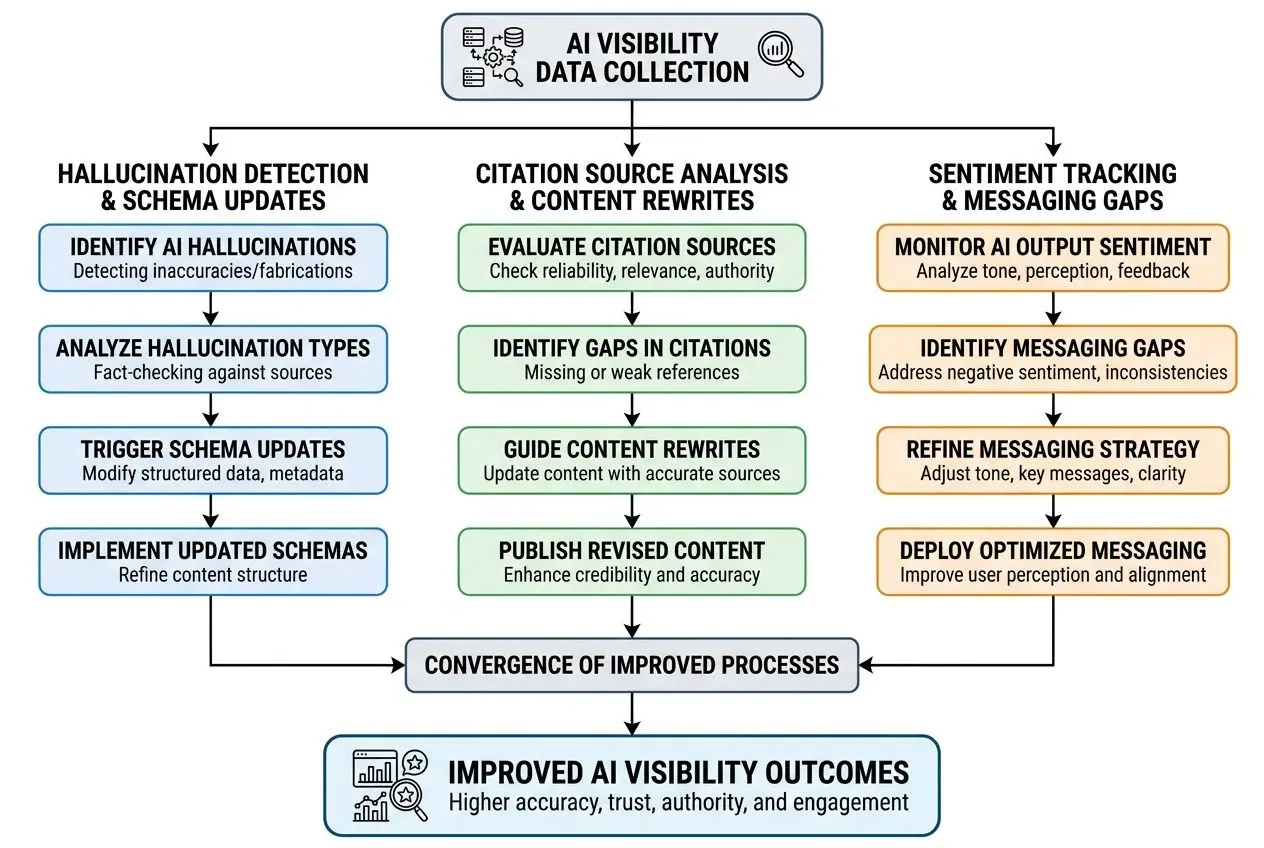
From Raw Mentions to Prioritized Content Fixes
Advanced AI visibility tools convert data into clear, prioritized recommendations. For example, if an AI model cites a competitor's pricing page instead of yours, the platform will flag a potential schema markup issue. This direct guidance shortens the time between identifying a problem and implementing a solution.
Quick audit cycles are completed in minutes, establishing feedback loops that manual analysis simply can't compete with. By discovering the most effective prompts, you reveal the topics that truly drive search visibility. This allows you to concentrate your content efforts on the formats that AI models prefer to reference.
Any effective visibility tool should offer detailed breakdowns by model, topic, and sentiment to highlight quick-win opportunities. You might find you need to implement FAQ schema, refresh product pages, or develop new content to narrow competitive gaps. These prioritized actions yield measurable outcomes in just a few weeks.
Historical Trends and Competitor Gap Analysis
Monitoring historical search visibility shows whether your brand's presence is growing, holding steady, or declining across AI search platforms. This allows you to make proactive changes before competitors gain an advantage. Trend analysis links visibility increases to specific initiatives, demonstrating which strategies are truly effective.
Competitor gap analysis identifies topics where your brand gets fewer AI mentions than others in your industry. This directs your SEO investments precisely into areas needing more representation. You can then tackle these growth opportunities by creating better content, refining your schema, or building topical authority.
How Sedestral Agents Accelerate Visibility Improvements
Sedestral's Marc agent monitors your brand across both traditional Google rankings and AI search engines at the same time. This closes the visibility gaps that standard rank trackers often miss. Meanwhile, Rémi can optimize your pages with a single click to improve the semantic relevance that models look for when citing content.
- Alya discovers keyword clusters: She finds semantic topic groups recognized by AI models, making sure your strategy aligns with how large language models find and deliver answers.
- Rémi optimizes for AI comprehension: He monitors your pages, detects quick wins and rewrites your pages and product sheets so they outperform the competition.
- Nox validates technical foundations: Nox identifies broken schema markup, missing structured data, and indexing problems, preventing technical issues from limiting your mentions.
- Maya builds authority through backlinks: She acquires links from media sites and thematic blogs, and a link that disappears during the guarantee period is replaced or refunded.
This comprehensive workflow delivers results far more quickly than a standard visibility tool that only tracks data. It integrates gap identification, content refinement, and intelligent link building into a single process.
How to Choose the Right AI Visibility Tracker for Your Needs
Choosing the perfect visibility tracker means finding the right balance of engine coverage, usage limits, and cost that aligns with your specific business objectives. The search visibility needs of a small startup testing the waters will be vastly different from those of a large, scaling e-commerce brand.
Matching Tool Tiers to Team Size and Budget
Your budget is a key factor in determining which AI search visibility tools are the best fit. Starter packages typically offer essential prompt tracking for a monthly fee ranging from about $29 to $100, while some tools such as Scrunch start around $250. In contrast, enterprise-level options provide massive search capacity for a higher investment.
- Solo Operators and Small Teams ($0–$100/month): Begin with freemium tiers to try out a visibility tool before committing to a more expensive plan.
- Mid-Market Agencies ($100–$500/month): Growth-tier search visibility tool platforms offer a great balance of coverage and budget, often tracking over 100 prompts across multiple search engines.
- Enterprise Organizations ($500+/month): Premium AI search visibility tools justify their cost with extensive engine coverage, powerful automation, and advanced error detection.
- E-commerce at Scale ($200–$800/month): Combine a specialized monitoring platform with tools like Sedestral to automate routine content refreshes.
Many companies gradually upgrade their plans as their chosen optimization tool demonstrates its value. This measured, step-by-step approach minimizes financial risk while ensuring your software costs scale directly with your business growth.
Integration, API Access, and Workflow Compatibility
A robust search visibility tool should integrate seamlessly with popular platforms such as WordPress, Shopify, and Webflow. Reliable API access is crucial for embedding search visibility tracking directly into your daily operations, eliminating the need for extra manual work.
- Native CMS Integration: One-click syncing for your content and metadata ensures your recommendations stay current as your site evolves.
- API Access and Webhooks: These automated features connect system alerts directly to your content workflows, significantly increasing daily efficiency.
- White-Label Reporting: Agencies managing multiple clients frequently need custom dashboards and white-label reports from their visibility tracker.
- Automation Integration: Connections to services like Zapier allow you to automatically trigger actions, such as scheduling content updates when performance dips are detected.
Sedestral offers direct integration with major CMS platforms, effectively pairing visibility tracking with automated technical audits. This connection frees you from constantly switching between your monitoring platform and your primary optimization tool.
Building a Full Search Visibility Stack Long-Term
It's important to see AI-powered search visibility tracking as a single component of a comprehensive, automated SEO ecosystem. While a simple app can help validate ideas, a dedicated AI search visibility tool provides the consistent monitoring needed to inform long-term strategy.
Teams responsible for multiple websites should prioritize platforms that include automated competitor discovery. This feature continuously updates your benchmarking data as the market shifts, freeing your team from the burden of manual research.
Long-term success comes from treating your online presence as a continuous, authority-building endeavor. Analyzing historical performance data allows teams to fine-tune their strategies based on real-world results, ultimately leading to a much quicker return on investment.
Frequently asked questions
What are the best AI visibility tracking tools for monitoring brand mentions across ChatGPT, Perplexity, and Google AI Overviews?
Otterly.ai is a premier visibility tool for monitoring brand mentions across ChatGPT, Perplexity, and Google AI Overviews, offering valuable share-of-voice benchmarking. Peec AI specializes in tracking your precise placement within each AI model's specific responses.
For enterprise-level needs, Profound covers nine engines and Lumentir seven, giving you a complete picture of your AI ecosystem. Sedestral uniquely combines visibility tracking with automated content updates, integrating answer engine tracking and swift page optimizations to address any gaps in search visibility.
How does prompt tracking differ from traditional keyword rank tracking, and why does it matter?
Traditional SEO focuses on standard search rankings, whereas prompt tracking specifically monitors when your brand appears within AI-generated answers on platforms like ChatGPT, Perplexity, and Google AI Overviews. Even with a high rank on Google, you might still be missing out on crucial search visibility within these AI responses.
Prompt tracking illuminates these unseen visibility gaps, allowing you to optimize your content for better AI citations. By testing a wide range of queries, you can identify which ones genuinely boost your brand visibility in these models. This analysis provides clear insights into which topics enhance your overall LLM visibility.
How can AI search visibility monitoring prevent hallucinations from damaging my brand and sales pipeline?
A basic monitoring platform might only tally mentions without identifying when AI is generating incorrect information about your products or pricing. In contrast, an effective search visibility tool will proactively detect and flag these damaging hallucinations. A dedicated AI search visibility tool cross-references what the models are saying with your actual product details.
For example, if a model cites outdated pricing, the system alerts you so you can quickly correct the error. These rapid updates safeguard your sales pipeline from being disrupted by misinformation. Utilizing comprehensive AI search visibility tools ensures that inaccurate data does not reach potential customers.
Practical testing has shown that simple LLM visibility tracking frequently overlooks significant accuracy issues. Protecting your brand requires a robust visibility tracking platform that consistently identifies and helps you resolve these critical flaws.