Let's be honest—running a blog alongside your e-commerce business can be utterly draining. Between updating products and handling customer inquiries, finding time to create content that actually ranks in search engines feels nearly impossible. The good news is that you no longer have to manage this overwhelming workload on your own.
Modern AI tools now handle the heavy lifting of blog automation, turning what once took weeks into a process that can be completed in just a few hours. This guide provides actionable methods to automate blog tasks using AI—handling everything from research to publishing. By improving your content workflow, you'll free up time and energy to focus on strategies that genuinely grow your business.
How AI tools generate complete blog articles
Let's put to rest the outdated idea that AI-generated content is robotic or unusable. Modern platforms can analyze your top competitors, grasp search intent, and deliver polished drafts in mere minutes. We’re talking about fully structured articles complete with headings, bullet points, and internal links—all ready to publish.

Automated draft creation from keywords and outlines
This is where AI content generation tools really shine. Simply input a keyword, and the platform will analyze top Google results to understand what’s currently ranking. Then it builds a comprehensive outline aligned with search intent and expands each section into well-researched, informative paragraphs. AI-powered platforms offer a complete solution for WordPress blogs, from running SEO audits and generating optimized articles to fine-tuning existing posts with ease. By analyzing top-ranking pages, suggesting keywords, and implementing semantic improvements, these tools let you publish high-performing content without needing deep technical know-how. Automate your blog with AI today to see how quickly you can say goodbye to the dreaded blank page.
- Instant outline generation: The AI builds a logical hierarchy of headings before writing a single paragraph.
- Competitor analysis integration: It scans high-ranking pages to replicate their successful structure and depth.
- Keyword-optimized sections: Each paragraph seamlessly incorporates relevant keywords—no awkward stuffing required.
- Internal linking suggestions: The tool reviews your existing content and intelligently recommends where to place internal links.
Most platforms offer two modes: fully automated blog writing for a hands-off experience, or a hybrid approach where you guide the AI. Choose the hybrid method if brand voice is a priority, or go fully automatic for pure speed. Whichever you pick, creating blog posts that once took hours can now be completed in under an hour.
Real-time SEO optimization during content generation
Automated blog writing isn’t just fast—it’s smart. While the AI drafts your article, it runs simultaneous SEO checks to ensure quality. You’ll see real-time feedback on keyword density, readability, and overall structure.
Many platforms preemptively flag potential issues—like a meta description that’s too long—and may suggest adding specific terms or improving anchor text. It’s like having an SEO expert by your side throughout the entire process.
Using detailed content scores, you can track keyword relevance and readability as you refine your draft. You’ll see exactly why a post scores an 8.2 and what minor edits can boost it to a 9.1. This transparency keeps you in control while still benefiting from AI-driven insights.
Multilingual content adaptation and translation features
For global audiences, you can craft one core article and instantly adapt it into over 100 languages. The AI doesn’t just translate—it localizes, preserving keyword relevance and metadata. It adjusts tone and examples so each version feels authentic and has a real shot at ranking.
This is content generation at its most scalable. A single brief can quickly turn into natural-sounding articles in Spanish, French, or Japanese. Your international readers get AI-generated content that reads like it was written by a native speaker, not a clumsy machine translator.
Setting up automated publishing workflows without coding
The true magic happens when your AI-generated drafts connect directly to your website, completely eliminating copy-pasting and manual formatting. Articles can move smoothly from creation to publication through an automation pipeline that preserves your brand voice and follows your publishing schedule. This approach empowers non-technical teams to compete effectively with agencies that depend on dedicated developers.
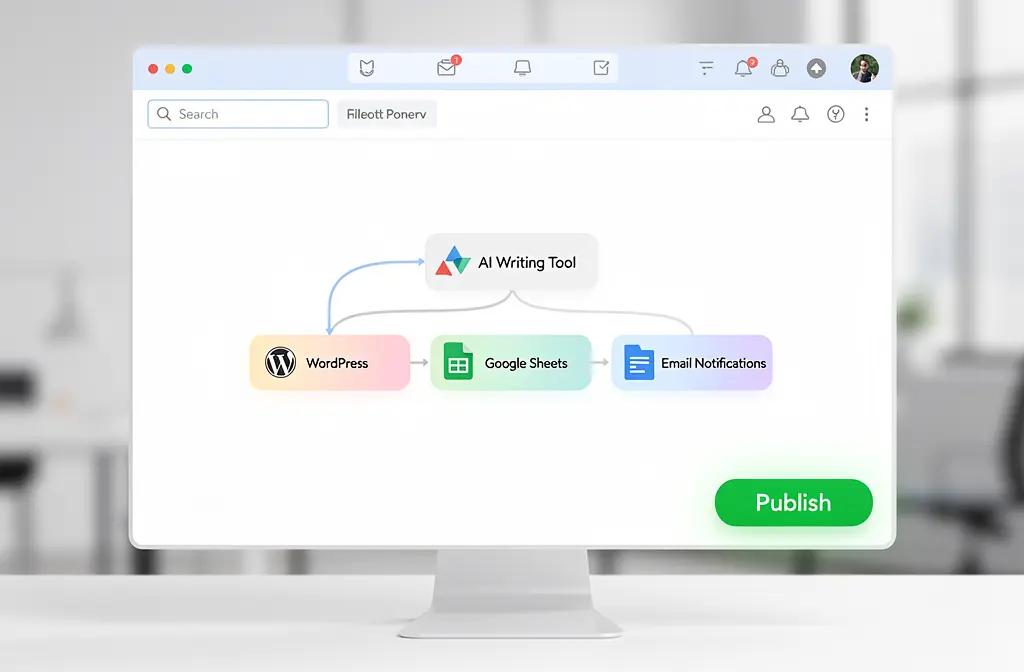
Connecting AI tools to WordPress and other CMS
No-code automation platforms like Zapier, Make, and n8n make this process seamless. They offer native plugins and API connections that integrate your AI software, WordPress blog, email systems, and spreadsheets—all without writing a single line of code. Drafts synchronize automatically from your AI tool, ready to be published or queued for review based on your preferred rules.
Picture this common workflow: the AI generates a draft and the system marks it as "Draft" for an editor to review. Once approved via Slack, it publishes automatically at your chosen time, while meta tags, schema markup, and internal links are applied without any manual work. This entire operation takes just seconds, saving you the 20 minutes you might normally spend on formatting and data entry.
Most popular platforms provide native CMS integration to make your work easier. Whether you're using WordPress, Shopify, Wix, PrestaShop, or Webflow, your CMS is probably supported. Even if there's no direct plugin available, automation bots can mimic user actions to fill in fields—which remains much quicker than manual entry.
This AI-driven SEO platform enables you to fully automate your blog workflow. You can perform one‑click site audits, create optimized blog posts within minutes, and enhance existing content instantly through semantic analysis and keyword ideas. It even monitors your rankings in real time, helping you fine-tune your strategy automatically. This makes blog creation and optimization quicker and more impactful. For a streamlined publishing process, you can easily Automate Your Blog with AI‑Driven SEO.
Google Sheets and automation platform integration methods
Chances are, your content calendar is managed in Google Sheets, where your marketing team adds new ideas each Friday. With the right setup, entering topics like "Single-origin coffee brewing" or "Cold brew fermentation science" can kick off an automated response. Using Zapier triggers, each new row initiates a workflow that turns rough ideas into polished drafts—all without human intervention.
- Live content backlog: Maintain an updated Google Sheet with columns such as "Article Idea," "Target Keyword," "Guidelines," and "Status."
- Zapier "New Row" trigger: Whenever someone adds a new row, the system instantly creates a writing brief using the entered values.
- Dynamic prompt mapping: Each spreadsheet column feeds into variables that map keywords to the brief and guidelines to tone.
- Weekly trend injection: Your automation can perform keyword research every Monday, filling your backlog with trending topics to maintain a stream of fresh ideas.
By the week’s end, you might have 5–10 draft articles waiting for review—all created while you were sleeping. Editors wake up to Slack notifications with direct links to each draft, enabling quick approval or edits. This keeps your content pipeline continuously feeding your website with high-quality posts.
Bulk scheduling and multi-channel content distribution
Imagine producing 30 blog posts for the next quarter in a single batch. Simply export a CSV file containing titles, body text, meta descriptions, and alt text for each article. Upload the file to your platform and watch as it schedules everything according to your calendar, optimizing publish times based on known traffic patterns.
Your content shouldn’t be limited to just your blog—the same material can be repurposed across multiple channels. Automated snippets can be posted to X (formerly Twitter) with relevant hashtags, LinkedIn can feature article summaries, and your newsletter can highlight the week’s top posts. One piece of content fuels five distribution channels effortlessly, keeping your social media active and your blog consistently updated.
Automating Keyword Research and SEO Optimization Tasks
Traditionally, keyword research meant spending countless hours analyzing competitors and making educated guesses about which topics would resonate in your niche. Now, an AI-powered automation solution handles the entire blog SEO workflow for you. It analyzes your site to produce optimized, ready-to-publish articles without any manual effort. Start automating your blog content with AI today to guarantee a consistent flow of fresh material. This empowers you to build a data-driven content strategy in minutes, uncovering opportunities your competitors have completely overlooked.

AI-Driven Keyword Discovery and Competitor Gap Analysis
Sophisticated keyword research automation technology scans your entire website. It identifies every phrase you rank for, detailing its current position and the specific user search intent behind it. The system then performs a deep analysis, comparing your profile against your main competitors to highlight the most crucial content gaps you're missing. If a rival is ranking for a high-volume keyword where you have no presence, the AI instantly suggests a targeted article idea to capture that traffic.
- Keyword extraction from your site: Powerful AI SEO audit tools meticulously analyze every page to catalog your current rankings alongside their precise search volumes.
- Competitor keyword mapping: The technology maps the entire keyword universe of your top three competitors, pinpointing actionable gaps where you can compete.
- Search intent classification: Every topic is automatically classified as informational, commercial, or transactional, ensuring you always publish the perfect type of blog content.
- Trend-based keyword injection: Weekly automated scans identify emerging keywords by tracking shifts in search volume and seasonal patterns, keeping your strategy ahead of the curve.
You can finally stop guessing which blog post might eventually drive revenue. Instead, you can confidently publish articles that data predicts will rank well and gain traction over time, systematically building your essential topical authority.
| Content Gap | Search Volume | Your Rank | Competitor Rank | Estimated Monthly Traffic |
| Sustainable packaging materials comparison | 8,200 | Not ranking | #3 | ~650 |
| How to reduce packaging costs for e-commerce | 5,400 | Not ranking | #5 | ~270 |
| Eco-friendly shipping boxes bulk pricing | 3,100 | Not ranking | #7 | ~155 |
| Custom branded packaging design guide | 6,800 | #12 | #2 | ~340 |
One-Click SEO Audits and Automated Fix Implementation
Historically, SEO audit tools generated lengthy, complex reports that often ended up forgotten on a shared drive. Now, a single click initiates a comprehensive audit of every page—from blog content to product listings—instantly flagging technical issues like missing meta tags or broken links. You receive a clear, prioritized action list with tasks such as optimizing meta descriptions to boost click-through rates or strategically adding internal links.
The platform goes a step further by handling the heavy lifting through intelligent automation. You can simply instruct the AI to rewrite thin content with richer semantic variations or optimize hundreds of title tags in an instant. Best of all, you can watch improvements happen in real time, observing your rankings climb as critical elements like schema markup and internal linking structures are automatically enhanced.
Integrated rank-tracking dashboards update daily, providing a clear visual of the positive impact each automated fix has on your visibility. This immediate feedback loop removes all doubt, demonstrating a direct correlation between the AI's adjustments and your rising search rankings. This level of visibility builds tremendous confidence and solidly justifies your ongoing investment in intelligent content production.
Maintaining Quality and Ethics in Automated Blogging
It's a common and valid worry among e-commerce owners that their blogs might come across as robotic. The key, however, is to combine modern AI with robust editorial processes to create content that confidently meets high-quality standards. By treating automation as a collaborative partner rather than a complete replacement, you can achieve truly superior results. Implementing the right guardrails and a human review process ensures your content excels in both SEO performance and genuine brand authenticity.
Plagiarism Checks and Humanization Techniques for AI Content
A strong content quality assurance regimen begins long before you hit the publish button. Integrated plagiarism detection tools meticulously scan every AI-generated draft against billions of web pages. If the originality score falls below your predefined threshold, the system instantly flags the piece for a manual review. This crucial step prevents the nightmare of publishing duplicate content, which can severely damage your site's credibility with Google.
- Uniqueness scoring: Every draft receives a detailed score that pinpoints how much is original versus similar to existing content.
- Humanizer layer: Advanced algorithms then rewrite sentences to improve phrasing and vary their structure, ensuring nothing sounds like a robot wrote it.
- Final read-through: A last check makes sure the text reads naturally, so readers won't dismiss your articles as obviously bot-generated.
Think of the humanizer as a vital second pass that actively injects personality into the text. While a raw AI output might use overly formal language, like "the implementation of sustainable packaging," the humanizer streamlines it into a more natural phrase such as, "Customers notice when you choose sustainable packaging." The core information stays the same, but the voice becomes more distinctly human and relatable.
Human Oversight Checkpoints in Automated Workflows
Adopting a robust human-in-the-loop workflow lets the technology handle the heavy lifting while your team focuses on the nuanced details. People manage the irreplaceable 20 percent of the work: fact-checking, ensuring brand alignment, and giving final approval. Once the content calendar triggers a new generation, an editor receives a direct link to review the draft. After verifying sources and fine-tuning the tone, the system automatically publishes the approved article right on schedule.
This careful process catches rare AI hallucinations—like incorrect statistics—before they can cause public embarrassment. It also guarantees that your brand's unique voice always shines through in the final text. Whether you need the energetic tone of a startup or the polished sophistication of a luxury brand, your editors can make the necessary refinements. In essence, while the technology dramatically speeds up production, human expertise is there to perfect the final output.
Performance Monitoring and Continuous Content Improvement
Post-publication analytics are essential for closing the feedback loop on your content strategy. Comprehensive dashboards display key metrics—like traffic, bounce rates, and search rankings—for every published article. Insights from top-performing topics are fed directly back into the system, establishing them as preferred themes for future content. If certain topics significantly outperform others, the system learns to generate more of that successful material.
You'll receive automated alerts if your rankings drop or a competitor publishes on a similar topic. The platform often suggests quick fixes, such as tweaking a headline or adding strategic internal links to improve content depth. You can frequently apply these improvements with a single click to help reclaim lost search positions. This proactive approach ensures your content remains competitive and resilient, even after major search algorithm updates.