For an overwhelmed site manager, choosing the right autonomous AI tools for SEO can seem complicated. Yet, good search engine optimization is essential for developing an online presence. This guide shows you how the best SEO tools in 2026 work: they combine keyword data, content creation, technical corrections, and tracking into a single platform.
Why the best AI SEO tool in 2026 matters
The digital marketing landscape has radically changed in recent years. Achieving good rank is no longer limited to Google; you also need to ensure your search visibility in the responses of ChatGPT, Perplexity, Gemini, and Copilot. Old monitoring systems completely miss this challenge.
Your competitors are already using intelligent agents to perform audits, build links, and optimize content simultaneously. Manual tasks like keyword data analysis or article writing used to take weeks. Modern tools condense this work and free up time for strategy.
How AI is reshaping the SEO tool landscape
Autonomous agents manage complex processes without human intervention. They collect data, apply schema tags, and publish directly to your CMS. They also perform in-depth competitor analysis and quickly adapt to ranking fluctuations.
This is a far cry from traditional platforms that only track basic metrics. Modern AI search visibility tools actively monitor brand mentions in LLM responses. Relying on old visibility tools is no longer enough. To stay competitive, you must master your brand visibility across the entire artificial intelligence ecosystem.
What to look for when ranking SEO platforms
To evaluate an AI SEO platform, look at its technical capabilities, the depth of its integrations, and the speed of ROI. The best SEO platform supports content generation, technical corrections, and backlink strategy all in one place. A truly effective system removes friction and delivers immediate value.
- Multi-engine visibility tracking: This feature monitors your positions on Google as well as citations in the responses of major AI models. It addresses crucial gaps ignored by traditional systems.
- Hallucination detection and correction: It identifies misinformation propagated by AI models about your brand, then triggers automated corrections via schema updates.
- Automated content and technical workflows: Generates articles and corrects faulty schemas without manual intervention. Direct publication to your CMS saves time.
- Native CMS integration: Works seamlessly with WordPress, Shopify, and Webflow without complex configuration, ideal for quick activation.
Price matters, but return on investment matters much more. Recovering lost conversions due to AI hallucinations offers real value. Modern platforms must work immediately, without costly installation services.
Why Sedestral fits the 2026 SEO challenge
Sedestral combines six specialized agents into a unified workflow. No more juggling multiple applications: a single platform automates the entire cycle. This coordination is essential to perfectly align strategy and technical indexing.
Marc tracks every week how ChatGPT, Gemini, Perplexity, Google AI Overview and Google AI Mode cite your site, with the sentiment of each citation, so you can spot where your brand is poorly represented. You also get valuable insights to identify differentiation opportunities that others might miss.
Sedestral's AI agent tool ecosystem explained
An AI SEO writer truly shines when specialized agents collaborate. Sedestral deploys six distinct agents (Marc, Rémi, Alya, Nox, Maya and Louise), each mastering a unique part of your SEO cycle. Rather than one algorithm, they form a team, sharing critical insights for maximum impact.

Meet the six agents and their key features
These AI SEO agents operate like a high-end marketing squad. Marc oversees your brand visibility across Google Search and AI responses, with daily ranking data from Google Search Console. The AI SEO competitor tool flags rivals in AI answers, pinpointing gaps you can leverage.
Rémi manages page optimization, rewriting your pages and product sheets so they outperform the competition. Alya uncovers keyword clusters recognized by AI models to build calendars aligned with real searches. Nox handles the comprehensive AI SEO audit, scanning your site for errors that hinder growth.
- Marc agent (visibility and competitor intelligence): Provides daily rank tracking synced with consoles, shift alerts, and quick-win keyword opportunities.
- Rémi agent (page and product optimization): Monitors your pages, detects quick wins and rewrites pages and product sheets, which you approve before they are republished.
- Alya agent (keyword strategy and content planning): Discovers AI-recognized clusters, analyzes rival content, and drafts SEO-optimized articles with built-in FAQs.
- Nox agent (technical SEO audits): Runs full HTML scans, monitors indexation, and delivers technical SEO action plans.
Maya handles link building on media sites and thematic blogs: she picks the pages that will gain the most from new links, runs the campaigns and monitors each link. If a link disappears during the guarantee period, it is replaced or refunded. Louise, the creative agent, produces the on-brand images that illustrate your articles and pages.
How agents collaborate across the SEO cycle
This synergy creates SEO automation 2026 capabilities that a solo tool can't match. Alya finds keywords and writes, Marc tracks rankings and competitors, Rémi optimizes pages, Nox runs audits and indexing, Maya handles links and Louise creates the images. This orchestrated flow slashes weeks of manual effort into seamless automation.
Workflow accelerates via CMS integration: Alya's articles publish directly to your CMS. Nox scans for issues, and Marc starts monitoring the tracking data immediately. Your optimized page is often indexed within a day—a task that usually stretches for weeks.
Technical Audit and Content Tool Key Features
The technical quality of your site and the quality of your content determine whether AI models cite your brand. Simple errors, like a missing schema or slow loading, can block the ingestion of crucial training data. This section details Sedestral's key features: you will see how our tools remove these barriers to visibility.
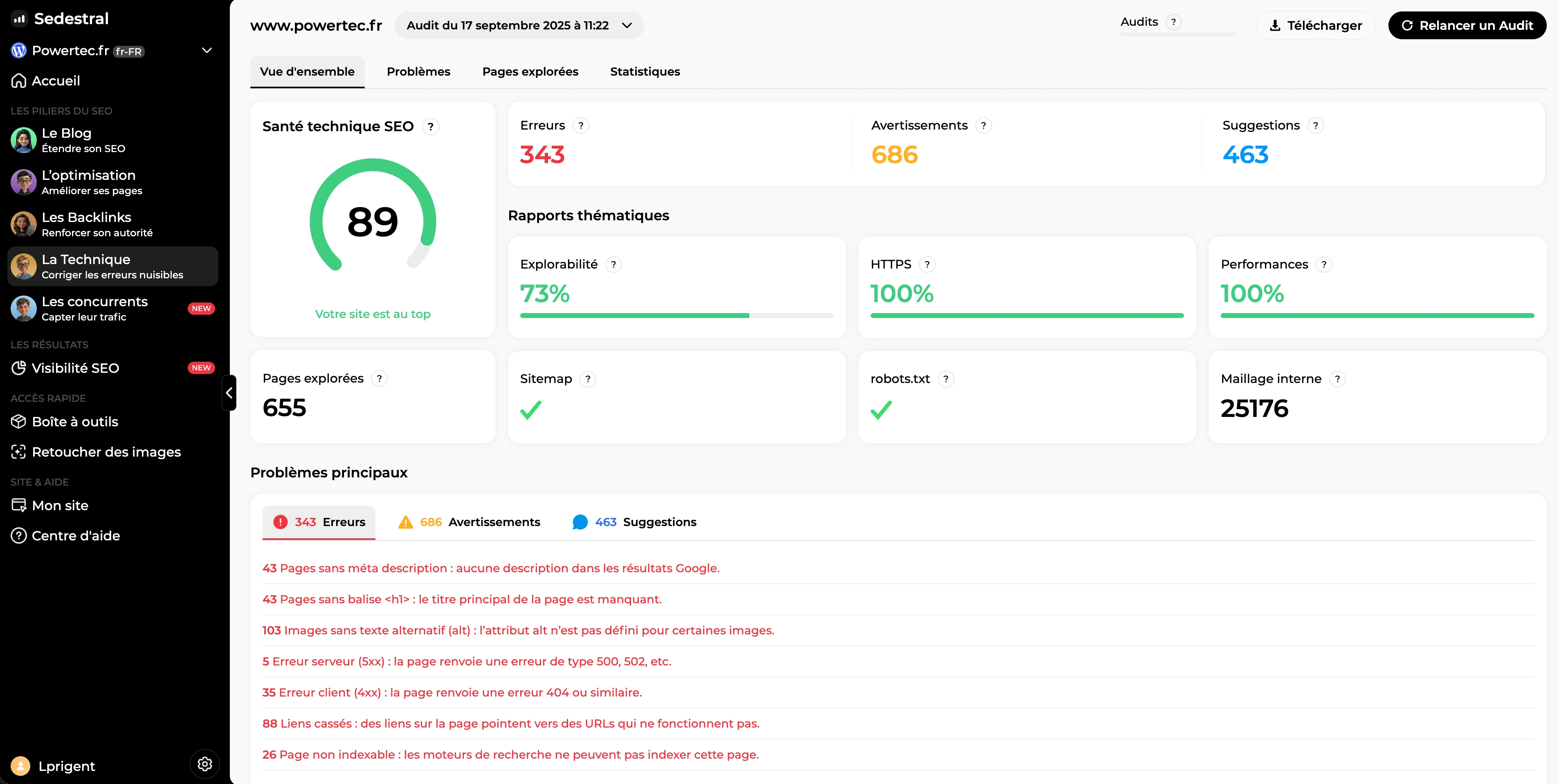
Nox: Automated Technical SEO Scanning and Fixes
Nox is a powerful technical SEO audit tool that performs continuous monitoring. It analyzes your HTML structure, checks mobile compatibility, and automatically flags crawling errors. As soon as a Technical SEO problem appears, the tool sends alerts with prioritized fixes to protect your ranking.
- Structured Data Checks: Flags missing or invalid structured data and explains each fix step by step, ready to hand to your team or developer.
- Indexation Monitoring and Alerts: Monitors Google crawling and indexing, and alerts you to any blocking issues that could harm your ranking.
- Performance and Mobile Scanning: Continuously assesses page speed and mobile adaptability, uncovering improvement opportunities for Google ranking and LLM citations.
| Issue Type | Impact on Ranking | Detection Speed | Fix Automation Level |
| Broken Schema Markup | Prevents LLM Citations and Featured Snippets | Within 1-2 Hours of Scan | Generates Correct Code, Ready to Copy-Paste |
| Crawl Errors and Blocked Resources | Can keep pages out of Google’s index | Daily Automatic Scanning | Identifies Root Causes with Fix Priority |
| Missing Meta Tags and Descriptions | Weakens SERP Presentation and CTR | Within Hours of Page Scan | Auto-generates Templates Matching SEO Best Practices |
| Page Speed and Core Web Vitals | Impacts Ranking, User Experience, and LLM Evaluation | Continuous Monitoring | Recommends Specific Optimization Actions by Priority |
Unlike manual audits that take months, Nox's automated approach resolves critical errors in just days. If a schema breaks during an update, Nox detects it immediately and suggests a correction. You just have to approve it, preventing the usual drop in visibility that would follow.
AI Blog and Content Creation Workflow
Alya offers effective AI Content Optimization: it delivers complete articles, ready to publish, and tailored to your audience. The system performs Competitor Analysis to identify keyword Gaps and trending topics. It manages the entire Content Generation process, with structured headlines, and allows for direct deployment to your CMS.
This Content Optimization process always respects your tone and quality standards. The articles maintain high readability and avoid robotic phrasing that undermines trust. You retain total editorial control before publication, condensing weeks of writing into just a few hours.
Comparing Top AI SEO Tools and Ranking Sedestral
The search engine optimization landscape has expanded considerably, bringing a host of new platforms to the fore. While traditional tools still lead for backlink databases and search volume tracking, Sedestral presents a unified alternative. It's designed to help you select the best AI SEO tools for 2026 that align precisely with your workflow.
Sedestral vs. Traditional Ranking and Audit Tools
Conventional platforms are masters of their specific domain—Semrush delivers robust keyword data, and Ahrefs is excellent for feature tracking. But they often demand additional integration effort. If you're exploring the best AI SEO tools for 2026 with free versions, you'll typically encounter limited functionality, leaving you to manually piece together your insights.
- Hallucination Detection and Brand Protection: Standard systems frequently overlook false AI-generated information. Sedestral actively performs monitoring across platforms like ChatGPT and Gemini, offering full protection against costly inaccuracies.
- Automated End-to-End Workflows: Other tools necessitate manual coordination between research and publishing. Sedestral automates this entire cycle, making content creation and competitor analysis genuinely effortless.
- Generative AI Visibility Tracking: Older trackers focus solely on classic Google rankings. Sedestral provides comprehensive visibility tracking across modern AI search engines and conversational interfaces.
Surfer SEO excels in content grading by evaluating top-performing pages to uncover ranking potential. It's a solid pick for fundamental on-page optimization. It publishes to WordPress through its own plugin, but it does not acquire backlinks for you.
Sedestral’s all-in-one platform showcases practical scalability, especially for fast-growing digital agencies. Juggling multiple client accounts becomes unwieldy with scattered tools. Sedestral centralizes everything—voice share, backlink openings, and rank fluctuations are visible in one dashboard.
Pricing, Free Options, and Real ROI in 2026
Budget considerations are vital, yet any SEO tool pricing comparison should factor in projected return. A platform that saves hours each week offers far greater value than a low-cost but fragmented alternative. Sedestral uses clear, straightforward pricing that scales predictably as your business expands.
Free tiers usually provide only basic research capabilities, which fall short for live projects. Sedestral offers a free plan, so you can test core features before choosing a paid plan. For agencies overseeing numerous sites, this streamlined approach is a major advantage.