Selecting the ideal SEO automation tools in 2026 demands a clear understanding of which solutions genuinely save time, reduce overall cost, and enhance search rankings. This guide reviews leading platforms and breaks down the potential returns on your investment. We'll also demystify the complexities behind SEO automation pricing, helping you make the most of your budget.
What SEO automation tools actually do in 2026
Effective SEO automation deploys intelligent software to handle repetitive tasks—such as keyword research, technical scans, and content optimizations. These tools pull data directly from your analytics and CMS, creating a smooth-running SEO workflow that shifts your team’s focus from manual labor to strategic growth.

From manual work to AI-driven SEO workflows
The shift is striking: what once took hours now takes only minutes with modern SEO automation tools in 2026. Lengthy manual SEO reviews are condensed into quick automated SEO audits, freeing up hundreds of hours yearly—time teams reinvest into gaining a competitive advantage.
- Audit automation: Intelligent crawlers automatically detect broken links, missing schema, duplicate content, and performance issues across entire sites.
- Keyword research acceleration: Massive keyword datasets are processed rapidly, clustering terms by topic and user intent—eliminating the need for slow manual analysis.
- Scaled content generation: AI drafts optimized articles, adding meta descriptions, headers, and internal links in one seamless workflow.
- Ongoing monitoring: Real-time alerts flag ranking dips and crawl errors, allowing for instant response instead of delayed monthly reporting.
Emerging research highlights that marketing professionals see AI adoption as both compelling and complex. Studies indicate diverse perceptions, recognizing clear benefits alongside adoption barriers. Ultimately, AI marketing adoption augments human expertise, boosting performance while transforming traditional approaches.
Key features every automation platform covers
A modern SEO platform analyzes a wide array of technical elements at once—delivering health scores and competitor comparisons. These AI-driven SEO tools keep your site responsive with scheduled scans and instant notifications. They highlight critical issues and competitor opportunities in a unified dashboard, cutting out tedious manual research.
- Technical factor analysis: Automatically checks title tags, meta descriptions, and page speed, offering clear corrective guidance.
- Competitive benchmarking: Compares your search performance against top rivals, revealing content gaps and keyword opportunities.
- One-click optimization: Instantly implements recommendations for meta tags and keyword usage across multiple pages for fast impact.
- Built-in integrations: Native links with major CMS platforms simplify data sharing, avoiding complicated API setups.
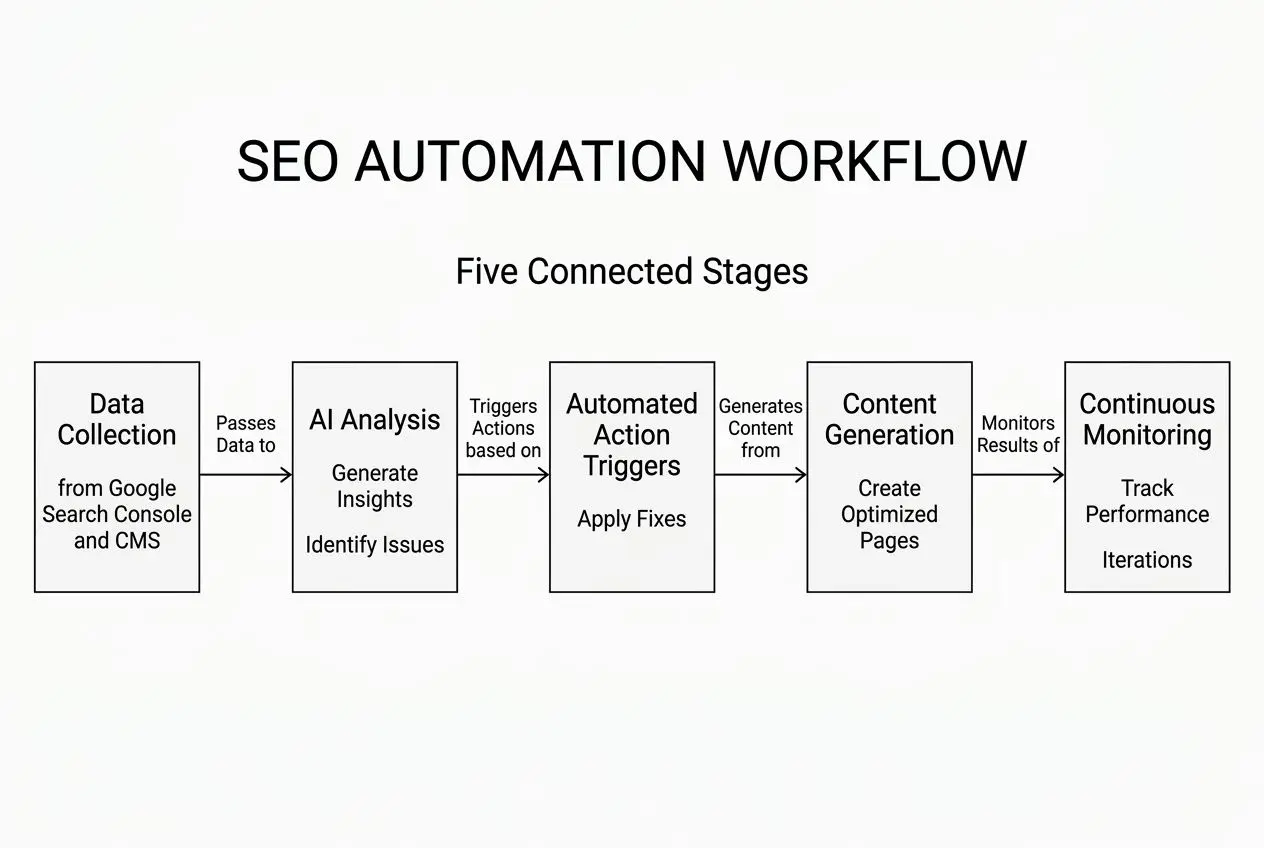
The system operates through ongoing data collection, delivering insights, triggering fixes, and generating optimized content. This cycle repeats continuously without requiring manual oversight—distinguishing it from older tools. By leveraging these key features, you simplify routine SEO audits and boost overall team efficiency.
Why adoption is growing despite initial resistance
Initial skepticism around AI promises is natural among marketers. Yet today’s autonomous platforms handle entire workflows—from detecting issues to executing fixes and monitoring results. Teams now spend mere minutes reviewing updates, empowering agencies to reclaim countless hours once lost to manual SEO tasks.
This hesitation dissipates once the return on investment becomes tangible. An affordable subscription quickly compensates for labor costs well before rankings climb. By month three, many teams observe measurable growth in organic traffic directly tied to automated enhancements.
Top SEO automation tools and platform categories compared
The market naturally splits into several distinct software categories. You'll find an all-in-one platform that combines audits, rank tracking, keyword research, and content optimization, alongside single-purpose tools, autonomous AI agents, and specialized agency solutions.
All-in-one platforms vs. Single-purpose SEO tools
Comprehensive platforms like Semrush, Ahrefs, and Similarweb bring together technical audits, tracking, and content improvements under one roof. They significantly cut down on tool clutter while simplifying onboarding and keeping your data consistent. Thankfully, the best SEO automation tools are available across a range of price points, making optimization achievable even for smaller teams.
Single-purpose tools perform well at specific tasks, but they still require you to act on their recommendations manually. You have to spot the issues and apply fixes yourself, a process that inevitably eats into valuable time. Modern platforms now offer true SEO automation, handling both detection and execution without needing human input at every step.
Best picks by team size and use case
Solo marketers benefit greatly when a single SEO automation platform replaces several separate tools. Smaller teams often combine an audit tool with tracking to keep a close eye on monthly costs. Agencies, on the other hand, tend to prioritize a custom dashboard and white-label reporting to deliver polished results to their clients.
| Team Size | Recommended Approach | Monthly Budget Range | Priority Features |
| Solo/Freelancer | All-in-one platform or freemium starter | $0–$99 | Ease of use, keyword research, rank tracking, basic audits |
| Small team (2–5 people) | All-in-one + specialized content tool | $200–$400 | API integrations, collaboration features, content optimization, technical audits |
| Mid-size (5–15 people) | Comprehensive SEO automation platform | $400–$800 | Scalability, white-label options, advanced analytics, workflow automation |
| Agency/Enterprise | Enterprise platform + specialized tools | $1,000+ | Multi-client management, custom reporting, dedicated support, API access |
Key features that separate leading platforms
Strong integration with tools like Google Search Console and WordPress helps you avoid frustrating data silos. Up-to-date data and accurate insights are absolutely critical for making well-informed marketing decisions. Among the most important key features to look for is ease of use, ensuring that non-technical team members can adopt the software without a steep learning curve.
- Native CMS integrations: Direct connectors with WordPress or Shopify allow you to publish content and implement schema markup effortlessly, no developer required.
- Autonomous workflow execution: The best SEO automation tools go beyond flagging problems; they automatically apply smart fixes, cutting resolution times and reducing the risk of human error.
- Custom dashboards and reporting: Agency-focused platforms stand out by offering branded client portals and automated reports, making it easy to present compelling insights in a professional format.
The right choice ultimately comes down to your workflow and the integrations your team relies on most. A budget-friendly tool that fits neatly into your existing CMS will often deliver better returns than a complex alternative you barely use. At the end of the day, simplifying your daily process matters far more than having access to every feature imaginable.
Core SEO automation features worth paying for in 2026
Not every software tool justifies its monthly cost in the long run. You should focus on SEO automation features that actively save time, enhance rankings, or efficiently scale your output. Accelerating your keyword research and content optimization workflows delivers a faster, more measurable return on investment.
Technical SEO audit automation and site health monitoring
Continuous crawlers quickly spot broken links, missing schema, and duplicate content across large website structures. Modern platforms evaluate hundreds of on-page factors to assign accurate technical health scores. Today’s SEO automation features also provide real-time alerts, keeping sites responsive to sudden algorithm shifts.
- Automatic crawl scheduling: Websites are scanned daily or weekly without manual intervention, continuously gathering data about technical health, mobile usability, and page speed issues.
- Page-level health scoring: Every page gets a specific health score reflecting its technical SEO audit quality. This helps you prioritize fixes efficiently, especially across large product catalogs.
- Competitive technical analysis: Your overall technical health is regularly benchmarked against top Google search results. This reveals hidden structural advantages competitors may be using.
- Actionable remediation tickets: Detected issues instantly trigger tickets with specific fixes and severity levels, enabling better team management and sprint planning based on concrete data.
A reliable technical SEO audit subscription quickly pays for itself in saved labor hours alone. Most marketing teams reclaim several hours each week for higher-level strategy, freeing them from manual crawling, deep data analysis, and tedious report compilation.
Content and keyword automation key features
Modern keyword research workflows process huge datasets rapidly to uncover high-intent search terms. Automated systems draft optimized articles with ideal headings, internal links, and meta descriptions. Dedicated content optimization tools analyze top-ranking pages to generate specific, competitive recommendations.
- AI-powered keyword clustering: Thousands of target phrases are automatically grouped by topic and search intent, eliminating hours of manual spreadsheet work.
- Automated content brief generation: Top-ranking pages are analyzed to extract semantic themes, word counts, and heading structures. Data-driven briefs are generated in minutes.
- Real-time content scoring: As you type, an intelligent system scores your draft against top competitors, highlighting missing phrases and linking opportunities for proactive content optimization.
- NLP-based recommendations: Advanced natural language processing identifies semantic relationships between your copy and target keywords. It suggests related terms and topics to improve user intent matching.
These valuable key features save content teams many hours weekly. Writers no longer spend endless time researching competitors or manually analyzing search results. Marketing teams can scale output while automatically applying consistent optimization standards.
Internal linking, schema, and rank tracking automation
Internal linking automation maps your site structure to identify orphaned pages. It suggests contextual linking opportunities and automatically inserts them across hundreds of pages. Modern schema generators create and validate JSON-LD code based on deep page analysis.
Advanced daily rank tracking provides detailed keyword position monitoring and automated stakeholder reports. These platforms track thousands of keywords simultaneously, instantly alerting you to significant ranking shifts. This enables a proactive response to fluctuations instead of discovering drops weeks later.
Reliable rank tracking saves countless hours previously spent manually checking Google positions and formatting spreadsheets. Automated scheduling ensures essential SEO automation reports reach clients without manual reminders. This frees up team time for strategic marketing decisions instead of tedious administrative work.
Seo Automation Tools Pricing Models and Hidden Costs
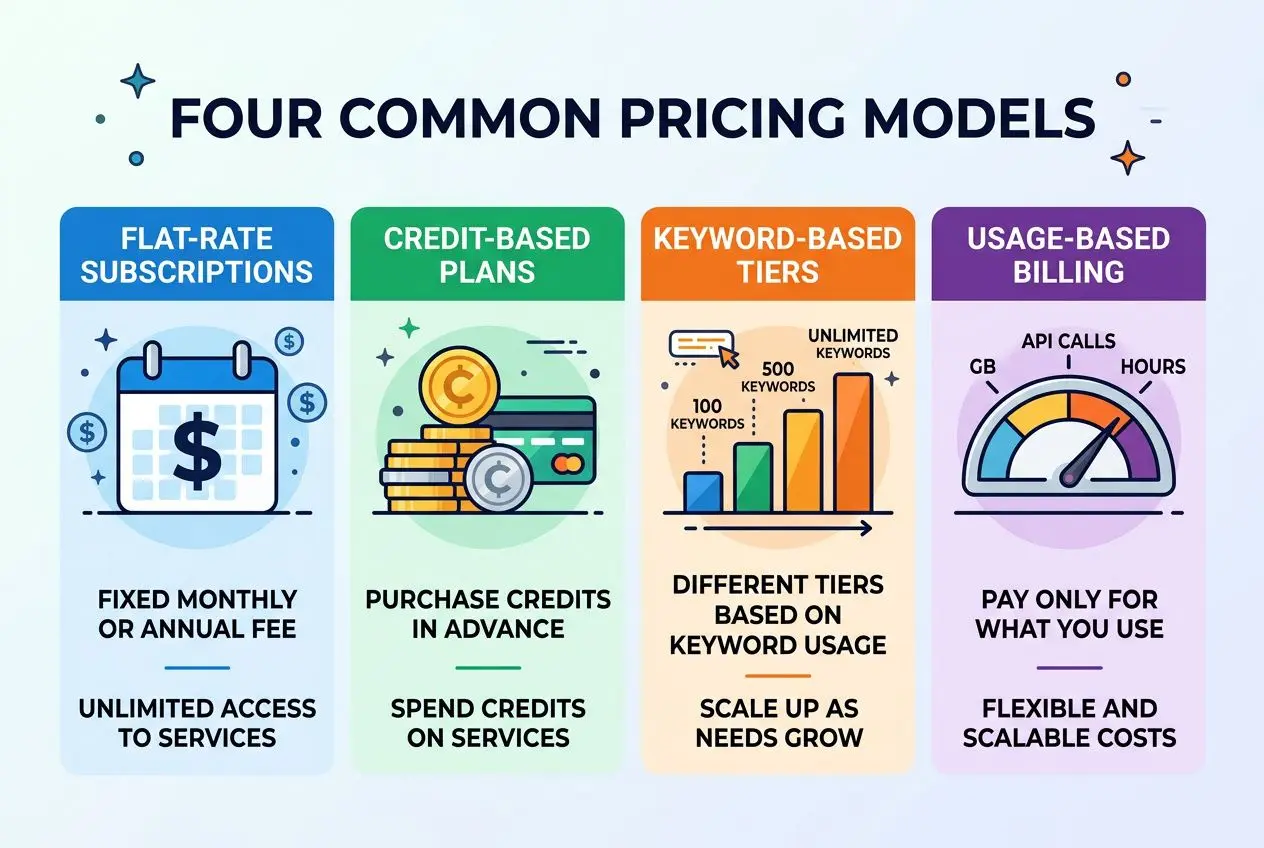
Four distinct pricing models define the landscape of SEO automation tools pricing today: flat rates, credits, keyword tiers, and usage billing. Understanding these cost structures is key to preventing unexpected budget shocks and determining whether a platform can scale affordably with your growth.
Pricing Tiers from Free Plans to Enterprise SEO
Starter plans typically limit crawls to around 1,000 URLs, making them a good fit for small blogs wanting to test SEO automation capabilities. Pro tiers cater to growing sites by offering unlimited crawls, advanced analysis, and comprehensive keyword tracking. For the largest projects, enterprise setups use custom SEO automation tools pricing, which often exceeds $500/month based on specific volume and feature requirements.
- Freemium Tier Limitations: While free plans are excellent for initial testing, they come with strict constraints. You typically receive a cap of 1,000 crawls, basic reporting, and minimal keyword tracking capabilities.
- Pro Tier Sweet Spot: The pro tier represents the ideal balance for many agencies. It unlocks content optimization tools, eliminates crawl limits, and provides API access for seamless integration with other SEO software.
- Enterprise Flexibility: Enterprise-level options offer massive crawl limits and often include dedicated support. The cost here is usually based on your actual usage rather than a rigid, pre-defined package.
- Volume Discounts for Agencies: Agencies managing a high volume of clients frequently qualify for significant discounts. This practice effectively reduces the cost per client and improves overall service margins.
Mid-size companies typically budget between $300 and $650 per month to cover their total SEO software cost. This investment generally includes technical audits, visibility analysis, and various stages of content optimization.
Hidden Costs That Inflate Your SEO Automation Budget
The base subscription price often hides additional, larger expenses. Incorporating essential add-ons like rank tracking, schema markup tools, and link building support can quickly increase your total SEO software cost. A standard toolkit might start at around $200 per month but can easily reach $600 once you integrate these specialized functions.
Using multiple platforms with overlapping features is another common budget inflator. If you're paying for several tools that all perform keyword tracking or content optimization, you're essentially purchasing redundant SEO software. Conducting a thorough audit of your tools can help consolidate these functions, saving money and reducing tedious manual data entry.
How Annual Billing and Discounts Reduce Total Spend
Opting for annual billing instead of a monthly subscription can lead to savings of 15–25%. For example, a $200 monthly plan costs $2,400 annually, but a 20% discount for paying upfront saves you $480. Committing to a multi-year agreement can unlock even greater long-term savings.
Mid-size teams with a monthly spend of $400–$500 can save over $1,000 per year simply by paying annually. These savings can then be redirected into new strategic initiatives or team training programs.
The return on investment (ROI) is often very clear, as the labor hours saved by SEO automation typically surpass the monthly cost. A tool costing $200 per month that saves just five hours of work each week quickly pays for itself. In the end, month-to-month billing often becomes a more expensive compromise when compared to the value of an annual commitment.
Measuring SEO Automation ROI and Implementing Tools Correctly
Calculating your return requires establishing baseline metrics before automating tasks. Track progress meticulously each month and assess outcomes honestly. Avoid vanity metrics, focusing instead on labor hours saved and tangible traffic improvements directly tied to automated changes.
How Much Time SEO Automation Realistically Saves
Effective SEO automation can save professionals several hours every week, especially on audits and keyword research shrinks from 12 hours to roughly 30 minutes. The SEO automation ROI becomes evident here. A modest monthly cost is frequently recovered quickly, generating continuous surplus value.
- Audit tool hour savings: Automated crawling and reporting reduce weekly tasks from six hours to nearly nothing. This workflow enhancement frees up valuable time for strategic planning and content optimization.
- Rank tracking recovery: Scheduled rank tracking eliminates the need for manual spreadsheet updates. This simple switch saves three to five hours of reporting work every week.
- Content generation acceleration: AI-assisted drafting and optimization cut weekly content cycles from 15 hours to just three. This drastically reduces editorial overhead and accelerates publication schedules.
- Workflow automation gains: Connecting disjointed platforms through integration tools removes duplicate data entry. This seamless process saves up to eight hours weekly on administrative coordination.
Marketing agencies often reclaim 40 to 60 hours monthly by using automated workflows across multiple client sites. This recovered time can be redirected toward strategic work or business development initiatives.
Tracking ROI with the Right Baseline Metrics
Establish strong performance baselines before any automation begins. Log your existing traffic volume, keyword rankings, and weekly hours spent on SEO tasks to allow for accurate future comparisons. Monthly tracking then provides a clear analysis of true automation impact instead of relying on guesswork.
- Labor hour tracking: Document time spent on specific tasks for two weeks before automating. After implementation, track hours monthly to calculate recovered time and assign its monetary value.
- Ranking and traffic analysis: Monitor search impressions and Google ranking positions weekly. This ongoing tracking helps identify which automated changes directly correlate with rank improvements.
- Technical health metrics: Track improvements in page crawlability, Core Web Vitals, and proper schema implementation. Resolving these technical issues builds a solid foundation for sustainable growth.
Watch for red flags like ranking declines or negligible time savings after 90 days. Overlapping tool functionalities that waste budget are another concern. These issues may indicate a need to adjust configurations or consider platform alternatives.
Phased Implementation to Maximize SEO Automation Impact
Best practices recommend adopting a phased rollout for new systems. Begin by piloting a single repetitive task for one week to measure labor hours and output quality. Once you demonstrate a positive return, gradually expand the scope to prevent overwhelming team members.
Always prioritize your most time-consuming daily activities. If technical audits consume 20 hours weekly, automate them first for immediate value recovery. Early success builds organizational confidence and reduces skepticism as you introduce more advanced workflows.
Blend software recommendations with human oversight rather than relying exclusively on autonomous execution. While tools effectively identify issues and opportunities, human strategists must apply judgment regarding prioritization and timing. This hybrid approach drives efficiency while maintaining quality control and strategic nuance throughout your SEO automation journey.
Frequently asked questions
Which SEO tasks can be fully automated in 2026?
You can now fully automate technical tasks such as rank tracking, keyword research clustering, and schema markup generation. Tasks like content brief creation, internal link mapping, and metadata optimization also require zero manual effort with modern SEO automation tools.
Essential processes including site crawling, mobile usability analysis, and broken link detection operate independently. Similarly, automated content generation, optimization suggestions, and reporting systems function seamlessly without intervention.
While SEO automation efficiently handles repetitive daily tasks, human expertise remains crucial for strategic decision-making, competitive positioning, and creative problem-solving.
What are the best free SEO automation tools available in 2026?
Free options from leading platforms, such as Semrush's free account, Ahrefs Webmaster Tools, or SE Ranking's 14-day free trial, offer limited testing capabilities. These typically include a few monthly crawls, basic keyword tracking, and simple reporting functions. Google Search Console complements these with complimentary crawl analysis.
Platforms such as Ubersuggest and Mangools provide free tier options for initial keyword research and fundamental site audits. These solutions work adequately for individual bloggers or conducting small-scale tests. However, their restrictive limitations quickly become impractical for active agencies.
As your operational volume increases, the subscription cost becomes easily justified. Investing in premium SEO automation tools ultimately proves more economical than wrestling with constrained free alternatives.
How should I calculate SEO automation ROI realistically?
To realistically calculate your SEO automation ROI, compare the total time saved against the tool's subscription expense. Additionally, consider improvements in organic traffic and search rankings resulting from the automation.
Begin by documenting your baseline hours for routine tasks before implementing new software. Then, measure actual monthly hours spent and assign an hourly value based on your team's compensation rates.
For instance: saving 20 hours monthly at $50/hour equals $1,000 in labor value. With a $300 subscription cost, this results in a $700 monthly gain before accounting for any traffic increases. This method demonstrates the tangible value of SEO automation investment clearly and quickly.