Topic clusters sound fantastic in theory—a central pillar page serves as the foundation, while supporting articles explore specific subtopics, all interconnected through strategic internal links. But in practice, many e-commerce businesses and content teams struggle, creating disorganized clusters that confuse search engines instead of establishing authority.
Our topic cluster guide is crafted to help you overcome these challenges. It highlights common topic cluster mistakes and provides clear guidance on how to avoid them, empowering you to turn fragmented content into a powerful engine for improved rankings.
Weak pillar page foundation undermines topic cluster strategy
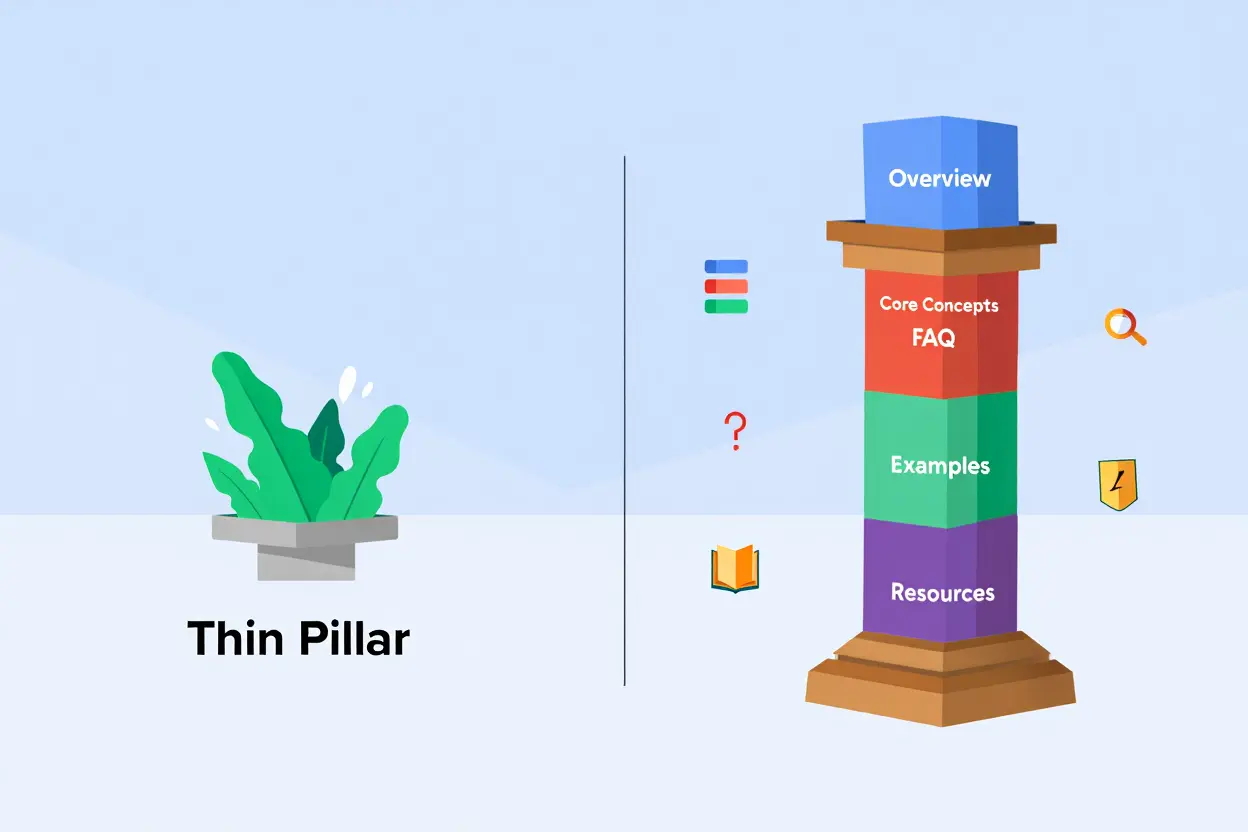
If your pillar page only contains a few links or brief paragraphs, it's essentially just a placeholder rather than a valuable resource. Both search engines and visitors will quickly notice this lack of depth, which can harm your overall rankings. A solid pillar page structure must include substantial, comprehensive content to properly anchor your topic cluster and demonstrate clear topical authority to Google.
How to build comprehensive pillar pages that rank
An effective comprehensive pillar page should typically contain between 2,000 and 3,000 words of valuable content, covering core concepts and offering actionable insights. When reviewing your topic cluster audit checklist, evaluating the quality of this central page should be your top priority. Without a strong foundation, even the best supporting articles won’t be able to reinforce a weak central page.
Enhance these pages by adding multimedia elements—such as videos and infographics—including an FAQ section to answer real user questions. Be sure to use headers rich with keywords that clearly connect to your main pillar topic. Your goal is to create a thorough, definitive resource, not just a gateway pointing to other articles.
- Cover the topic in depth: Google says it has no preferred word count, so length should follow what the topic needs; thin content can weaken the entire cluster.
- Incorporate multimedia assets: Videos, infographics, and custom images make content more engaging, reduce bounce rates, and increase time on page.
- Include an FAQ section: Answering specific user queries improves relevance and encourages visitors to stay longer on your page.
- Use clear, keyword-focused headers: Your H1 and title tags should immediately clarify the page’s intent for both users and search engines.
For example, turning a basic “Eco Sneakers” page into a detailed guide—covering history, materials, environmental impact, and consumer benefits—can make a huge difference. Providing substantial introductory context helps you avoid common topic cluster mistakes like thin or superficial content. This attention to depth often determines whether your page ranks highly or goes unnoticed.
Avoiding overlapping pillars that confuse search engines
It’s essential to define one broad pillar page per core topic, as multiple pages covering similar subjects can cause you to compete against yourself. For instance, having two separate “SEO Audit” guides divides your authority and confuses Google about which page to rank. Your structure should always remain clear: one pillar, one primary keyword, one cohesive topic cluster.
Before you begin building, validate your pillar topic using thorough keyword research and competitive analysis. If a topic lacks search volume or audience interest, it’s not worth the investment. Overlapping pillars waste resources and fragment your topical authority across multiple mediocre pages instead of concentrating it on one strong pillar.
Scoping cluster articles to support one pillar
Every piece of cluster content should explore a specific subtopic that directly relates to and supports your main pillar. Avoid vague articles that could apply to multiple categories, as this ambiguity confuses search crawlers and dilutes your topical relevance. Strong semantic signals are essential for a successful topic cluster strategy.
To maintain focus, limit how many loosely related articles you group under a single pillar. For example, placing twenty only marginally relevant posts under “Content Marketing” creates noise instead of building authority. Each article in the cluster should clearly explain its relevance to the central pillar topic.
It’s helpful to outline your cluster’s scope before writing. Map out how each proposed article supports the pillar and addresses a distinct subtopic, ensuring every piece links back meaningfully. This kind of planning prevents fragmented content creation and helps preserve your topical authority when you perform an SEO audit.
Internal Linking Mistakes That Weaken Content Clusters
Internal links are the glue that holds your entire content strategy together, yet many websites fail to implement them effectively. Without strong, meaningful connections, your pillar page remains isolated while your supporting pages drift aimlessly. Common mistakes—like using generic anchor text or failing to create necessary links—break the very semantic bonds that search engines need to recognize a coherent and valid topic cluster.
Building Bidirectional Links Between Pillar and Clusters
It is essential that every single cluster page links back to its pillar page using descriptive anchor text that contains the primary keyword. At the same time, your pillar page must reference all of its supporting cluster pages within relevant, contextual passages. This type of bidirectional internal linking for topic clusters creates the topical web that Google looks for and rewards.
Resist the urge to simply dump all your pillar links into a footer or a generic sidebar list. Instead, weave them naturally into your content where they add the most value. When a cluster page discusses a subtopic that relates to the pillar theme, insert the link directly within that paragraph. This approach helps with user navigation and reinforces topical relevance.
Using Contextual Anchor Text Instead of Generic Links
Using generic, non-descriptive phrases like "click here" or "read more" wastes a valuable SEO opportunity. Descriptive anchor text—such as "email copywriting best practices"—clearly tells search engines what the linked page is about. This level of specificity is a form of crawlability optimization, as it strengthens the topical signals across your entire site.
- Use phrase-based anchors: Choose specific anchor text like "organic cotton t-shirt care tips" instead of vague terms—this adds far more value and clarity.
- Link contextually near relevant content: Place internal links inside paragraphs that discuss related ideas, rather than isolating them in unrelated lists or menus.
- Implement breadcrumb navigation: Breadcrumbs help both users and crawlers understand the site hierarchy and keep every page accessible within three clicks.
Avoid linking from your cluster pages primarily to your homepage or to entirely unrelated articles. These habits weaken semantic clarity and confuse search engines about what your content clusters actually cover. Instead, link supporting pages to relevant products or services that help guide visitors toward a conversion.
Fixing Orphaned Pages and Broken Cluster Connections
Regular audits using tools like Screaming Frog can help you identify structural weaknesses across your site. Look out for orphaned pages—cluster articles that have no incoming internal links—and broken connections that disrupt the user journey. Fixing these invisible orphans is often a quick win, since they otherwise limit your entire strategy’s effectiveness.
If you find a supporting article with broken links or weak anchor text, address these issues right away. Replace generic labels with clearer, more descriptive ones—such as "Caring for Recycled Denim"—and double-check that all URLs resolve correctly. Keeping a clean and consistent URL structure also helps search engines better understand the hierarchy of your content.
Keyword Cannibalization Destroys Topical Authority Signals
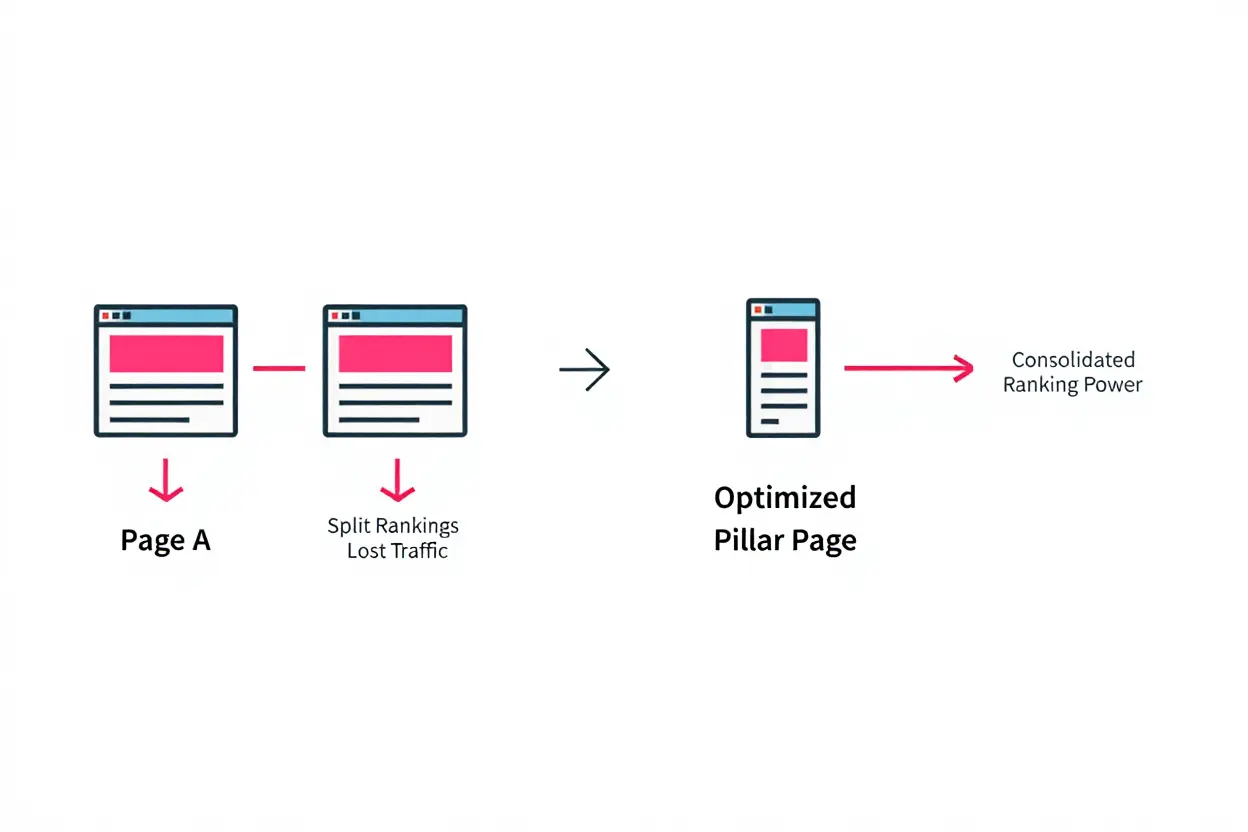
When multiple pages compete for the same primary keyword or user intent, Google ends up dividing ranking signals between them. As a result, both pages underperform compared to their individual potential, reducing your overall search visibility. This form of keyword cannibalization often goes undetected without a proper audit, and it significantly weakens your cluster's performance and your efforts in topical authority building.
Mapping Primary Keywords to Avoid Internal Competition
To prevent this issue, assign a unique primary keyword and a clearly documented search intent to each page. Before publishing, it's essential to map keywords to URLs in a spreadsheet—this is a foundational step for effective keyword cannibalization prevention. For example, if multiple pages target "eco-friendly sneakers," Google may struggle to determine which one to rank, ultimately harming the performance of all.
Ideally, reserve broad, high-volume keywords for your pillar page. Then, use more specific long-tail variations for your cluster pages to attract more targeted traffic.
- Create a keyword-intent map: Clearly define the primary keyword and search intent for every cluster page, and flag any potential duplicates before going live.
- Use long-tail variations strategically: While your pillar page might target "sustainable sneakers," use cluster pages to focus on subtopics like "how to choose eco-friendly sneaker materials" or "best recycled sneaker brands."
- Validate uniqueness with SEO tools: Use tools like Ahrefs or Google Keyword Planner to confirm that each page addresses a distinct query and user intent.
- Audit existing content for overlap: Review all current keywords and merge any pages that compete for the same user intent before introducing new topic clusters.
It's also important to regularly update your keyword assignments, as search intent can evolve over time. New trends or changes in user behavior may unexpectedly introduce cannibalization risks. A page that was safe a year ago might suddenly compete with a newer article, making quarterly audits essential.
| Common Cannibalization Scenario | Problem Impact | Solution |
| Two posts both optimized for "best email marketing software" | Rankings split; both pages rank lower than they should; traffic lost to cannibalization | Consolidate into one comprehensive guide; 301 redirect the duplicate to the keeper |
| "Eco-friendly sneakers" pillar and "sustainable sneakers" cluster both targeting same intent | Topical authority diluted across two pages; neither achieves full ranking potential | Reserve "sustainable sneakers" for pillar; use "organic sneaker options" or "eco-friendly materials" as distinct cluster topics |
| Multiple pages with vague titles like "SEO Tips" competing unintentionally | Scattered authority; search engines confused about which page to rank; poor cluster coherence | Rename cluster pages to target specific subtopics like "SEO title tag optimization" or "meta description best practices" |
Consolidating Duplicate Content That Splits Rankings
If two or more pages have significant content overlap, consider merging them or rewriting one entirely. Using a 301 redirect from the duplicate to the main page helps preserve valuable backlink equity. This consolidation process strengthens your topical authority by concentrating ranking signals into fewer, higher-quality resources.
Regular content cleanup also helps keep your topic cluster content calendar free of repetitive or near-identical posts.
- Identify near-duplicates: Use plagiarism checkers or SEO audit tools to automatically detect content with significant overlap.
- Consolidate strategically: Merge overlapping cluster content into a single, stronger resource, and use 301 redirects to pass link equity to the primary page.
- Use canonical tags for preservation scenarios: When you need to keep multiple versions for technical reasons, apply canonical tags to indicate the preferred version to search engines.
- Refresh and differentiate: If you decide to keep similar pages, make sure each one targets a unique user intent or audience—for example, separating beginner guides from advanced strategy content.
A practical solution is to replace competing posts like "Top 10 Sustainable Sneakers" and "Best Eco-Friendly Sneakers" with a single, comprehensive pillar page. You could create an "Ultimate Guide to Sustainable Sneakers" and support it with specific cluster topics like "Cleaning Tips for Recycled Footwear." This ensures every page serves a distinct purpose and eliminates cannibalization entirely.
Misaligned Intent and Thin Content Hurt Topical Authority
Content clusters often fail because individual pages either miss the mark on user intent or lack substantial information. For instance, an informational "how-to" article feels out of place when it ends with an aggressive "Buy Now" button. Likewise, a mid-funnel comparison guide shouldn't get sidetracked by overly technical installation details.
This type of misalignment frustrates visitors and signals confusion to search engines about your content's purpose. Ultimately, failing to meet user expectations weakens your overall standing and undermines your cluster's perceived topical authority.
Matching Cluster Content to User Intent Stages
Before you begin writing, it's essential to identify whether the search intent is informational, navigational, or transactional. Structure your strategy so that awareness content educates, while mid-funnel content helps users compare options and assess fit. Bottom-funnel content should then focus on driving conversions through clear pricing, trials, and strong calls to action.
True search intent alignment ensures that every page serves its specific audience effectively. This approach guides visitors naturally through their buying journey without pushing them into decisions they aren't ready to make. Always analyze top-ranking pages for your target queries to understand exactly what users expect to find.
If current search results are dominated by educational guides, publishing a sales-heavy page won't help you rank. Instead, mirror the structure of those top performers while adding unique value. Differentiate your cluster content by including better examples, fresh data, or more distinct insights.
- Awareness stage: Focus on educational guides and explainers; use internal links to guide readers toward mid-funnel comparison content.
- Consideration stage: Develop detailed reviews and assessments; link strategically to product pages to help move users closer to a decision.
- Decision stage: Highlight clear pricing and ROI tools; use direct CTAs like "Start your free trial" to capture high intent.
- Map internal links by funnel stage: Ensure awareness pages lead to consideration content, which then flows naturally into decision-focused resources.
Avoid forcing conversion elements into early-stage awareness content where they don't belong. A user searching for broad advice isn't ready to buy immediately—they're simply researching their options. Leading them gently toward comparison content respects user intent and significantly improves your overall conversion rates.
Adding Depth and E-E-A-T Signals to Clusters
Thin content, characterized by sparse text and generic advice, completely fails at effective topical authority building. Your cluster pages should aim for substantial length, enriched with real-world examples, original data, and helpful visuals. Including actionable steps ensures that readers leave with genuine value rather than empty fluff.
Strengthen your content by adding author credentials, expert quotes, and citations from primary research. These specific elements are crucial for establishing E-E-A-T signals—Expertise, Experience, Authoritativeness, and Trustworthiness. This approach boosts credibility and proves your cluster's authority to both Google and your human readers.
Pruning Underperforming Pages to Strengthen Authority
A central pillar page supported by only one or two weak posts will appear thin and unfocused. On the other hand, creating too many hyper-niche pages that barely relate to the main topic fragments your authority. You should only expand into subtopics that demonstrate measurable interest through keyword volume or audience surveys.
To keep your strategy effective, you must prune underperforming pages regularly to maintain a lean, authoritative structure. Monitor key metrics like page views and time on page to identify which assets aren't pulling their weight. Consolidating weak content helps improve the signal-to-noise ratio and prevents authority dilution across your site.
Frequently asked questions
What's the most common mistake when building content clusters?
Many content teams make the mistake of creating a weak central resource that isn't robust enough to support the surrounding content. A common error is publishing a pillar page with only a brief overview—often just a few hundred words—and then wondering why the strategy underperforms. Without a strong pillar to anchor the topic cluster, your supporting pages are unlikely to gain meaningful visibility.
A well-built pillar should serve as a definitive guide—typically between 2,000 and 3,000 words—and include useful visuals or embedded media. If this core page isn't truly valuable and comprehensive, the entire content cluster structure can lose effectiveness. Always evaluate and strengthen your pillar before moving on to optimize other parts of your cluster strategy.
How do I know if my pages are cannibalizing each other's rankings?
You can detect this problem by conducting a keyword audit using tools like Ahrefs, SEMrush, or Google Search Console. Start by listing all your current pages alongside the main keywords each one targets. If you find multiple pages competing for the same keyword or addressing the exact same search intent, they are likely undermining each other's performance.
Monitor rankings over time: if related pages rise and fall in sync or consistently rank poorly, it's a sign of internal competition. The best approach is to merge overlapping content into one stronger resource using 301 redirects. Afterwards, make sure any remaining pages target clearly distinct keywords to preserve your topical authority.
How often should I audit and refresh my topic clusters?
It's best to perform a complete audit at least annually, though active content clusters often benefit from more frequent check-ins every quarter. During audits, look for broken internal links, orphaned pages, outdated facts, or shifts in audience interests. Consistent upkeep helps keep your clusters relevant and prevents new cases of keyword cannibalization.
Aim to refresh your best-performing content quarterly by incorporating recent statistics, current examples, and useful resources. Set clear performance benchmarks—if a page isn't attracting traffic after six months, consider rewriting, merging, or archiving it. This helps maintain your content as a ranking asset rather than letting it dilute your domain authority.