Does SEO sometimes feel like trying to push a boulder up a hill? You know that higher rankings lead to more revenue, but managing keyword research, competitor analysis, content creation, and technical fixes eats up time you don’t have. That’s where this AI search optimization guide comes in—it explains how AI-powered tools can automate the whole process, from finding search intent keywords to publishing fully optimized pages, helping your website climb the rankings faster and with far less stress.
AI-Powered Keyword Research for Strategic Optimization
Machine learning has completely changed the game for keyword research. It scans billions of search queries, finds gaps your competitors are missing, and clusters related terms into meaningful semantic groups. This data-rich process uncovers long-tail keywords that reflect genuine buyer intent—not just empty traffic—giving your optimization strategy the precision it needs to deliver lasting results.

How Machine Learning Uncovers Hidden Keyword Opportunities
An AI search optimization guide will tell you that algorithms analyze search data in ways humans can't. They detect seasonal trends, new topics, and niche search behaviors, then surface keywords that may have modest volume but very little competition—perfect opportunities for growing websites to build authority before bigger players catch on.
- Query clustering via NLP: Natural language processing groups related search phrases together, helping you plan content hubs rather than isolated pages.
- Intent classification: Each keyword is tagged by intent—informational, transactional, or navigational—so your content aligns with what users are really looking for.
- Search volume forecasting: AI predicts which topics will trend, sometimes weeks ahead, so you can publish early and capture more traffic.
Sedestral’s AI-powered keyword tool pulls top keywords from competitor URLs, assigns difficulty scores, and suggests long-tail variations. It helps you base keyword choices on data rather than guesswork.
Competitor Gap Analysis to Capture Market Share
The future of SEO with AI isn’t just about which keywords your competitors rank for—it’s also about the ones they’re ignoring. AI scans rival sites across thousands of search terms, uncovering untapped search intent clusters and SERP features, so your website can publish authoritative content and capture market share before anyone else reacts.
Simply upload competitor URLs into an AI-powered platform and receive clear reports within minutes. These highlight keyword gaps, unexplored topics, and opportunities to snag featured snippets, “People Also Ask” boxes, or video carousels. This data feeds directly into your content plan, making sure every new piece meets real demand and has strong traffic potential.
Predictive Modeling for Proactive Content Strategy
By analyzing years of historical data, AI identifies patterns like seasonal trends, viral cycles, and industry shifts. It then forecasts emerging keywords months in advance, so you can create content proactively and lead the conversation before demand peaks.
Predictive modeling pinpoints exactly when a topic will trend in your niche—like summer fashion, holiday shopping, or a new tech release—and automatically schedules content aligned with those cycles. Your team stays focused on creating, while the AI handles timing and analysis.
Automated weekly reports keep you updated on search volume changes, with alerts that include priority level, difficulty score, content angle suggestions, and traffic estimates. This shifts your decision-making from intuition to data, keeping your optimization strategy agile and forward-looking through smarter keyword selection.
Structured data is revolutionizing how search engines and AI systems understand your web pages, directly boosting your website's visibility. As The Generative Engine Optimization research found that content changes such as adding sources, quotations and statistics can boost visibility in generative engine responses by up to 40%. Structured data remains a useful complement that helps machines interpret your pages.
Structured data tactics for generative engine visibility
Generative engine models will only highlight information they can confidently interpret. Therefore, using validated markup to explicitly declare every key detail is crucial. Clearly tell Google or any other emerging generative engine, "This is a product and here is its price," or "This is a verified organization," and machines will interpret your page more reliably. Google states, however, that no special markup is required to appear in AI Overviews or AI Mode.
Schema markup types that maximize AI citations
Effective schema markup for AI involves carefully selecting and implementing the specific structured data types that modern generative engines understand. For instance, FAQPage is perfect for question-and-answer content, HowTo clarifies step-by-step guides, Product communicates essential e-commerce information, and Organization establishes your brand's credibility. Each specific schema tells AI models exactly what kind of content they are processing, which significantly increases the likelihood of your information being directly quoted in generative search results.
- FAQPage schema: Tags individual question-and-answer pairs, making them easy for machines to parse, although Google no longer displays FAQ rich results.
- HowTo schema: Breaks down tutorials into clear, ordered steps. Google retired HowTo rich results in September 2023 and requires no special markup for AI Overviews.
- Product, Review, and Rating schemas: Provide crucial data like prices, availability, and customer sentiment, which boosts your visibility and conversion rates on all AI-powered shopping platforms.
Complete Product markup, detailing materials, sizes, colors and stock levels, gives shopping surfaces accurate, machine-readable data about your catalog.
Automated schema generation and validation workflows
Scaling your structured data for AI SEO is most efficient when you use AI-powered tools to generate flawless JSON-LD code, which is then instantly validated against Google's guidelines.
Advanced, machine-learning-powered crawlers can now audit your entire website, flag missing or corrupted data, and then prioritize fixes based on their potential impact on traffic. This means a broken Product schema on high-traffic pages gets an immediate ticket, while a minor issue with an Organization schema might be scheduled for later—ensuring your technical SEO resources are always focused on what will most improve your visibility.
Finally, modern CMS plugins can now automatically inject schema fields at the moment of publishing, pulling data directly from your product catalogs and blocking any invalid code before it ever goes live. This creates a closed-loop workflow that prevents regressions, keeps your structured data consistently compliant, and secures your long-term success with generative engine optimization.
Content creation often feels like a never-ending cycle. You research keywords, analyze competitors, develop outlines, write drafts, add markup, format HTML, embed images, and craft meta descriptions. Multiply that process across 10–20 articles each month, and creative burnout becomes almost unavoidable. Leveraging an AI autopilot system to handle every stage automatically empowers your website to sustain a steady publishing rhythm while preserving creative energy.
AI-Driven Content Creation and Optimization Workflows
Rather than replacing writers, AI magnifies their productivity. Enter a single keyword, and the AI engine collects data from the top pages on Google—evaluating metrics like word count, heading structure, markup usage, and keyword density. It then maps out semantic relationships and prepares an outline crafted to address user intent and enhance visibility before any writing begins.

Automated Content Generation from Keyword to Publication
Every AI content optimization workflow starts with gathering insightful data. When you enter a target keyword, the system evaluates competing pages, identifies LSI keywords connected to the main topic, calculates the ideal article length, and generates a structured outline grounded in a successful strategy.
- Semantic outline generation: The system structures H1, H2, and H3 hierarchies that align with user intent, incorporating FAQs, tables, and high-ranking subheadings.
- Natural-language paragraph generation: It produces original, natural-sounding content that weaves in the primary keyword and related terms organically, strengthening semantic SEO without resorting to keyword stuffing.
- Automated image selection and alt-text: Relevant images are selected from stock libraries or your own uploads, renamed for keyword relevance, and paired with descriptive alt text to boost visibility in image search.
- One-click CMS integration: Completed articles are seamlessly published to platforms like WordPress, Shopify, Wix, or Webflow with scheduled posting, optimized meta fields, and smart internal linking.
Consistency in publishing builds topical authority far more effectively than sporadic updates, signaling to Google that your content merits greater visibility.
Content Scoring and Real-Time Optimization Recommendations
Before going live, the platform evaluates each draft against more than 50 quality factors. Effective content optimization includes relevant entities, ensuring the article incorporates synonyms, industry-specific vocabulary, and contextual phrases that Google associates with the topic. Readability, keyword density, and heading quality are all assessed, transforming ambiguity into actionable data.
- Readability optimization: The tool offers suggestions to simplify language until the Flesch Reading Ease score reaches an optimal 60–70, making content easier for readers to digest.
- Keyword density analysis: Real-time feedback identifies keyword gaps and recommends additions like bullet points or examples to maintain an ideal 1–2% density range.
- Entity completeness: The engine alerts you to missing concepts, enabling seamless insertions that boost relevance without disrupting the narrative flow.
Human editors still refine tone and messaging, but AI-powered optimization eliminates guesswork around what search algorithms favor.
Dashboards track key metrics like click-through rate, dwell time, bounce rate, and scroll depth. When engagement dips, the system suggests targeted improvements—such as updated headings, restructured sections, or new FAQs—enhancing both visibility and user satisfaction through a data-driven strategy.
Dynamic Metadata for Maximizing Google CTR
Meta titles and descriptions serve as miniature ads on Google's results pages. Leaving them unchanged means missing out on valuable traffic. AI tools with dynamic capabilities monitor CTR, experiment with wording variations, and automatically deploy the best-performing versions.
The AI generates multiple titles (around 60 characters) and descriptions (around 155 characters), tests them in real search environments, and selects the top performers.
Technical SEO Automation with AI-Powered Audits
This guide highlights how subtle yet damaging technical issues—such as broken links, orphaned pages, duplicate meta tags, and faulty schema markup—can gradually erode search rankings. Manually auditing a 5,000-page website could take weeks, but with an AI-powered crawler, the same task wraps up in just hours. The system then generates a prioritized repair list so you can confidently tackle optimizations that offer the greatest traffic potential.
Continuous Site Monitoring and Issue Detection
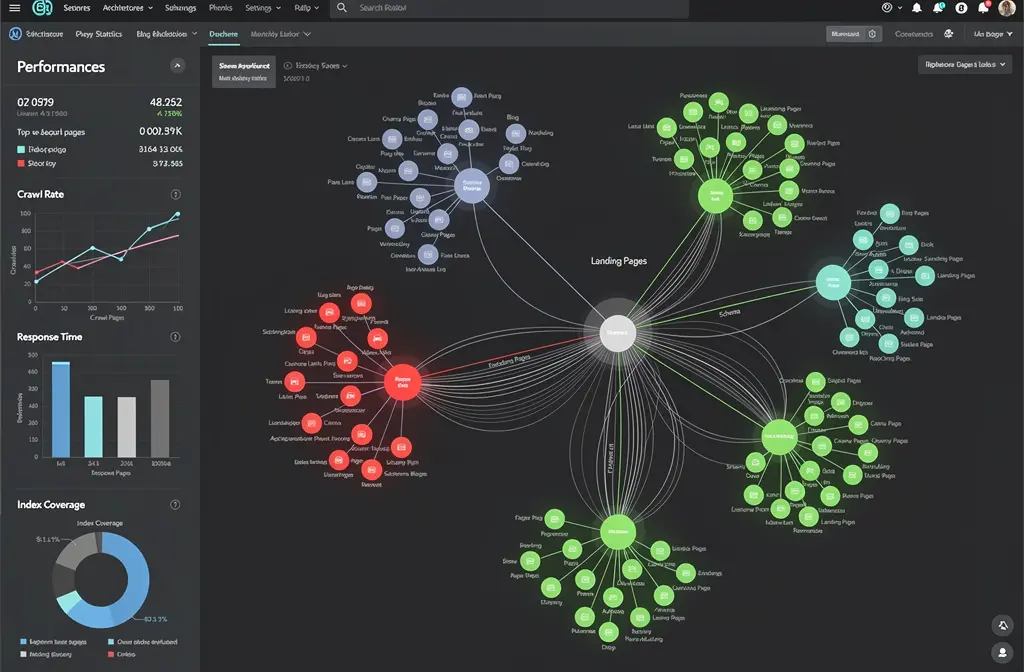
Unlike once-a-year reviews, technical SEO automation employs continuous monitoring around the clock. AI-driven systems automatically identify broken links, orphaned pages, duplicate metadata, missing alt text, crawl bottlenecks, and lengthy redirect chains—turning each issue into an actionable ticket complete with step-by-step guidance and projected impact.
Through advanced AI log-file parsing, you gain visibility into what Google’s bots are truly crawling. This reveals wasted crawl budget, misleading soft 404s, redirect loops, and suspicious bot behavior. On large e-commerce sites, faceted navigation is a common source of wasted crawling, and Google documents how to keep filter URLs under control.
Predictive Core Web Vitals Optimization
A modern AI SEO audit leverages predictive modeling to preemptively evaluate Core Web Vitals before updating your code. Instead of relying on guesswork, AI forecasts the impact of adjustments like image compression, script deferral, and resource preloading—ultimately preventing costly reversals that can harm search performance.
- Image optimization simulation: The model evaluates multiple compression levels against visual quality thresholds and predicts LCP improvements before assets are deployed.
- JavaScript bundle analysis: It identifies render-blocking scripts and estimates the LCP and INP gains that result from bundling, deferring, or inlining resources.
- Resource prioritization: AI recommends optimal preloading, preconnecting, or lazy-loading strategies based on usage data, delivering maximum performance gains with minimal effort.
- Interaction readiness prediction: Simulations anticipate how proposed changes influence INP, ensuring that your pages remain responsive even under heavy user demand.
Moving pages from “Poor” to “Good” improves user experience, but Google notes that good Core Web Vitals alone do not guarantee higher rankings.
Backlink Analysis and Toxic Link Identification
The quality of your backlinks influences domain authority and ranking potential. AI examines millions of links, differentiating authoritative endorsements from risky ones that could attract Google penalties. Machine-learning models highlight low-quality referring domains, over-optimized anchors, and abrupt increases in spammy links—transforming chaotic data into a structured, actionable guide for optimization.
Using toxicity scoring, the system advises which links to disavow first. A thousand harmless low-authority links pose less risk than one truly toxic backlink. AI prioritizes each link by its potential to harm, helping you direct cleanup efforts where they provide the strongest protection.
| Link Quality Indicator | AI Assessment | Recommended Action |
| Relevant domain, natural anchor text | High authority signal | Monitor and strengthen relationship |
| Unrelated domain, exact-match anchor | Moderate toxicity risk | Contact webmaster for anchor diversification |
| Private blog network, keyword-stuffed anchor | High penalty risk | Disavow immediately |
| Sudden spike, low-quality domains | Negative SEO attack signal | Disavow batch; monitor for future spikes |
Keep in mind that Google says it can usually assess which links to trust on its own, so most sites never need the disavow tool. Reserve it for cases where many spammy or artificial links have caused, or are likely to cause, a manual action.
Topic authority wins rankings. When Google recognizes that your website offers thorough, multi-faceted exploration of a specific topic, it rewards your entire domain for related search queries. AI-driven topic cluster automation builds this authority systematically, defining pillar pages, generating satellite content, and guiding internal linking—all without requiring manual architecture design.
Topic clusters for generative engine optimization success
Topic clusters fundamentally change how search engines and AI systems perceive your expertise. Rather than publishing isolated articles, you build a network: one central pillar guide covers the broad topic, while interlinked satellite pages explore specific subtopics in more detail. This interconnected approach mirrors how Google’s generative engine interprets authority, favoring websites that provide deep, cohesive coverage over scattered standalone posts.
Building pillar-satellite content architectures with AI
The creation of topic clusters begins when AI identifies your pillar theme. For example, if you enter a broad topic like “sustainable fashion,” the engine scans the web, groups related keywords semantically, analyzes competitors’ coverage, and organizes opportunities into logical content clusters. This data-backed strategy ensures your cluster captures every high-value search intent within your niche.
- Semantic keyword clustering: AI categorizes thousands of keywords into 20–30 semantic groups, each representing a distinct subtopic deserving of its own satellite page.
- Visual cluster mapping: Automatically generated diagrams display relationships between pillars and satellites, recommended internal linking paths, and opportunities to fill content gaps.
- Content brief generation: AI simultaneously creates detailed outlines for pillar and satellite pages, guaranteeing consistent depth and alignment with optimization goals.
A sustainable fashion retailer used AI to develop topic clusters around three pillars: “eco-friendly materials,” “ethical manufacturing,” and “circular economy.” This complete topical coverage speeds up rankings faster than optimizing individual pages ever could.
Automated internal linking to boost topical authority
Strategic internal linking improves how link equity flows through your site and helps crawlers navigate your architecture. Generative engine optimization depends heavily on topical relevance, so AI places thoughtfully contextual anchor text that strengthens the semantic connection between pillar and satellite pages. Automated linking also prevents orphaned content and makes sure every article contributes to your site’s overall authority.
- Contextual link insertion: AI identifies natural opportunities for anchor text, inserting meaningful semantic links that enhance—not disrupt—the reader experience.
- Crawl efficiency optimization: Intelligent internal linking shortens click depth, helping Google find and index even your deepest satellite content faster than your competitors.
- Link equity distribution: AI optimizes authority flow from high-performing pillars to newer satellite pages, speeding up how quickly they rank.
Performance dashboards show how stronger internal linking lifts topical authority metrics.
Identifying competitor gaps for strategic content planning
Your competitors’ topic coverage reveals key market opportunities. AI analyzes the topics they address, identifies neglected subtopics, and highlights search volume where quality answers are still missing.
Simply upload rival domain URLs, and the system extracts their entire topic cluster structure, identifies the keywords they rank for, and surfaces related queries they’ve overlooked. By aligning your content strategy around these gaps, you can capture untapped search intent before your competitors even notice.