Does your content often disappear in the digital void? This topic cluster strategy guide revolutionizes your SEO approach by organizing articles into interconnected groups centered around a pillar page. You'll learn to craft semantic structures that search engines reward, helping your site dominate competitive keywords while establishing genuine expertise.
We'll demonstrate how to identify core topics, create seamlessly linked content, and leverage AI tools to streamline the process. Say goodbye to endless spreadsheets and hello to more time growing your business.
Why topic clusters transform your SEO performance
Let's face it - random blog posts rarely make an impact. A topic cluster strategy organizes your content into a logical system that search engines recognize as authoritative. When Google finds a pillar page surrounded by tightly interlinked content covering specific subtopics, it identifies you as a true subject matter expert.
Properly built clusters help search engines understand how your pages relate to one another, which supports rankings across a broader set of related queries.
How topic clusters boost rankings and traffic
Topic clusters work by channeling link authority through internal links back to your main pillar page. This enhances its ranking potential for competitive keywords because search engines favor well-structured content that mirrors human thought processes. Instead of seeing disconnected articles, Google identifies a comprehensive knowledge base with clear topic cluster SEO advantages.
These benefits compound over time, leading to faster indexing and stronger keyword rankings. The strategy establishes clear topical relationships that showcase your site's expertise.
- Focused link power: Internal linking from supporting pages concentrates authority on your pillar page, amplifying its ranking potential for primary keywords.
- Meaningful connections: Search engines recognize related concepts across your cluster, demonstrating your mastery of semantic SEO.
- Smarter navigation: Clusters keep visitors engaged longer by providing clear pathways from broad topics to specific answers that match user intent.
- Quicker discovery: Crawlers easily comprehend your site's structure when content follows this logical system, helping you build topical authority more efficiently.
You gain a real competitive advantage when you address more topics and user needs than competitors. While others publish isolated guides, you create an interconnected content network that captures traffic across entire subject areas.
Topic cluster advantages over traditional content
Conventional content strategies treat each post independently - you publish, optimize, and hope for the best. Topic clusters revolutionize this approach by organizing everything around topical authority. Instead of competing content, you assign each piece a specific keyword and purpose to avoid conflicts.
The difference is structural. One well-developed topic cluster can rank for numerous related keywords, while isolated articles typically rank for just one or two. You're building a powerful system that grows stronger with each new addition.
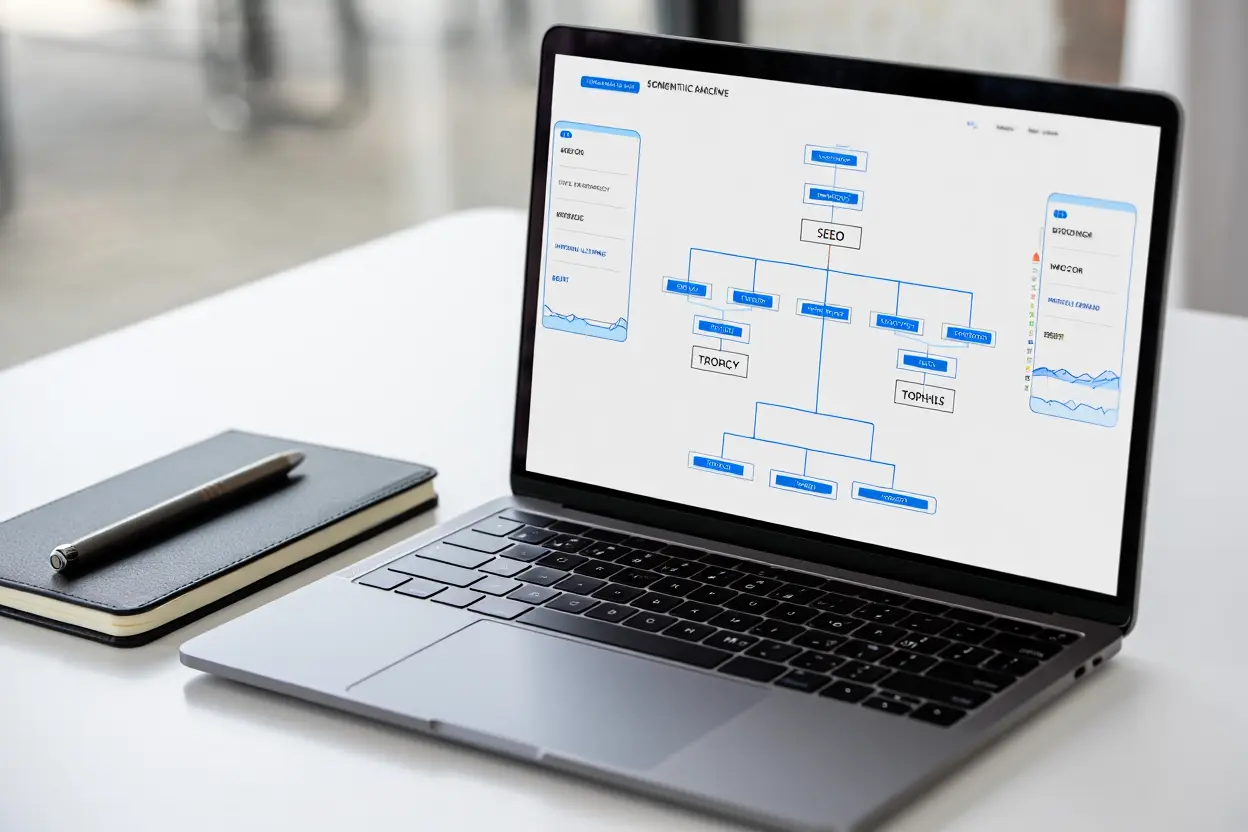
Understanding topic cluster architecture and components
To build an effective content cluster, you first need to grasp its fundamental structure. A topic cluster isn't simply a random assortment of pages - it's a carefully designed hierarchy where each component serves a distinct purpose. At its core lies the pillar page, acting as your comprehensive hub, while supporting pages explore subtopics in greater detail. Strategic internal linking weaves everything together, creating what SEO professionals refer to as a "semantic web" that search engines recognize as authoritative and well-organized.
What makes a strong pillar page foundation
The pillar page stands as the backbone of your entire cluster strategy. Aim for 1,500 to 3,000 words of thorough coverage that addresses the central topic from multiple perspectives, answering key questions and satisfying various user intents. Consider this page your go-to resource - the perfect starting point for anyone seeking foundational knowledge. Following a well-designed topic cluster template helps maintain consistency, so be sure to include:
- Comprehensive overview: Address the main topic holistically, anticipating exactly what your audience needs before they explore specific subtopics.
- Clear navigation: Include a clickable table of contents to help visitors and search engines quickly identify all covered sections.
- Strategic linking: Use descriptive, keyword-rich anchor text when connecting to satellite pages to provide clear context.
- Thorough optimization: Pay special attention to title tags, meta descriptions, and structured data for your primary keyword.
Remember, your pillar page should educate rather than sell. Readers should finish feeling informed about the broader topic and naturally inclined to explore your more specialized content. The design doesn't need to be complex - just ensure logical flow and genuine value. For practical implementation tips, explore our complete guide to topic cluster strategies that demonstrate how automation can streamline pillar page creation without compromising quality.
How cluster pages support the pillar
Satellite pages function as specialized supports for your pillar content. Each one focuses intensively on a single long-tail keyword or specific user intent, typically ranging from 1,500 to 2,500 words. While your pillar might broadly cover "content marketing," cluster pages would tackle precise angles like "measuring ROI for B2B content marketing." This intentional cluster structure prevents keyword overlap while thoroughly covering your topic.
Every satellite page should link back to the pillar using anchor text that reinforces your main keyword. These bidirectional connections create a semantic network that signals relevance to search engines while guiding users through your content. Links between related satellites further strengthen this web of relationships, establishing your authority across all aspects of the topic.
This sophisticated internal linking approach helps distribute authority evenly throughout your cluster. Modern tools can automate much of this process - discover how AI can automate your topic cluster strategy by identifying relevant keywords and publishing interconnected content that consistently builds your site's topical authority.
Topic clusters versus content clusters explained
Here's a crucial distinction: while similar, content clusters and topic clusters aren't identical. Content clusters often group pages by broad categories without necessarily developing deep coverage. True topic clusters, however, ensure exhaustive treatment of a subject and its related subtopics, organized by semantic relationships - the approach that consistently delivers superior SEO results.
Building your topic cluster strategy step by step
Ready to put your plans into action? This guide walks you through implementing an effective topic cluster strategy - from initial concept to published content. You'll learn how to identify your core pillar topic, conduct strategic keyword research, organize relevant subtopics, and create an interconnected structure that search engines will recognize as authoritative.
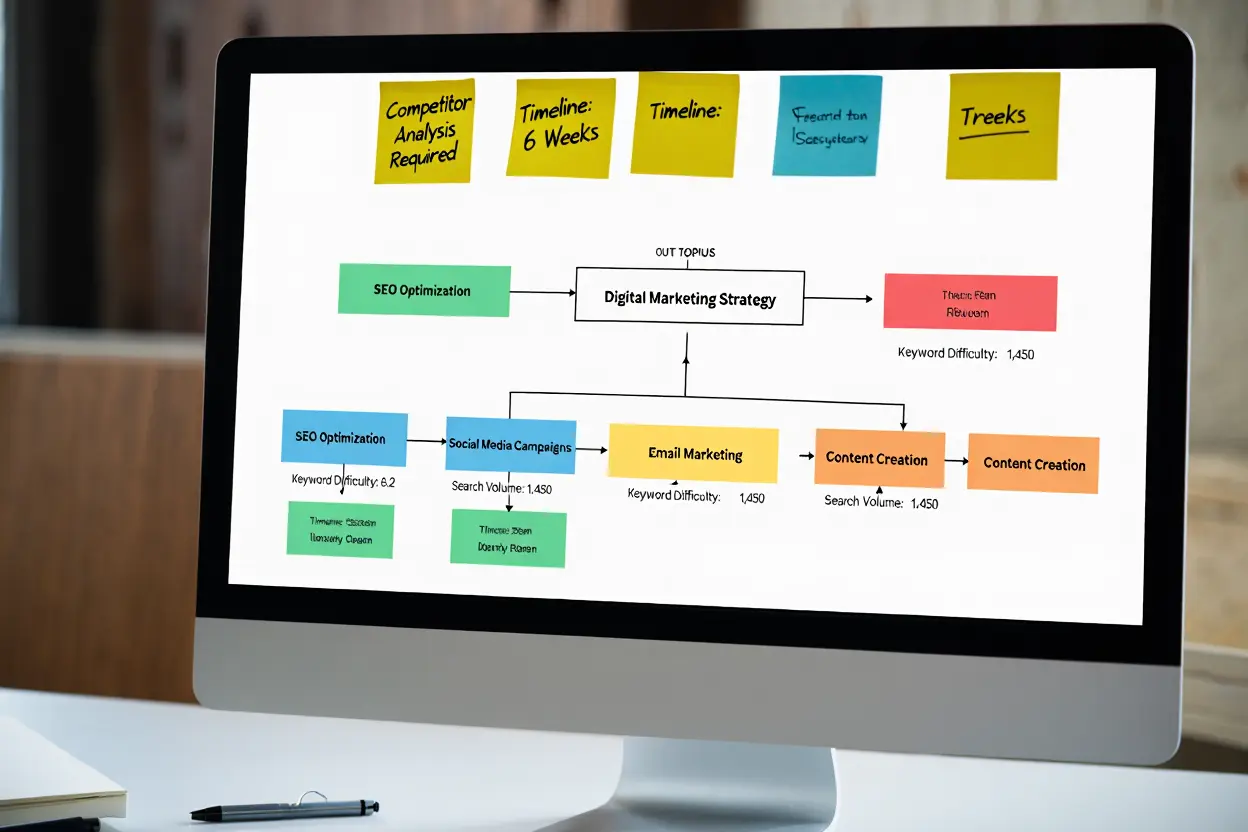
Selecting your core pillar topic with keyword data
Start with comprehensive keyword research to identify your pillar topic. Your ideal central topic should have:
- Substantial search volume (1,000+ monthly searches)
- Moderate competition
- Clear commercial intent (for e-commerce sites)
- Strong alignment with your business offerings
Focus on broad questions your audience is actively searching for. For example, "Winter coat buying guide" works better than "outerwear materials" because it directly matches user intent rather than being too technical.
Mapping sub-topics and identifying content gaps
Once you've chosen your pillar topic:
- Conduct a content audit of existing relevant pages
- Use keyword tools to find 10-15 supporting long-tail queries
- Group related keywords into natural subtopics
- Align each with specific buyer journey stages (informational, commercial, transactional)
Pro tip: Check competitive rankings - if top results are weak, that's a prime opportunity for your content to rank.
To find overlooked opportunities, research questions on forums like Reddit. Grouping those questions by theme, by hand or with an LLM, can reveal valuable new angles for content creation.
Prioritizing clusters by business value and demand
Not all topics deserve equal attention. Evaluate each potential cluster on three factors:
- Business value (How important is it to your goals?)
- Search demand (How many people are looking for it?)
- Competition level (How hard will it be to rank?)
Rate each factor 1-5 to identify the best opportunities. For example, a jacket retailer would prioritize "winter coat buying guide" (5/5/4) over niche technical topics with little customer interest.
Finally, create a content map showing all satellite pages with at least two internal links each. This ensures you build a well-connected network while avoiding content that competes with itself for rankings.
Creating and interlinking your topic cluster content
Strategy gets you started, but execution builds lasting results. Here's your practical guide to crafting pillar and cluster pages that work in harmony. You'll discover how to optimize internal linking to boost authority signals while creating a smooth journey for visitors.

Writing pillar pages that anchor your cluster
Your pillar page should be the definitive guide to a broad topic - imagine teaching the subject to someone intelligent but unfamiliar with it. Use plain language, practical examples, and substantial depth to maintain engagement. Analyzing successful topic cluster examples reveals common traits like intuitive navigation structures.
High-performing pillars typically combine text with multimedia elements and strategic internal linking. The AI semantic SEO tool scans top-ranking pages for your search term, identifies gaps, and offers live recommendations to supercharge your content using AI-driven topic clustering.
- Structured with purpose: Begin with a detailed, clickable table of contents that lets visitors jump directly to relevant subtopics.
- Visual storytelling: Incorporate videos, charts, or infographics to explain complex ideas and improve engagement metrics.
- Organic linking: Blend internal links naturally into your writing instead of clustering them awkwardly at the end.
- Technical signals: Implement schema markup like Article to help search engines understand your page structure for better SERP presentation.
For example, a comprehensive "content marketing strategy" pillar might cover research, creation, distribution, and analysis - each section linking to specialized satellite pages that explore those aspects further.
Crafting cluster articles with clear focus
Cluster content thrives on specialization. Each satellite should concentrate on a single keyword and address one specific user intent. Resist the urge to cover multiple aspects - that's the pillar page's job. A piece about "SEO content writing best practices" would focus exclusively on writing techniques, not keyword research or link building.
This narrow focus prevents overlap while clearly defining each page's unique value. Use semantic analysis to identify related terms (like including "lead scoring" in a "marketing automation" post) without awkward repetition. Including these contextual terms helps build topical authority naturally.
Every satellite piece must link back to its pillar using anchor text that reinforces the main topic. This internal linking strategy shows search engines exactly how these content pieces connect, strengthening your pillar and cluster structure.
Internal linking best practices for clusters
Most websites implement internal linking poorly or inconsistently. Effective linking requires strategy, not randomness. You need bidirectional connections between hubs and satellites, plus logical links between related cluster posts to create a web of relevance.
- Hub to satellites: The pillar should link to all its satellites, ideally within context or via a clear navigation element.
- Satellites to hub: Each supporting article should link back using the pillar's primary keyword as anchor text.
- Satellite connections: Link related cluster pieces to each other when they naturally complement one another.
- Natural density: Maintain about 3-5 well-placed internal links per 1,000 words - enough to guide without distracting.
Remember: links should always help readers first. If a connection feels forced or breaks the reading flow, remove it. Your content strategy succeeds when every element serves user needs while subtly reinforcing your SEO goals.
Monitoring and Optimizing Your Topic Cluster Over Time
Your content journey doesn't end at publication - that's when the real work begins. To achieve true SEO success, you'll need to regularly monitor performance, test strategies, and refine your approach based on data-driven insights. The key is identifying what's working well, recognizing underperforming elements, and making smart adjustments to your topic cluster strategy.
Tracking Performance Metrics for Clusters
Keep a pulse on how both your main pillar page and satellite content are performing by tracking crucial metrics like organic traffic, keyword rankings, and user engagement. Semantic SEO analysis is particularly valuable here - it shows how effectively your content aligns with search intent, which directly impacts rankings and user satisfaction.
- Keyword rankings: Track positions for both your primary pillar keyword and all supporting terms. A drop in rankings often serves as an early warning for potential traffic declines.
- Organic traffic: Analyze traffic patterns across your entire cluster while identifying which specific pages drive the most value.
- Engagement metrics: Metrics like time-on-page and scroll depth indicate content quality, while high bounce rates may signal content-search intent mismatches.
Automate your performance monitoring with built-in reporting features from SEO platforms. These typically offer convenient weekly or monthly dashboards. Remember - while single data points are informative, the most valuable insights come from observing long-term trends.
Using Semantic SEO Tools to Refine Content
Leverage semantic analysis tools to evaluate each page's effectiveness. These tools generate scores based on how comprehensively you cover related concepts, synonyms, and entities compared to ranking competitors. They'll specifically highlight any missing elements your content needs for improvement.
Semantic SEO tools simplify performance monitoring by automatically identifying underperforming satellite content. Conduct regular competitive analyses - if top-ranking pages include concepts like "user-generated content" that your content lacks, find natural ways to build these elements into your text.
Updating Clusters to Maintain Rankings
Stay ahead by refreshing your topic cluster quarterly - update statistics, refresh examples, and address any shifts in search intent. When new subtopic opportunities emerge, create targeted content and integrate it into your existing structure.
Backlinks represent another critical opportunity. Every link to any satellite page strengthens your pillar content through link equity. Creating authoritative content that earns backlinks creates a virtuous cycle where every piece reinforces the others, boosting your entire cluster's performance.