Your customers have started asking ChatGPT and Gemini the questions they used to type into Google. "Which brand should I buy from?" "Is this shop reliable?" The assistant names two or three brands and the conversation moves on. If yours isn't one of them, you never even knew the question was asked. No impression, no click, no trace in Google Search Console.
This guide shows how AI Visibility in Sedestral fixes that blind spot: which prompts get tracked, how Marc queries ChatGPT, Gemini, Perplexity, Google AI Overviews and Google AI Mode every week, how to read mentions, sentiment and the competitors cited in your place, and what the other agents do to make your site show up more often.
What Is an AI SEO Agent?
An AI SEO agent is an autonomous software module that executes a specific SEO task, such as writing content, auditing pages or tracking rankings, independently, without requiring manual input for each action.
Why being cited by ChatGPT and Gemini matters
Let's be honest about the shift. A growing share of product research now happens inside an AI assistant, and the answer is a shortlist, not ten blue links. There's no page two. Either the model mentions you, or it recommends someone else, often with a link to a source page that isn't yours.
The good news: these assistants don't invent their answers. ChatGPT with web search and Gemini both run searches behind the scenes, read a handful of pages, and write from what they found. So the game has rules, even if nobody publishes them: rank on the queries the models run, be present on the pages they cite, answer the questions your customers actually ask. That's what generative engine optimization (GEO) is about, and why Sedestral treats it as an extension of your SEO rather than a separate discipline.
The first problem is measurement. Asking ChatGPT yourself now and then is neither neutral (your history colours the answers) nor repeatable. AI Visibility turns that guesswork into a weekly, comparable measurement.
How the tracking works
AI Visibility lives under "Results & insights" in the left menu, next to SEO Visibility, and is run by Marc, the analysis agent who also handles your competitors. The mechanism:
- You choose a list of prompts, the questions a customer might ask an AI assistant and where your brand should come up.
- Every week, Marc asks each prompt separately to ChatGPT (with web search enabled), Gemini, Perplexity, Google AI Overviews and Google AI Mode, in the language and from the country configured for your site, with no conversation history. That reflects what a new customer would see.
- Each answer is analysed: is your brand mentioned, with what sentiment (positive, mixed, negative), at what position, which sources were cited, which keywords the AI searched for. Competitors named in the answers are detected too.
Two tabs organise all of this: "Overview" for the aggregated picture, "My Prompts" for the questions and the raw AI answers.
Setup: brand context and suggested prompts
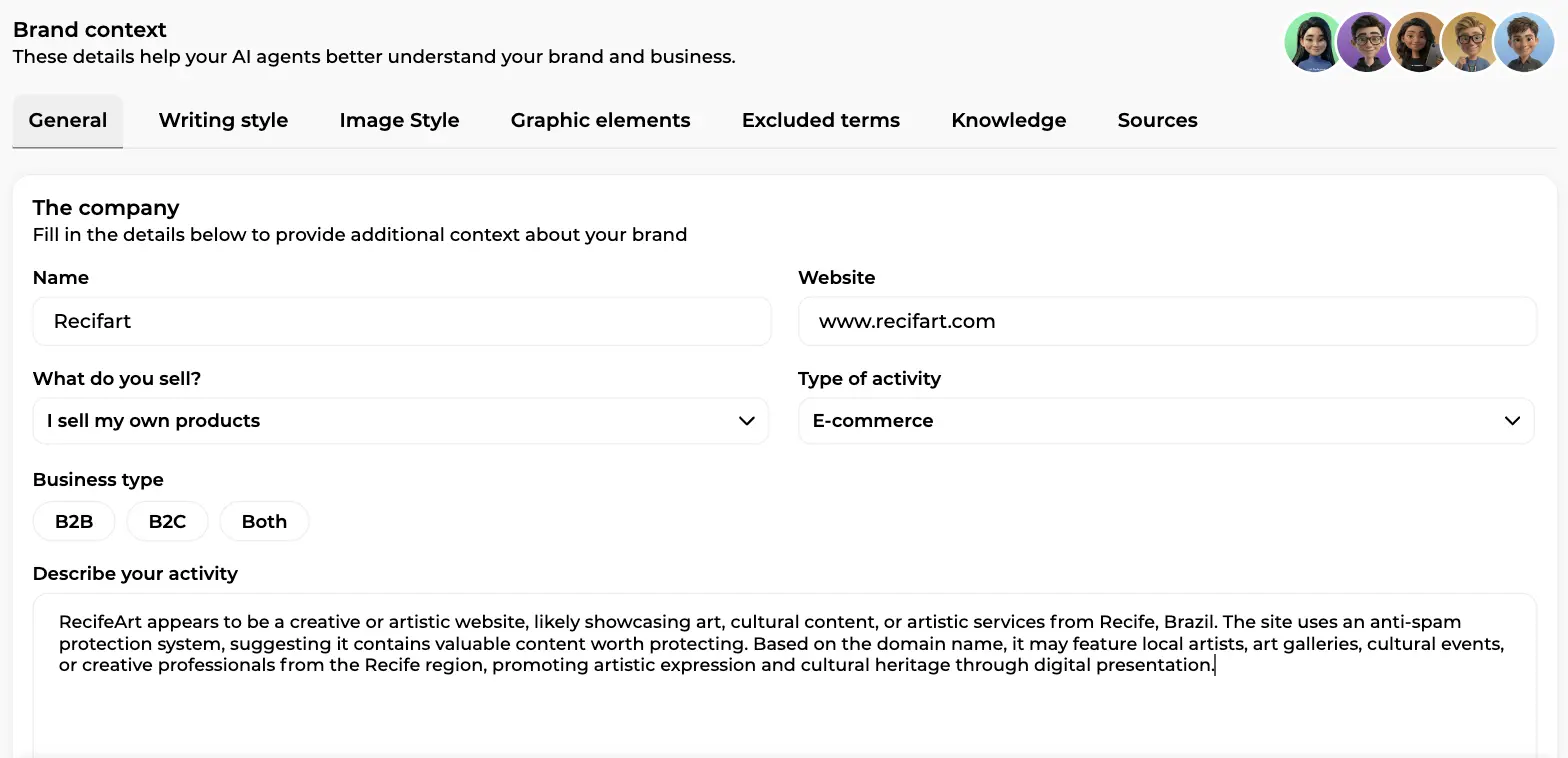
On your first visit, Marc walks you through two steps. Step one is the Brand Context: a brand name (the exact name to look for in the answers) and an activity description (what you sell, to whom, in which market). Both are pre-filled from the General tab of your brand context, shown below. Check them: the quality of everything that follows depends on this description, so if it's vague or off target, fix it before continuing.
Step two is the list of prompt suggestions. Marc reads your brand and proposes the questions your customers are likely to ask, grouped by category: brand questions ("Is [your brand] any good?"), product questions ("What is the best tool for..."), intent questions ("How to choose a..."), and guide questions ("How do I..."). Tick the ones to track, double-click any prompt to rewrite it, or ignore the suggestions and type your own. Then press "Start Tracking". The selected prompts are sent to the tracked AI assistants straight away, and the first answers usually land within the hour.
Tip: phrase prompts the way a customer talks, not the way an SEO writes. "What's the best skimmer for a small reef tank?" beats "protein skimmer best".
The "My Prompts" tab
Once tracking is on, this tab lists every active prompt by category, "submitted weekly to ChatGPT and Gemini" as the header says. The example below is Sedestral's own brand, tracked on our French-language site, which is why the prompts read in French while the interface stays in English. 20 prompts are active, spread over four categories: trust and support, advice and guides, features, comparison. Each category carries an average sentiment and a mentions total, and each prompt has its own Mentions count, a Sentiment face and a "See responses" link. The numbers tell a story in one glance: the trust prompt ("Is Sedestral reliable to manage my site's SEO on my own?") gets 24 mentions with a positive sentiment, the comparison category reaches 53, while two generic advice questions ("Which SEO tool for an SMB with no marketing team?") show a dash, meaning the assistants answered without naming us. Those dashes are the work to do.
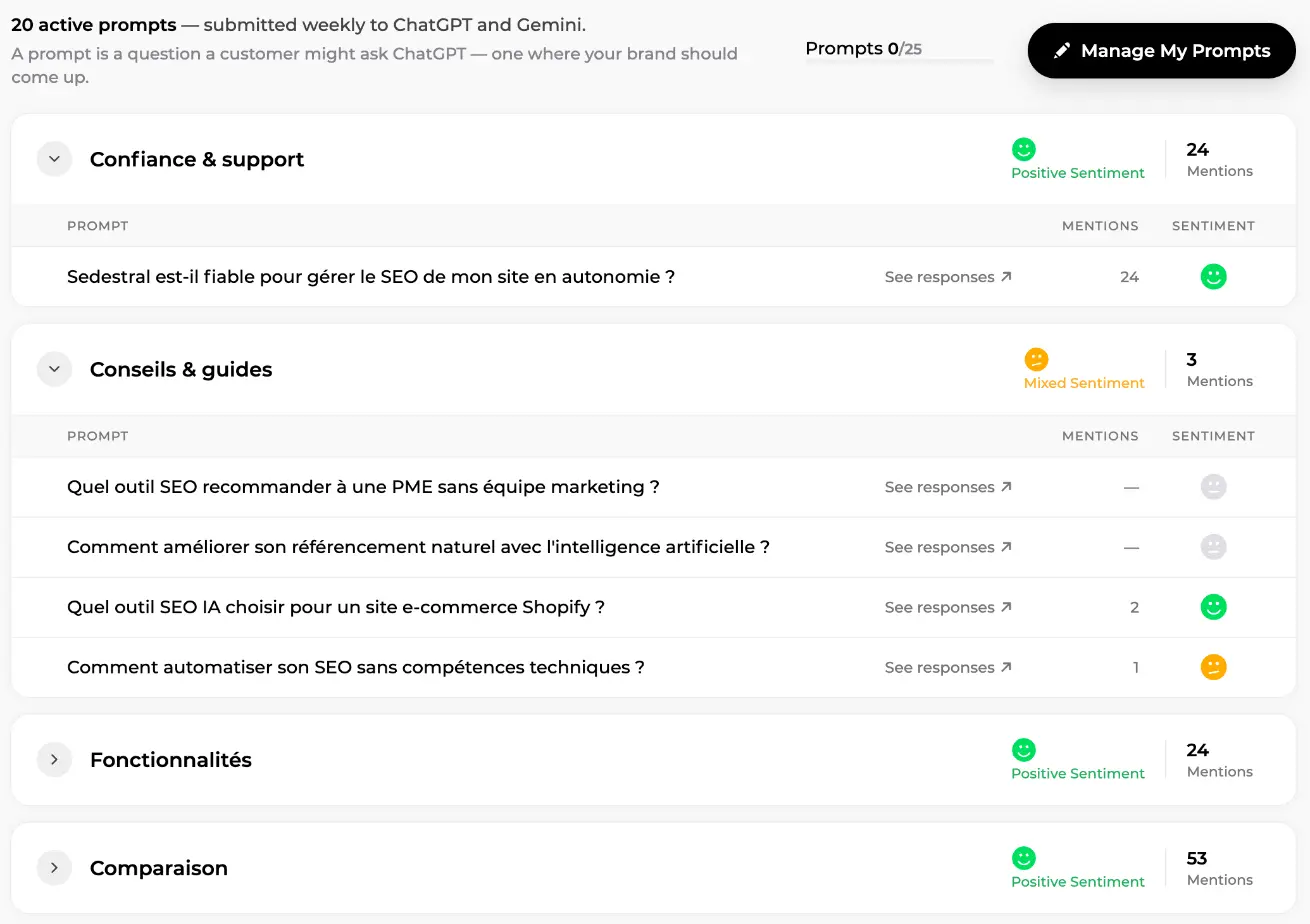
"See responses" is where it gets concrete. For a given prompt you read the full answer from each AI, flagged "Mentioned" or "Not mentioned", with the sentiment and the sources the model cited. That's the fastest way to see how an assistant describes you, which competitor it puts first, and which page it leaned on to say so.
"Manage My Prompts" switches to edit mode: add a prompt or a category, rename or delete, then "Finish" to save. New prompts join the next weekly round. Deleting a prompt drops its history, so to rephrase a question, edit it instead.
Reading the overview
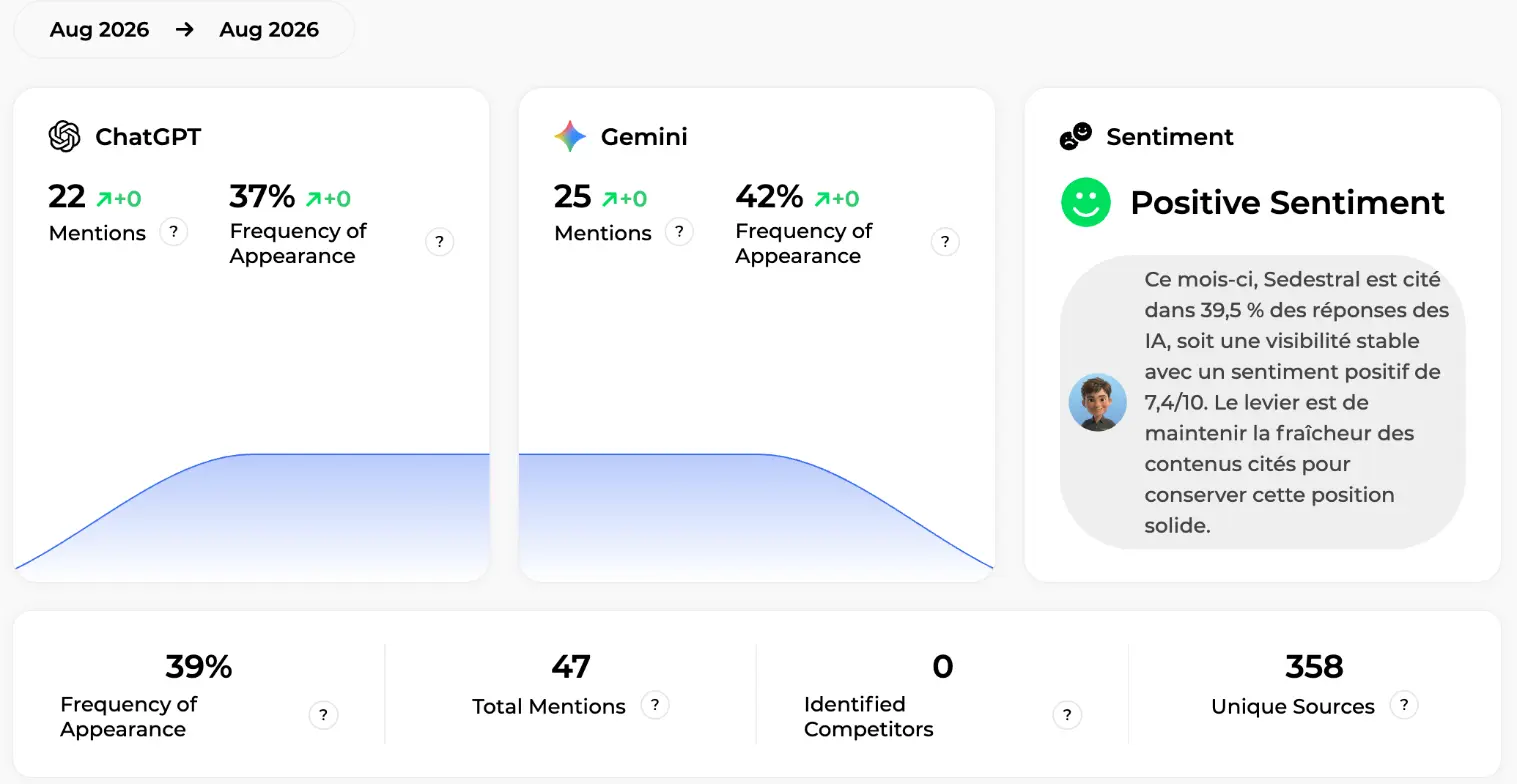
The "Overview" tab is the screen you'll open each week. Below, the same Sedestral tracking after a month of weekly rounds: ChatGPT cites the brand in 22 answers, a 37% frequency of appearance, Gemini in 25 answers, or 42%, and the Sentiment card reads "Positive Sentiment". Marc's note (in French here, as the site is French) sums it up: cited in 39.5% of AI answers, stable visibility, a positive sentiment of 7.4 out of 10, and one lever to keep that position, refreshing the content the AIs cite.
On this screen you can see:
- A period selector, last 28 days by default.
- One card per assistant, ChatGPT and Gemini, with Mentions, Frequency of Appearance (the share of that assistant's answers that mention you) and a weekly trend line. It's common to be cited by one and ignored by the other.
- The Sentiment card: positive, mixed or negative, with a short analysis from Marc explaining why.
- Four key indicators: Frequency of Appearance across all prompts (39% here), Total Mentions (47), Identified Competitors (the brands detected in the answers, including the ones cited instead of you; 0 on this period) and Unique Sources (358 distinct web pages cited).
- Keywords, the queries the AIs ran behind the scenes, with a "View Keywords" button for the full list, filterable by AI.
- Sources, the pages most frequently cited by the assistants, with a "See All" button.
How to read it in two minutes? Frequency of Appearance is your headline number: 39% means roughly two answers out of five. Identified Competitors tells you who wins the other three. Keywords tells you what to rank for, Sources tells you where to be present. Those two panels turn "the AI doesn't mention us" into a to-do list.
Don't draw conclusions from a single week. AI answers vary from one query to the next. Trends over four to eight weeks are what you act on.
How Sedestral improves your AI visibility
Measuring is half the job. The other half is already built into the agents that write and optimise your content. Four levers.
GEO optimizations in every article
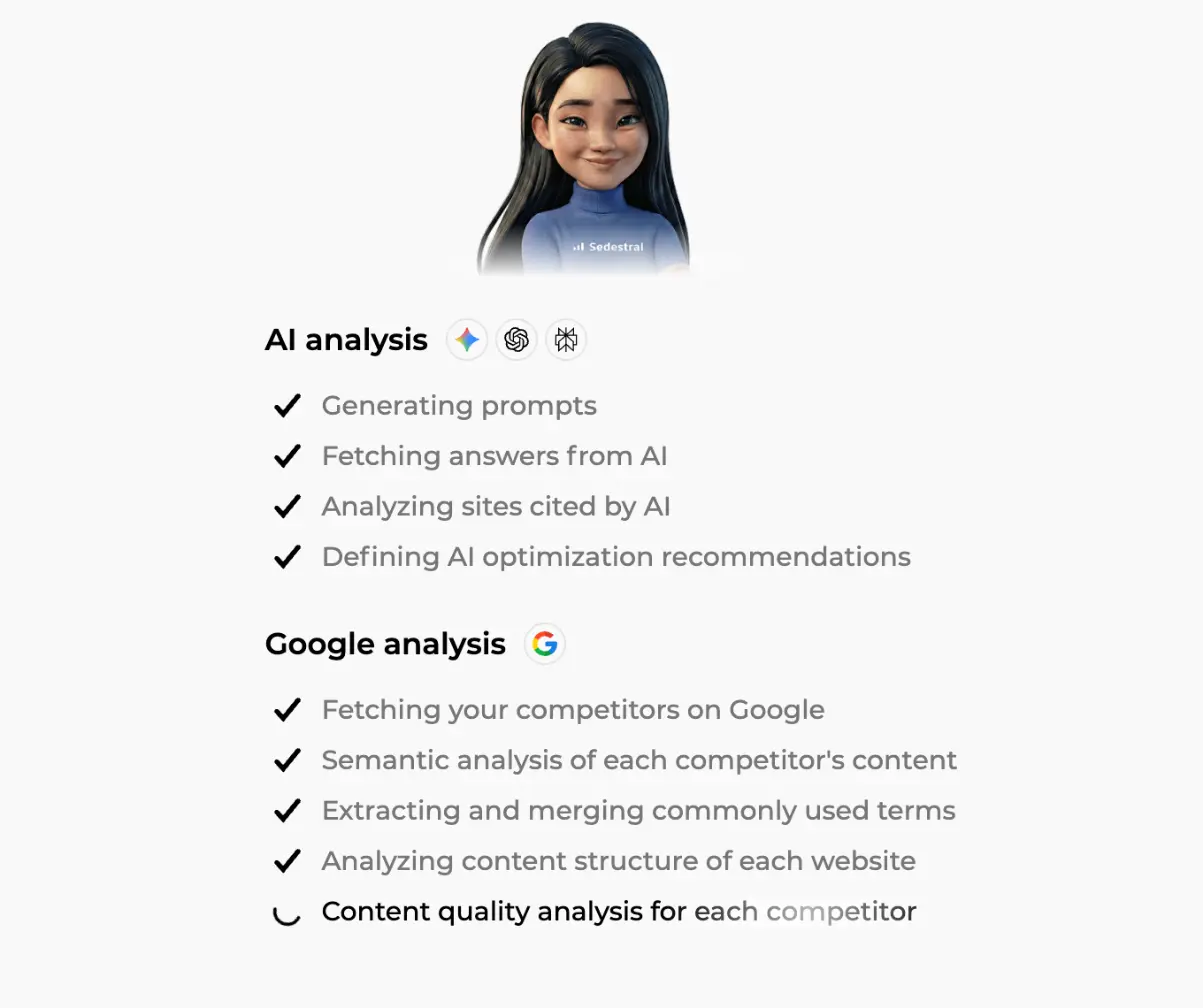
Since June 2026, every article Alya writes is analysed and optimised for AI search as well as for Google. Nobody knows exactly why an assistant picks the tenth result rather than the first, so Sedestral takes the problem in reverse: from the article's main keyword it generates dozens of questions, submits them to several AI models, identifies the sites and information that come up most often, and works those into the article. You see it happen during creation: the "AI analysis" block runs "Generating prompts", "Fetching answers from AI", "Analyzing sites cited by AI" and "Defining AI optimization recommendations", right before the classic Google analysis of your competitors.
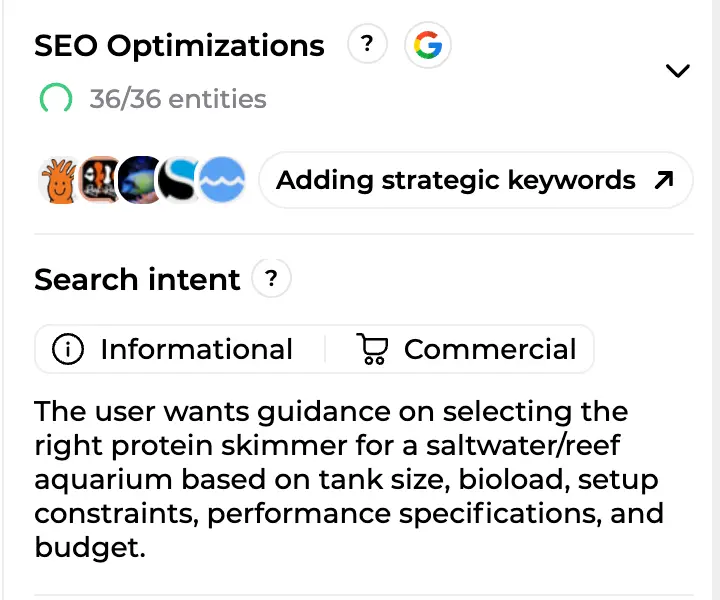
In the editor, the right-hand panels show the result next to the content score. The "SEO Optimizations" panel counts the entities covered (36 out of 36 here), lists the competitor sites the terms come from, and states the detected search intent, informational and commercial in this example. The AI search (GEO) recommendations sit alongside, so you see what's missing before publishing. The full flow is covered in the AI article writing guide.
AI search keywords in your topics
Your content strategy is built from topics, and since 2026 Alya no longer limits them to Google keywords. She generates natural questions, submits them to several AI models, collects the keywords those models search for and merges them into your clusters. On the topic map below, each cluster shows its keyword count and total volume, and the "Focus areas" column on the left groups the subtopics to cover. Add a cluster to Autopilot and the articles get scheduled without you.
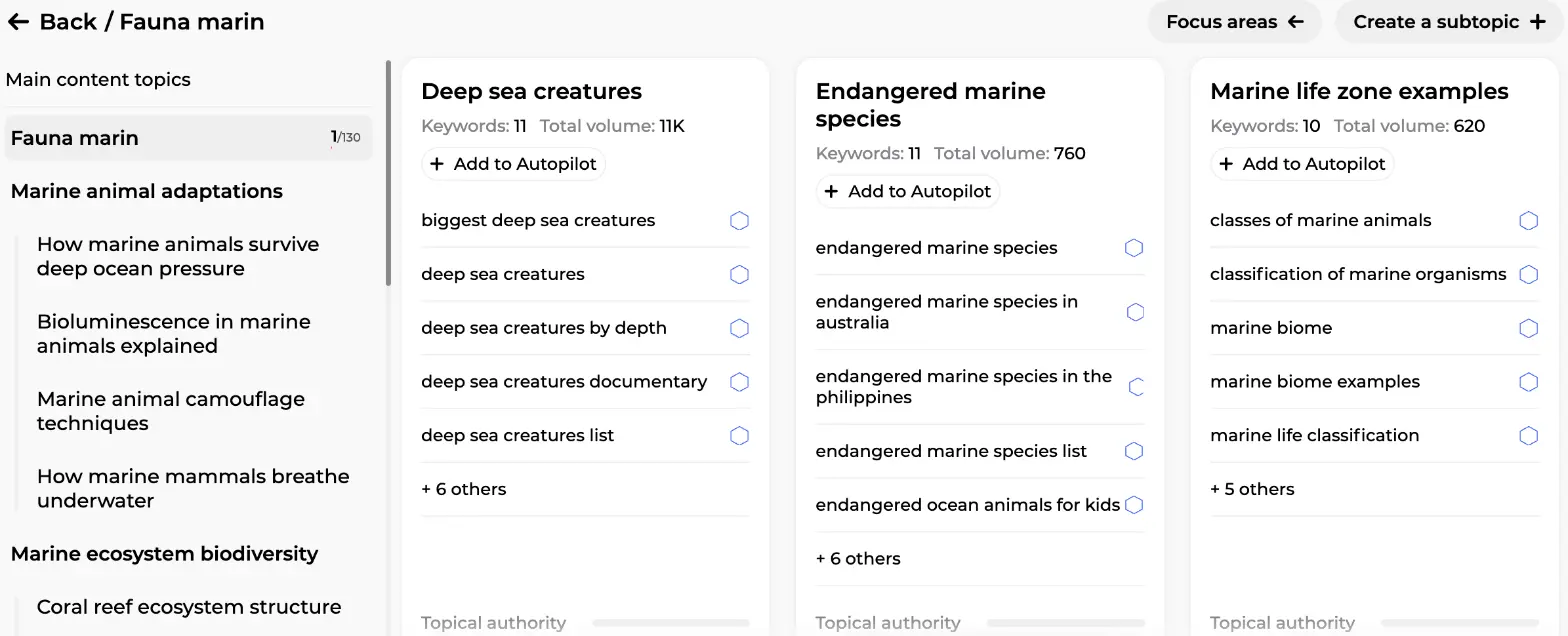
This is where the Keywords panel of the overview pays off: if the assistants keep searching a query you have no page for, create the topic.
Trusted sources and citations
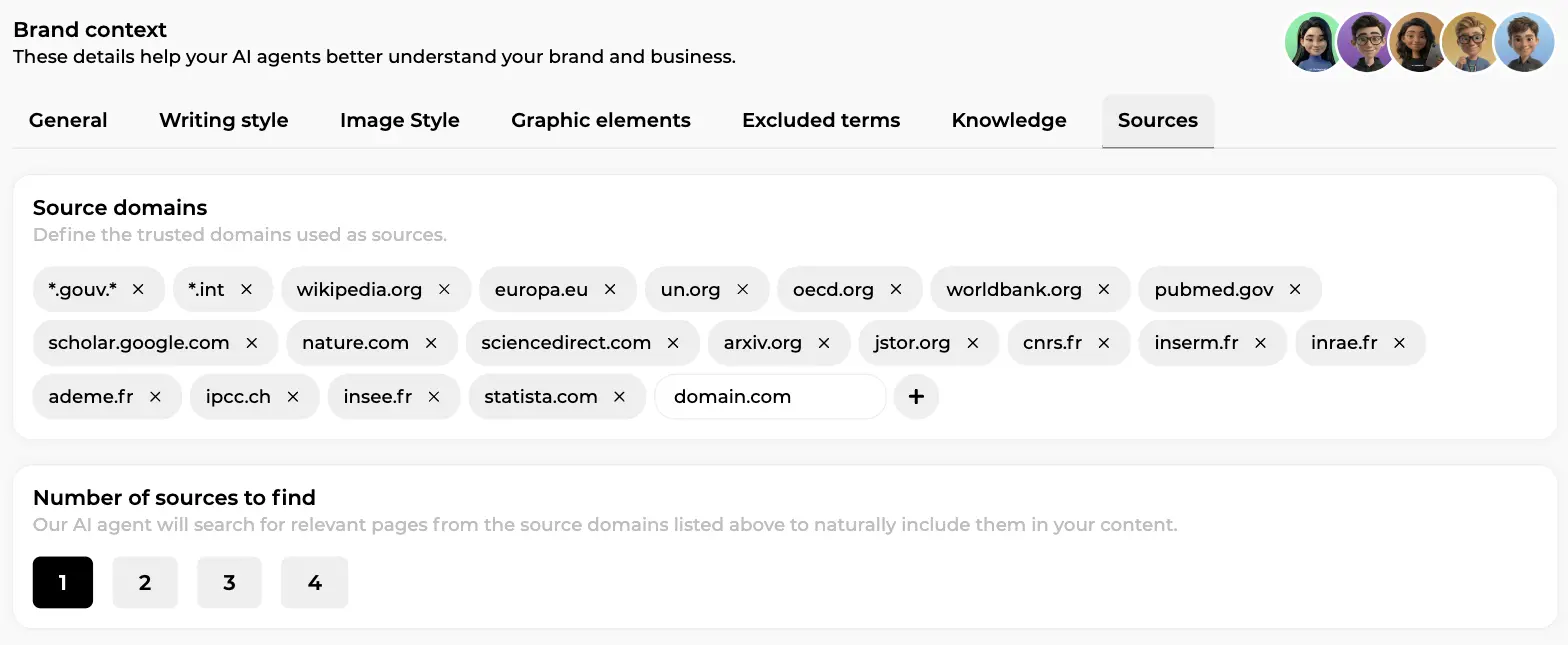
AI assistants trust pages that themselves cite credible sources. In Site configuration, the Sources tab of the brand context lets you list the domains the agents may cite (institutional sites, scientific publishers, statistics portals) and how many sources to find per article, from one to four, as on the screen below. Then use the Sources panel of the overview the other way round: the sites the AIs cite most in your market are the ones worth being mentioned on, through a guest article or a comparison, which is what Maya's backlink campaigns are for.
Google rankings still come first
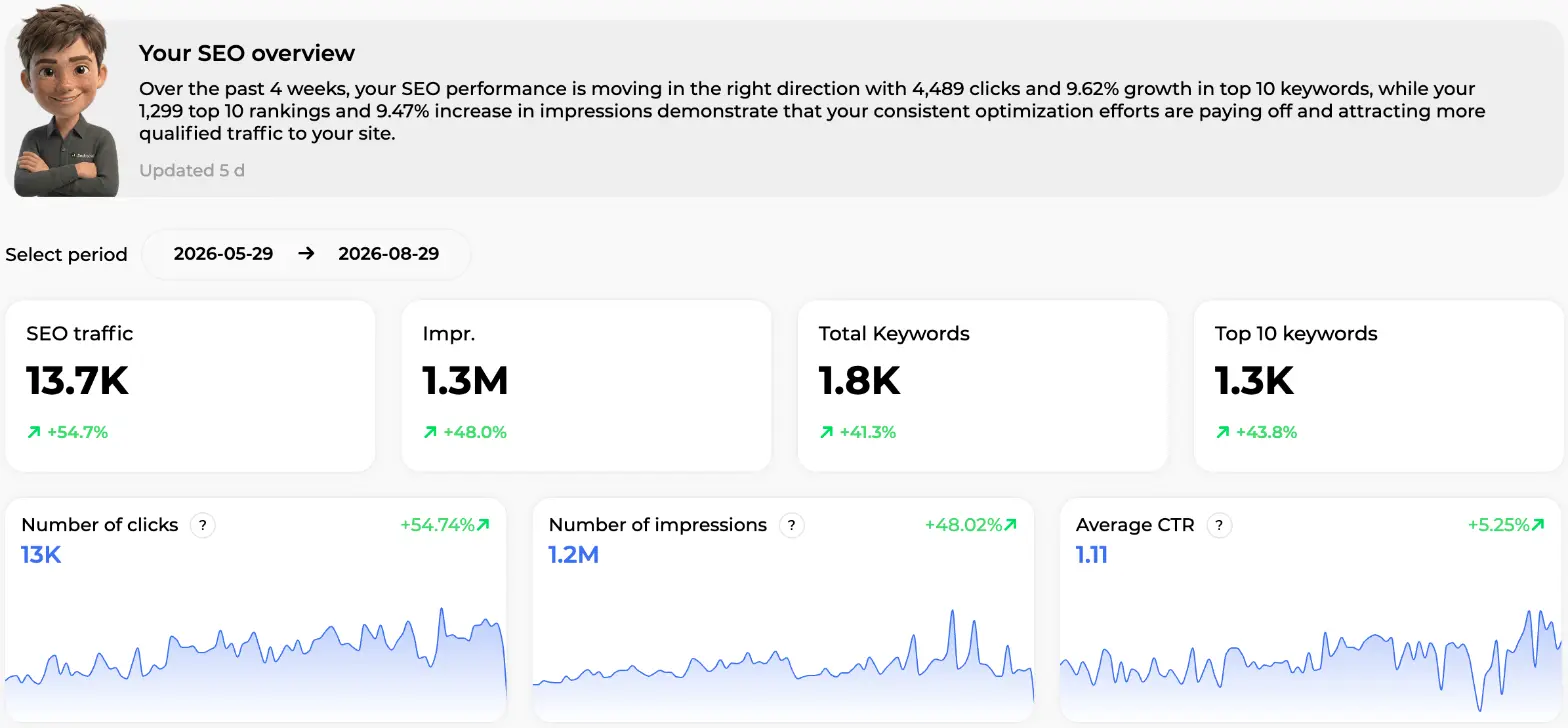
To be visible in AI, you first need to be visible on Google, because that's where the assistants look. Marc's SEO overview, below, gives clicks, impressions, total and top 10 keywords with their trend, plus a plain-English summary. Cross-check the two screens: a keyword the AIs search for where you sit on page one is a mention waiting to happen; the same keyword on page three explains a silence. Rémi's page optimisation is the shortest path between the two.
Still wondering whether AI-written content can rank at all? Yes: Google judges quality and usefulness, not the tool. Our guides on SEO for LLMs and Google AI Overviews go through the details.
Create your account and connect your site
Every action stays in your hands: prompts are yours to write, articles land in the editor for validation, nothing is published without your say-so.
In short
- AI Visibility tracks whether ChatGPT, Gemini, Perplexity, Google AI Overviews and Google AI Mode mention your brand, weekly, on prompts Marc suggests or you write yourself.
- Each answer is scored: mention, sentiment, position, sources cited, keywords searched, competitors named instead of you.
- The Overview gives frequency of appearance, total mentions, identified competitors and unique sources; "My Prompts" gives the raw answers.
- To improve: GEO optimizations in every article, AI search keywords in topics, trusted sources, and solid Google rankings, since the assistants search before they answer.
- Prompts, validation and publishing stay in your hands; the agents do the querying and the drafting.
Discover the full Sedestral SEO team

Automate Your SEO With AI Agents
Sedestral connects six AI agents to your website to handle content, audits, rankings, backlinks and images, without the manual grind.