Large language models (LLMs) like ChatGPT, Gemini, Perplexity and Claude are radically changing how people access information online. Unlike classic search engines, these AI tools deliver instant, synthesised answers without always sending anyone to an external site.
👉 So how do you get your site mentioned in those AI-generated answers?
This guide walks through the best approaches in SEO and in GEO (Generative Engine Optimization), a newer branch of SEO built specifically for generative AI.
What Is an AI SEO Agent?
An AI SEO agent is an autonomous software module that executes a specific SEO task, such as writing content, auditing pages or tracking rankings, independently, without requiring manual input for each action.
Why rank your site on ChatGPT and LLMs?
In 2026, despite the explosion of LLMs like ChatGPT (now well over 800 million weekly users), Google still dominates: its AI Overviews alone reached more than 2 billion monthly users in 2025, according to Alphabet.
Hugely popular as it is, ChatGPT still accounts for only a small slice of daily searches worldwide, a few percent at most.
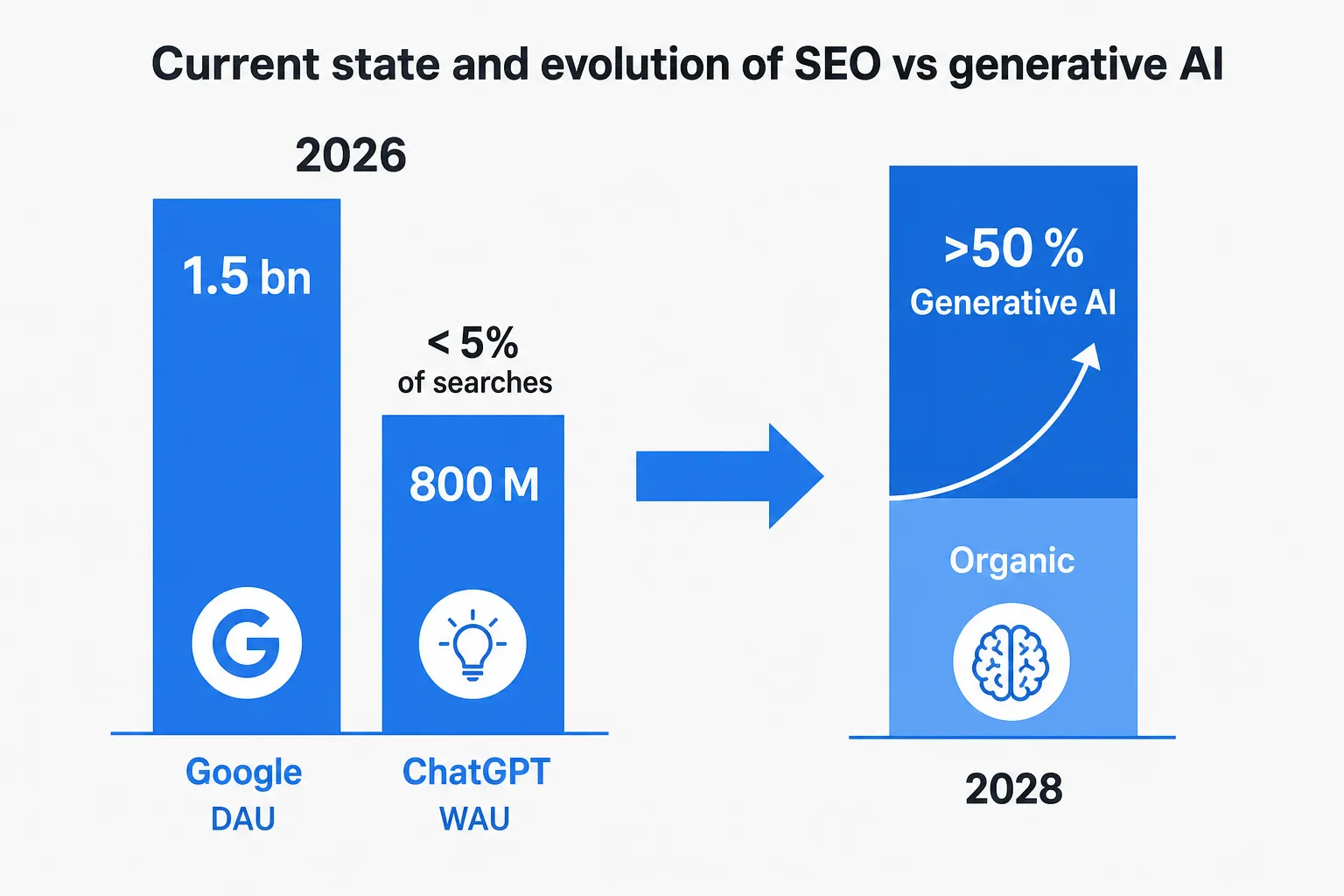
👉 Traditional SEO on Google and Bing is therefore still absolutely crucial today, and the effort you put into ranking is as essential as ever.
That said, things are moving fast:
- Adoption of generative AI like ChatGPT and Gemini keeps climbing month after month.
- Some projections suggest traffic from AI answers could overtake classic organic traffic as early as 2028.
Google isn't going anywhere. But it does underline how important it is to build an LLM-ready SEO strategy right now (GEO), alongside your traditional SEO.
Key takeaway: optimising for Google remains non-negotiable, but to stay competitive tomorrow you now need to adapt your content for AI too. Its influence will only grow. The earlier you get ahead of this shift in how ranking, engine optimisation and search work, the better placed you'll be.
Understanding how LLMs work versus Google
To optimise your SEO strategy for what's coming, you first need a clear picture of the differences between traditional search engines (like Google) and large language models (LLMs) such as ChatGPT. Here's how the two technologies actually work:
How do search engines like Google or Bing work?
Search engines like Google use automated bots (crawlers) to scan the web continuously. When someone runs a search, the system:
- Looks up its index of known web pages,
- Applies its ranking algorithms (based on relevance, content quality, backlinks and so on),
- Displays a list of results with links to the most relevant sites.
Here, the web page is the final destination: the user clicks through to reach the site in question.
Learn more about how Google works
How do LLMs like ChatGPT, Perplexity, Claude or Gemini really work?
Large language models (LLMs) rely on two main methods to answer questions:
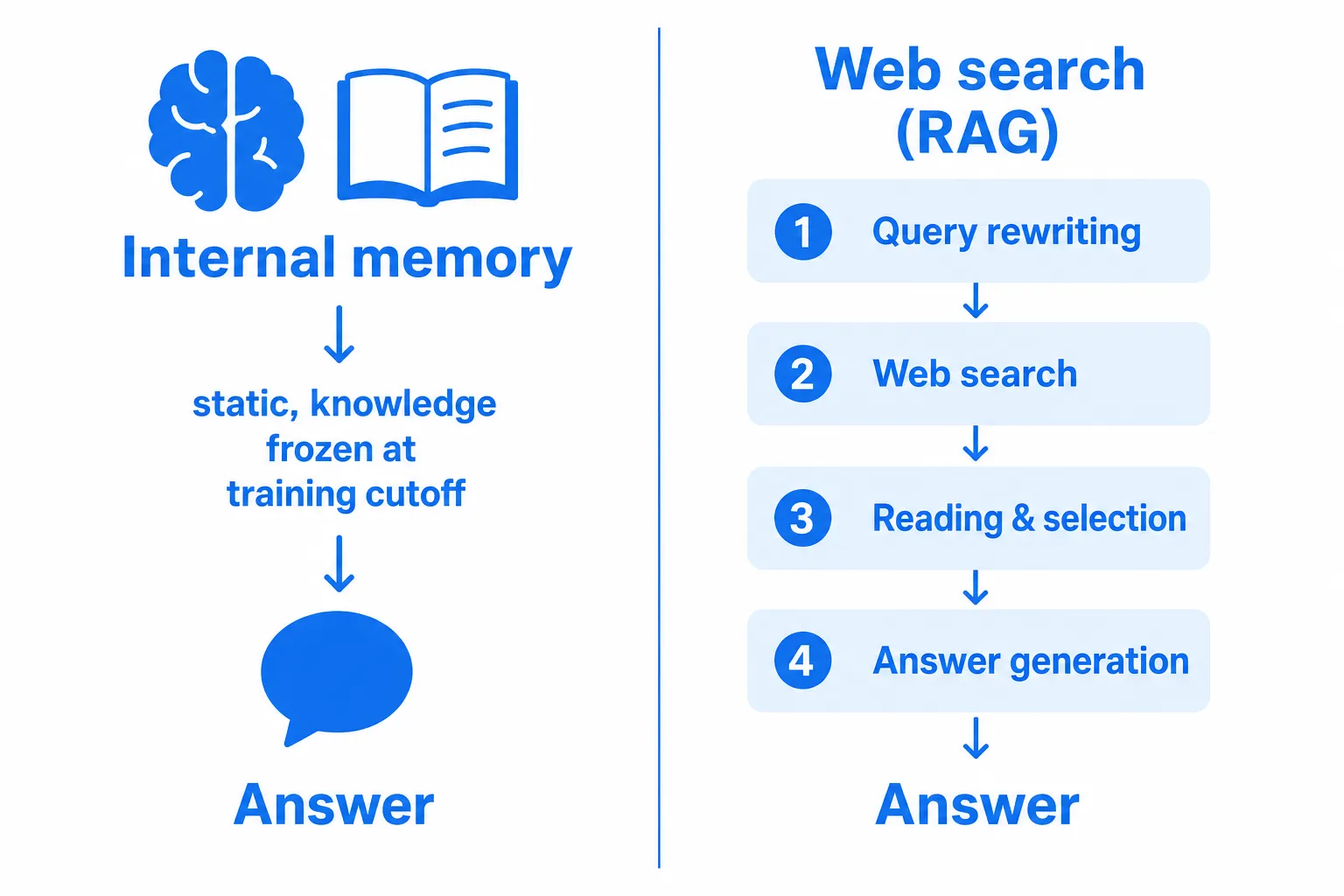
Their internal memory (pre-trained knowledge)
During training, LLMs ingest enormous volumes of public data:
Websites, encyclopedias, books, forums, specialist articles, source code and more.
That's how they pick up general knowledge, language skills and reasoning ability.
But this knowledge base is frozen: it doesn't update itself. Every model has a training cutoff date, often a year or more before you're actually using it. That limits its ability to handle recent or highly specialised information.
Direct web access through search engines
To work around those limits, some AI models like ChatGPT can query the web live through traditional search engines. That's the case for:
- ChatGPT (with search powered by Bing),
- Perplexity (which cross-references multiple sources),
- Gemini (built on Google's index),
- Copilot (connected to Bing).
These systems use a technique called RAG (Retrieval-Augmented Generation), which combines information retrieval with text generation. The process runs in four key steps:
- Query transformation: the AI turns the user's question into one or more web-optimised queries, which usually map very closely to real search intent.
- Querying the web: those queries are sent live to search engines like Google to retrieve the freshest information (news, websites, articles or already indexed data).
- Reading and selecting sources: the system analyses the top results (often the top 10 pages), checks their relevance, pulls out the key points and cross-checks them for reliability.
- Generating the answer: finally, the AI produces a clear, well-structured answer from the sources it identified (sometimes cited or referenced), aiming for accuracy, completeness and easy verification.
In short
| Information source | Content | Strengths | Limits |
| Internal memory (training) | Knowledge acquired while the language model was trained | Fast answers, very broad knowledge | No recent news or local data |
| Built-in web search | Results pulled from Bing, Google or other search engines | Recent, verifiable, precise information | Depends on indexing and on the quality of the pages found |
👉 The two approaches complement each other.
LLMs like ChatGPT start with their internal memory, then, when needed, consult external sources to enrich or refresh their answers.
The big difference between search engines and LLMs
The main distinction between a traditional search engine (like Google) and a language model (like ChatGPT) comes down to how they answer:
- Search engines act as intermediaries: they offer links to different pages and leave it to the user to browse, evaluate and interpret that content to find their answer.
- LLMs, on the other hand, act as synthesisers: they hand you a written answer directly, based either on their internal knowledge (from training) or on data fetched through a real-time web search.
👉 Google points you towards the solution; ChatGPT hands it to you ready-made.
That difference fundamentally changes how information is accessed: one is a search engine built for navigating, the other a generative engine built for synthesised answers.
Traditional SEO: the key to existing in the world of generative AI
There's no shortcut: AI systems, just like people, use Google and Bing for their searches.
One caveat, though: AI doesn't just run a simple search on Google the way an everyday user does. Its goal is to reproduce human behaviour... while improving, automating and speeding it up.
When a person searches, they scan the titles, check a few results, open several links, then compare the information before forming an opinion. That process is often driven by intuition or habit.
AI systems, by contrast, work far more rigorously and demandingly:
- They start by formulating long, complex, ultra-precise queries, far more detailed than anything a human types.
- They analyse the top 3 to 10 results, with a clear preference for the top positions, then extract and methodically dissect their content.
They assess every site in fine detail:
- Quality of structure (hierarchical headings, clear paragraphs, organised lists)
- Clarity and semantic consistency of the content
- Accuracy of the information provided
- And above all, exact relevance to the original query
The crucial difference: where a human can hop between several pages or tolerate a few tangents, AI selects and decides without a second thought.
It picks, on the user's behalf, whatever it considers the most appropriate answer.
Any content judged vague, poorly structured or not precise enough is discarded on the spot. It becomes invisible to the AI.
⚠️ The major consequence: you're no longer writing only for human readers. You now have to convince the AI too.
"Good content" is no longer enough. You need content that is:
- Perfectly structured
- Tightly targeted
- Easy to parse
- Compliant with every SEO criterion
- And compelling enough for the AI to reuse it in its answers
🎯 In plain terms: SEO is no longer played out only in front of your visitors, but also inside the AI's analysis algorithms. Only highly optimised, highly relevant content comes out on top.
Why this is essential in the age of generative AI
AI models like ChatGPT have become unavoidable intermediaries between people and information.
To deliver precise, up-to-date answers, they lean heavily on traditional search engines (Google, Bing). But unlike the quick, sketchy queries humans type, AI generates questions that are:
- Long and detailed
- Richly contextualised
- Reflecting an ultra-precise search intent
Concrete examples:
- Human user: "best men's watch"
- LLM: "which elegant men's watch under $300 has an automatic movement and offers good value for money?"
👉 That kind of search demands a perfectly targeted answer, with zero ambiguity. It has to be precise, well organised and immediately useful.
This new paradigm is rewriting the rules of web content.
How do LLMs use search results?
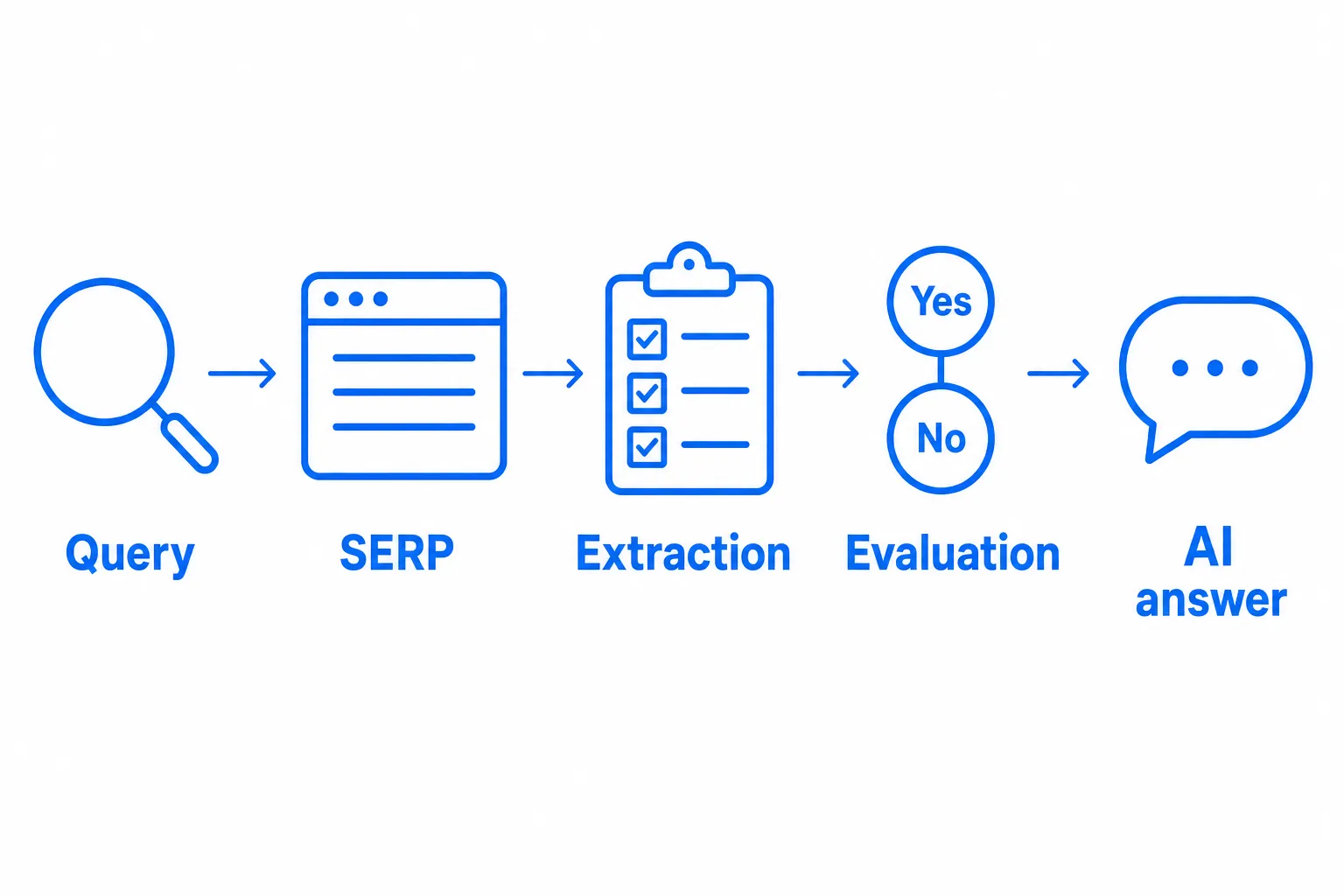
When it receives a query, the AI pulls up a search results page (SERP), exactly like a human would.
But unlike a person, who often explores several links, the AI follows a strict selection method:
- It examines the top 3 to 10 results, with a strong bias towards the top 3.
- It automatically extracts the text content from those pages.
- It assesses content quality against strict criteria:
- Clear structure (well-organised headings, paragraphs, lists)
- Readability and consistency
- Precision of the answers given
- Exact relevance to the original search
- It decides whether or not to include that content in its final answer.
⚠️ If your page doesn't meet those criteria, because it's too vague, badly written or poorly targeted, it gets rejected every single time.
👉 And the AI doesn't waste time on it: it simply moves on to the next result.
It then picks a better-optimised competitor's content, with a clearer structure and tighter relevance.
🎯 The result: your competitor gets the visibility in the AI's answers, and potentially the clicks that come with it.
You did the work... but someone else reaps the reward.
What this means for your SEO strategy
If you want your content to be seen, retained and used by an AI, whether it shows up in its answers or drives clicks, you need to rethink your approach:
"Winning over visitors" is no longer enough on its own.
From now on, you have to convince an invisible but ruthless reader: the AI's analysis algorithm.
To get there, a few principles become absolutely essential:
1. Rank well in the search results
No visibility, no analysis.
AI focuses on Google's top 3 to 10 positions, and especially on the top 3. If your page isn't there, it simply doesn't exist as far as its selection process is concerned.
Traditional SEO work (technical optimisation, semantic depth, backlinks) therefore matters more than ever.
2. Answer a precise search intent
Language models (LLMs) are after precise answers above all, not generalities. Your content must respond concretely to a specific query, such as "lightweight hiking boots for dry terrain" rather than "a general guide to footwear".
Each page should cover a single, clearly defined topic so AI systems can identify it instantly.
3. Deliver perfectly structured content
AI systems parse your content to pull out the relevant information.
The better organised, more hierarchical and more breathable your text, the easier it is to understand and reuse.
To achieve that, always use:
- A logical heading structure (H1, H2, H3...)
- Short, easy-to-read paragraphs
- Bulleted or numbered lists
- Tables, definitions and callout boxes
- Reliable, easily reusable data (figures, dates, clear sources)
4. Cut everything superfluous
AI has no tolerance for padding. It has neither the time nor the patience to dig useful information out of a rambling or overlong text.
Banish filler sentences, tangents and needless jargon.
Your content should be direct and efficient, with no pointless detours.
In short
Your site's SEO is no longer only about your human visitors.
It now extends to how AI systems interpret it.
Models like ChatGPT, Gemini and Perplexity don't read every word. They select, analyse and decide what really counts.
They're the ones deciding which content deserves to be seen, understood and shared, before the end user ever discovers it.
And what they choose isn't rough, disorganised or vague text.
What they actively look for are clear, precise, well-structured answers perfectly aligned with the user's specific search intent.
👉 Ranking well on its own is no longer enough.
👉 Elegant writing on its own is no longer enough.
👉 Generic information is no longer enough.
The key today lies in your ability to create content that's useful to the user... and immediately usable by AI.
Content that nails the technical side (SEO, structure, markup), the editorial side (clarity, concision, relevance) and the strategic side (a direct answer to a precise query).
Think of every page as the ideal answer to a question someone asked an AI.
Because if you don't, your competitors will.
And it's their content, not yours, that will be selected, cited, summarised and displayed.
They're the ones who'll gain visibility, authority... and therefore qualified traffic.
Case study: two web pages facing an AI query, which one wins?
Picture a typical query someone might put to an AI like ChatGPT or Perplexity:
"Which elegant men's watch under $300 has an automatic movement and offers good value for money?"
The AI then scans Google's search results to find the most relevant pages. It lands on two very different pieces of content: page A and page B.
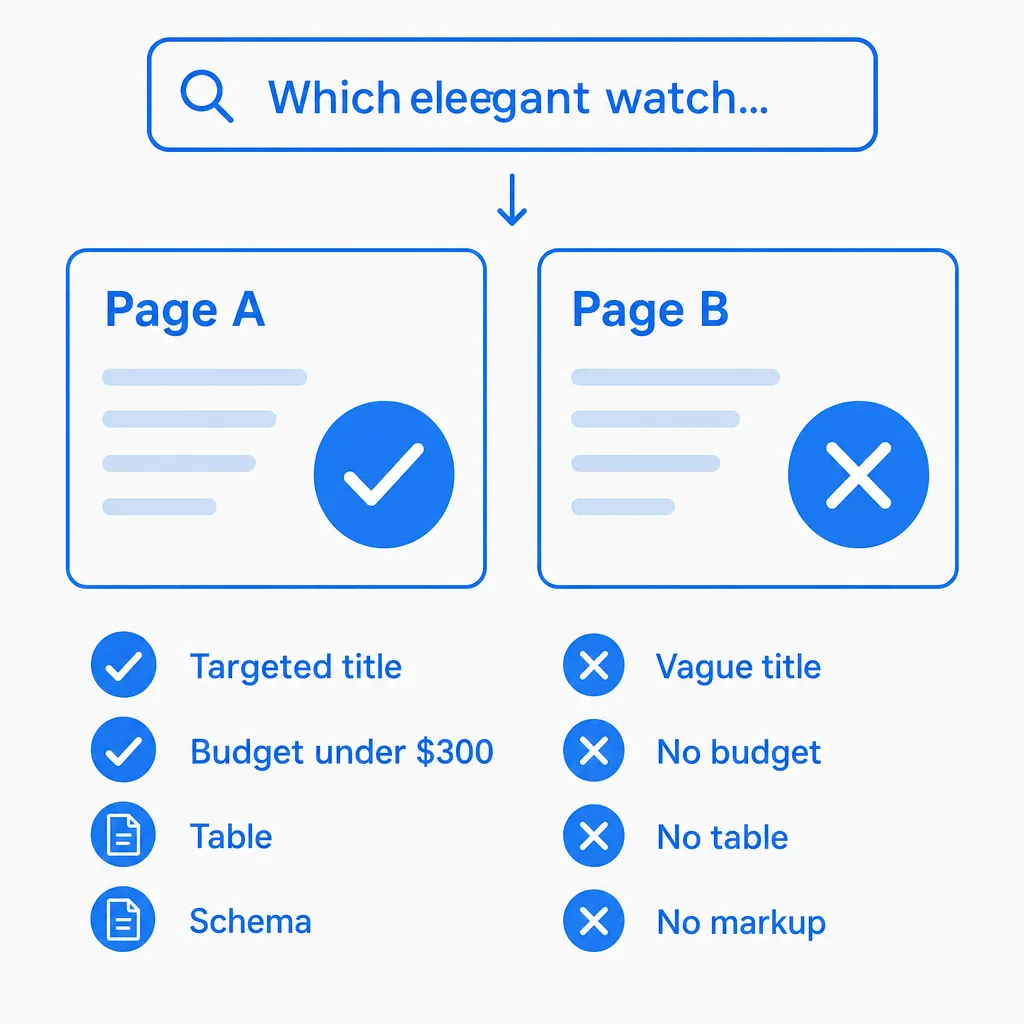
✅ Page A (selected by the AI)
Main title:
"Comparison: top 7 elegant automatic watches for men under $300 ( 2026 )"
Content strengths:
- A clear title that matches the query exactly
- An exclusive focus on automatic watches
- A precise budget stated right from the start
- Well-defined comparison criteria (design, reliability, movement, price, value for money)
- Impeccable structure with H1, H2 and H3 headings used properly
- An organised comparison table with models, prices and features
- Short, precise descriptions focused on customer benefits
- Use of structured data (
schema.org) to make processing easier for the AI
❌ Page B (ignored by the AI)
Main title:
"How to choose a men's watch"
Major problems:
- A title too vague to match the search
- Every type of watch mixed together with no distinction
- No clear indication of price
- Fuzzy, badly organised selection criteria
- Poor structure with few subheadings and overlong paragraphs
- No practical comparison between products
- Wordy content that sometimes wanders off topic
- No structured markup, which makes analysis hard for automated systems
Comparison table: page A vs page B
| Criterion | ✅ Page A (selected) | ❌ Page B (ignored) |
| Title | Clear and targeted (elegant automatic watches, < $300) | Vague and generic |
| Type of watch | Automatic models only | Mixes every type with no hierarchy |
| Target budget | Explicit budget (under $300) | Budget not stated |
| Precise criteria | Defined from the intro (style, price, movement) | Fuzzy, scattered and unstructured |
| Clear structure (Hn) | Yes: hierarchical H1, H2, H3 headings | No, weak structure |
| Comparison table | Present: models, prices, movement, materials | Absent |
| Product descriptions | Short, precise and immediately usable | Long, salesy and hard to reuse |
| Structured SEO markup | Yes: schema.org and structured data | No |
Why does the AI only keep page A?
Automated analysis doesn't pick pages at random. It consistently favours those that:
- Answer the original query precisely.
- Offer a clear structure and a smooth read.
- Make analysis easier through rigorous organisation.
- Allow easy data extraction thanks to appropriate markup (schema.org).
Conversely, vague or badly organised content like page B will be discarded every time, even if it shows up for generic queries.
Optimising your site for AI algorithms now calls for a highly targeted approach:
- Creating ultra-specific pages
- Logical structure with a well-thought-out architecture
- Perfect alignment with precise search intents
Neglect these and you're leaving the field wide open to better-prepared competitors.
Structuring your content for LLMs: the golden rules
For your content to be properly understood and used by AI models like LLMs, a clear structure and solid SEO are essential. Here are the best practices for maximising your visibility and traffic.
Open with a concise TL;DR
Place a short, punchy summary (1 to 3 sentences maximum) right at the top of your page. This preview should carry the essential information so ChatGPT or other AI tools can lift it as-is.
Example: "Optimise your structured content for LLMs with clear headings (H1-H3), lists and structured data. Short, well-organised text improves your chances of being cited."
Organise into Q&A and reusable lists
Favour short question-and-answer pairs (1-2 sentences), backed up where needed by a few explanatory paragraphs. Bullet lists and tables are ideal for letting LLMs parse the information easily.
Always finish with a concise FAQ of key answers that can be reused directly.
Use a logical heading hierarchy (H1 > H2 > H3)
Every heading should be short, precise and keyword-rich. Consider adding HTML anchors like #seo-optimisation or #structured-data to make navigation and indexing easier.
Pile on the numbers, examples and checklists
To catch an LLM's attention, build into your structured content:
- Quantified results (e.g. "150% increase in organic traffic")
- Clear action lists (steps, key points)
- Practical case studies with method and sourced results
Add a "How to cite this page" block
Make your content easy to reuse by offering several citation formats (APA, Chicago...). It encourages LLMs to credit you correctly.
Implementing markup and structured data for maximum visibility
To maximise your visibility and boost your chances of being cited by LLMs, structured markup is essential.
This kind of markup lets AI systems understand, extract and reuse your content efficiently.
Deploy the essential JSON-LD schemas
Add the right schema.org types for each kind of page you publish:
- Article: for your editorial content (blog posts, guides, tutorials)
- FAQPage and QAPage: perfect for your question-and-answer sections
- HowTo: ideal for detailed tutorials (Google retired HowTo rich results in September 2023, and no special markup is needed to appear in AI Overviews or AI Mode)
- Dataset: suited to your studies and structured data
- Person/Organization: strengthens your credibility and E-E-A-T
- Product/Review: essential for your product pages and reviews
- Breadcrumb: improves navigation and context
Wrap FAQ, TL;DR and datasets in dedicated markup
All your key elements (summaries, Q&As, tables) should be clearly identifiable to bots and RAG systems through appropriate markup.
This good habit significantly increases your chances of appearing in LLM-generated answers.
Expose machine-readable endpoints
Where possible, offer public APIs (e.g. /api/knowledge, /api/summary) returning the essential metadata (titles, summaries, last-modified dates).
This structured data makes automated integration easier for AI agents and third-party partners.
Optimise OpenGraph and Twitter Card meta tags
Take control of how your snippets look when assistants share or cite them.
Write a concise description (120-150 characters) that includes your main summary, and make sure it's accurate.
Make sure structured content is in the initial HTML
All your strategic content (text, FAQ, tables, JSON-LD) must be available on first load (SSR/SSG), without relying on client-side JavaScript.
Make sure bots and LLMs can reach your structured data immediately, with no delay.
Strengthening E-E-A-T to earn the trust of LLMs
For large language models to treat your content as credible, you need to work on your E-E-A-T (Experience, Expertise, Authoritativeness and Trustworthiness). Here's how:
Clearly display the author and their credentials
Every article should be clearly attributed to its author. Make sure you include:
- A detailed biography highlighting their skills,
- A professional photo to humanise the content,
- Relevant titles and certifications,
- Links to public profiles (LinkedIn, personal site, etc.),
- JSON-LD semantic markup so AI can read it easily.
Always cite your external sources
Every claim should be verifiable. To make that happen:
- Mention the original sources (studies, reports),
- State the dates of the data,
- Attach technical documents as appendices where useful,
- Create a "References" section at the end of the article.
This traceability dramatically strengthens your credibility in the eyes of the LLMs analysing your pages.
Be transparent about your use of AI
If you use AI tools for writing:
- Display a clear notice such as "Written with AI assistance, reviewed by our experts",
- Describe your editorial process, including human review.
That honesty prevents misinformation and builds trust in your site.
Provide evidence of hands-on experience
Demonstrate your expertise through:
- Concrete case studies (problem, solution, results),
- Reproducible test protocols,
- Precise figures ("287% increase in traffic").
These elements prove your experience and set your content apart from generic pages.
Earn and showcase quality backlinks
Backlinks from authoritative sites (specialist media, institutions) are powerful trust signals for LLMs analysing your link profile.
Our full guide lays out an effective method for optimising your SEO content in 2026: SERP analysis, building topic clusters, structured markup, technical optimisation and KPI tracking. We put the emphasis on:
- The E-E-A-T approach
- Responsible use of large language models (as writing aids, with human validation)
- Content lifecycle management (regular updates)
An essential strategy for generating sustainable traffic and succeeding at SEO in the age of LLMs.
Discover the complete guide to succeeding at LLM SEO
Backlink strategies and authority signals for LLMs
Language models (LLMs) place great weight on the quality of the sources that cite your content. A well-targeted link building strategy significantly increases your chances of being referenced and mentioned.
Prioritise a few high-quality backlinks
Quality over quantity. A handful of links from authoritative sites in your niche (think The Guardian or respected SEO blogs) beats a mountain of low-relevance links.
Key points to check:
- Topical relevance: the linking site should cover the same subject as yours
- Domain authority: analyse Trust Flow, Domain Rating and organic traffic
- Link placement: naturally integrated in the content (not in the footer or sidebar)
- Anchor text: natural, varied and free of excessive optimisation
Apply the 80/20 rule to anchors
For a natural link profile:
- 80% raw anchors (brand name, URL, "click here")
- 20% optimised anchors (e.g. "SEO for ChatGPT ")
This approach strengthens your credibility with search engines and AI systems like Google's.
Build "link magnets"
Create content that naturally attracts links:
- Original studies with unique data
- Easily shareable infographics
- Free tools your audience finds useful
- Reusable datasets
These resources raise your chances of being referenced by specialist sites and media.
Track and convert unlinked mentions
Use Google Alerts or tools like Ahrefs to spot mentions that don't link to your site. Then reach out to the authors to turn those mentions into backlinks.
Manually vet the quality of link sources
Always check:
- The site's actual topic (steer clear of link farms)
- Trust Flow and Domain Rating
- Recent organic traffic
Aim for 2 to 5 relevant backlinks a month and track them in Ahrefs or Google Search Console.
Our full guide details an effective method for earning lasting backlinks: competitor audit, spotting opportunities (guest posting, broken links), rigorous selection of target sites and results tracking. These best practices improve your site's authority and visibility while strengthening its ranking signals for LLMs and engines like Google.
Read the complete link building guide to improve your rankings
Technical accessibility, crawlability and content freshness
For an LLM to analyse and use your content properly, your site has to be technically sound. Here are the key points to keep an eye on at all times:
Ensure server-side rendering or pre-rendering
Your main content, FAQs and summaries included, should be generated server-side (SSR) or pre-built (SSG). Avoid content that only appears through client-side JavaScript, as it risks going unnoticed by bots and LLMs.
Publish an up-to-date sitemap.xml and RSS/Atom feed
Maintain a well-organised, current sitemap.xml listing all your important pages. An RSS or Atom feed lets AI tools quickly detect your new content and updates.
Keep datePublished and dateModified tags updated
Whenever you make a significant change to existing content, remember to refresh the dateModified tag in your JSON-LD markup. It shows LLMs your information is current, boosting your chances of being cited.
Use stable URLs and canonical tags
Avoid changing your URLs. If you must, set up 301 redirects and use canonical tags to consolidate authority on a single version of each piece of content. Offer printable or PDF versions too, to make sharing easier.
Include OpenGraph and Twitter tags for consistent snippets
Control the snippets shared on social networks and voice assistants by optimising your OpenGraph (title/description) and Twitter Card tags so they reflect your content accurately.
Check robots.txt and monitor indexing
Make sure your robots.txt file isn't accidentally blocking access to your strategic content through Disallow rules, and that no stray noindex tag or header is keeping key pages out of the index.
Monitor indexing in Google Search Console and submit new pages or major updates manually so search engines like Google pick them up faster.
Measurement, KPIs and monitoring your presence in LLMs
To optimise your visibility in LLMs effectively, you need rigorous tracking of your performance. Here are the main indicators to analyse and the concrete actions that improve your presence:
Track citations in conversational assistants
Regularly test specific queries in ChatGPT and other platforms like Perplexity or Gemini to check whether your site shows up in the answers. Then analyse how your content is being cited.
Alongside that, monitor traffic from AI interfaces in Google Analytics (by identifying referral and direct sources, or specific user agents where possible).
Key indicators to track
- Mention frequency: how often your content is cited in AI answers;
- Organic backlinks: new links earned naturally after a citation;
- AI visitor behaviour: bounce rate, session duration and conversions;
- Featured snippets: passages from your pages appearing in position zero or embedded in answers.
Essential tools
- Semantic analysis: assess the relevance of your vocabulary and how well it matches queries;
- SEO crawlers: like Screaming Frog to audit your site structure;
- Schema validation: use the schema.org Validator for your JSON-LD tags;
- Automated tests: set up scripts to track how your results evolve in LLMs.
Operational roadmap
- Identify user questions: gather the real questions your audience asks;
- Create targeted content: build dedicated pages that answer those questions precisely;
- Mark up with schema.org: keep your Article, Product and Organization markup accurate (FAQ and HowTo markup no longer produce rich results in Google);
- Steer and adjust: track performance and adapt your content accordingly;
- Optimise continuously: refine titles and structure based on what the LLMs pick up.
Act early to secure the first-mover advantage
Sectors like e-commerce, finance and healthcare will feel the impact of LLMs on their traffic fast. By anticipating these changes and optimising your content now, you take a decisive lead in SEO and position your site as the reference.
Access control, security and your policy towards AI bots
The rapid rise of LLMs raises serious questions about security, control and management of your content. Here's our advice for regulating AI systems' access to your data:
Master robots.txt and HTTP headers
Your robots.txt file and HTTP headers (such as X-Robots-Tag) let you restrict crawler access. One warning, though: some AI bots don't always respect these directives.
Also consider newer conventions like llms.txt, a proposed file that gives language models a curated overview of your content. It does not control access: that remains the job of robots.txt.
Set up monitoring of AI user agents
Watch your server logs for AI bot user agents (such as GPTBot, ClaudeBot or PerplexityBot). Then configure rate limiting or targeted blocking if their traffic gets too heavy.
Protect sensitive content
For your high-value content, several options:
- Noindex tags: keep certain pages out of the index,
- Paywall or authentication: reserve full access for your subscribers,
- Public excerpts + paid access: offer a free summary, then the full content after payment,
- Secured API: distribute your data through a controlled API.
Transparency and accountability
Be explicit about:
- Your sources: studies, experts, data used,
- The limits of your claims: context, scope, currency,
- Your editorial process: use of AI, human review.
That transparency reduces the risk of misinformation and strengthens your credibility with LLMs and users alike.
Offer secure machine-readable alternatives
Where it makes sense, provide public APIs, open datasets (CSV, JSON) or protected PDFs to make reuse easier while keeping control of your content.
Internal organisation, continuous auditing and team collaboration
To keep your visibility in LLMs over the long term, you need structured processes and joined-up work across your teams.
Here are the best practices to adopt:
Monthly audit and optimisation process
Run a complete monthly audit cycle covering:
- Content analysis: identify outdated, underperforming or duplicate pages
- Consolidating similar content: merge redundant articles to avoid SEO issues
- Refreshing metadata: check and update titles, descriptions and schema.org tags
- Quality control: thorough proofreading, source validation and a consistent tone
Coordinating editorial and technical teams
Keep writers, SEO specialists and developers in constant sync to:
- Maintain a clear structure (Hn headings, lists, tables)
- Optimise technical performance (SSR rendering, load speed, Core Web Vitals)
- Respect markup standards (schema.org, OpenGraph)
Use pre-publication checklists
Before publishing, check meticulously:
- The heading hierarchy (a single H1, logical H2/H3)
- The metadata (title, description, social cards)
- The URL structure (short, clear, stable)
- The structured data (JSON-LD Article, FAQ, HowTo)
- The publication dates (datePublished and dateModified properly filled in)
- The references cited (external links, academic sources)
Strengthen author biographies
Keep enriching author profiles with:
- A detailed professional introduction
- Relevant degrees and certifications
- Links to their professional networks
- JSON-LD Person markup so AI interprets it correctly
AI watch and periodic testing
Set up a monitoring routine for how LLMs evolve (new features, algorithm changes). Regularly test your key content in ChatGPT and other assistants, then refine your editorial strategy based on the results.
High-performing formats and multichannel distribution
LLMs (advanced language models) understand and process certain types of content more effectively. Here are the formats that work best, plus the best ways to distribute them and maximise your visibility:
Formats to favour
- FAQs: an ideal format with clear questions and concise answers,
- Step-by-step guides: tutorials neatly organised into numbered steps for easier understanding,
- "Top N" comparisons: summary tables that make it easy to compare products or solutions,
- Data-driven studies: exclusive data, benchmarks and test results to back up your arguments.
These formats help AI algorithms extract data automatically and raise your chances of being cited.
Distribute on social networks and third-party platforms
For maximum impact and better SEO, publish your structured content on:
- Social networks: LinkedIn, X and Facebook for broad reach,
- Newsletters: through platforms like Substack, Beehiiv or Mailchimp to reach a targeted audience,
- Editorial platforms: Medium, Quora, Reddit or specialist forums to reach an engaged audience.
Every share and mention strengthens your online presence and raises the odds that LLMs like ChatGPT flag you as a reliable source.
Choose an SEO-friendly CMS
For effective optimisation, favour a CMS that supports markup and structured data:
- WordPress (with plugins like Yoast SEO or Rank Math for better rankings),
- Webflow (great design flexibility with advanced SEO tools built in),
- Shopify (ideal for e-commerce sites, with dedicated SEO apps),
- Gatsby and Next.js (perfect for modern sites with server-side rendering or static generation).
Tailor your optimisation to each ecosystem
- Bing for ChatGPT: make sure your site is properly indexed in Bing Webmaster Tools,
- Google for Gemini and AI Mode: start by optimising your rankings through Google Search Console,
- Perplexity: bet on well-organised content, FAQs and cited sources.
Control visibility: the option of partial de-indexing
If needed, use noindex tags, configure your robots.txt file or add authentication to limit crawler access. Bear in mind these methods aren't foolproof and keep evolving. Regularly monitor changes in LLM behaviour and adjust your strategy accordingly to keep your site's visibility at its best.

Automate Your SEO With AI Agents
Sedestral connects six AI agents to your website to handle content, audits, rankings and backlinks, without the manual grind.