Your content isn't ranking, even after hours of keyword research? These days, the key to successful organic SEO lies in understanding the hidden motivations that push a user to run a search in the first place.
This practical guide shows you how to decode what searchers actually expect. You'll learn how to create content that answers the intent behind every query, optimise your SEO and improve your visibility in Google's results.
The pros' secret: Forget over-optimisation, it doesn't pay anymore. A good SEO strategy rests on a sharp analysis of user intent, and that approach beats keyword stuffing every single time.
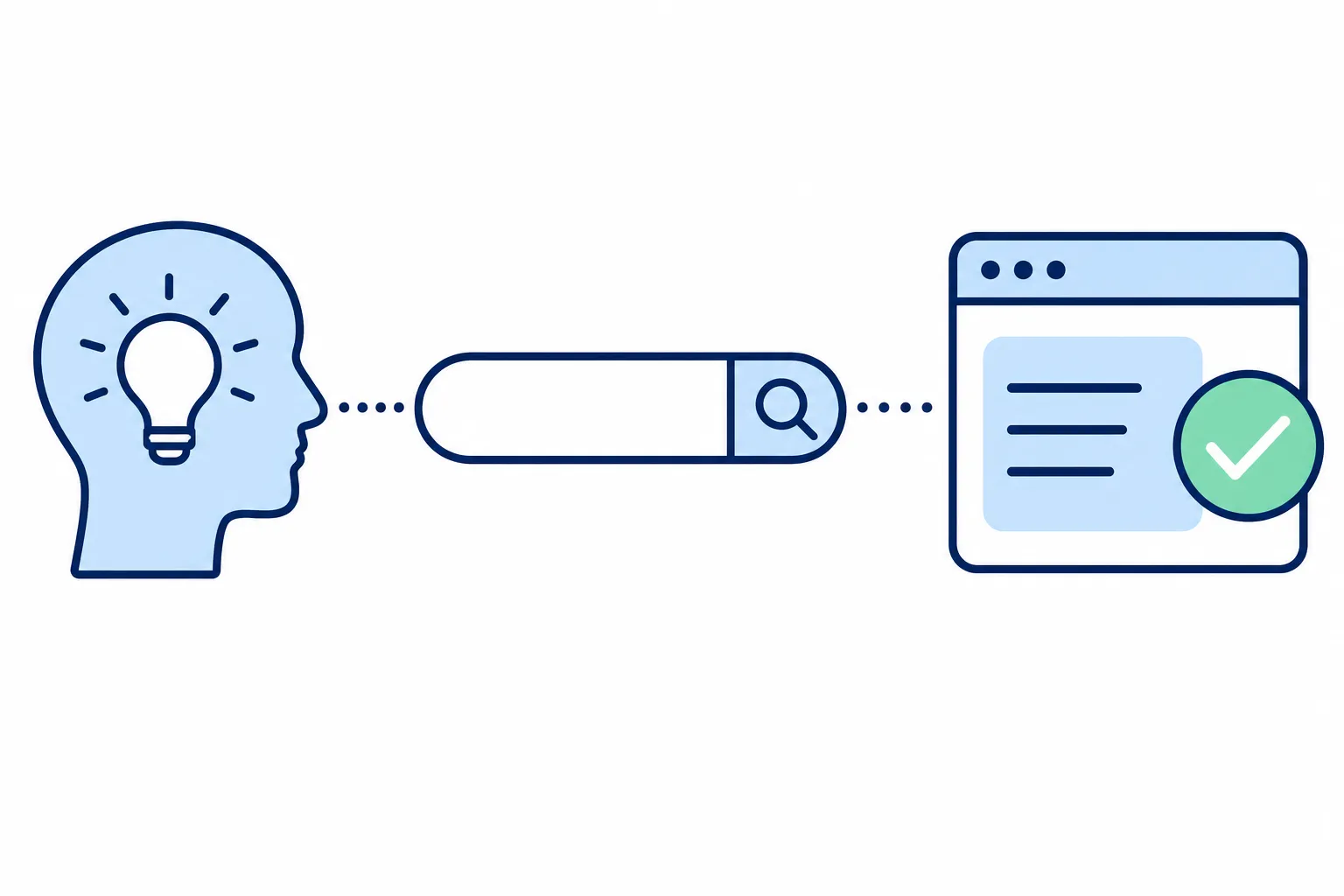
What is search intent and why does it matter so much in SEO?
Search intent is the real goal a user has when they type a query. It goes well beyond the literal definition of the words: it reveals the actual need behind each search. Take the keyword "camera": is the person after a technical guide (informational intent) or looking to buy a specific model (transactional intent)? That distinction changes everything, because the page that wins for one intent will fall flat for the other.
In modern SEO, understanding the intent behind queries is essential. Search engines consistently favour pages that match precisely what searchers expect. Content crammed with keywords but off-topic gets pushed down fast. That's why identifying search intent is the foundation of any effective organic SEO strategy.
- A better user experience: When visitors find exactly what they came for, they spend more time on your site and engage more.
- A positive signal for Google: Long dwell time and a low bounce rate show you've met the initial need.
- A better ROI: By targeting intent precisely, you attract qualified traffic with real conversion potential.
How does Google interpret search intent?
Google reads search intent with unnerving accuracy thanks to systems like RankBrain and BERT (MUM is only used for a few specific applications). The engine looks at the query, search history, context (location, device) and the user's usual behaviour. Depending on the intent it detects, Google adapts its results pages (SERPs) by mixing in different content formats.
Looking at the SERPs teaches you a few key lessons:
- Featured snippets and related questions: They mostly reflect an informational need from searchers.
- Local pack with a map: Signals a location-based search, like "bakery near me".
- Google Shopping ads: Suggest a search with a purchase in mind, where the user is ready to buy.
- Video carousels: Show that the user prefers a visual, interactive format.
This step-by-step guide shows you how to decode the SERP to identify precisely what your visitors need and adapt your content. You'll find: a clear explanation of the different types of intent (informational, transactional, commercial, navigational), a simple method to analyse the top results (their format, depth, structure and authority), plus tips for mining the semantic field through People Also Ask and related searches. We also share the must-have tools (browser extensions, SEO platforms, Google Search Console) to track how SERPs evolve. In short, a complete approach to turn your results-page analysis into effective, lasting optimisations for your rankings.
Read the full guide to decoding the SERP and search intent
The types of search intent: SEO's working model
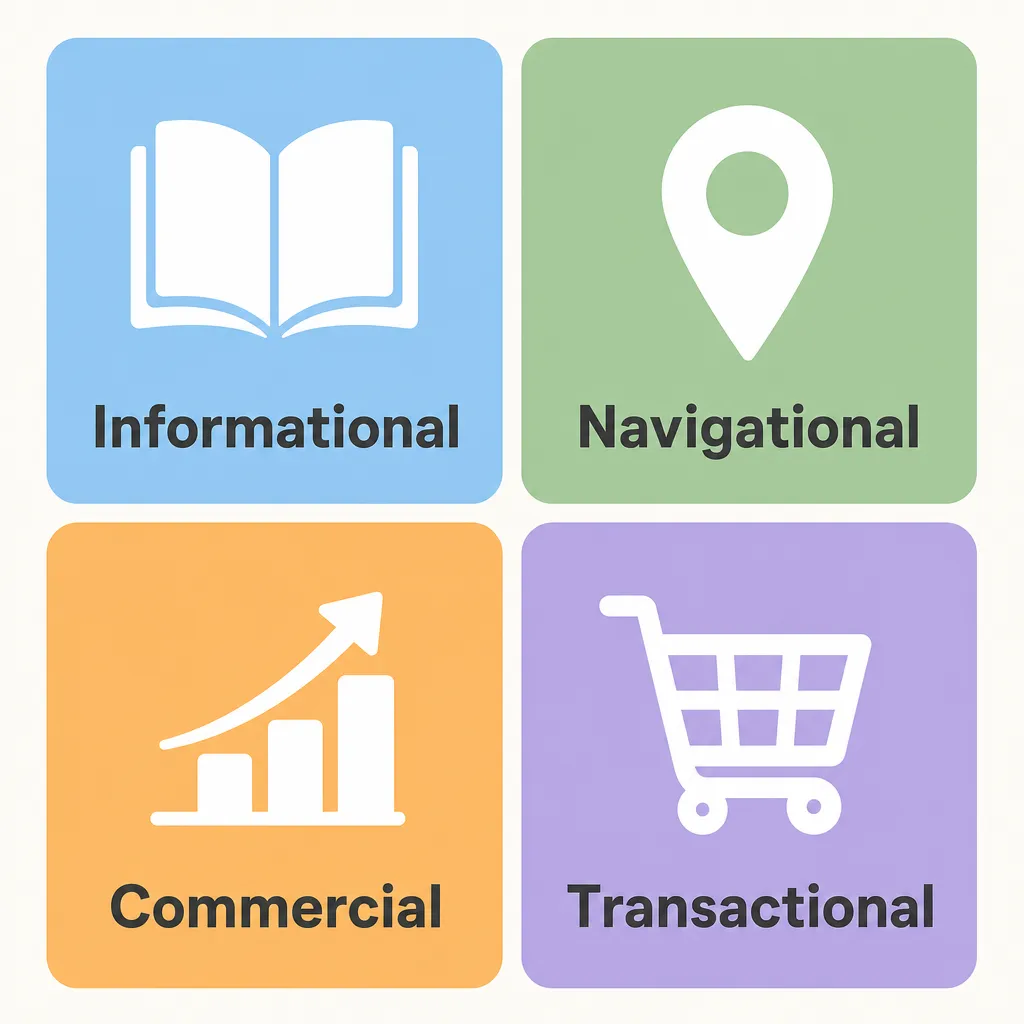
In SEO, professionals sort queries into four main categories of search intent. This framework lets you design tailor-made content and sharpen your SEO strategy.
Informational intent: "I want to know"
Here the user is looking for information, explanations or knowledge. This kind of informational search often matches the awareness stage, when the need is just starting to take shape.
Key indicators:
- Typical keywords: "how", "why", "explained", " definition", "tutorial"
- What shows up in the SERPs: Featured snippets, the "People also ask" box, well-ranked articles
- Real-world example: For "how to choose a good wine", the results are mostly detailed guides with highlighted snippets and explainer videos
Suitable content formats:
- Blog posts with a clear heading hierarchy (H2/H3)
- Step-by-step guides with plain explanations
- FAQs answering common questions
- Infographics and concrete examples that make learning easier
Navigational intent: "I want to go to..."
When someone runs a navigational query on Google, they know exactly where they want to go and use the search engine as a shortcut to a specific site. This mostly concerns well-known brands or services, where navigation is simply the fastest route.
Here's what defines this type of search:
- Terms used: Mostly brand names ("Facebook") or direct requests ("Amazon login").
- Optimisation required: Your homepage absolutely must rank for your own brand name.
- Useful structures: a clear site structure and internal linking help Google generate sitelinks, which are automated (no markup controls them) in the SERP results.
Commercial intent: "I want to choose"
At this stage, the user knows their need but is still weighing up options. This comparison phase is a strategic point in the buying journey.
Characteristics:
- Typical keywords: "best", "review", "vs", "compare", " comparison", "alternative"
- SERP trend: Results favour buying guides, product reviews and in-depth analyses
- Real-world example: A commercial query like "best blender 2026" mostly returns detailed comparison pages
The best content formats for this intent:
- Visual comparisons that highlight the key differences
- Full reviews that lay out strengths and weaknesses objectively
- Buying guides that genuinely help people decide
- "Top picks" roundups built on relevant criteria
Transactional intent: "I want to buy"
This is the moment the user is ready to buy. Transactional intent calls for content designed to trigger action.
Key indicators:
- Tell-tale vocabulary: "price", " buy", "deal", "free shipping", "discount"
- Type of results: SERPs mostly show product pages, price comparison sites and online stores
- Typical example: The search " buy robot vacuum" returns almost exclusively commercial pages
Ways to improve conversions:
- Detailed product pages with high-quality images and technical specs
- Optimised pages with clear, visible call-to-action buttons
- Trust signals: Customer reviews, security badges, clear returns information
- E-commerce optimisation for better visibility in Google Shopping
Watch out for ambiguous queries: Some searches can match several distinct intents. In those cases, Google either shows the most common interpretation or blends results based on how searchers behave.
Practical methods to identify search intent
Pinning down the intent behind a query takes careful analysis that combines manual observation with technical tools. This approach helps you understand what your target audience expects and adjust your editorial strategy accordingly.
Decoding the SERP to identify search intent
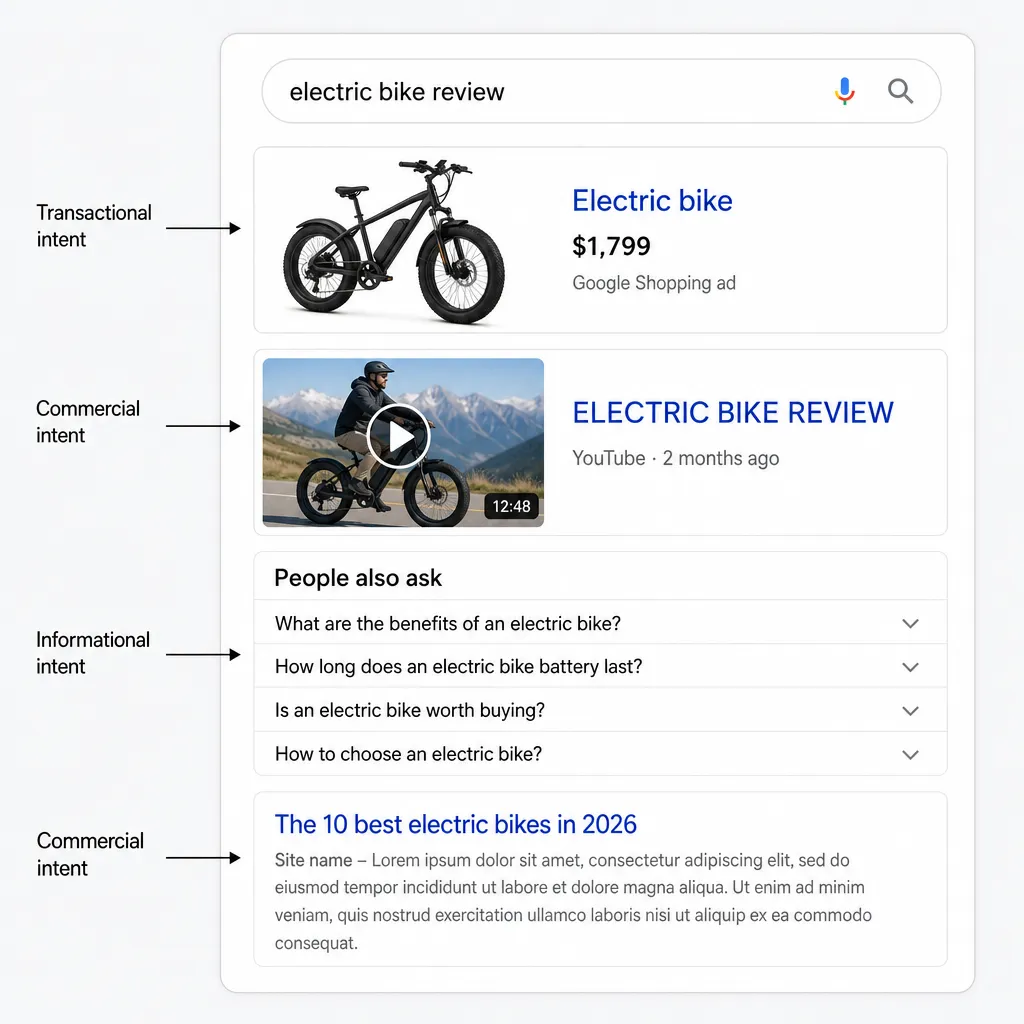
Google's results page (SERP) is your best tool for understanding what users really want. Every element the search engine displays reveals what it considers the most relevant answer, so you're effectively reading Google's own verdict on the query.
A 5-step analysis method:
- Open a private browsing window to get neutral results, free from your history
- Type your main keyword and look closely at how the SERP is structured
- Spot the key indicators: a featured snippet, a "People also ask" box or carousels give away the type of intent
- Examine the top results: study the first 3-5 results in detail (format, richness, depth) to gauge the difficulty and the angle to take
- Interpret the visual elements:
- Featured snippet = strongly informational intent
- Local pack with reviews = local intent
- Shopping carousel = clear purchase intent
- "People also ask" = need for further information
Real-world example: For "best robot vacuum", a SERP showing comparisons, review videos and product pages points to commercial intent. Adapt your content: go for a transactional angle if product pages dominate, or build a complete guide if in-depth articles win out.
Using Google Autocomplete and behavioural data
Google's autocomplete feature is a great way to uncover what searchers are after. By analysing these suggestions, you spot related queries and work out whether the intent is mainly informational, purchase-driven or navigational.
Deeper analysis techniques:
- The alphabet method: Start with your main keyword and add each letter of the alphabet in turn (for example "SEO a" to surface "SEO agency").
- Question modifiers: Use words like "how", "why" or "best" to spot queries with informational intent.
- Commercial signals: Terms like "comparison", "review" or " buy" often point to transactional intent.
- Behavioural analysis: Dig into Google Search Console data to study queries, impressions and click-through rates. Lots of impressions with few clicks can reveal a title tag or meta description problem.
Using SEO tools to scale intent analysis
Specialist SEO tools make studying intent easier and let you handle large keyword volumes efficiently, sharpening your SEO strategy in the process.
- Semrush, Ahrefs, Moz: These platforms automatically identify the intent behind each keyword and group terms by semantic similarity.
- AnswerThePublic, AlsoAsked: Perfect for discovering the questions users ask and understanding the nuances of their intent.
- Google Search Console: Reveals the gaps between what the user searched for and the results they got, through click-through rate and impression analysis.
- Grouping by topic: Structure your keywords into distinct categories depending on whether they answer a need for information or for action, so you can target intent more accurately.
This practical guide explains how to choose your keywords based on search intent: it describes the four types of intent (informational, navigational, commercial, transactional), shows how to analyse the SERPs to work out what content is expected, and highlights the value of long-tail queries and topic clusters for attracting qualified traffic. You'll find concrete techniques (finding key phrases, silo architecture, on-page optimisation) along with recommended free tools (Keyword Planner, Google Trends, AnswerThePublic) to turn a plain keyword list into a high-performing editorial strategy.
Analyse search intent and choose your keywords
Adapting and optimising your content for the intent you identified
Once you've identified your audience's search intent, create content that matches their expectations exactly. This fit between format and intent is crucial to boost your rankings and satisfy what visitors really need.
Copy the winning format and structure for the intent
Study the results at the top of the SERP and build more complete content that adds real value:
- Informational intent:
- Detailed articles with clear headings (H2/H3)
- Practical guides illustrated with diagrams or infographics
- FAQs covering common questions (the "People Also Ask" box)
- Short, precise answers to land featured snippets
- Navigational intent:
- Homepages optimised for brand searches
- Contact details visible in one click
- Simplified navigation with strategic internal links
- Commercial intent:
- Complete comparison with a summary table (technical specs, prices)
- Impartial product reviews with pros and cons
- Verified reviews to trigger the buying decision
- Demo videos and high-quality visuals
- Transactional intent:
- Ultra-complete product pages (stock, pricing, ratings, product zoom)
- Site structure built for intuitive navigation
- Sales pages with well-placed call-to-action buttons and simplified forms
- Trust signals (encrypted payments, responsive customer service)
Mining the semantic field to enrich your content
Reuse "People Also Ask" questions in your FAQ, and work the key terms from snippets and related searches into your headings. This approach guarantees full coverage of the intent and improves your rankings.
- Semantic analysis: Spot the keywords that recur across the top results and use them naturally
- Frequent questions: Organise PAA questions into themed sections to answer them effectively
- Long tail: Target niche queries ("best multicooker for one person 2026") for a higher conversion rate
Optimising for conversions along the funnel
Each level of intent matches a stage of the customer journey. Your content should make it easy to move on to the next step:
- Top of the funnel (informational): Soft prompts (free guides, newsletter sign-ups)
- Middle of the funnel (commercial): Steer towards free trials or quotes
- Bottom of the funnel (transactional): Optimise the checkout flow and calls to action
This practical guide details how to build a high-performing SEO strategy by answering your audience's search intent precisely. You'll learn to run a complete audit (technical and editorial), assess the quality of your pages (with a 100-point scoring system based on 500+ criteria, including fit with search intent and semantic analysis), optimise your content, organise your keywords into clusters, publish relevant content regularly (with AI tools if you like), sync with your CMS and track your performance through Google Search Console for continuous adjustments.
Find out how to answer search intent
Organising clusters and tracking intent day to day
To run a content strategy built around search intent effectively, organise your keywords into topic groups and set up methodical tracking. Without that, even good content ends up scattered and hard to measure.
Building topic clusters by intent
Develop a central page around your main keyword, supported by satellite content covering related queries. This approach strengthens your rankings while covering every user need:
- Informational pillar page: "running plan for beginners"
- Supporting content: "5K plan in 2 months", "exercises for new runners", "weekly running schedule"
- Linking between pages: Connect your content wisely with relevant internal links
- Separating intents: Keep informational content clearly distinct from commercial pages
On-page optimisation and concrete best practices
Apply these optimisation techniques, tailored to each type of intent:
- Technical: Simple, descriptive URL, compelling title tag including the keyword, engaging meta description
- Content architecture: Logical H1/H2 structure, strategic keyword placement, exhaustive answers to the questions surfaced in the SERP
- Multimedia: Optimised alt text and coverage of related queries
- Markup: Product schema (and Article for editorial content) to answer Google's expectations better; FAQ rich results are no longer shown
Tracking and iterating on your intent strategy
Monitor your performance regularly and adjust your approach:
- Tools: Google Search Console (position/CTR tracking) and SEO platforms to analyse the competition
- Priorities: Target keywords sitting in positions 8-15 and push them up
- SERP monitoring: Keep an eye on changes (algorithm updates, new features, trends)
- Opportunities: Identify high-potential pages that are under-optimised

Rank Higher Without the Manual Work
From technical audits with Nox to competitor monitoring with Marc, Sedestral's AI agents cover every layer of SEO so your team doesn't have to.