This practical guide to the inbound marketing funnel gives you everything you need to turn visitors into loyal customers, without wasting time or budget. You'll learn how to build a solid inbound marketing strategy with the ToFu-MoFu-BoFu method and how to fine-tune every stage to get better results.
What is a marketing conversion funnel
A conversion funnel maps the complete journey a prospect takes, from the moment they discover your brand to the day they become a repeat customer. Laying it out clearly helps you see each key phase, plug the leaks and push your conversion rate up.
Definition and customer goal
The inbound marketing funnel is built around four core stages: attract, convert, close and delight. Its main job? Cutting drop-offs at every level by giving prospects what they need based on where they sit in the funnel.
This approach lifts conversions because it spots friction points and lets you adapt your content and marketing actions accordingly. A prospect in discovery mode will appreciate educational articles, for instance, while one who's ready to buy will respond better to targeted offers or customer reviews.
The goal of the funnel is to guide the prospect naturally towards a purchase while building trust along the way. It's especially well suited to complex sales that require several touchpoints.
From visitor to lead to customer
The marketing funnel gradually moves people through five statuses: stranger → visitor → qualified lead → customer → promoter. This segmentation lets you sharpen your inbound strategy according to each person's level of engagement.
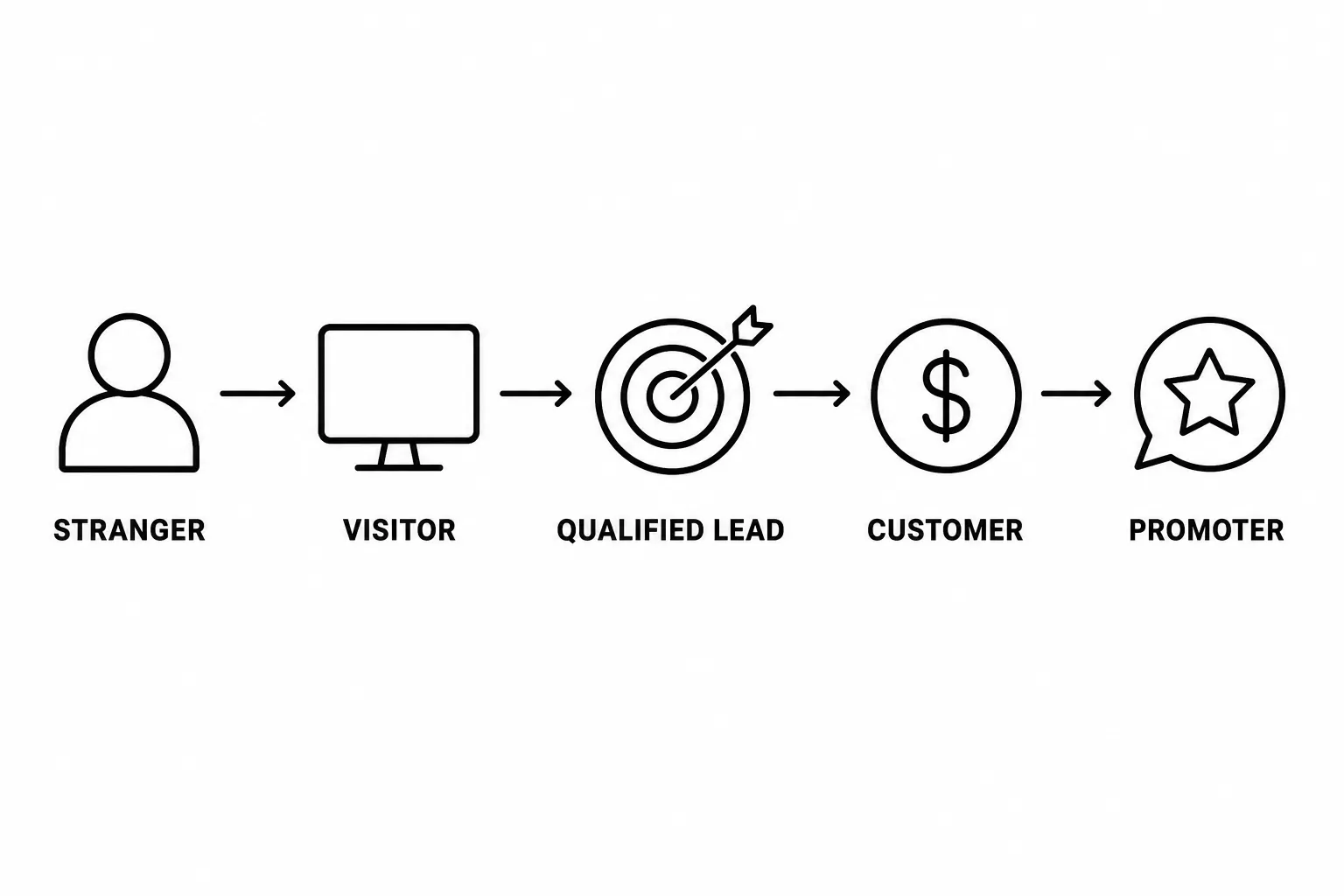
Each transition needs its own levers: engaging content to attract visitors, premium resources to generate leads, sales arguments to win the purchase, and a great customer experience to encourage referrals. Having the right tools at each stage is essential if you want to optimise your conversion rate.
Role of content and KPIs
Content is the engine that moves prospects down the funnel. Formats and objectives change with each phase: SEO content to attract, white papers or webinars to convert, demos to close the deal.
Your key metrics shift too: traffic and search rankings for acquisition, landing page conversion rate for lead generation, lead-to-customer rate for sales, and satisfaction scores for retention. Tracking these closely helps you quickly identify what's working and what needs fixing.
ToFu, MoFu, BoFu in inbound marketing
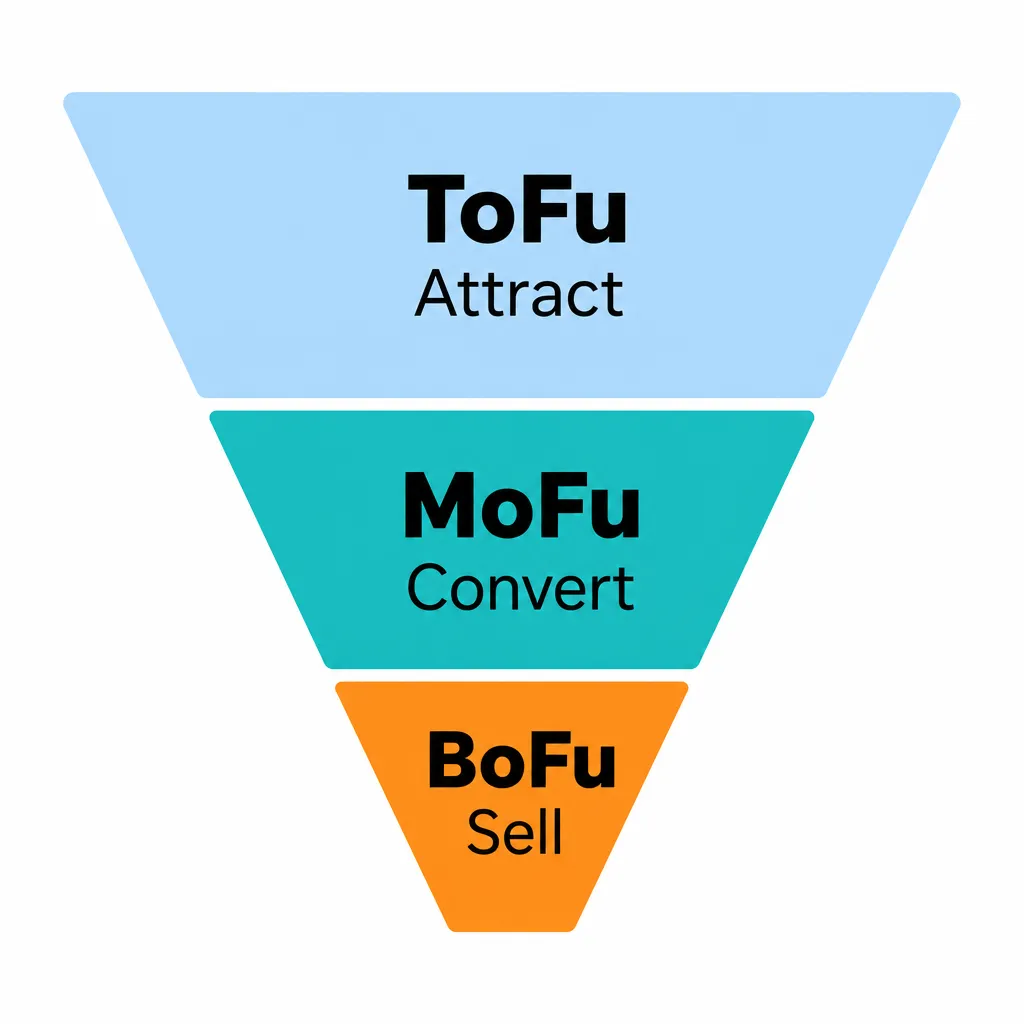
The ToFu-MoFu-BoFu model splits the conversion funnel into three key stages that follow the prospect's buyer journey. It lets you adapt your marketing strategy and content to how engaged each visitor actually is.
Content and channels by stage
A high-performing inbound marketing funnel unfolds in three distinct phases. The first (ToFu) grabs attention with informative content. The second (MoFu) builds the relationship with your leads. The third (BoFu) turns those prospects into customers.
- ToFu (Top of Funnel): Build visibility with optimised blog posts, social media content and educational resources that match what your audience is looking for.
- MoFu (Middle of Funnel): Deepen engagement with specialised content (ebooks, webinars) and kick off a nurturing process to qualify your leads step by step.
- BoFu (Bottom of Funnel): Convert efficiently with tailored demos, relevant offers and concrete proof of the value you deliver.
This segmentation helps you focus your resources on the most promising prospects. The ToFu phase needs a steady investment in content to build a lasting presence and attract qualified visitors.
From visitors to qualified leads
Turning visitors into qualified leads is the pivotal step in the middle of the funnel. An effective conversion funnel starts with compelling content, then offers a premium resource in exchange for contact details, converting the visitor into a marketing qualified lead (MQL).
The difference between an MQL (marketing interest) and an SQL (sales interest) matters. An MQL consumes your content, while an SQL shows genuine buying intent. This gradual qualification ensures a smooth handover to the sales team at the right moment.
Final conversion into a customer
The BoFu phase calls for close collaboration between marketing and sales. Content like case studies, comparison pages or testimonials helps remove the last objections to buying.
Make buying easy: trim your forms, offer several payment options and highlight your guarantees. These details are especially reassuring for new customers making their first purchase.
And the process doesn't stop at the sale. A well-designed retention programme, with onboarding, responsive support and a referral scheme, improves customer satisfaction and generates recommendations that feed the top of your funnel.
Building and optimising a conversion funnel strategy
Building an effective conversion funnel takes a structured approach that combines an inbound marketing strategy, the right technology and clearly defined processes. Here's how to turn your approach into a proper system for converting qualified leads.
Marketing processes and tools
A high-performing inbound marketing funnel relies on a few key tools: a CMS to manage your content, SEO software, a CRM to track your prospects, and a marketing automation platform to personalise journeys.
Connecting these tools creates automated flows that guide each prospect. Downloading a white paper, for example, can trigger an email sequence while gradually enriching the lead's profile.
- Attract your audience: publish SEO-optimised articles, show up on the social networks your target actually uses, build a relevant content strategy.
- Convert efficiently: optimised landing pages, simplified forms, high-value content.
- Nurture your leads: personalised emails, automatic scoring, alerts for the most promising prospects.
Segmenting your audience finely by behaviour lets you tailor messages and offers, which lifts your conversion rates at every stage of the digital marketing funnel.
CTAs, forms and content
Optimising the key elements is essential if you want a better funnel. Your calls to action need to be visible, persuasive and lead with a concrete benefit.
Forms are often a friction point: keep them short with only the essential fields (usually name, email and company). Every extra field you add risks lowering your conversion rate.
| Stage | Content type | Goal | Preferred format |
| ToFu | Educational | Attract and inform | Blog posts, infographics |
| MoFu | In-depth | Qualify and nurture | Ebooks, webinars |
| BoFu | Decision-focused | Convert | Demos, case studies |
Keep every touchpoint consistent to build trust and make the prospect's journey easier. Each piece of content should lead naturally to the next step through relevant calls to action.
Lead scoring and follow-up
Automatic lead scoring identifies your most qualified prospects by analysing their interactions: pages viewed, engagement with your content, email opens... This quantitative approach makes prioritisation much easier for your sales team.
Adjust your qualification thresholds to your sales cycle. When marketing and sales work together, you can keep refining the criteria based on the real quality of the leads being handed over.
Measuring conversion funnel performance
To improve your inbound marketing funnel effectively, you need to track results precisely at every stage. This analysis pinpoints the weak spots and helps you optimise your return on investment. Unlike random tweaks, a data-driven approach guarantees that your changes actually make sense.
KPIs by marketing stage
Each phase of the customer journey needs its own metrics. At the top of the funnel (ToFu), watch organic traffic, search rankings and click-through rate to measure how well you attract qualified visitors.
In the middle of the funnel (MoFu), the focus shifts to conversion: visitor-to-lead rate, cost per lead and growth in qualified contacts. These metrics reveal how effective your content and landing pages really are in the conversion process.
Spotting visitor and lead leaks
Leaks in the buying funnel tend to happen in the same places: forms that are too long, poorly placed buttons or unnecessary steps in the customer journey. These obstacles cost you prospects at decisive moments.
Behavioural analytics tools (heatmaps, session recordings...) give you concrete answers about why people abandon. That level of detail is essential for targeting the right optimisations in your inbound marketing funnel.
Optimising all the way to loyal customers
Systematic A/B testing is the key to refining every element of the funnel (calls to action, forms, sales pitches...). This scientific method validates improvements before you roll them out at scale.
Retention is often overlooked, yet it's a goldmine. A satisfied customer generates far more value over time. Track metrics like retention, customer satisfaction and word of mouth to assess the quality of your post-conversion nurturing.
Document your tests rigorously so you can build on what you learn. That knowledge base stops you repeating the same mistakes and makes it easier to spot the best practices for your audience.
Real-world inbound marketing strategy examples
Here are some practical illustrations of how to run an effective inbound marketing funnel, depending on your industry. These scenarios show how adaptable the method is and the nuances to apply based on your type of business and your target audience.
Case studies from visitor to customer
Picture a standard conversion funnel for a B2B SaaS product. It starts with an SEO-optimised blog post on a specific topic. That informative content captures relevant visitors, who are then offered a white paper with concrete answers to their challenges.
- Attraction phase: An article titled "How to automate your SEO reporting: a step-by-step guide" brings in 500 visitors a month thanks to its rankings on strategic keywords.
- Conversion phase: A contextual pop-up offering "The ultimate SEO audit checklist" in exchange for contact details converts 3% of visitors into leads.
- Nurturing phase: A sequence of 4 educational emails spread over 15 days, including customer testimonials and an invitation to a personalised demo.
The identified prospect then gets a 14-day free trial, backed by tailored follow-up and priority access to customer support. This step-by-step approach builds credibility and lowers the barrier to committing.
Content and lead frameworks
The ToFu, MoFu, BoFu funnel maps neatly onto the AIDA model (Attention, Interest, Desire, Action) for guiding prospects. ToFu matches the awareness stage with engaging content, MoFu deepens Interest and Desire through nurturing, and BoFu triggers the final decision.
A content strategy organised into topic clusters also strengthens your SEO: a pillar page (e.g. "How to boost your search rankings") ties together a set of supporting articles. This topical architecture improves visibility and intuitively guides visitors towards more specialised resources, speeding up their journey through the inbound marketing funnel.

Automate Your SEO With AI Agents
Sedestral connects six AI agents to your website to handle content, audits, rankings and backlinks, without the manual grind.