Building a content strategy isn't about writing a few articles or posting a couple of videos: it's the backbone of your whole online presence. A methodical approach lets you plan relevant content that speaks to your prospects and pushes you up the search engine results. This guide walks you step by step through building an effective content strategy, from defining your goals to analysing performance, including how to build SEO topic clusters and keep optimising what you publish.
Content strategy: definition and goals
Putting a content strategy in place means organising how you create and distribute useful, consistent content to hit specific marketing goals. It structures your output around targeted themes, which attracts your target audience and builds your credibility in your industry. Our practical guide to building an SEO content strategy with topic clusters goes deeper into the method and the concrete gains you can expect.
What the practical definition covers
A real content strategy goes far beyond sharing a few blog posts or updates on social media. It's a big-picture view that decides which content to create, for which audiences, on which channels and how often. It's grounded in solid research into what your market needs and which strategic keywords matter.
Unlike intrusive advertising, this approach favours genuinely useful, high-quality content. You build trust with your prospects by answering their questions precisely. That positioning establishes you as a reference in your field, the one people come back to when they need answers.
Managing your content also means mixing formats: technical articles, explainer videos, infographics or customer testimonials. Each format matches a specific stage of the buying journey, from first awareness to the final decision.
Why goals drive your choices
Your goals directly shape your editorial priorities and your SEO choices. Do you want more organic traffic, more qualified leads, or a better conversion rate? Each ambition calls for a different mix of keywords, formats and distribution channels.
Winning new prospects means targeting broad, informational queries, while conversion focuses on more commercial terms. A successful content strategy balances these different levels of intent so you can support visitors all the way along their journey.
Performance analysis relies on metrics aligned with your aims: visits for brand awareness, sign-ups for lead generation, contact requests for conversions. This data-driven approach lets you keep adjusting your strategy based on real results.
Avoid cannibalisation with topic clusters
Organising your content into SEO topic clusters stops your own pages competing against each other in the search results. The technique structures your web content around central pages covering a broad theme, linked to supporting pages that develop specific aspects.
For example, a central page on "ecommerce SEO" can be backed by supporting pages on "improving product pages", "page speed" or "internal linking". This architecture helps Google recognise your expertise on the subject.
The links between central and supporting pages reinforce your site's topical coherence. You guide visitors to the most useful information while consolidating the authority of your main pages in the search results.
Build clusters and set priorities
Structuring your content into SEO topic clusters is a fundamental step for boosting your organic visibility. This methodical approach lets you cover your topics exhaustively while cutting out pointless repetition. Here's how to build coherent topic groups and decide on your editorial priorities.
Pillars and supporting pages explained
Topic clusters bring clear logic to your content architecture. The pillar page covers a central theme in depth, while the cluster pages explore specific aspects or answer precise questions. This structure makes navigation easier for your visitors and for search engines alike.
- Pillar page: comprehensive content on a broad topic, optimised for a high-volume primary keyword
- Cluster pages: focused articles targeting more specific queries related to the central theme
- Two-way links: connect the pillar and its cluster pages to strengthen topical cohesion
- Internal linking: a system of relevant links that naturally guides users to the information they're after
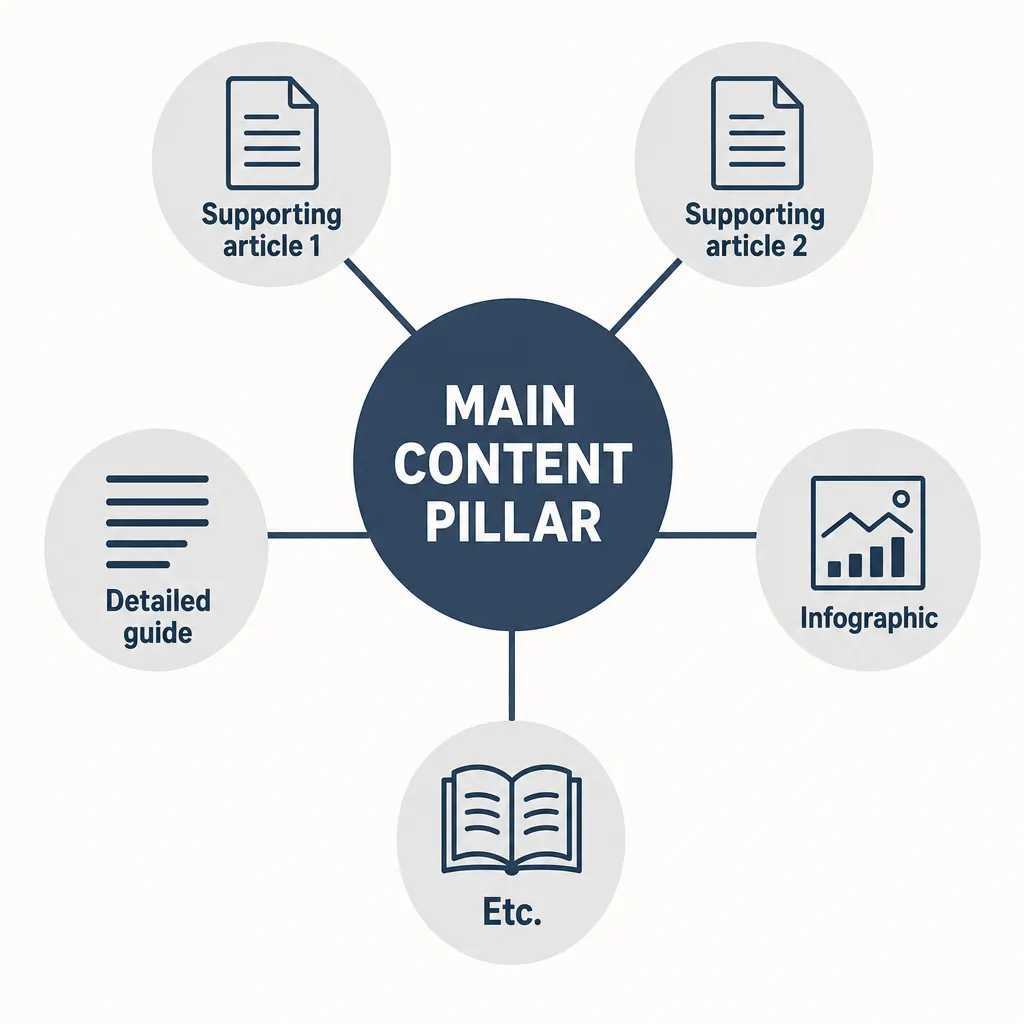
This structure matches search intent perfectly while making your site easier for Google to crawl. Search engines get a better grasp of your expertise and can surface your content for a range of related queries.
How to prioritise topics
Prioritisation rests on a rigorous analysis of each topic's potential. Internal linking plays a crucial role in redistributing authority across your pages according to their strategic importance. We look at three main criteria: search volume, ranking difficulty and fit with your business goals.
Easy SEO wins are queries with solid traffic potential and moderate competition. These topics deliver quick results and early momentum before you take on more competitive, higher-volume keywords.
Analysing your existing pages often reveals content sitting on page two that just needs targeted optimisation to reach page one. These quick wins are immediate priorities for growing your traffic without publishing anything new.
Plan and iterate with data
An editorial calendar turns your strategic priorities into a concrete production plan. It needs to balance the gradual build-out of your clusters with the regularity SEO demands. We recommend a steady publishing rhythm, ideally 2 to 3 pieces a week to keep your site active.
Read the guide to building a high-performing SEO content strategy to follow this structured approach. The tool simplifies keyword research, automatically identifies relevant clusters and spots the priority opportunities in your sector.
Search Console and Google Analytics data help you fine-tune your strategy. If a page gets plenty of impressions but few clicks, test punchier titles and meta descriptions. This data-led approach keeps improving your performance without flooding your site with content nobody asked for.
Research and optimise before you create
To produce quality content, you first need to understand what your target audience expects. This initial phase directly determines how well your content performs and how much qualified traffic it pulls in. Here's how to spot the best opportunities and optimise your content for search engines.
Understand intent and personas
Search intent is the cornerstone of your content strategy. It reveals whether your prospects are looking for information, comparing solutions or ready to buy. Each intent needs a tailored approach to reach your visitors effectively.
Defining your personas precisely lets you anticipate your audience's needs: job role, professional challenges, decision criteria and preferred channels. These details guide you in picking the right tone, choosing relevant examples and writing calls to action that convert.
The customer journey breaks down into three stages: awareness, consideration and decision. Your content creation should naturally support prospects at each stage, with answers matched to how far along they are.
Select and group keywords
Keyword research identifies the terms your market actually uses. With dedicated tools, we uncover long-tail opportunities, less competitive but more relevant. This fine-grained analysis becomes a real strategic asset, because it shows you where the demand is and how your competitors are answering it.
Grouping keywords by theme lets you organise your content logically. By targeting a coherent set of keywords on a single page, you cover a topic exhaustively and improve your visibility across varied but related queries.
Optimise on-page SEO and internal links
The technical optimisation step makes your site easier for search engines to crawl. That means a clear structure (H1 to H3 headings), engaging meta descriptions, descriptive URLs and images optimised with proper alt text.
Effective internal linking smooths navigation and strengthens your pages' authority. By linking complementary content wisely, you steer visitors towards your strategic pages while helping search engine bots crawl your site.
Distribution and amplification
Creating content for your blog is only the first step of your strategy. To maximise the impact of your articles, you need to distribute them across several channels. This multi-platform approach significantly boosts your visibility and improves the return on your content marketing investment.
Choose the right formats and channels
The real art of content marketing lies in adapting your content to each social network. A single article can become a series of LinkedIn posts, a punchy infographic or an engaging video. This diversification reaches more prospects without much extra effort, since the research and the thinking are already done.
Pick your formats based on your specific goals:
- In-depth articles to demonstrate your expertise and improve your rankings
- Short videos, perfect for driving traffic from social media
- Downloadable content such as ebooks to capture qualified leads
A consistent visual identity and tone of voice across all your channels is essential. Whether your leads find you through SEO or social media, they should recognise your brand instantly.
Align SEO, social and paid search
Social media optimisation (SMO) complements your SEO strategy perfectly by creating social engagement and sending traffic to your site. Your social posts can massively amplify the reach of your key content.
Meanwhile, paid search campaigns (PPC) let you target strategic keywords while your organic rankings build up. This smart combination generates prospects immediately while building your long-term organic presence.
Analysing customer journeys shows how your channels interact: a visitor might discover your brand through an Instagram video, read a blog post found via Google, then convert after seeing a targeted ad. This holistic view makes your content creation considerably more effective.
Measurement and governance
To make your editorial strategy pay off, tracking key metrics and regularly adjusting your approach is vital. This data-driven process lets you identify what's performing, improve what's struggling and focus your effort on the content with the most potential.
Choose the right KPIs
Picking the right KPIs is fundamental to judging whether your content strategy actually works. Traffic from search engines reflects your online visibility, while average reading time shows how engaged your audience is. Conversions (such as sign-ups or purchases) prove concretely how your content supports your business goals.
A detailed breakdown of performance by format and channel reveals which types of article and which topics deliver the best results. Those insights guide your decisions on future content and help you allocate your editorial resources wisely.
| Goal | Primary KPI | Secondary KPI | Measurement frequency |
| Visibility | Organic traffic | Search impressions | Monthly |
| Engagement | Time on page | Bounce rate | Weekly |
| Conversion | Leads generated | Cost per lead | Monthly |
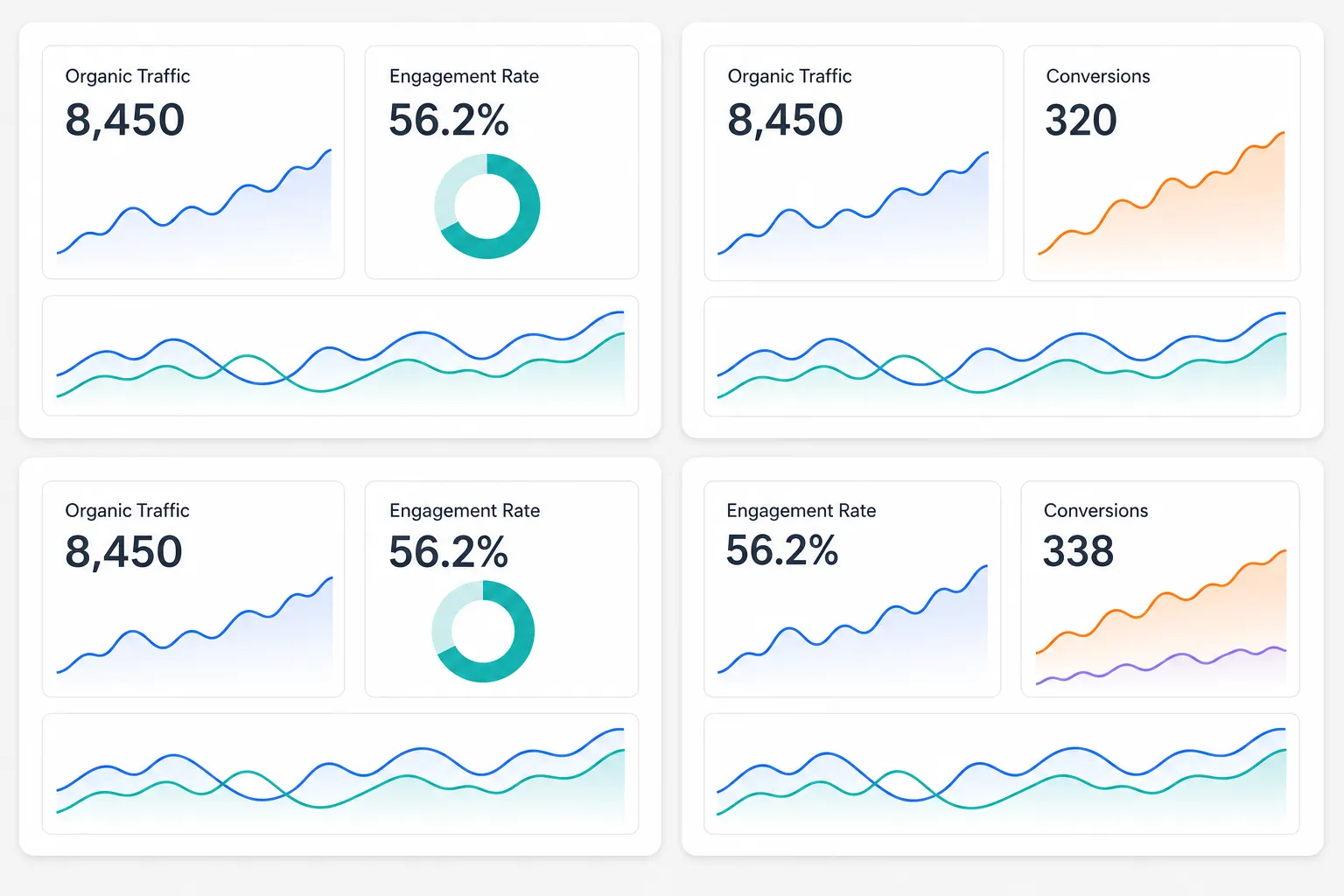
Well-designed dashboards centralise these metrics for effective monitoring. By connecting tools like Google Search Console and Google Analytics, you automate data collection and spot optimisation opportunities more easily.
Audit and prioritise continuously
A regular content audit lets you analyse how your existing content is performing. It reveals which articles need refreshing, which pieces would be better merged to avoid redundancy, and which topics deserve coverage to strengthen your internal linking.
Prioritisation depends on several factors: users' search intent, semantic quality, HTML structure and UX. The golden rule is always to start with the pages offering the best editorial ROI.
Practical recommendations speed up improvements: adding semantic depth, rewording H1 headings, adding relevant images or consolidating internal links. These targeted fixes deliver quick results without advanced technical skills or a developer on call.
Iterate with data
Continuous improvement is driven by real statistics. For a page with high impressions but a low CTR, test different title variants. When the conversion rate disappoints, optimise your CTAs, rework the offer or add social proof such as reviews and case studies.
A/B testing key elements (titles, meta descriptions, buttons) delivers meaningful gains without a full rebuild. This iterative approach protects your rankings while steadily improving your performance.
Integrating with your SEO and publishing tools makes optimisations simpler to roll out. Automatic metadata generation and smart internal linking drastically cut the time between analysis and fix.
Templates to create and execute
To run a high-performing editorial strategy, you need a method that fits your business. Here are flexible templates that will help you hit your goals, whatever your industry, by following a structured, measurable process.
Concrete examples by industry
These practical examples show how to adapt your content to your specific sector. A B2B SaaS company will focus on targeted technical guides and customer case studies, while an ecommerce store will lean on product comparisons and video tutorials.
- B2B SaaS: a flagship "Shopify SEO guide" backed by supporting content like "optimising your product pages", "speeding up your store" and "using structured data"
- Ecommerce: content organised by product range with buying guides, comparisons and FAQs
- Local services: geo-targeted content showcasing customer reviews and local expertise
- Training: progressive educational content backed by certifications and case studies
Remember to repurpose your core content on social media to maximise its reach. Turn a complete guide into a series of LinkedIn posts, educational Instagram stories or short videos. This smart approach to content production maximises your return on investment.
To create relevant content, get your teams actively involved. Sales brings the customer objections, technical staff clarify the complex parts, and customers provide authentic testimonials. This natural collaboration enriches your articles considerably.
Calendar and key checklists
A well-designed editorial calendar structures your long-term planning. It keeps you consistent while covering your strategic themes, alternating cornerstone content with more specialised topics, without overloading your team.
A balanced template usually includes: one flagship piece a month, three to four supporting articles, four to eight social posts a week, a fortnightly newsletter, and regular refreshes of your best-performing content. This organisation guarantees a continuous presence while protecting your team's time and resources.

Rank Higher Without the Manual Work
From technical audits with Nox to competitor monitoring with Marc, Sedestral's AI agents cover every layer of SEO so your team doesn't have to.