You publish web content on a regular basis, but the results just aren't there? You're navigating the digital world without a real compass? Building a solid editorial strategy is the key to turning your output into a genuine growth lever, one that's tightly matched to your business goals.
Here's a concrete, workable method to build an editorial strategy that performs. From the initial analysis to scheduling your posts, via topic organisation and SEO optimisation, you'll see how to create relevant content that attracts qualified traffic and generates measurable conversions.
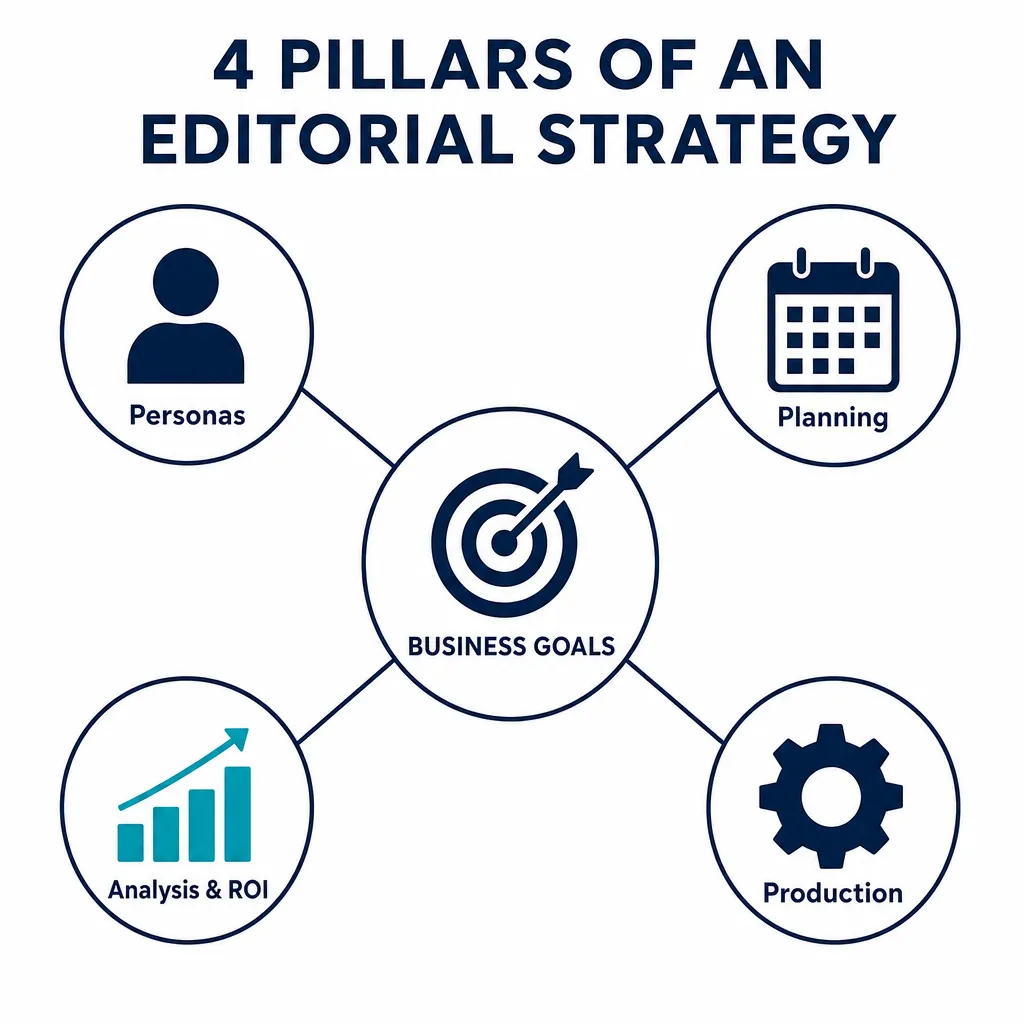
What does web editorial strategy actually mean?
Your online presence should feel like a structured conversation with your target audience. The editorial strategy is the thread running through it: it keeps your communication consistent, optimised for organic search and aligned with what the business actually needs.
A roadmap that serves your goals
The editorial strategy steers content creation, distribution and optimisation. It sets the rules for every digital channel you use - blog, newsletters, social media - while keeping a single, unified brand identity.
To define an editorial line that works, think through these essentials:
- Tone and style: Are you going for expert, educational or relaxed?
- Core topics: Which subjects reflect your expertise and match what your target audience is looking for?
- Preferred formats: in-depth articles, practical videos, infographics or case studies?
- Publishing cadence: What frequency is realistic given your resources?
These strategic choices guide your writers and build a distinctive identity for your target audience. To build an editorial strategy that delivers, four steps are crucial:
- Identify your personas: Who exactly are your personas? What are their needs and behaviours?
- Set SMART goals: for example "Increase leads from the blog by 20% within 6 months"
- Choose channels and formats: Where and how does your audience consume information?
- Organise everything in an editorial calendar: Who does what, by when, tracked with which metrics?
This approach turns every piece of web content into a strategic investment, fully wired into your business goals and designed to build a strategy that lasts.
Why is the editorial line a non-negotiable pillar?
Your editorial line acts as a compass, keeping every blog article and every social post in harmony. Its main goal? To create a recognisable signature that keeps your audience coming back and strengthens your brand identity.
By clarifying your core topics, your tone and your editorial angles, it keeps everyone on subject and in sync - writers, the content marketing team and community managers. To stay effective, this consistent editorial line has to keep adapting to user feedback, market shifts and new SEO opportunities.
Aligning marketing ambitions with editorial output
An effective editorial strategy relies on perfect alignment between your business goals and your editorial calendar. Every post should serve one clear goal: lead acquisition, brand awareness, market education or conversion. That's how content marketing becomes a real growth accelerator.
Set precise KPIs - organic traffic, SERP rankings, conversion rate, reading time - and track them in Google Analytics 4 and Search Console. This data-driven approach lets you adjust your content production in real time based on results. It's the foundation for building an SEO strategy that performs over the long run.
Initial audit and planning: laying the foundations
Before you create any new web content, get a precise diagnosis of where you stand today. A thorough audit is the crucial step that makes your future web content strategy, and your content strategy as a whole, actually work.
Running an in-depth editorial audit
Step one: take a complete inventory of your existing content - articles, pillar pages, guides, product pages - then analyse it with tools like Screaming Frog or SEO platforms (Semrush, Ahrefs).
Your analysis should cover:
- Organic performance: traffic generated, rankings for your strategic keywords, impressions and CTR in Search Console
- Engagement: average time on page, bounce rate, pages per session, conversions
- Opportunities: under-exploited topics, cannibalisation, pages ranking in positions 11-20 (quick wins)
- Technical issues: duplicate content, orphan pages, missing tags, unoptimised images
At Sedestral, we offer an audit tool that shows you, for every page, its ranking, its traffic and above all its SEO health. Spot the content to optimise first at a glance.
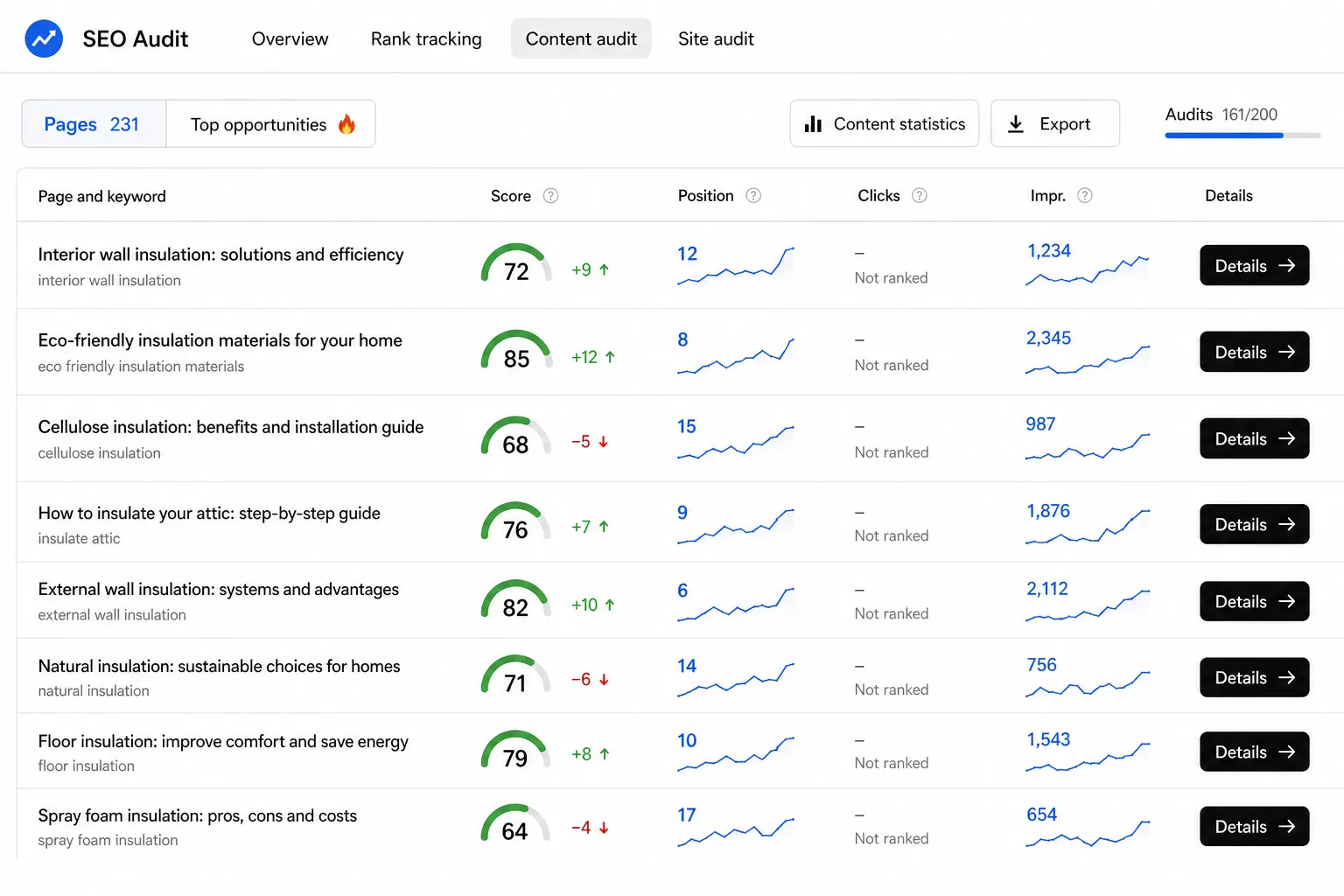
If you'd rather outsource this key phase, bear in mind that this technical and semantic analysis is core work for an SEO consultant: identifying what's holding you back and detecting the levers for organic growth.
Our 4-phase audit method:
- Inventory: build a complete list of your content with URLs, publication dates, monthly traffic and conversion rate.
- Quantitative and qualitative assessment: analyse performance (rankings, click-through rate, conversions) while judging writing quality and SEO.
- Deciding on actions: work out which articles to keep, update, merge or delete, and flag missing topics and quick wins.
- Semantic organisation: structure your content pillars and their supporting articles to strengthen your topical architecture.
This audit gives you a solid base for a consistent editorial line and keeps your pages from cannibalising each other.
Running a targeted competitor analysis
Studying your competitors isn't about copying them, it's about spotting strategic opportunities. Focus your analysis on:
- Their best-performing content (estimated traffic, backlinks, social engagement)
- Angles they cover superficially or ignore altogether
- The relevance and difficulty of the strategic keywords they target
Tools like Ubersuggest or Semrush help you identify the opportunities with the best ratio between traffic potential and ranking difficulty.
Example of a competitor comparison table:
| Metric | Your site | Competitor A | Competitor B | Opportunities |
| Articles published per month | 4 | 8 | 6 | Increase publishing frequency |
| Main topics covered | Marketing, SEO | SEO, social media | Marketing, email | Build an "Email marketing" hub |
| Dominant format | Long-form text | Videos, articles | Infographics | Diversify with video and visuals |
| Link profile | 32 referring domains | 78 referring domains | 51 referring domains | Invest in link building |
Structuring topic clusters and optimising internal linking
Once the audit is done, organise your content around topical content pillars (also called "topic clusters"). This structure strengthens your SEO while giving visitors a better experience.
- The pillar page: A complete guide (2,000 to 4,000 words) covering a main theme, such as "ecommerce SEO".
- The cluster pages: 4 to 8 articles that dig into specific aspects: technical audit, product pages, case studies.
- Internal linking: Relevant links with descriptive anchors, connecting the articles to each other and to the pillar page.
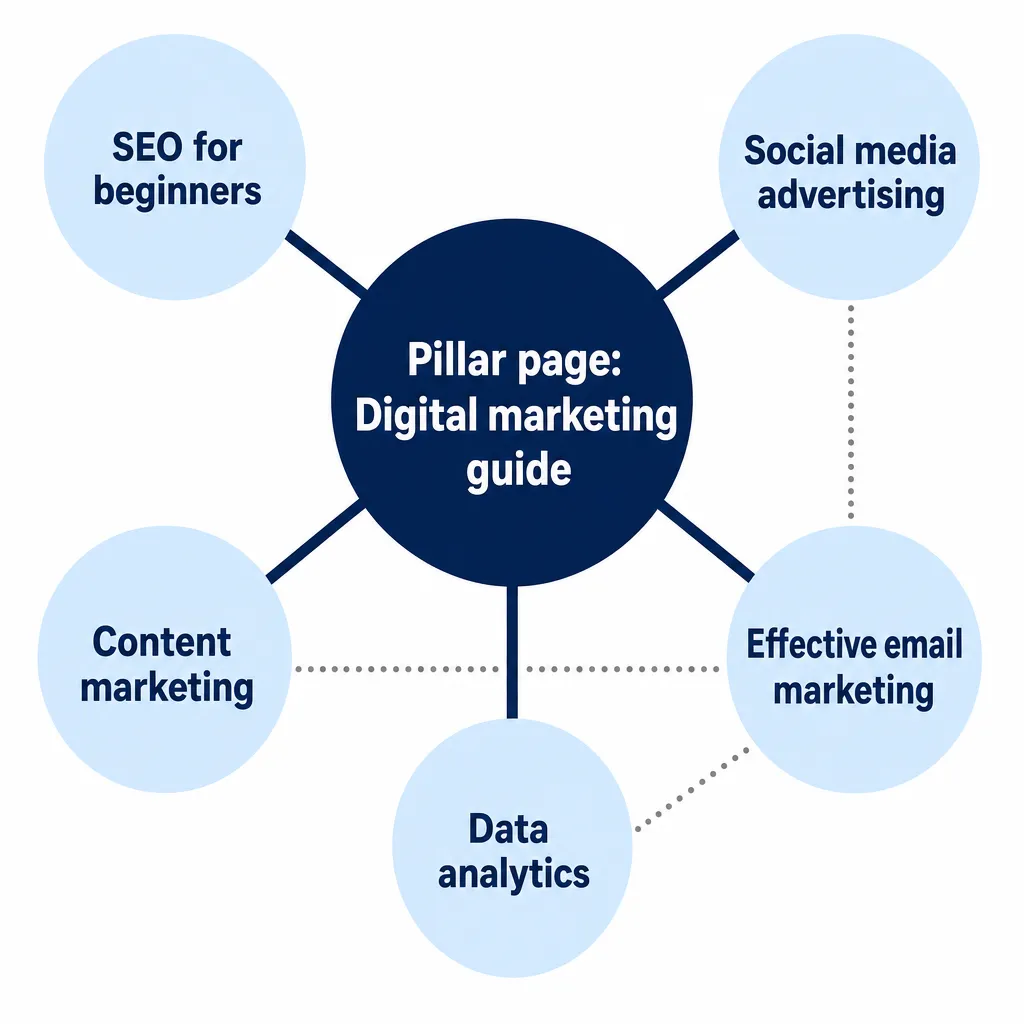
This structure boosts your topical authority, spreads link juice intelligently across the whole cluster and makes navigation easier for your visitors. Applied methodically, it forms the base of an effective, sustainable SEO content strategy.
The style guide: your reference for consistency
The editorial style guide is the essential framework for keeping your content production perfectly cohesive. This reference document gathers every standard and best practice that all your writers must follow, whether they work in-house or externally.
Your style guide absolutely must cover:
- Writing rules: Tone used (educational, expert or conversational), writing style (concise sentences, active verbs), formatting conventions (use of H2/H3, emphasis with bold and italics).
- SEO recommendations: Ideal article length (1,500 to 2,500 words for in-depth content, 800 to 1,200 for practical guides), natural keyword density (around 1 to 2%), heading architecture (a single H1 containing the main keyword, logically built H2/H3s), meta descriptions that sum up the page in a sentence or two (Google sets no character limit and truncates snippets to fit the screen), short and clear URLs.
- Linking strategy: At least two relevant internal links per article, one external link to a trusted source, varied and descriptive anchor text.
- Media management: Recommended formats (WebP/AVIF), explicit file names (e.g.
strategie-editoriale-planning-exemple.webp), precise alt text for accessibility and SEO, lazy loading as standard, mandatory source credits. - Approval workflow: A well-defined process: Writing → Editorial review → SEO check → Final approval → Publishing. Platforms like Trello, Asana or Notion make this coordination much easier.
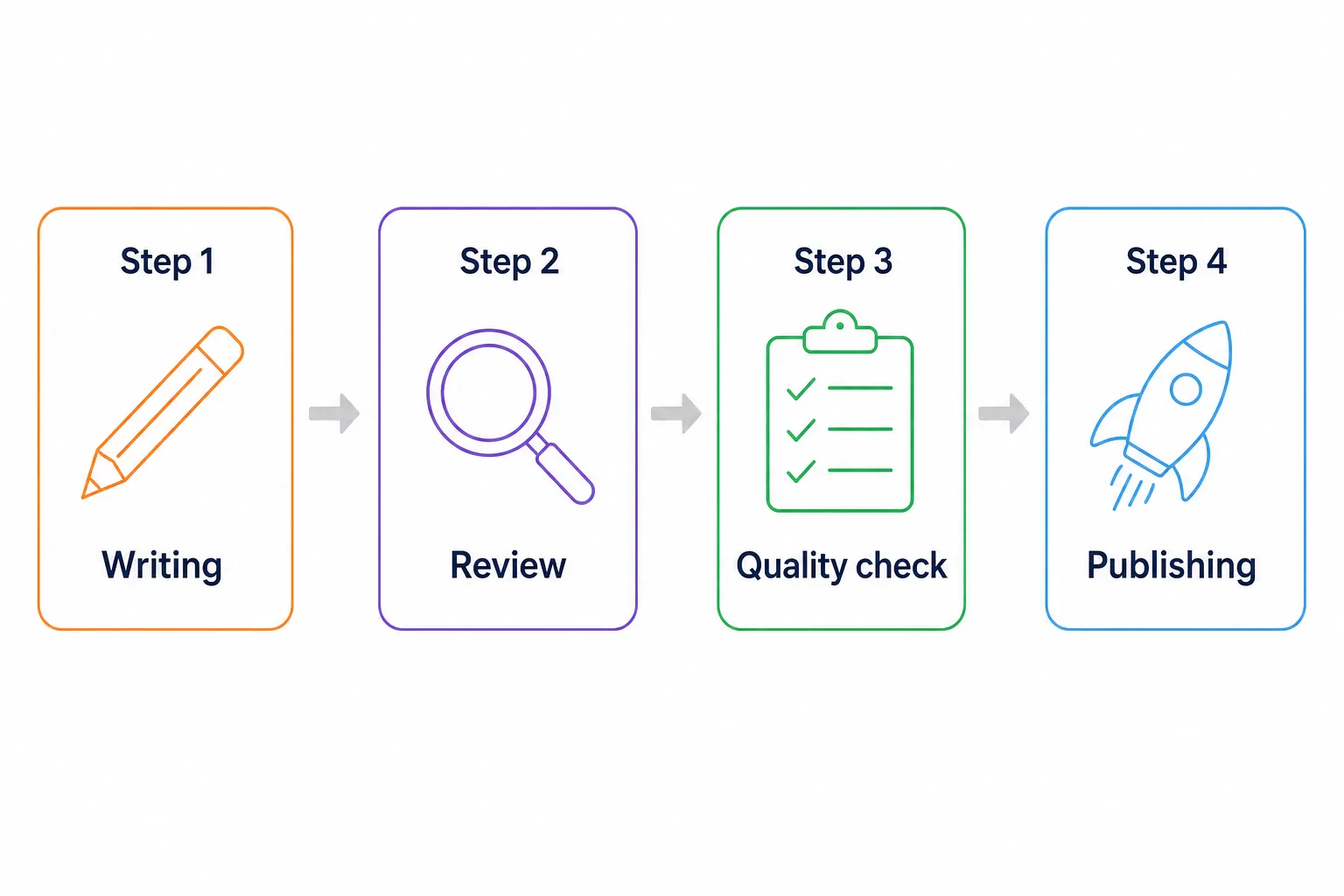
A living document by nature, this style guide needs a yearly update to fold in algorithm changes (Core Web Vitals, structured data, E-E-A-T) as well as emerging trends in web content and SEO.
Aligning your strategy with your target personas
Quality content, even flawlessly written, will have zero impact if it doesn't reach the right person, at the right time, with the right message. Tailoring your editorial strategy precisely to your buyer personas is therefore essential for concrete, measurable results.
Building actionable buyer personas
A useful persona goes well beyond a simple demographic profile. It should accurately reflect the needs, blockers, professional goals, objections and decision-making journey of your ideal customer. Combine quantitative data (Google Analytics 4, Search Console) with qualitative input (customer interviews, sales feedback, NPS surveys) to build profiles you can actually use.
These personas then concretely guide your choice of topics, editorial tone, preferred formats and distribution channels. For example: Julie, marketing manager at an SMB, wants practical SEO guides she can get through in 30 to 60 minutes, available on LinkedIn and by newsletter.
Concrete example: An organisation like JustGiving, which targets several audiences (charities, donors, fundraisers), maximises its impact by creating specific articles for each persona, addressing exactly their problems.
Selecting channels and formats for each target
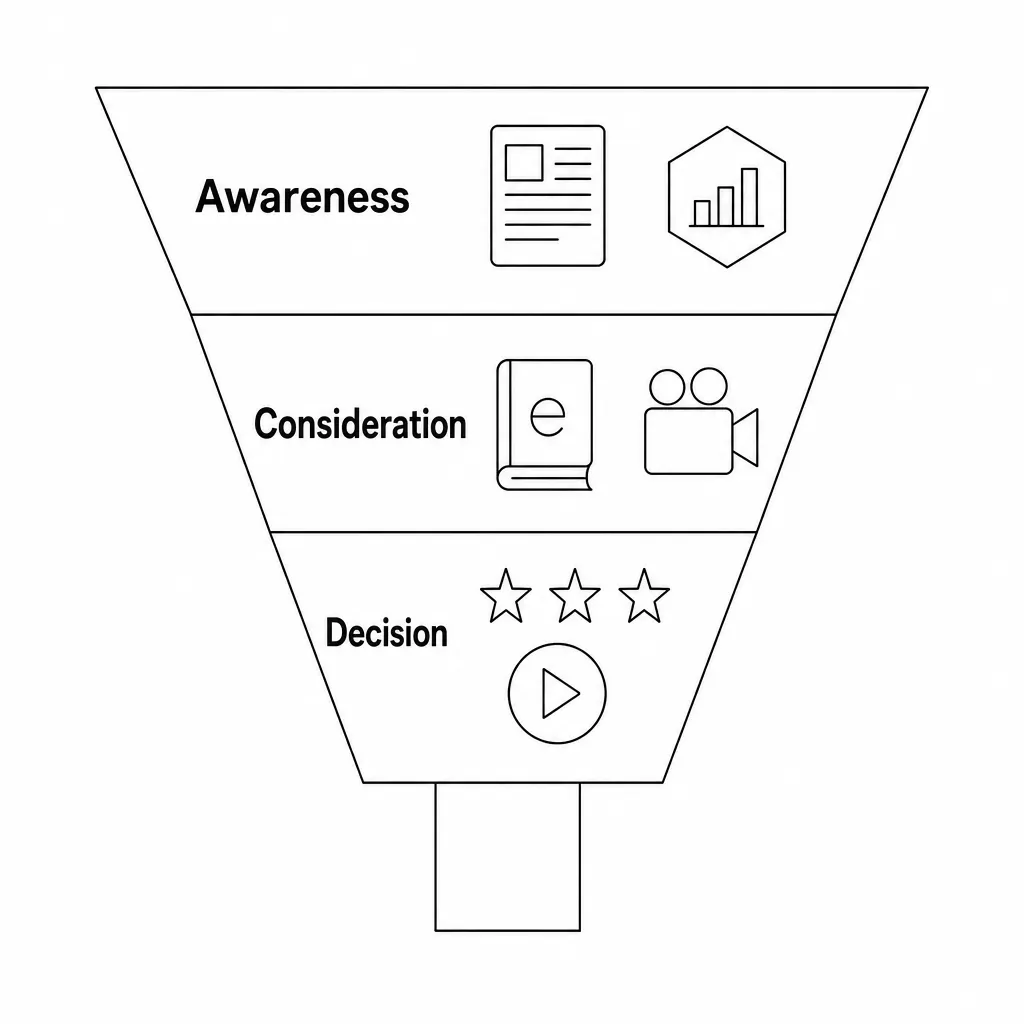
Don't spread yourself thin. For each persona, identify two or three priority distribution channels (company blog, LinkedIn, niche newsletter, YouTube). Adapt formats and content type to where the prospect is in their buying journey:
- Awareness stage (top of the funnel): articles on the blog optimised for SEO, short video tutorials, educational infographics, engaging LinkedIn posts.
- Consideration stage (middle of the funnel): detailed case studies, interactive webinars, downloadable white papers, solution comparisons.
- Decision stage (bottom of the funnel): comparative buying guides, product demos, customer testimonials, free trials.
Bringing personas into your reporting
Systematically analyse your KPIs - clicks, conversions, average reading time, shares - segmented by persona. If you notice that video tutorials generate three times more qualified leads with your "Junior Project Manager" persona than long articles do, shift your resources to maximise the ROI of your content marketing.
Integrating link building into your editorial strategy
Link building shouldn't be an afterthought. It's a key element to build in from the moment you start designing your editorial strategy. Relevant backlinks considerably strengthen the authority of your pillar pages and their visibility in search results. Our dedicated guide explains how to combine link building with your online editorial strategy through several actions: auditing your existing links, finding opportunities (such as guest posting on a partner blog or creating link-worthy content), choosing credible sources in your field, optimising anchors (following the 80/20 rule) and acquiring links progressively (2 to 5 per month, for example). The emphasis is on quality over quantity, well-structured internal linking and content strong enough to earn natural backlinks. Tracking with tools like Ahrefs and Search Console helps you maximise the SEO payoff and improve visibility. Learn how to integrate link building into your web editorial strategy
Aligning pillar pages with link building goals
Right from the design phase, identify the pillar pages that will be the main targets of your backlink acquisition efforts. For example, a "Complete Shopify SEO guide" naturally becomes a strategic page to promote to ecommerce trade media.
Planning publication and outreach campaigns
Coordinate the publication of high-value content (original studies, free tools, shareable infographics) with well-targeted outreach campaigns aimed at the influential players in your sector. A realistic goal is two to five quality backlinks per month pointing to your strategic content.
Creating linkable assets
Favour formats that invite citations and spontaneous sharing:
- Original studies with exclusive data (with embeddable charts and downloadable datasets).
- Free-access tools (calculators, simulators, automatic generators).
- Well-sourced, properly credited infographics that are easy to reuse.
- Exhaustive guides such as "The 50 checkpoints of a technical SEO audit".
Remember to include clear summaries and key figures to encourage other sites to cite you.
Following the 80/20 anchor text rule
In your link profile, aim for 80% natural anchors (brand name, generic URL) and only 20% anchors optimised with your keywords. Favour genuine editorial collaborations, broken link building and quality guest blogging over forced link exchanges.
Creating quality SEO content: the 5-step method
For your editorial strategy to succeed, content creation optimised for SEO needs a methodical approach. Here's our 5-step process for producing content that's relevant, well structured and performs in search results. Our dedicated guide shows you concretely how to build an effective editorial strategy in 2026, combining SEO best practices (E-E-A-T, topic clusters) with rigorous organisation: SERP analysis, defining the semantic core, UX-friendly content structure, media optimisation and relevant link building. You'll also find technical advice (Core Web Vitals, structured data), best practices for using AI wisely, and methods for tracking performance and keeping your content current (regular audits against obsolescence). Read the complete guide to optimising your web editorial strategy
Step 1: Analyse the SERP and decode search intent
Before you start writing, study the top Google results for your main keyword closely:
- Which content types dominate? (detailed articles, listicles, comparisons)
- What approach do the top 3 results take?
- Which related questions appear in "People also ask"?
- Are there featured snippets you could win?
This research lets you align your content with what people are actually searching for while spotting original angles.
Step 2: Define the semantic core and structure
Develop a rich semantic network around your keyword using:
- Google's autocomplete suggestions;
- Tools like Semrush or AnswerThePublic;
- Analysis of the best competing content.
Then structure your ideas with logical H2/H3 headings that cover the whole topic while keeping the read fluid.
Step 3: Write for humans, optimise for search engines
Adopt an effective writing style that serves both your readers and SEO:
- Short, well-spaced paragraphs;
- Lists and tables for quick scanning;
- Concrete examples and practical cases;
- A tone suited to your target persona.
Work your keywords in naturally, without overdoing it. AI can help with the writing, but a human review remains essential to guarantee quality and relevance.
Step 4: Optimise media and technical performance
Don't neglect technical optimisation:
- Modern image formats with good compression;
- Descriptive alt text and specified dimensions;
- Lazy loading for off-screen images;
- Structured data to enrich how you appear in results.
Aim for excellent Core Web Vitals (LCP < 2.5 s, INP < 200 ms, CLS < 0.1) by regularly optimising your hosting and scripts.
Step 5: Weave strategic internal links
Slot every new piece of content into your existing content pillars:
- Link to the topic cluster's pillar page using clear, relevant anchor text.
- Link the cluster pages of the same cluster to each other to reinforce their semantic cohesion.
- Refresh your existing articles by adding natural links to your new content.
This approach distributes link juice effectively, increases time on site and improves your topical expertise in the eyes of search engines.
The editorial calendar: plan to perform
A well-designed editorial calendar is the operational backbone of your editorial strategy. It turns your ambitions into concrete, measurable actions. Our dedicated guide details how to build an editorial strategy that performs: set SMART goals, analyse your personas, study the competition, organise your keywords into clusters and plan 3 to 6 months ahead. You'll find the keys to:
- Keeping multichannel consistency
- Boosting writing productivity
- Strengthening your topical authority
The guide also offers a 5-step method (audit, persona, keyword research, planning, optimisation) and compares the right tools for each maturity level. Learn how to create an editorial calendar that performs
Must-have fields in your schedule
Your editorial calendar should always include:
- Working title including the main keyword
- Target persona and customer journey stage
- Main keyword with its search volume
- Content type (blog article, video, etc.)
- Main distribution channel (blog, social media...)
- Quantifiable goal (traffic, conversions...)
- Writing and SEO owners
- Key dates (writing and publication)
- Progress status
- Complete SEO checklist
Recommended tools by maturity level
- Getting started: Google Sheets (simple and free)
- Growth: Trello or Notion (visual, flexible management)
- Scale: Asana/Airtable (advanced automations)
Atomisation and multichannel amplification
Maximise the impact of every piece with smart repurposing:
- One blog article can become: 3 LinkedIn posts, a thread on X, a newsletter, 1 infographic and 1 short video
- Standardise your visuals with Canva/Figma
- Stagger your posts over 2-4 weeks
Continuous steering: measure, adjust, improve
To stay effective over the long term, a solid editorial strategy has to keep evolving. Rigorous tracking and regular optimisation are essential to maintain and improve performance month after month.
Dashboard and essential KPIs
Build a monthly dashboard in Google Analytics 4 and Search Console to analyse:
- Overall traffic, especially on your strategic pages.
- The average position of your priority keywords (top 10).
- The average CTR and the volume of impressions in Search Console.
- The conversion rate driven by your content (leads, sales, sign-ups).
- Time on page and bounce rate by content type.
- New referring domains earned during the month.
Fighting content decay
Your content ages naturally over time. Run a quarterly audit to identify:
- Pages whose rankings are slipping (Search Console data over 6 months).
- Outdated information that needs refreshing (figures, examples, visuals).
- Opportunities for semantic enrichment (new featured snippets, trends).
Corrective actions: update, expand, merge redundant content (with 301 redirects), or remove underperforming pages.
Data-driven tests and iterations
Adopt a test-and-learn approach:
- Test different variations of titles and meta descriptions on pages with low CTR.
- Experiment with various CTAs (buttons, forms, pop-ups) to lift conversions.
- Study user journeys in GA4 to spot friction points.
- Focus your efforts on the best-performing formats and topics for each persona.
Be patient: a rigorous editorial strategy usually takes several months of consistent work before its effect on organic traffic and conversions becomes clear.
Strengthening E-E-A-T and building trust
Google now puts real weight on E-E-A-T (Experience, Expertise, Authoritativeness, Trustworthiness) to assess content quality. Folding these criteria into your editorial strategy is now essential for your visibility.
Showing experience and expertise
- Detailed author bios: include their photo, professional background, certifications and links to their profiles such as LinkedIn.
- Concrete proof: share tests you've run, customer case studies, hard numbers and industry certifications (such as a Gas Safe registration for heating engineers).
- Bylined content: every article should clearly name its author, whose expertise in the field must be verifiable.
Building authority and trust
- Quality backlinks: earn 10 to 15 links from recognised specialist sites in your sector (for example Construction News or Engineering News-Record for the building trade).
- Person and Organization schema markup: make it easier for search engines to recognise your expertise.
- Maximum transparency: always show publication and update dates, your sources and your methodology.
- Legal documents: make your legal notice and privacy policy prominent, GDPR and CCPA compliant, and easy to find.
AI governance in production
If you use artificial intelligence to speed up your content production:
- Position AI as an assistant, never as the lead writer.
- Always run a human review before publishing.
- Rigorously check every fact, figure and quote.
- Enrich content with practical cases, field feedback and expert analysis.
Resources, team organisation and governance
For your editorial strategy to succeed, how well your organisation runs matters as much as the quality of your content.
Typical make-up of a high-performing editorial team
- Editorial lead: steers the strategy, coordinates actions and tracks key metrics.
- Writers: handle content production in line with the briefs and the style guide.
- Subject matter expert: guarantees technical accuracy and brings hands-on know-how.
- SEO specialist: manages keyword research, technical optimisation and link building.
- Designer: creates visuals, infographics and graphic templates.
- Community manager: runs social media and analyses performance.
Documented workflow and clear governance
- Standardisation: unify file names, URLs and how visuals are archived.
- Formal deadlines: allow 5 days for writing, 2 days for approval and 1 day for going live.
- Continuous evaluation: analyse results at 30 days, then optimise at 90 days.
- Refreshing: revise your strategic content every 6 to 12 months.
Strategic outsourcing
Depending on your needs, you can delegate:
- The initial audit and the definition of your editorial strategy to specialist consultants.
- Large-scale content production to freelance writers or agencies.
- Backlink acquisition to link building experts.
- Training your teams in SEO and web writing.
Practical guide: first steps in SEO
Just getting interested in organic search and looking to build a strategy that works? This complete guide is made for you. Designed as a true companion, it explains the key concepts and lays out a concrete method for taking action. Perfect for beginners, it shows step by step how to build a web editorial strategy that performs: from the fundamentals (crawling, sitemaps, robots.txt) to indexing, via intent-focused keyword research, content organisation (H1/H2/H3 tags), SEO writing techniques, internal links and content pillars, right through to link building and tracking with Google Search Console and Analytics. You'll also learn to pick the right formats, tap into the long tail, refresh your content regularly and run audits to boost your online visibility for good. Plenty of practical tools to build or improve your editorial calendar. Learn how to optimise your web editorial strategy.
On the agenda:
- Understanding how Google crawls, indexes and ranks web pages.
- Finding the keywords that truly match what your visitors search for.
- Organising your content effectively (H1/H2/H3 headings, internal links).
- Writing for SEO while meeting readers' expectations.
- Tapping into the long tail and picking the right formats.
- Measuring your results with Google Search Console and Analytics.
This knowledge will immediately help you build or refine your editorial calendar, so that every post actively contributes to your organic visibility.

Automate Your SEO With AI Agents
Sedestral connects six AI agents to your website to handle content, audits, rankings, backlinks and images, without the manual grind.