After a decade spent optimising websites, if we had to pick a single SEO tool to run our SEO strategy, we'd pick Ahrefs without hesitating. It's far more than a piece of software: it turns messy data into concrete opportunities to grow your visibility and get ahead of the competition.
This Ahrefs guide walks you through our step-by-step approach to analysing, strengthening and outranking your competitors. You'll learn how to structure your work, estimate the cost and get the most out of every feature so your organic rankings keep growing in 2026.
Why Ahrefs is the must-have SEO tool in 2026
Ahrefs is a complete analysis tool that examines every corner of a website: it estimates organic traffic, analyses the link profile and pinpoints your key pages. Together, these features let you audit your content, measure how well your link building is working and focus your effort where it moves the needle.
The essential Ahrefs features
Ahrefs offers five core modules that cover every SEO need:
- Site Explorer: Analyse any domain to list its backlinks, anchors, top pages and organic traffic. This overview helps you quickly find the pages that drive traffic and the referring domains that matter strategically.
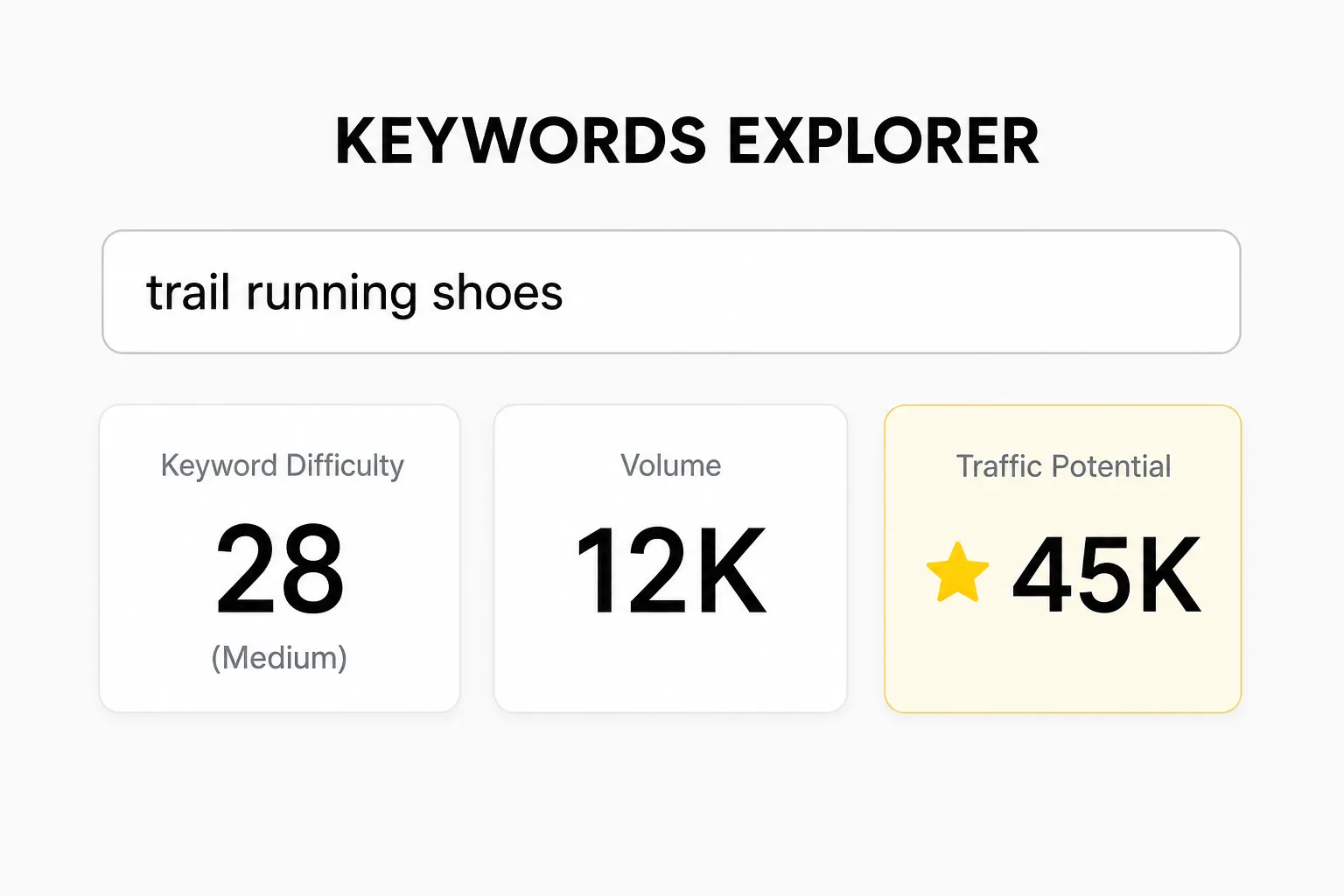
- Keywords Explorer: A real search engine of its own that surfaces relevant keywords: volume, keyword difficulty, estimated clicks and related topics. Prioritise your targets by combining difficulty with real clicks rather than relying on volume alone.
- Content Explorer: Finds the most shared and most linked articles on any topic. Use it to explore ideas, spot the formats that perform and find collaboration opportunities.
- Site Audit: A technical crawler that flags 404 errors, duplicate tags, canonical issues, load speed problems and Core Web Vitals.
- Rank Tracker: Daily or weekly position tracking with visibility charts, traffic estimates and a full history of movements.
The Ahrefs tool also sends alerts for every new or lost backlink, offers a browser extension for quick checks and provides an API to automate your reporting. A genuine must-have SEO tool for growing your site.
The key metrics for measuring a site's authority
To measure a site's authority, Ahrefs relies on a handful of essential metrics:
- Domain Rating (DR): A score from 0 to 100 reflecting the overall strength of the inbound link profile.
- URL Rating (UR): Measures the strength of an individual page based on its inbound links.
- Ahrefs Rank (AR): Ranks a site by the quality and quantity of its links; a low Ahrefs Rank means a strong link profile.
- Referring Domains (RD): Counts the number of unique domains pointing to your content.
⭐ Expert tip: Set up alerts in Ahrefs so you're notified the moment a competitor earns a quality backlink. You can then study their strategy in real time and go after similar opportunities.
Initial setup: creating your first Ahrefs project
To get started with your Ahrefs account, the first step is to create a dedicated project for your domain. This basic setup centralises your key data and lets you schedule automatic analyses so you save time from day one.
Project setup steps
- Create the project: Start by choosing the right protocol (https or http), then enter your strategic keywords and your main competitors. Finally, connect your Google Search Console and Google Analytics accounts so you can cross-reference error data with your real traffic.
- Set up monitoring: Build keyword lists, switch on alerts to track your backlinks and rankings, then configure the technical audit crawls.
- Organise your initial workflow: Structure your approach in four steps: 1) Technical audit, 2) Link profile analysis, 3) Keyword research and content gap identification, 4) Prioritising the pages to optimise.
Running Site Audit to catch critical issues
The site audit tool is your best ally for quickly identifying major technical problems. Here's how to use it well:
- Run a full crawl: Detect critical errors (broken links, redirect loops, unindexed pages), common anomalies (duplicate tags, missing titles) and performance issues (Core Web Vitals).
- Prioritise the fixes: Start by resolving indexing problems and server errors (5xx), then focus on pages that drive traffic but load too slowly (LCP > 2.5 s, CLS > 0.1).
- Schedule regular audits: Set up weekly or monthly crawls to catch any issue that appears after a technical change.
Automating tracking with Rank Tracker
Configure Rank Tracker with your location (country, city) and device type (mobile or desktop). Local mobile tracking often reveals specific ranking drops, showing you exactly where to focus your optimisations.
- Automate your reports: Set up automatic reports combining rankings and major errors so you can react immediately to any abnormal drop.
- Enable meaningful alerts: A sudden five-position drop can signal a technical problem or an algorithm update that needs fast attention.
⭐ Expert tip: Connect your Search Console to compare the issues Ahrefs detects with your real traffic. This approach lets you concentrate on the fixes that will genuinely affect your visibility.
Keyword research: finding profitable opportunities
Keyword research is the foundation of any effective SEO strategy. With Keywords Explorer, you can uncover thousands of variations in seconds, then group them by theme to build relevant topic clusters.
A practical keyword research workflow
- Start with seed terms, then expand: Create location-based variants, questions and long-tail phrases, for example "restaurant london" → "best cheap italian restaurant shoreditch".
- Check the essential indicators: In Keywords Explorer, look at volume, difficulty (KD), estimated clicks, CPC and parent topic, then pick keywords based on search intent and competition.
- Prioritise by intent and real traffic: Favour queries with strong buying intent or a high click-through rate over those that simply have a big volume. The Traffic Potential metric estimates the total traffic a top-ranking page can bring in from all its related keywords.
- Organise by topic: Gather each keyword group around a pillar page, then build supporting content to establish your expertise.
Creating optimised content briefs
To create content that dominates the SERP, first inspect the top 10 pages your competitors rank with. You'll extract the ideal structure and see what it takes to beat them.
- Define the 3 key criteria: Content type (blog post, product page, video), format (guide, top 10, comparison) and angle (beginner, expert, budget option).
- Structure with H2-H3 headings: Borrow the sub-topics the leaders use and adapt them to your own strategy.
- Gauge the investment required: Estimate how many backlinks you need to compete with the top results, then plan your campaign accordingly.
- Optimise with AI: Automatically generate detailed briefs (with H2/H3 and section ideas) to produce faster without sacrificing quality.
Organising your content into topic clusters
Don't just target isolated keywords: group them into coherent topics. A pillar page on "electric bike" can be linked to supporting articles such as "electric bike benefits" or "electric bike battery maintenance", consolidating your expertise on the subject.
- Build a hub-and-spoke structure: Create a network where every supporting piece points to the pillar page through strategically placed internal links.
- Vary your anchors: Use different anchors to reinforce semantic relevance and spread authority effectively.
- Offer real added value: Add exclusive data, studies or downloadable tools to attract backlinks naturally and lift your metrics.
Competitor analysis: Content Gap and Link Intersect
Study where your site stands against your competitors to identify the keywords they exploit and you overlook. A thorough Ahrefs analysis reveals these gaps so you can fill them and improve your SEO performance.
Using Content Gap to spot the gaps
The Ahrefs Content Gap tool lets you compare yourself with up to five competitors at once. It detects the queries they rank for while you're nowhere to be seen. Sort those queries by volume or search intent to build an optimised editorial strategy.
- Choose your competitors: Add between two and five rival sites in the Content Gap tool and launch the analysis.
- Spot the opportunities: Pull the list of keywords where your competitors rank but you're absent.
- Prioritise the queries: Focus first on terms that generate strong traffic with high commercial potential.
- Measure the results: Done well, this strategy can deliver significant organic traffic growth within a few months.
Finding backlink opportunities with Link Intersect
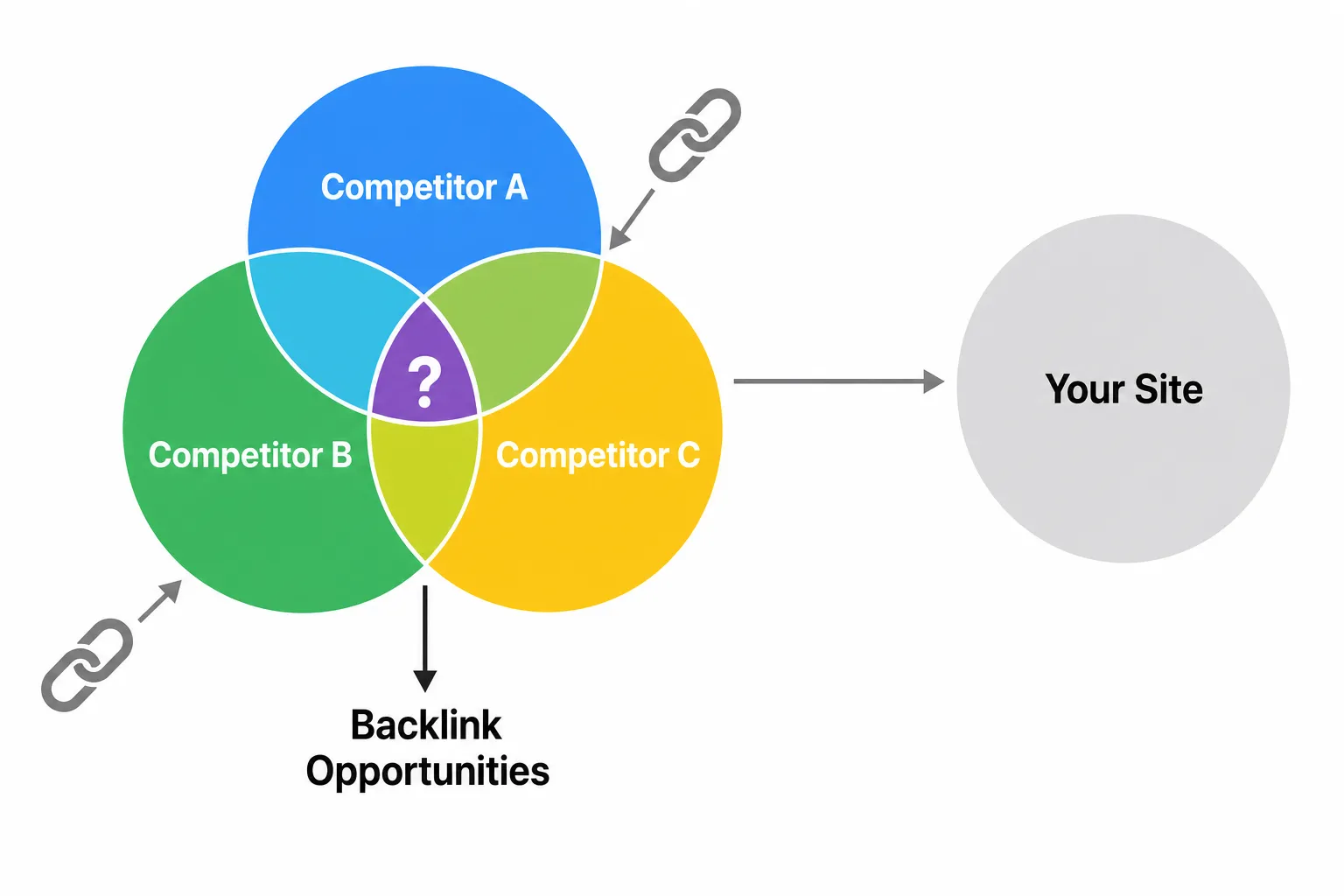
Link Intersect identifies the sites that link to your competitors without mentioning you, revealing ideal targets for earning relevant backlinks.
- Define your competitors: Enter the URLs of two or three competitors in Link Intersect to run the analysis.
- Refine the results: Target domains with a DR > 30, decent traffic and a topic that matches yours.
- Reach out to the target sites: Find their contact details, send a personal message that offers value and follow up rigorously.
- Bet on relevance: A single link from a trusted source in your industry is worth more than dozens of links with no real value.
Targeting vulnerable competitor pages
Go after competitor pages that rank well but have few backlinks. By producing better content and earning a few strategic links, you can overtake them with relative ease.
⭐ Expert tip: Use Content Explorer to find popular but poorly optimised articles. Publish an improved version, then pitch the same sources to win those valuable backlinks. This technique builds your authority fast and widens the network of links you can explore.
Backlink audit and strategy: building a solid link profile
To succeed at link building, the quality of your link profile is everything. A thorough audit of your backlinks lets you detect toxic links, check the safety of your anchors and spot the pages affected by suspicious inbound links.
Auditing and cleaning your inbound link profile
Put an effective strategy in place: contact the owners of the sites involved or prepare a disavow file if needed. Also look for broken links pointing to your competitors and suggest your own content as the replacement to strengthen your inbound link profile.
- Referring domain analysis: Sort them by DR (Domain Rating) and prioritise disavowing unreliable sites (.xyz domains, outdated directories).
- IP/C-block check: Detect possible PBN networks by examining clusters of similar IP addresses.
- Anchor optimisation: Keep a healthy balance (~70% brand, 20% URL, 10% generic) and avoid any over-optimisation.
- Disavow procedure: Select the problematic links, export them as CSV, convert the file to .txt, then submit it through Google Search Console.
Recovering lost and broken links
Turn mentions of your brand into real backlinks with a strategic approach. A well-run campaign can give your organic visibility a real boost within a few months.
- Broken links (404) and lost links: Bring the page back, set up a 301 redirect or contact the webmaster to restore the link.
- Quality assessment: Consider DR, referral traffic, topical relevance and dofollow/nofollow status before taking any corrective action.
- Regular monitoring: Set up alerts for new or lost links so you can act quickly.
Advanced link building strategies
Broken link building means finding external pages that return a 404 but still hold backlinks, then offering your content as the replacement. The Skyscraper technique identifies high-performing articles so you can create improved, more shareable versions.
- Acquisition process: Export your prospects with Content Explorer, collect their contact details, send a personalised email and follow up rigorously.
- Quality first: Target sites specialised in your niche rather than generic directories.
- Continuous monitoring: Enable alerts for every new or lost backlink, and document your actions systematically.
⭐ Expert tip: Natural variety in your anchors (brand, URL, exact/partial keywords) keeps Google happy, whereas an excessive concentration of optimised anchors risks triggering a penalty.
On-page optimisation: aligning content with search intent
Start by analysing the SERP: type your main keyword into Google, then use Keywords Explorer to explore its potential. Pay close attention to the three Cs (type, format and angle) that dominate the results, then adapt your content to the best-performing format.
Structuring your content for Google and readers
Organise your page with a clear structure: a single H1, logical H2/H3 subheadings and well-integrated FAQ sections and step-by-step lists. Place your main keyword in the introduction (first 100 words) for natural optimisation.
- Title (H1): Short and punchy, paired with a targeted
titletag (no official limit, but long titles get truncated). - Meta description: Compelling and concise (no official limit, but long snippets get truncated) to boost CTR.
- URL: Simplified, with the main keyword clearly visible.
- Images: Optimised with relevant file names, descriptive
alttags and WebP format for speed. - Schema markup (Article, Product, Breadcrumb): makes the page eligible for rich results, with no guarantee they will show.
Targeting featured snippets and rich results
Maximise your visibility with relevant Schema.org markup and write short answers (40-60 words) or lists to capture snippets. Google loves this format!
- Immediate answer: Open a paragraph with a clear, short explanation.
- Organised lists: Google's favourite format for featured snippets.
- Structured data: Schema markup multiplies your chances of appearing in rich results.
Bringing unique value
Set your content apart with genuine added value: exclusive studies, practical templates or original data. Avoid copying and innovate to earn links spontaneously.
Technical audit: fixing the invisible foundations
For lasting visibility in the SERPs, you need a fast site free of technical problems. Use the Ahrefs Site Audit tool to run a full site audit that detects 4xx/5xx errors, pages blocked by robots.txt or noindex, inconsistent canonical tags and orphan pages.
3-Step technical audit checklist
- Crawl and indexing: Launch a crawl with Site Audit, spot 404 errors, redirect loops, important pages set to noindex and canonical tag problems, then cross-check this data with Google Search Console.
- Speed and Core Web Vitals: Optimise for an LCP under 2.5 s (image compression, CDN), reduce INP by removing blocking JavaScript and stabilise CLS with fixed-size images. Then verify with PageSpeed Insights.
- Prioritisation and follow-up: Rank the fixes: P1 for 5xx errors and unindexed pages, P2 for duplicate content or 302 redirects, P3 for missing internal links or overly long metadata.
Once the problems are fixed, run a new audit a month later and compare how the Ahrefs Health Score and organic traffic have moved. For a more in-depth method, read our technical SEO audit guide.
Performance tracking: steering your strategy with data
Staying visible takes regular monitoring. With Ahrefs Rank Tracker, keep an efficient eye on your rankings, visibility, share of voice and SERP features.
Weekly KPIs and custom alerts
Every week, review how your keywords are moving and compare your market share with your competitors'. Any anomaly should trigger an immediate response.
- Key indicators: Track your target rankings, estimated traffic, backlinks gained/lost and the evolution of your Domain Rating.
- Proactive monitoring: Get alerted on ranking drops, the loss of an important backlink or the acquisition of a quality link.
- Automated reporting: Generate PDF/CSV reports for your teams/clients and run month-on-month comparisons.
- Prioritisation: For pages that have stagnated for 3 months, refresh their content, strengthen the internal links and step up your link building.
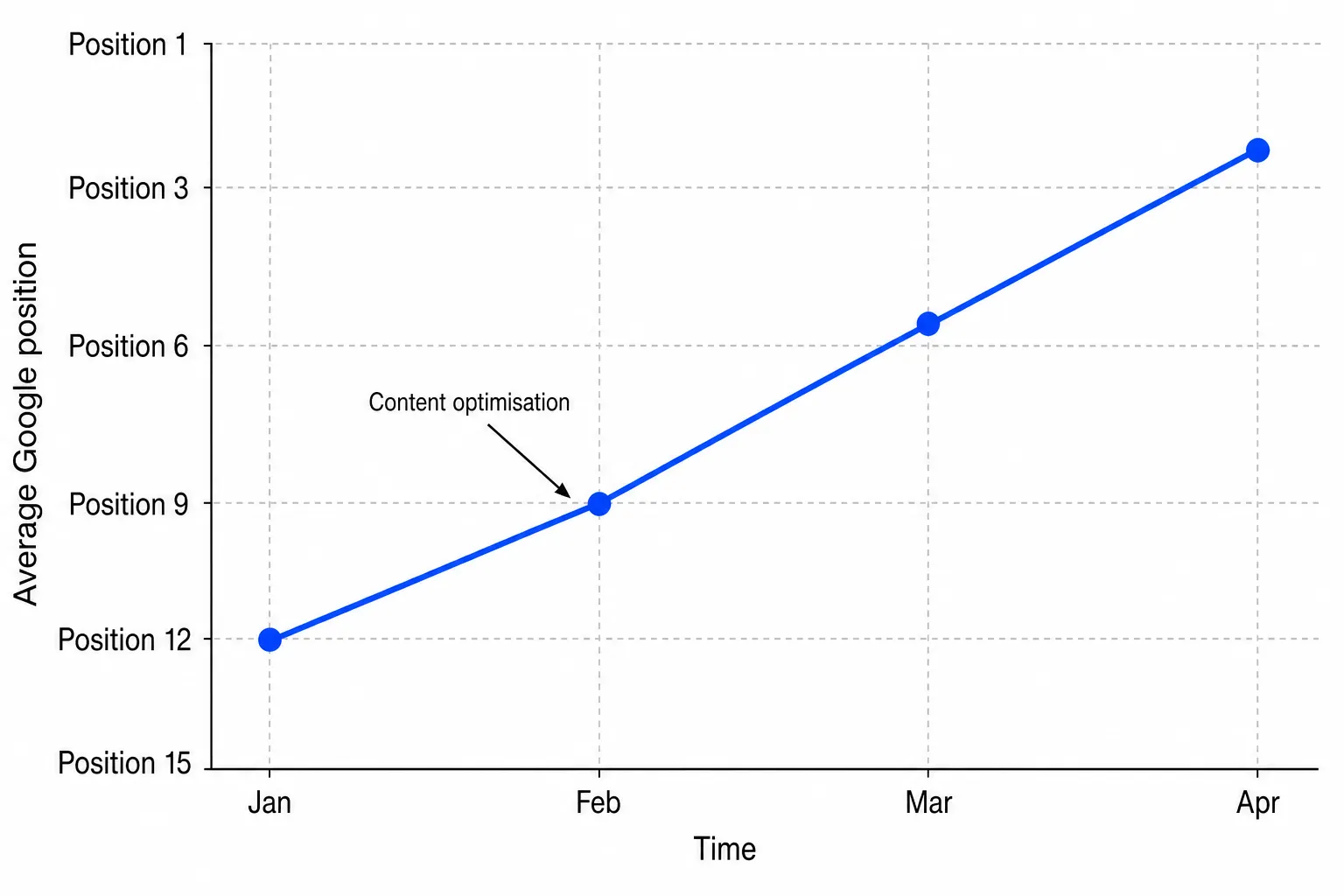
Our dashboard template centralises all these metrics; adopt it to anticipate the impact of algorithm updates.
| Target page | Main keyword | Starting position | Current position | Action taken | Result |
| /trail-guide/ | trail running shoes | 12 | 4 | Added a comparison table and updated 2026 data | Example: compare traffic after 60 days |
| /blog/seo-audit/ | technical seo audit | 8 | 3 | 5 illustrations + free PDF checklist | Featured snippet won |
⭐ Expert tip: The key isn't only to keep churning out new content. Think about optimising your existing articles too. Pages sitting between positions 5 and 15 are often easy wins waiting to be claimed.
A simple update, with fresh data, better optimisation and a few well-placed internal links, can be enough to push them onto page one. This method is called a content refresh.
Ahrefs pricing and alternatives: choosing the right tool for your needs
Ahrefs pricing is often a significant budget line for freelancers, agencies and small businesses. In most cases, the Standard plan offers the best value for money, since it includes all the essential Ahrefs features for analysing keywords, optimising your content and monitoring your competitors' SERPs.
| Alternative | Strength | Target audience |
| Semrush | Content marketing & PPC | All-round strategies |
| SE Ranking | Affordable | Beginners on a tight budget |
| Majestic | Backlink analysis | SEO specialists |
| Moz Pro | Beginner-friendly, Domain Authority | Small teams and in-house marketers |
Ahrefs stands out for its exceptional backlink database and constant updates. That's why we recommend it as the most accurate option for SEO audits, link building strategies and SERP monitoring in any content strategy.
Integrating Ahrefs into your daily workflow
To get full value from your subscription, build Ahrefs into all your professional tasks with a well-structured method. That's exactly the approach the Sedestral team uses every day, always on the lookout to find new opportunities.
Connecting Ahrefs to your other tools
- Google Search Console: Compare the technical issues identified by the Ahrefs site audit with the real traffic data in Search Console.
- Google Analytics 4: Analyse visitor behaviour on the strategic pages Ahrefs flagged to fine-tune your content.
- Sedestral: Our AI runs a complete SEO audit, optimises every post, writes high-performing articles and steers your strategy. Discover our Semrush guide as a companion to this one to broaden your skills.
Training your teams and documenting your processes
- Set clear procedures: Write an internal Ahrefs guide explaining each feature to ensure consistent use.
- Keep skills current: Ahrefs features change regularly, so organise quarterly training sessions.
- Show the results: Share the traffic and ranking gains achieved once you know how to use Ahrefs to keep your team motivated.

Automate Your SEO With AI Agents
Sedestral connects six AI agents to your website to handle content, audits, rankings, backlinks and images, without the manual grind.