Forget the so-called "SEO tricks". Keyword lists and density calculations are nothing more than a basic toolkit for SEO professionals these days. If you want to hold stable positions on Google in 2026, you need a more strategic approach: think of yourself as an information architect and a specialist in content creation.
This guide goes well beyond a simple checklist. It gives you a complete method for building content that earns lasting trust from your audience while sending search engines clear signals of authority. The goal? Turn your site into the go-to reference in its field and make every page a piece of relevant content, a real asset that keeps bringing in qualified traffic for years.
The philosophy of modern SEO: building trust and authority
Anything built to last starts with solid foundations. In SEO, those foundations rest on three core concepts that directly shape your visibility in the search results. Get them right and everything else in this guide becomes easier.
The E-E-A-T foundation: earning Google's trust
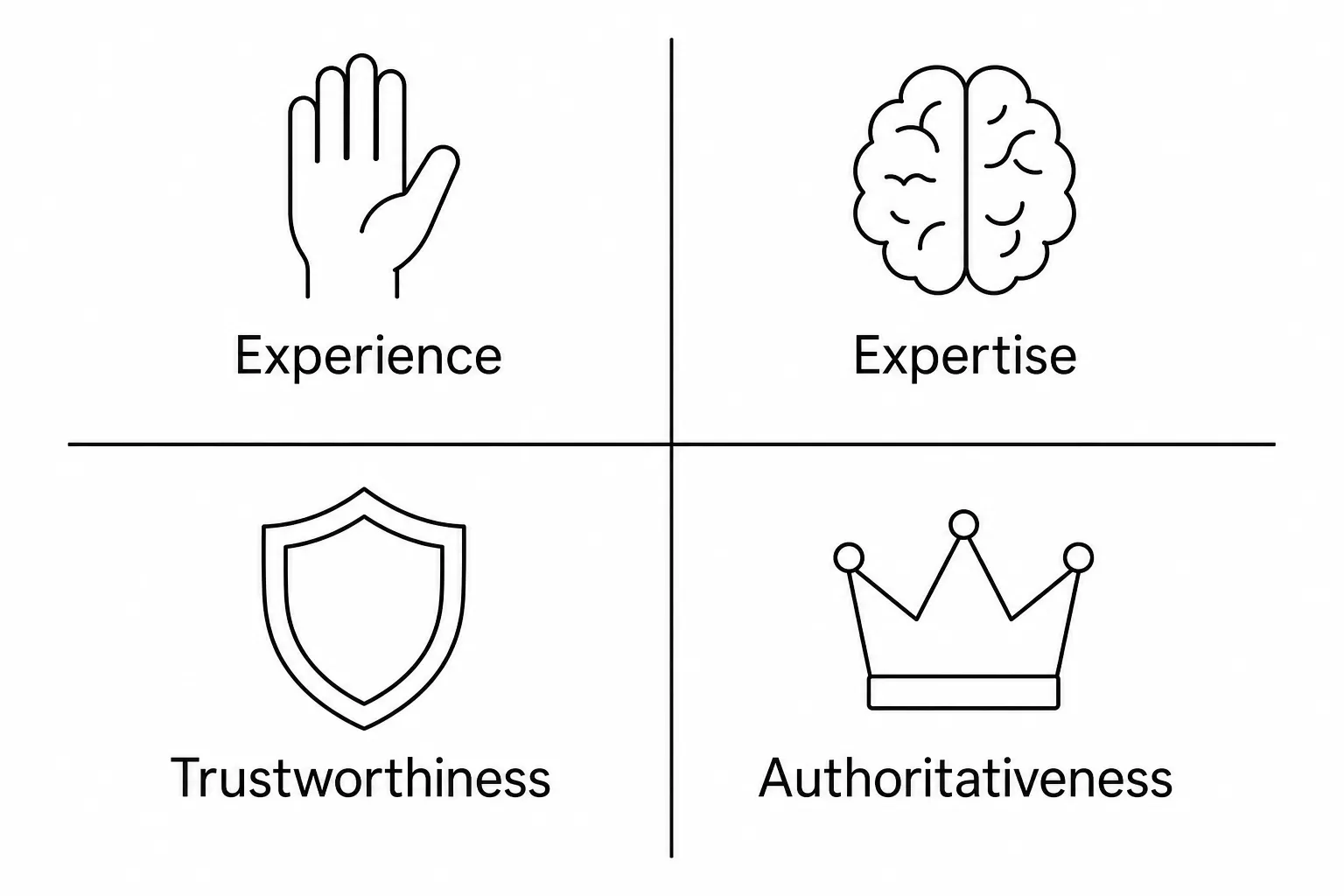
In 2026, optimised content isn't written to please algorithms. It has to prove its value against Google's E-E-A-T criteria, the standard now used to judge the quality of anything published online.
- Experience: Does the content show hands-on experience with the subject?
- Expertise: Does the author have deep knowledge of the field?
- Authoritativeness: Is your site recognised as a reference in its sector?
- Trustworthiness: Is the information in this text reliable and verifiable?
The helpful, user-first content principle
Google now rewards content written by people, for people. Its helpful content signals, now folded into the core ranking systems, favour articles that answer users' queries precisely. Before you publish anything online, ask yourself one question: "Will my reader leave satisfied, feeling they got a complete answer to their question?" If you hesitate, your content still needs work. Nobody ranks for long by padding out a page that doesn't actually help anyone.
Building topical authority with topic clusters
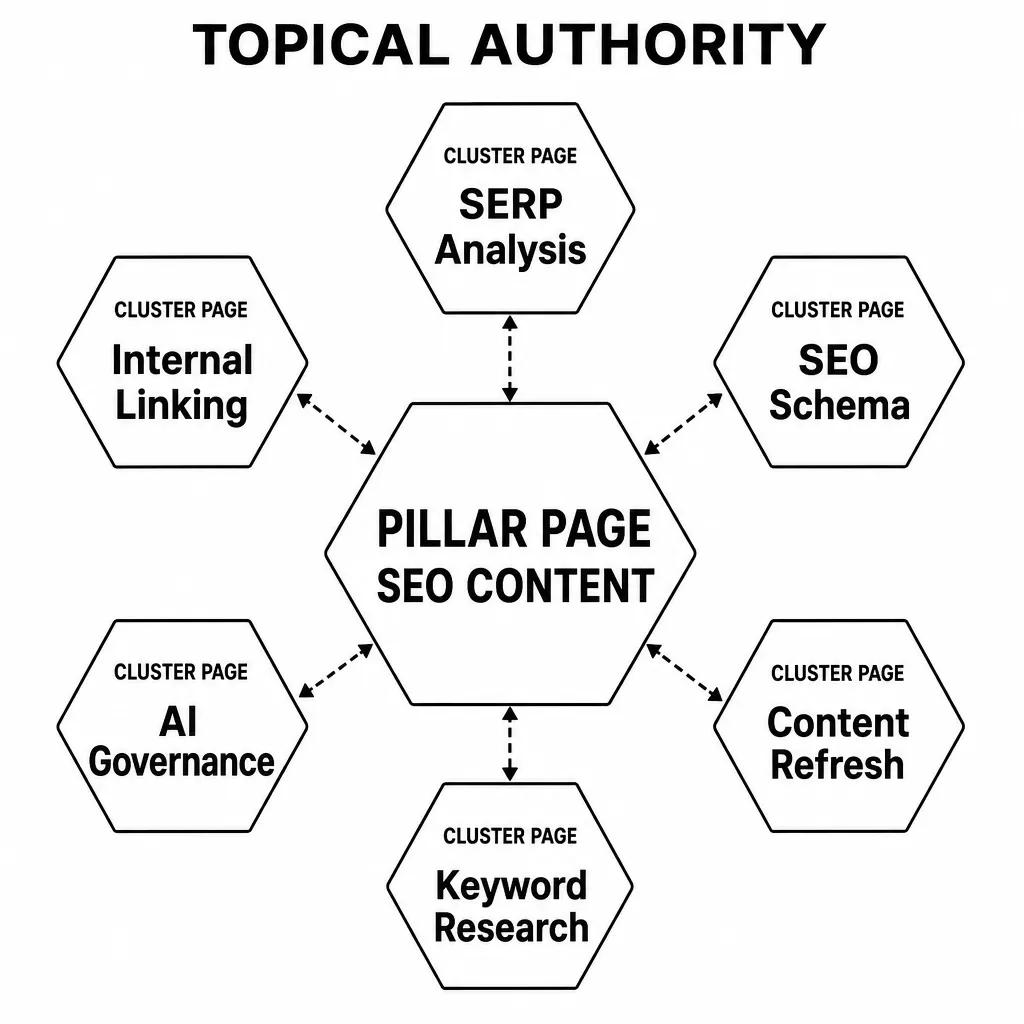
Google no longer judges isolated pages. It looks at sites as a whole to check whether they truly master a topic. Your SEO strategy should therefore organise your content into pillar topics and clusters, connected by smart internal linking, so they form coherent topic clusters.
- Pillar page: A complete, in-depth guide covering a broad subject (like this article on SEO content).
- Cluster pages: Specialised pieces that explore specific aspects (for example "analysing the SERP", "using Article schema" or "structuring your internal linking"), which point to the pillar page and get a link back in return.
This structure proves you own the whole semantic field, positioning your site as the obvious reference for search engines. Different SEO content formats fit into this approach, whether blog posts or optimised product pages.
Practical method: creating high-performing SEO content in 5 steps
For a page to perform, it needs a rigorous method from the first draft to publication. That's what guarantees complete, long-lasting optimisation, rather than a quick win that fades after the next core update.
Step 1: decode the SERP and search intent
Studying the search results (SERP) is non-negotiable. For every target query, open a private browsing window and analyse:
- The dominant format: Is Google favouring guides, listicles, videos or spec sheets? Shape your content accordingly, because fighting the format Google already prefers is a losing battle.
- The angle: Find an angle that's different from, or more complete than, your competitors' (beginner, expert, budget).
- Related questions: The "People also ask" (PAA) box is a goldmine. Fold those answers into your plan to create content that leaves nothing out.
- Visual clues: Local pack, Shopping, featured snippets... Every detail reveals the main intent and sharpens your approach.
A rank tracking tool lets you measure exactly how your pages affect organic traffic: it monitors your Google positions daily and ties every ranking to Google Search Console data. You get location-based tracking, mobile vs desktop analysis, competitor comparisons, real-time alerts, a detailed history and a list of declining keywords. Its scoring system (position, volume, difficulty) flags high-potential pages, especially those sitting in positions 11 to 20, to guide your content optimisation and quickly boost visibility in the SERPs. Discover the rank tracking tool
Step 2: build the semantic core and do your keyword research
Aim for exhaustive topic coverage. Your goal is a semantic network that demonstrates your expertise. Modern keyword research isn't just about volume anymore: it factors in intent, difficulty and commercial potential.
- Primary keywords: Pick one or two head terms with solid search volume.
- Long tail: Use more specific phrases (4 words or more) to attract higher-quality traffic.
- Lexical field: Work in synonyms and related terms naturally to strengthen semantic relevance.
- Semantic clustering: Group your keywords by search intent to build logical, complete content. One page, one intent: that's the rule.
Step 3: structure the page for the best experience
Your content structure has to serve both users and search engines. Every technical detail helps improve the overall relevance of your page.
- Heading hierarchy (Hn): The backbone of the page: one H1, then H2s, H3s and so on. This structure guides the reader and makes crawling easier for bots.
- Title tag & meta description: These two elements matter a lot to Google and deserve real care.
- The
titletag (keep it concise, since Google truncates long titles to fit the screen): Your marketing hook. Put the main keyword at the start and the user benefit at the end. Example: SEO Guide 2026: How to Reach Position One on Google - Meta description (short enough to read at a glance, Google sets no fixed limit): Spell out the value of the page and prompt action. This short description directly affects your click-through rate. Example: ✍️ Boost your traffic with optimised copy. Discover our proven method for creating content that converts and dominates the search results. Click here!
Step 4: optimise your media for engagement and performance
Media isn't just decoration: it plays a key role in user experience and SEO. Getting the technical optimisation right is essential for strong web performance.
- Images:
- Format: Go for modern formats like WebP or AVIF, which strike an excellent quality/weight balance.
- Attributes: Always set the dimensions (
widthandheight) to avoid page layout shifts (CLS). - Loading: Enable lazy loading on images that aren't immediately visible to speed up the initial load.
- SEO: Give every image a descriptive file name and precise alt text.
- Videos:
- Transcript: Provide a full text transcript to improve accessibility and indexing.
- Schema: Add VideoObject markup to maximise your visibility in the search results.
Step 5: weave a strategic internal and external linking web
Every link works like a channel that distributes authority and guides the user through your content ecosystem.
- Internal linking: Create relevant links between your pages with clear anchor text. This improves navigation for visitors, strengthens your SEO authority and helps Google understand your topical structure.
- External links: Cite reliable sources such as studies or institutional sites to bolster your credibility. Every link to a serious reference sends Google a positive signal, and it shows your readers you've done your homework.
- Cluster strategy: Organise your content into well-structured, interconnected clusters to maximise your expertise on a given topic.
Technical excellence: the invisible signals that make the difference
Even exceptional content won't rank well if it lives on a technically flawed site. Today, technical optimisation is essential for good organic rankings. Think of it as the plumbing: invisible when it works, impossible to ignore when it doesn't.
Optimised web performance: Core Web Vitals and user experience
Load speed directly influences your SEO rankings, user experience and conversions. Aim for these key targets:
- LCP (Largest Contentful Paint) < 2.5 seconds: Time to display the main content
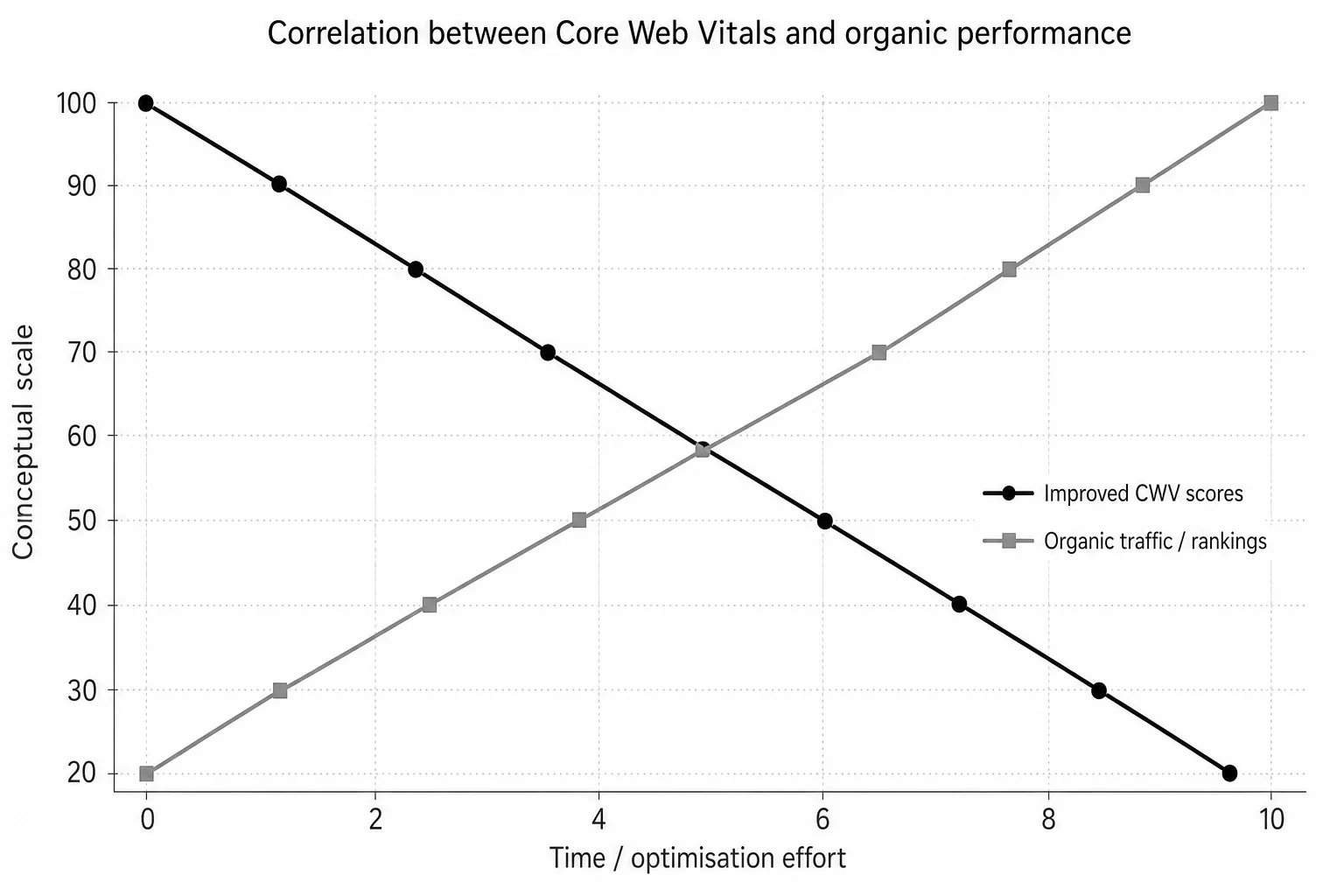
- INP (Interaction to Next Paint) < 200 milliseconds: How quickly the page responds to user interactions
- CLS (Cumulative Layout Shift) < 0.1: Visual stability while loading
Structured data: helping Google understand your content
Schema markup (structured data tags) helps Google interpret your page and its text. Implement at least:
Organization: Present your business professionallyPerson: Identify the author to reinforce E-E-A-TBreadcrumb: Improve navigation with a clear breadcrumb trailArticle: Optimise your news stories and blog postsFAQPage: Describe your questions and answers (Google no longer shows FAQ rich results)
Responsible AI governance in content creation
In 2026, using AI for content creation is standard practice, but using it carefully is what sets you apart. Treat AI as a writing assistant, never as a replacement. Every generated text needs to be reviewed, corrected and enriched by a human expert to deliver real added value.
Meet an AI editor built specifically for SEO content: this smart solution examines the top 10 positions in Google's search results and scores over 500 criteria to give you instant recommendations. Optimise your content automatically in one click and generate clear, fluent copy available in several languages. The tool also offers:
- In-depth competitor analysis
- Topic cluster building to organise your keywords
- A collaborative editor with change tracking
- A real-time quality score
- Audit and rank tracking features
Everything you need to grow your organic traffic and simplify the creation of content that performs. See how to boost your SEO content
Content lifecycle: from publication to continuous optimisation
Hitting publish is the start of the job, not the end. To keep its visibility in the search results, good content needs regular monitoring and ongoing adjustments. Treat every page as a living investment in your site, one that needs maintenance to keep paying off.
Measuring performance: the essential KPIs for your content
Track the impact of what you publish with precise indicators that inform your decisions. Your rankings in Google search remain a pillar of your content marketing strategy.
| Category | Key indicator (KPI) | Tool | Goal |
| SEO visibility | Ranking queries, average position, CTR | Google Search Console | Improve presence on strategic searches |
| Web performance | LCP, INP, CLS | Google Search Console | Meet the Core Web Vitals thresholds |
| Engagement | Time on page, scroll depth | Google Analytics 4 | Capture and hold visitors' attention |
| Business | Conversions, assisted revenue | Google Analytics 4 | Assess return on investment |
The refresh process: fighting content decay
Content decay is the gradual drop in organic traffic to a page whose content has gone stale. Build a quarterly audit into your SEO strategy to keep performance up. This regular optimisation is essential to protect your rankings.
- Identify: Use Google Search Console to spot pages whose traffic or positions are slipping.
- Analyse: Check whether the content is still accurate and still matches the search intent.
- Act:
- Refresh: Update the information, add new sections and raise the quality of the content.
- Consolidate: Merge underperforming articles on the same theme into a single guide, then set up a 301 redirect.
- Prune: When a piece of content no longer brings value or traffic, remove it and redirect its URL.
A worked example: applying E-E-A-T to a building materials store
Here is how the E-E-A-T principles apply to a typical content strategy.
The initial challenge: a building materials e-commerce site
Picture an e-commerce site selling building materials whose initial audit shows:
- Organic traffic: a few thousand monthly visitors
- Active pages: 150 product pages with minimal descriptive content
- Authority: No expert content and no author profiles
- Technical: Slow site (LCP well above 2.5 s) and a confusing structure
The method applied: E-E-A-T in action
Experience: Set up a rigorous testing protocol for every product. For thermal insulation, for example, run detailed analyses (R-value, optimal thickness, performance in damp conditions), then add these standardised test results to each product page.
Expertise: Write a detailed author bio highlighting real experience, certifications and background. Every article carries a byline, a photo and links to previous work.
Authoritativeness: Earn high- quality backlinks from trade media by publishing exclusive technical studies, and build partnerships with recognised engineering consultancies.
Trustworthiness: Complete the legal pages, publish a clear returns policy, display only accreditations you genuinely hold and update prices with a visible timestamp.
What to measure after 6 months
- Organic traffic: monthly visitors from search
- Rankings: number of keywords in the top 10
- Conversions: quote requests
- Core Web Vitals: LCP under 2.5 s and CLS under 0.1
- Engagement: time spent on the enriched product pages
Lessons for your own strategy
What this example shows about E-E-A-T for your site:
- Hands-on expertise always beats shallow content
- Transparency about your methods massively increases credibility
- Tangible proof (tests, certifications) is a decisive asset
- Technical rigour amplifies the impact of high- quality content
We've built this method into the Sedestral platform to automate E-E-A-T analysis and act as an effective guide for our customers.
Conclusion: a lasting commitment to quality
Creating SEO content that performs isn't a one-off task.
It's a long-term strategy centred on quality, added value and your audience.
By following this methodical approach - planning, building on solid E-E-A-T foundations and measuring results - you're not just doing SEO.
You're building durable digital equity for your rankings.
The future of organic search belongs to creators who master this holistic approach, combining technical expertise, user experience and real value.
Practical resources
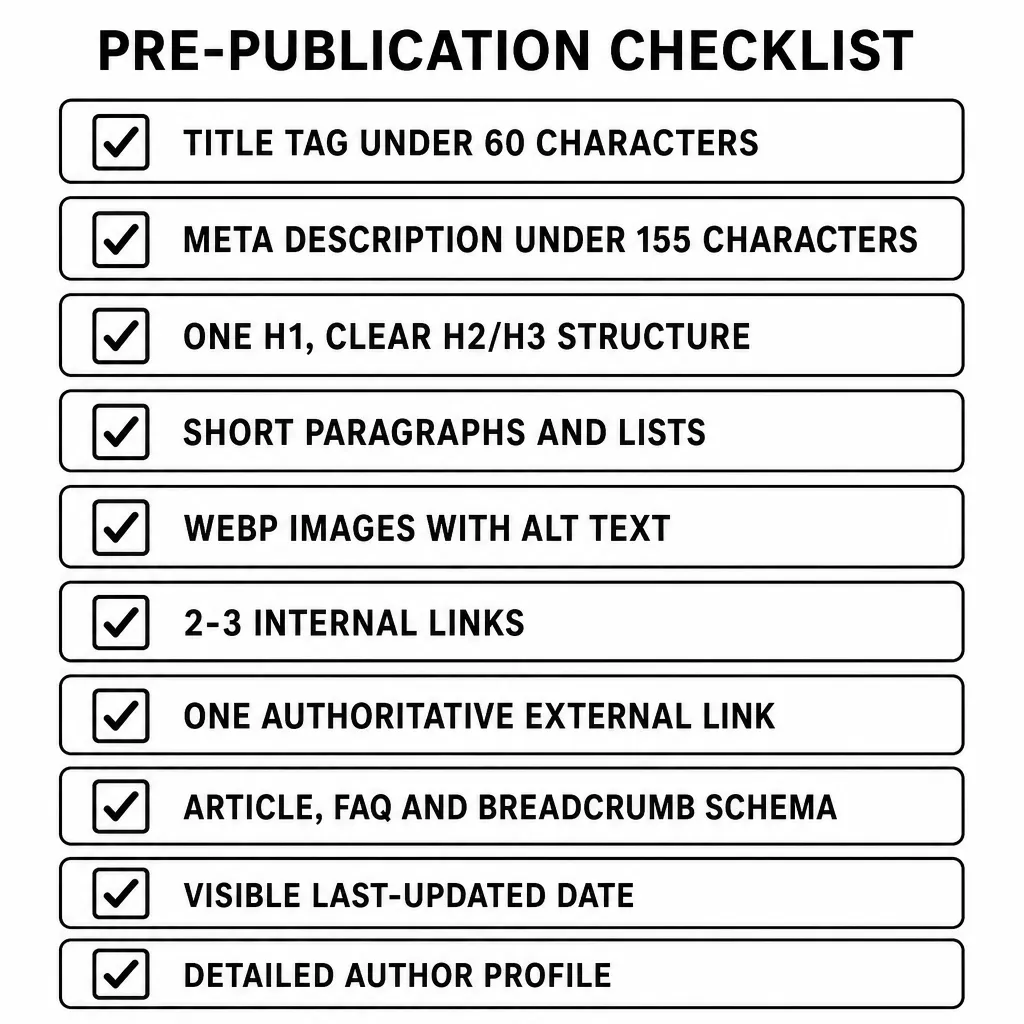
✅ The ultimate pre-publication checklist
- SEO title (title tag): concise, including your main keyword
- Meta description: a short summary with a clear call to action
- Heading structure: A single H1 and well-organised H2s/H3s
- Readability: Short paragraphs, lists and clear sentences
- Images: Modern formats (WebP/AVIF), alt attributes filled in and dimensions set
- Internal links: 2-3 links to other relevant pages on your site
- External links: At least one reference to an authoritative source
- Schema markup: Article, Breadcrumb and author schemas in place
- Freshness: Last-updated date visible to visitors
- Author: Detailed profile at the end of the article

Rank Higher Without the Manual Work
From technical audits with Nox to competitor monitoring with Marc, Sedestral's AI agents cover every layer of SEO so your team doesn't have to.