There's more content published every day than anyone could ever read. That's exactly why content curation has become a core skill for marketing and SEO professionals. This practical guide walks you through what effective curation looks like, from the fundamentals to the techniques experts rely on. You'll learn how to select, organise and share relevant content that builds your credibility and supports your SEO.
Content curation: definition and why it matters
Content curation is now one of the main pillars of any content strategy. It means identifying, sorting and packaging existing information so that it lands in a relevant way with a target audience. It's far more than aggregation: done well, it takes real expertise to turn raw material into a strategic resource.
What is content curation?
Content curation is the practice of finding, filtering and sharing the most relevant web content on a specific topic. Think of a museum curator who selects and contextualises the works on display. The digital curator does the same job, acting as an expert filter that turns a relentless stream of information into structured, enriched content.
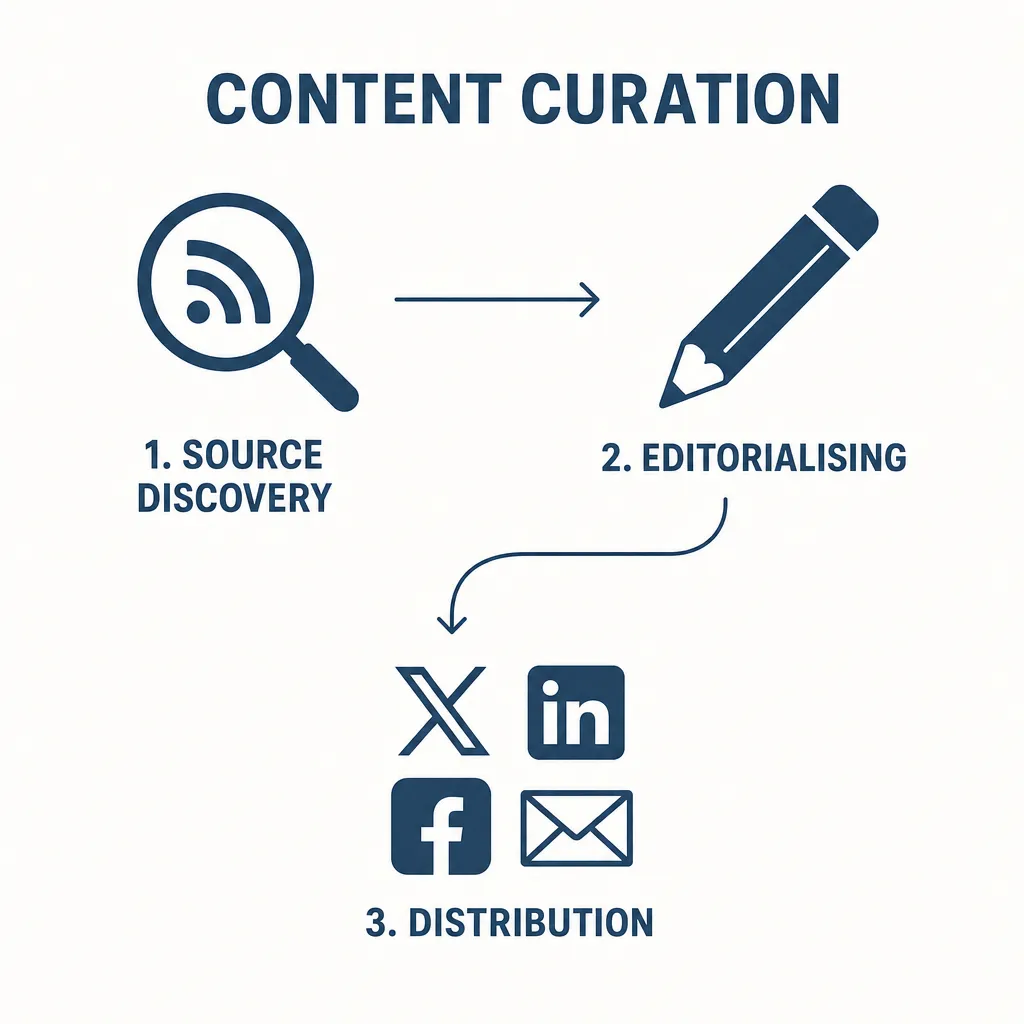
The process rests on three fundamental steps: spotting reliable sources (automatically or by hand), editorialising to add real value, and distributing on the right channels. For example, an expert might compile the best articles in their industry, annotate them with their own analysis, then share the result through a blog or a newsletter.
How it differs from monitoring, and what you gain
Industry monitoring and curation differ in their purpose. Monitoring is an internal activity: you watch and analyse what's happening in your field. Curation is public and editorial by nature, transforming raw information into content with genuine added value.
The benefits stack up. For the curator, it's a chance to cement your expertise while producing regular content without starting from a blank page every time. That makes it a particularly good fit for small teams who need to keep the editorial calendar full.
Added value and SEO impact
Content curation lets you create real value by organising scattered information. It turns raw data into actionable resources, enriched with commentary and relevant analysis. In an ecosystem where attention is scarce, that's a genuine advantage.
From an SEO standpoint, well-executed curation delivers strong results. By rewording and expanding on the content with your own original analysis (ideally 150 to 300 words), you avoid duplicate content. Adding strategic internal and external links strengthens your authority on your topic, and you'll often pick up natural backlinks when your sources share your work in return.
Choosing a tool and centralising your sources
To build an effective curation strategy, you need the right technical setup and a disciplined way of organising your sources. Those two things directly shape the quality of what you share and how efficient the whole process is. A well-chosen toolset automates part of the work while keeping the human value that makes curation worth reading.
Which tool to curate efficiently
There are plenty of curation tools out there, and each one serves a specific need at a different stage of the workflow, from research to publishing. Your choice should line up with your editorial ambitions and your practical constraints.
- Monitoring and discovery tools: Google Alerts tracks mentions of your keywords, Mention analyses online conversations, and BuzzSumo identifies the most widely shared content on a given topic.
- RSS readers: Tools like Feedly, Inoreader or NewsBlur centralise the RSS feeds of many websites, sorted into categories.
- Read-later and bookmarking tools: Raindrop.io and Instapaper give you a place to save articles for later, with tags for tidy thematic filing (Pocket, the old favourite here, was shut down in 2025).
All-in-one platforms such as Scoop.it, Curata or Flipboard offer integrated environments covering discovery, organisation and distribution. They make it easy to build thematic collections and often include automated publishing. Most of them also ship analytics tools to measure how your posts perform.
Several factors should guide your choice: the credibility of the sources on offer, annotation features, integration options (newsletters, CMS, social media), plus budget and the limits of free plans. A trial period of a few weeks is enough to check that a tool fits your real needs.
Collecting and sorting the best sources
The value of your curation depends first and foremost on the quality of the sources you pick. RSS feeds make it easy to follow specialist blogs, industry portals and institutional publications, giving you continuous monitoring without any daily effort.
Diversity matters if you want to offer a balanced perspective. Mix mainstream and specialist media, expert publications and academic research, domestic and international content. That multiplies your angles of analysis and limits bias. A quarterly audit of your sources helps you spot the most relevant ones and refine your selection.
Automating without losing quality
Smart automation combines productivity with editorial standards. RSS reader filters let you pre-select content by keyword, author or date. That first pass saves the curator a lot of time, which can then go into interpretation and context.
Human validation stays non-negotiable, though. No tool can replace the industry expertise and editorial judgement needed to make information meaningful. The ideal process pairs automated sorting with human expertise, so you can handle a high volume without sacrificing quality.
How to curate content step by step
Building a real curation strategy takes a methodical, organised approach. Here's a practical guide to move from theory to execution. It all starts with defining your goals, measuring your results and applying a rigorous methodology to keep your blog or editorial channel relevant.
The 6-step method
The curation process revolves around six key steps that safeguard the quality of your selection. This logical progression helps you maintain a consistent editorial line while working more efficiently. Each phase adds something meaningful to your monitoring.
- Strategic definition: Pin down your topic precisely, analyse your audience and set measurable goals with concrete indicators.
- Diverse sourcing: Gather a varied panel of information sources: specialist media, expert blogs, industry studies and relevant visual content.
- Active monitoring: Automate your monitoring with RSS feeds and alerts, while keeping a manual eye out to catch breaking news.
The last three steps cover presentation and sharing. Editorialising is the crucial one: it turns raw information into enriched content. This step includes summarising the main ideas, adding your own perspective and providing context. Choosing distribution channels and analysing results round off the process so you end up with genuinely high-quality content.
Editorialising and avoiding duplicate content
The heart of curation is the art of editorialising. This goes well beyond simple sharing to deliver real added value. It means contextualising every item you select, pulling out the key points and adapting them to what your readers need. That personal touch is what separates professional curation from copy and paste.
To steer clear of duplicate content, stick to these fundamentals: quote only short excerpts, always credit the original sources, and above all bring your own expert analysis. The goal is a unique piece of high-quality content that draws on external references while offering an original perspective and useful guidance.
Concrete examples and effective uses
Content curation shows its full value through practical cases and proven formats. Below you'll find concrete curation examples, the best distribution channels, and how to combine external content with in-house production. Use them as inspiration for your own projects.
Curation models in practice
Several curation examples prove how effective this practice can be. A themed newsletter that brings together five relevant articles with analysis gives readers a weekly summary they appreciate. You save your readers time while reinforcing your position as an expert.
The range of possibilities is wide:
- Summarise a complex study into key takeaways
- Cross-reference different trends to surface new perspectives
- Compare several analyses of the same subject
- Trace how an issue has evolved over time
Each approach brings distinct value to your audience.
Channels and formats to prioritise
Channel choice is crucial for effective curation. Adapt your formats:
- Short, punchy posts for social media
- In-depth analysis in your newsletters
- Complete roundups on your blog
This differentiation maximises engagement on each platform.
| Channel | Best format | Goal |
| Short post with analysis | Professional engagement | |
| Newsletter | Annotated selection | Loyalty |
| Blog | Thematic roundup | Building authority |
Measure your performance systematically: social media interactions, clicks through to your sources, time spent on your posts. That data will guide your adjustments.
From external content to in-house content
Monitoring and curation feed your own content creation. Analysing which topics get traction reveals what your audience cares about and inspires your original pieces.
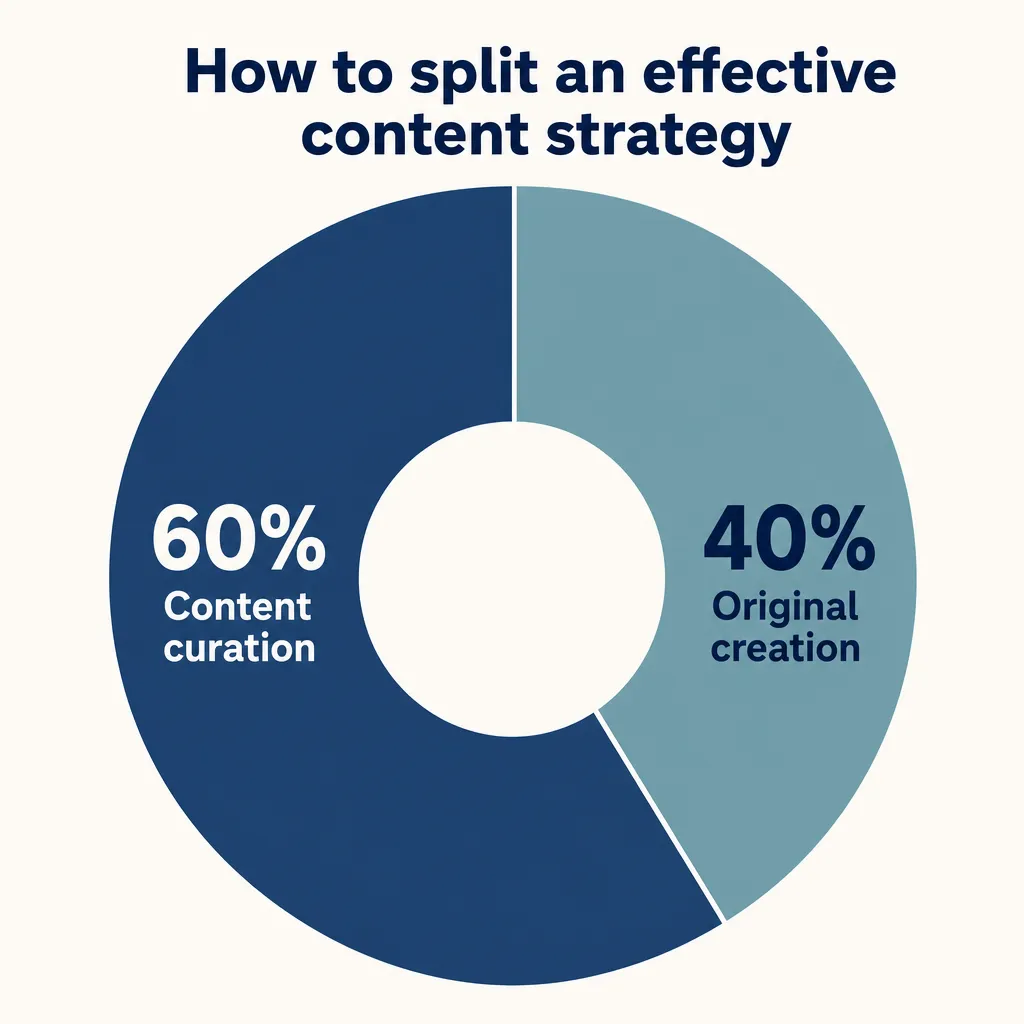
The chemistry between content curation and content marketing depends on getting the balance right. We recommend 40% original creation to 60% curation.
This approach:
- Keeps your publishing schedule regular
- Grounds your credibility in active monitoring
- Asserts your expertise through your own content
Measuring, governing and improving content curation
Optimising your curation strategy calls for a rigorous method, combining analysis of your performance metrics with editorial discipline. Here are practical ways to choose the right indicators, roll out incremental improvements and structure your workflow for lasting results that line up with your goals.
Useful KPIs and A/B testing
Effective editorial governance runs on quantifiable data. Start by tracking the basic metrics (clicks, social media shares, interactions) before moving on to deeper analysis such as the impact on your SEO. These insights will help you sharpen your content selection.
- Engagement: Study how your audience responds to the content you've selected (reading time, comments, shares)
- SEO performance: Track how your organic traffic and earned backlinks evolve
- Editorial efficiency: Monitor your email open rates and audience growth
A/B testing is a valuable way to refine your curation. Experiment with different formats (bare links versus annotated summaries), test the original headlines against those of the source articles, or vary your publishing frequency. These tests reveal what your readers prefer. Comparing a weekly send with a monthly one, for example, will tell you which rhythm drives the most engagement.
Process and responsibilities
For meaningful performance measurement, set up a transparent workflow with clearly defined roles. Split the steps between monitoring, validation and sharing, with quality criteria at each level. This structure keeps things consistent while letting you scale up your output.
Adopt a strict validation checklist: source credibility, timeliness of the subject, fit with your audience, legal compliance (copyright and fair use) and the value your own treatment adds. This framework maintains high standards and makes onboarding new contributors much easier. Finally, schedule a monthly review of your posts to readjust your strategy and keep improving the way you curate content.

Automate Your SEO With AI Agents
Sedestral connects six AI agents to your website to handle content, audits, rankings and backlinks, without the manual grind.