You're publishing solid content, but your traffic has flatlined? You're chasing hyper-competitive keywords and never cracking the top 10? The answer is often sitting where your competitors aren't looking: in the potential of long tail keywords.
This complete guide shows you how to turn these precise search queries into a real growth engine. Forget the bloodbath over generic head terms and focus on what matters: attracting qualified traffic, perfectly targeted and ready to act.
Here's what you'll learn:
- Why the long tail can add up to a large share of organic traffic and how to capture it
- How these queries outperform short keywords on conversion rate thanks to their clear intent
- The methods for finding and prioritising your long tail keywords with free and paid tools
- How to structure your content into topic clusters to build your expertise
- The key technical and editorial optimisations that boost your visibility
What long tail SEO is and why it changes everything
In any organic search strategy, getting your head around the long tail concept is essential. We're not talking about simple variations of generic keywords, but about phrases that open the door to a hyper-targeted audience and to rankings your competitors tend to ignore.
A clear, working definition of the long tail
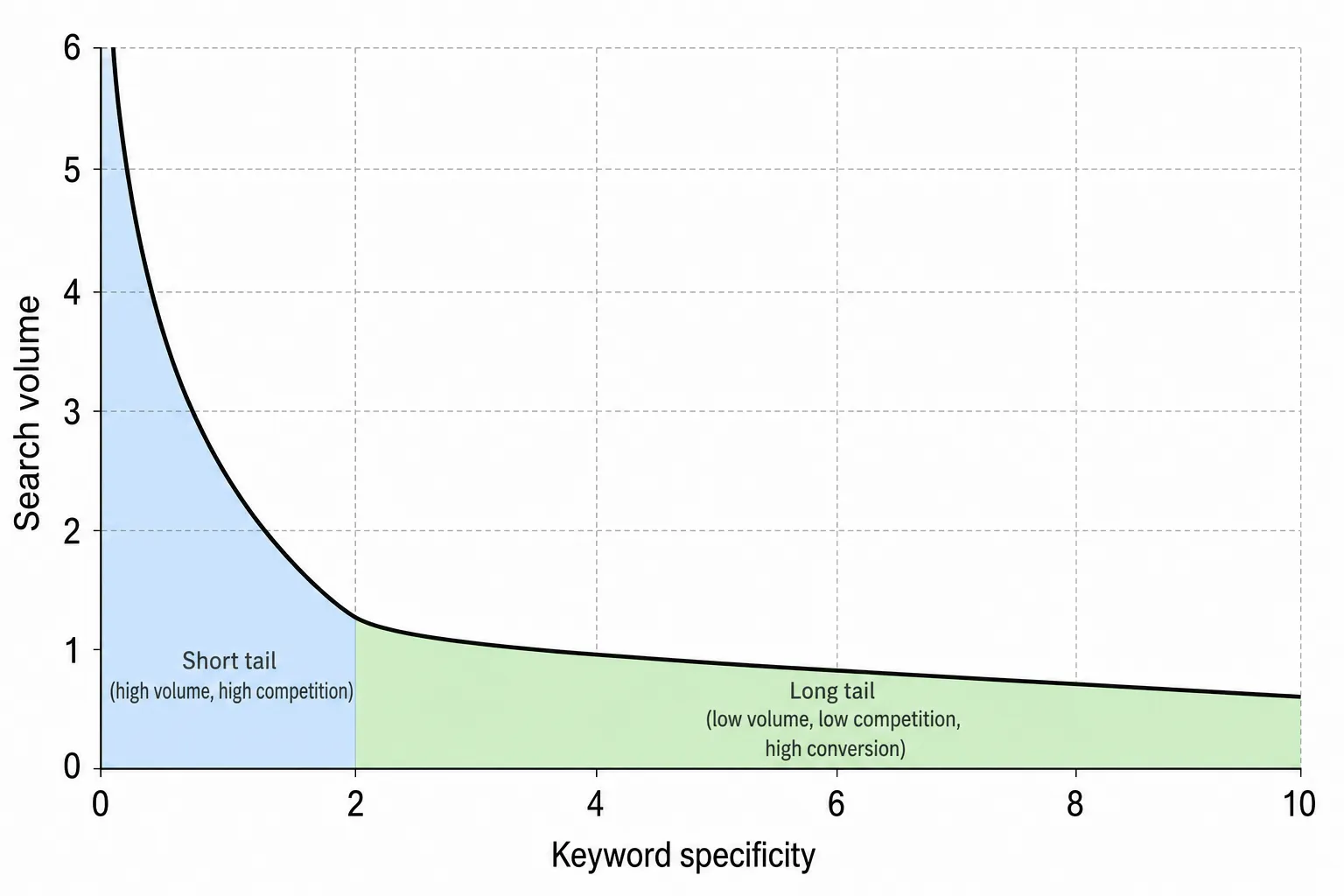
Long tail keywords are search queries of four words or more, highly specific, with a modest search volume but an extremely precise user intent. Taken one by one, these phrases bring in few visits, but together they build a substantial, durable stream of traffic.
A few telling examples:
- Generic keyword: "shoes"
- Long tail: "lightweight women's running shoes size 7 for marathon"
- Ultra-specific query: "20mm multifoil insulation for inverted roof with high thermal resistance"
This approach puts relevance ahead of popularity. Popularised by Chris Anderson in 2004, the concept showed that the combined sales of many niche products could outstrip the revenue of the bestsellers. Applied to SEO, the principle is identical: the cumulative traffic from hundreds of targeted queries is often larger, and far more profitable, than a single generic keyword.
Did you know? Long tail queries add up to a large share of all searches: Ahrefs found that almost 93% of the keywords in its US database get fewer than 10 searches a month. And that share keeps growing with the rise of voice search ("Ok Google, where can I find an emergency plumber in Manchester tonight?"), which relies on natural, conversational language.
Why the long tail converts better than generic keywords
Unlike generic keywords, which mostly attract visitors with little commitment, long tail keywords target users with a clear search intent, often at the buying stage or about to make a specific decision.
Because long tail keywords are so specific, you can create content that fits the demand exactly. Take a concrete example: a query like "best quiet 9kg washing machine 2026" signals a strong intent to buy.
Here, the user isn't browsing at random. They're actively comparing to make a choice. By contrast, the generic term "washing machine" could mean all sorts of searches: images, a definition, or even a repair guide.
The result: long tail queries tend to convert better than generic keywords, because the intent is clearer. That perfect fit between the query, your content and what the user expects sends a hugely positive quality signal to search engines.
Google rewards pages that answer needs precisely. And that creates a virtuous circle: optimised content → better rankings → more qualified traffic → more conversions.
Another big advantage: competition on these queries is usually far lower. While "running shoes" is fought over by e-commerce giants with enormous SEO budgets, "men's minimalist trail running shoes size 9" offers real opportunities for specialist sites and small businesses.
Finding and selecting your long tail keywords
To make the long tail work for you, start with methodical long tail keyword research. Here are the best techniques and tools at your disposal.
Use Google's free tools
- Autocomplete (Google Suggest): Start typing a query and look at what Google suggests. These suggestions reveal the exact phrasing your potential customers use.
- People Also Ask: These frequently asked questions expose the precise concerns of searchers. Use them to structure your articles with relevant subheadings.
- Related searches: At the bottom of the results page, these suggestions give you valuable variants to enrich your semantic field.
- Google Trends: Ideal for gauging the popularity of terms, spotting seasonal trends and planning your editorial calendar. Compare two or three variants side by side to see which phrasing is actually gaining ground.
Use specialist SEO tools
Platforms like Semrush, Ahrefs or Ubersuggest generate hundreds of variants from a single seed keyword. Then filter by search volume, keyword difficulty (KD) and intent to prioritise your opportunities.
Our platform, Sedestral, automates this process by quickly identifying high-potential queries while analysing the real intent behind them.
Analyse your own data
Pro tip: Dig into your Google Search Console. Head to the "Performance" → "Queries" tab and find the keywords that generate lots of impressions but few clicks, plus those where you rank between 8th and 15th. With a few targeted optimisations on the pages concerned, you can climb the results quickly. That's the quick wins method at its best!
Don't forget to analyse your server logs, the searches run through your site's internal search, your customers' frequent questions, their reviews and the conversations happening on social media. These sources often reveal natural phrasing and needs your competitors have overlooked. A single support ticket can hand you a query that no keyword tool has ever surfaced.
Prioritise your long tail keywords by intent and potential
Once you've built your keyword list, group it by theme using semantic clustering. Then rank your long tail keywords against these four criteria:
- Search volume: Even when volume is low (10 to 50 searches a month), don't dismiss these queries if they carry transactional potential.
- Competition (KD): Prioritise keywords with a difficulty score below 30 for fast results.
- Relevance and intent: Does the keyword really match what you sell? Is the user's intent informational, commercial or transactional?
- Conversion potential: Is the user ready to act or to buy?
Score each query from 1 to 5 on these criteria and focus your efforts first on the ones with the highest scores.
Validate with SERP analysis
Before you write a word, type your long tail keyword into Google (in a private window) and look closely at the first page of results. This step is fundamental to any long tail strategy.
- Who shows up in the SERP? Giants like Wikipedia or institutional sites, or rather blogs and small businesses?
- Which content formats dominate? Guides, product pages, videos or FAQs?
- Which topics are covered? Analyse the formats that perform and the questions present (or missing) in the People Also Ask boxes and featured snippets. That will give you ideas for creating content far more effective than your competitors'.
Building an SEO architecture around topic clusters
An effective long tail strategy goes well beyond picking keywords. The way your content is structured plays a crucial role in building topical authority and distributing link juice intelligently across your site.
The topic cluster principle
This method, sometimes called a content hub or semantic silo, dramatically amplifies the impact of your SEO. Here's how it works:
- Pillar page: A comprehensive piece on a broad topic (for example "getting started with running"). This page targets a main keyword and acts as the hub connected to every cluster page.
- Cluster content: Detailed articles covering specific aspects of the main topic, optimised for long tail keywords. Each cluster page contains several internal links pointing to the pillar page and to other pages in the same cluster.
A concrete example built around "getting started with running":
- Pillar page: "The Complete Guide to Getting Started with Running"
- Cluster pages:
- "How to warm up properly before a run" (linking to the pillar page)
- "8-week running training plan for beginners" (linking to the pillar page)
- "What to eat to improve as a runner" (linking to the pillar page)
This system gives visitors a richer experience while signalling your expertise on the subject to search engines. It significantly improves the rankings of every page involved. Our dedicated guide explains how internal linking, relevant backlinks and sound technical practices (301 redirects, canonical tags) strengthen your authority. You'll also discover how to:
- organise your topic clusters effectively
- optimise your link anchor text
- prioritise your pillar pages
- find and make the most of your orphan content
All of these techniques aim to channel link juice towards the content you've optimised for the long tail, while avoiding traps like PBNs (private blog networks). The guide offers sustainable alternatives (guest blogging, digital PR, creating "linkable" assets) and covers the essential tools (Search Console, Ahrefs, Screaming Frog) for measuring your progress. Learn to master link juice and boost your performance
Mapping search intent for every query
Fully understanding the search intent behind each query is fundamental to ranking well. Long tail phrases generally map to different stages of the buyer journey:
- Informational (the visitor wants to learn): queries containing "how", "why", "guide", "tips".
- Example: "how to choose your first pair of running shoes"
- Commercial (the visitor is comparing options): queries with "best", "review", "comparison", "vs".
- Example: "which running heart rate monitor to choose in 2026"
- Transactional (the visitor is ready to buy): queries containing "buy", "price", "deal", "discount".
- Example: "Garmin Forerunner 55 running watch deal"
- Navigational (the visitor is looking for a specific brand):
- Example: "Garmin official store UK"
By analysing these intents, you create natural journeys where an informational article leads logically to a comparison, before sending readers on to your product pages. This funnel structure significantly improves your conversion rate, because each page meets the visitor exactly where they are in their decision.
Optimising your pages for long tail keywords
Precision is everything when you optimise for long tail keywords. Work your keywords in naturally and strategically, because every on-page element directly influences your rankings.
On-page optimisation: the fundamentals
- Heading (<h1> tag) and title tag: Place your long tail keyword (or a natural variant) at the start of the title. Example: "Lightweight women's running shoes for marathon: our top picks for 2026".
- Introduction: Repeat the exact query within the first 100 words to show Google and your visitors that you're answering their search.
- URL: Create clear, concise URLs (e.g. /lightweight-womens-running-shoes-marathon/) and avoid unnecessary parameters.
- Meta description: Write an appealing description (around 150 to 160 characters) that includes the keyword. Example: "Find the best lightweight women's running shoes, perfect for marathon day. Maximum comfort at competitive prices."
- <h2> and <h3> tags: Organise your content with subheadings that contain semantic variants of your main keyword, without overdoing it.
- Image alt attributes: Describe your images with relevant variants. Example:
alt="lightweight women's marathon running shoes size 7".
Enriching content with structured data
Structured data (Schema.org) helps Google understand your content and display rich results. Use in particular:
- FAQPage: For your Q&A sections, to help search engines read them (FAQ rich results are no longer shown, and this markup does not feed the "People Also Ask" boxes).
- Article: For your blog posts, specifying the author, the date and the main image.
- HowTo: For your step-by-step practical guides (Google no longer shows HowTo rich results, but the markup still helps clarify the content).
- Product: For your product pages, with price, reviews and availability.
- VideoObject: For your videos, with a transcript to enrich the text content.
This markup increases your visibility in the results and improves your click-through rate.
Technical performance and Core Web Vitals
Google places ever more weight on user experience. Meet these thresholds:
- LCP (Largest Contentful Paint): Under 2.5 seconds for the main element to load.
- CLS (Cumulative Layout Shift): Below 0.1 to avoid content jumping around.
- INP (Interaction to Next Paint): Under 200 ms for optimal responsiveness (INP replaced FID in 2024).
- Optimised images: Favour modern formats (WebP/AVIF) to cut file size without losing quality.
A fast, smooth site improves engagement, reduces bounce and sends a positive signal to search engines.
Internal linking and anchor text strategy
Internal linking plays an essential role in spreading link juice and helping search engines crawl your site efficiently. Here are the best practices to apply:
- 2 to 3 relevant internal links per page: Add 2 to 3 contextual links to cluster pages in the same group or to your main pillar page.
- Precise anchor text: Favour descriptive anchors like "read our complete guide to running" over generic phrases like "click here".
- Strengthen key pages: Focus your efforts on strategic pages sitting between the 11th and 20th position so they get a boost from your best-performing pages.
- Optimised navigation: Implement breadcrumbs and an intuitive navigation structure to make life easier for users and crawlers.
- Recommendation blocks: Add "related articles" or "related products" sections to improve the user experience and increase time on site.
Our complete guide explains how to create high-performing SEO content in 2026 by leveraging long tail SEO: a 5-step method (SERP and search intent analysis, building a semantic core around a long tail keyword, page architecture, media optimisation, strengthening internal and external links), grounded in E-E-A-T principles, topic clusters and flawless technical foundations (Core Web Vitals, structured data). It stresses regular monitoring to stop content going stale, recommends using AI intelligently as an assistant and provides checklists and tools to turn every page into a lasting source of qualified traffic. Read the practical guide to long tail SEO content
Building the long tail into your editorial calendar
An effective long tail strategy demands careful organisation. Here's how to structure your editorial planning to get the most out of your long tail keywords.
Structuring your editorial planning
Adapt your calendar with these specific columns:
- Main long tail keyword
- Search intent (information, comparison, purchase)
- Target page (pillar or cluster)
- Main CTA (call to action)
- Performance indicators (impressions, clicks, conversions)
Publish your pillar page first, then roll out the cluster content progressively over the following weeks. Systematically interlink them with optimised anchors to maximise the flow of link juice.
Atomising your content promotion
Don't let your content sit idle after publication. Diversify its formats and distribute it across different channels:
- LinkedIn carousels: Pull out the 5 to 10 key points from your article.
- X (Twitter) threads: Condense the information into 8 to 12 posts.
- Infographics: Illustrate your key data visually.
- Newsletters: Share your best content with your audience.
- Videos: Use YouTube Shorts, TikTok or Instagram Reels to reach new audiences.
This multichannel approach strengthens your visibility, earns natural backlinks and consolidates your topical authority in organic search.
Our practical guide explains how to create a high-performing editorial calendar that turns content into a lasting SEO asset: setting clear business goals, studying personas in depth and analysing competitors to spot long tail SEO opportunities, structuring content into topic clusters, choosing keywords and planning 3 to 6 months ahead, then optimising continuously. It also details the essential components of a plan (owner, deadline, format, CTA), suggests suitable tools (Google Sheets, Trello, Asana/Airtable) and explains how to atomise and distribute each article on social media to maximise its visibility and topical authority. Optimise my editorial calendar for long tail SEO
Measure and iterate continuously
Monitoring your results is crucial for refining your strategy. Use Google Search Console and Analytics to track:
- Impressions and CTR: spot queries with lots of impressions but a low click-through rate (then improve your titles and meta descriptions).
- Positions: find pages sitting between 11th and 20th position, then push them up with content refreshes, better internal linking or targeted backlinks.
- Engagement: keep an eye on time on page, bounce rate and pages per session.
- Conversions: track your completed goals (downloads, sign-ups, sales).
Set up a quarterly update routine to fight content decay: refresh your data, add new long tail SEO variants, merge underperforming content and remove obsolete pages. A page that ranked well eighteen months ago won't stay there on its own, and a quick refresh is far cheaper than writing from scratch.
Link building and protecting link juice for the long tail
Link building, the practice of earning backlinks, remains fundamental to organic search. To strengthen the impact of your long tail strategy, prioritise quality and topical relevance.
Quality backlinks first
- Topical relevance: a link from a site specialising in your field (say, a running blog for your trail shoe articles) passes far more link juice than a generic one.
- Anchor variety: aim for roughly 80% branded or neutral anchors ("read more", "find out") and 20% optimised anchors (exact keyword or a variant) to avoid over-optimisation and penalties.
- Limit PBNs: prefer sustainable methods like guest posting on reputable sites, publishing original research, broken link building or digital PR.
Preserving link juice during migrations and redesigns
During a redesign, an HTTPS migration or a change of URLs, make sure you:
- Implement 301 redirects: to transfer authority from the old URLs to the new ones.
- Use canonical tags: to prevent duplicate content and concentrate link juice on the main version.
- Fix broken links: contact the sites linking to your old URLs and ask them to update their links.
Monitoring and disavowing toxic links
Check your link profile regularly with tools like Ahrefs, Semrush or Majestic. Identify toxic links (spam, penalised sites) and, if necessary, use Google's Disavow tool. Google says it ignores most spammy links on its own, so only disavow when you're facing a manual action or a clearly manipulative pattern.
Trends and developments: voice and conversational search
The growing use of voice search, mobile devices and naturally worded queries is driving more conversational, spontaneous long tail queries. SERP features (such as Autocomplete, People Also Ask or related searches) surface these phrasings and can be used to uncover interesting new variants.
Adapting your content to natural language
- Optimise for full sentences and questions: Favour phrasing like "What is the best time of year to run a marathon?" over clipped terms like "marathon season".
- Add FAQ or HowTo structured data: FAQ and HowTo rich results are no longer shown, and featured snippets are chosen automatically by Google without any markup: focus on clear, direct answers instead.
- Don't forget the local angle: Voice searches frequently include geographic markers ("near me", "in Brooklyn", "in central Manchester"). Adapt your content accordingly.
- Keep it concise: Put the key answers at the top of the page to make skimming easier and help search engines index your content.
Let AI Handle Your Content Publishing
Alya researches keywords, writes and publishes content directly to your CMS, WordPress, Shopify, Wix and more, on autopilot.