You pour time and budget into content and social media, yet your website only converts a handful of qualified prospects? Does it feel like you're shouting into the void, with nothing to show for it on the bottom line? You're not alone. Plenty of businesses never manage to turn their online presence into real sales opportunities, not because they lack effort, but because the effort isn't pointed in the right direction.
The fix is an inbound marketing strategy. Instead of chasing your audience with intrusive ads, this approach positions your brand as the go-to reference. You draw in relevant visitors naturally by giving them exactly the information they're looking for, at the moment they're looking for it.
This guide walks through the fundamentals of inbound marketing, from the theory to hands-on application. You'll find worked examples, proven processes and practical advice to turn your site into a genuine lead-generation engine.
What is inbound marketing? Definition and core principles
Inbound marketing is an acquisition strategy built on creating and distributing high-value content. Unlike traditional outbound marketing (TV spots, cold calling, banner ads), which pushes a message onto a passive audience, inbound attracts prospects who are already actively searching for solutions.
The approach runs on permission marketing: the visitor willingly hands over their contact details in exchange for premium content (a white paper, a practical guide, a webinar). You build a relationship of trust before you ever bring up the sales pitch, which makes the eventual conversation a lot easier.
The 4 stages of inbound marketing: from attraction to loyalty
The inbound methodology revolves around four complementary phases that gradually turn a casual visitor into a customer, then into an advocate for your brand.
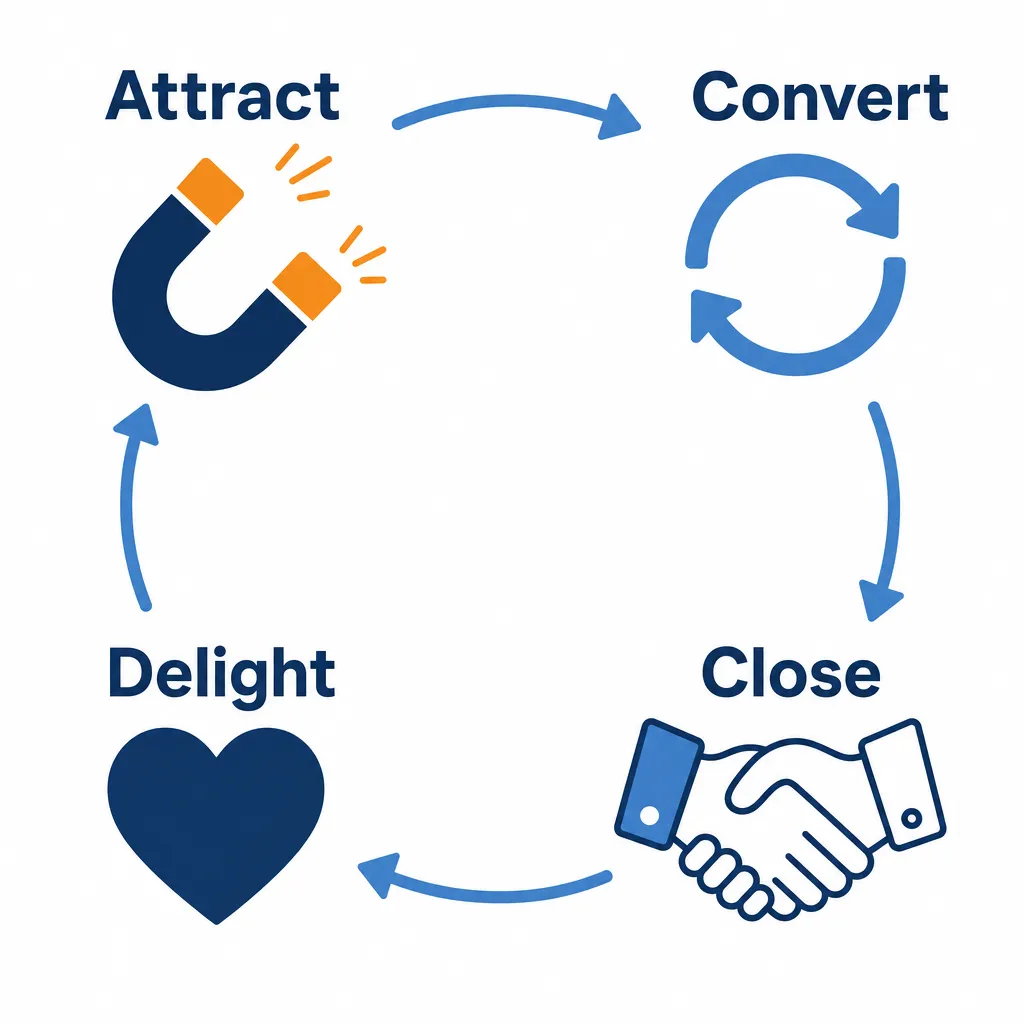
- 🧲 Attract (TOFU: Top of Funnel): Bring qualified traffic to your site with a content strategy optimised for SEO (blog posts, videos, podcasts). The goal is to answer your audience's questions and establish yourself as the expert.
- 🔄 Convert (MOFU: Middle of Funnel): Turn those anonymous visitors into identifiable contacts. Offer exclusive resources (ebooks, checklists, webinars) in exchange for their details via dedicated conversion pages.
- 🤝 Close (BOFU: Bottom of Funnel): Guide your leads all the way to purchase with lead nurturing (personalised emails) and lead scoring (a points system to spot the most engaged prospects).
- 🥰 Delight: Turn customers into promoters of your brand through personalised follow-up, responsive support, exclusive content and referral programmes.
This TOFU-MOFU-BOFU progression structures your entire inbound strategy. Every piece of content should map to a specific stage of the customer journey, with clearly defined conversion goals. A blog post that tries to close the sale on first contact is as misplaced as a demo offered to someone who just discovered your brand.
Inbound marketing vs outbound marketing: two complementary approaches
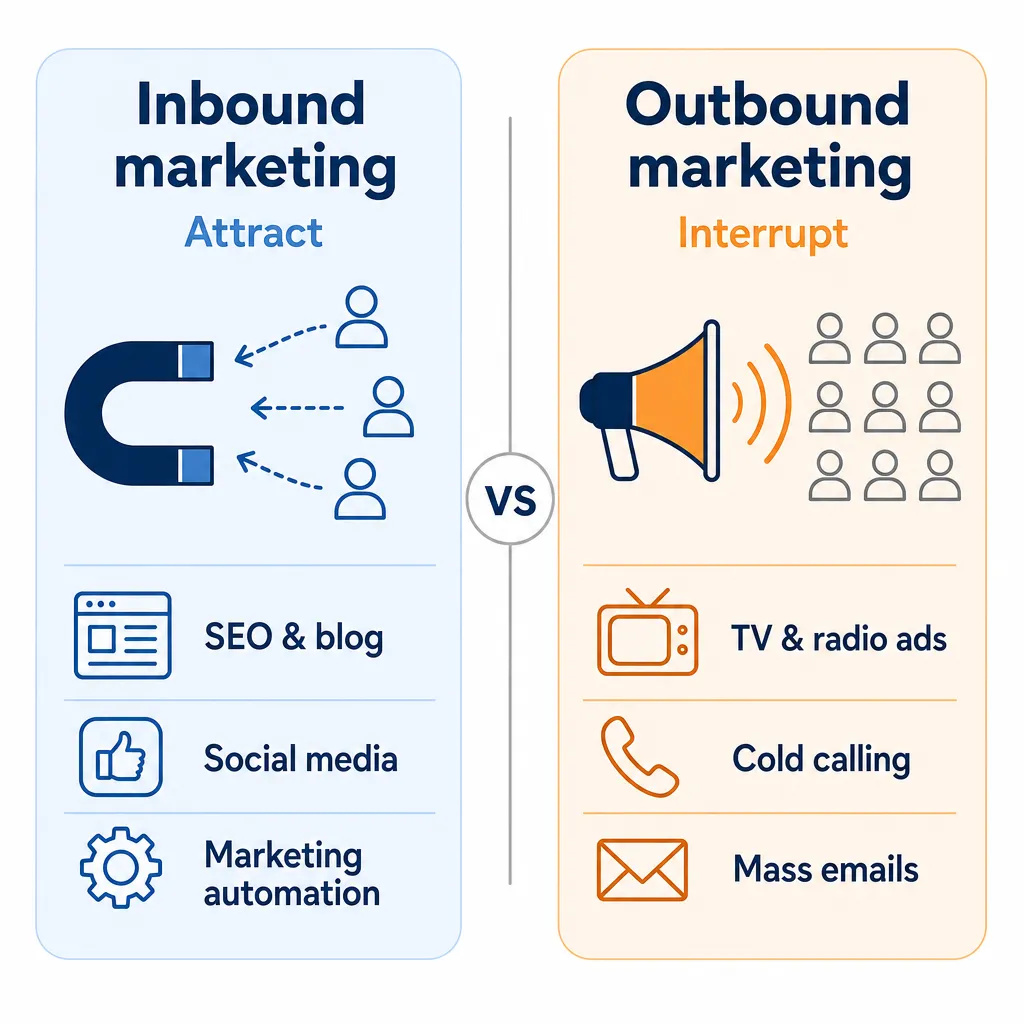
To really grasp why inbound marketing matters, it helps to set it against outbound marketing, which relies on a more intrusive, one-size-fits-all approach.
| Criterion | Inbound marketing | Outbound marketing |
| Philosophy | Attract and educate (pull strategy) | Interrupt and broadcast at scale (push strategy) |
| Main channels | SEO, blog, social media, marketing automation | TV/radio ads, display banners, cold calling, mass email blasts |
| Targeting | Qualified audience already actively searching | Broad public, often unsolicited |
| Acquisition cost | Falls over time as content accumulates | Flat or rising; stops the moment spending stops |
| ROI | Durable and compounding over time | Immediate but limited to the campaign's lifespan |
A concrete example: Take a B2B company that spends $5,000 on a LinkedIn ad campaign (outbound marketing) and gets 50 contacts, so $100 per lead. At the same time, it puts $5,000 into 5 SEO-optimised blog posts as part of an inbound marketing play. In month one, that content brings in 20 contacts ($250 per lead). After a year, it has generated 300 contacts, bringing the cost per lead down to $16.60. And those articles keep working the following year, at no extra cost.
Inbound marketing and outbound marketing aren't fundamentally at odds. In practice, they complement each other: outbound can boost the reach of an inbound asset by sponsoring a webinar on social media, or re-engage advanced prospects through retargeting. An effective marketing strategy often combines both to get the most out of each.
Defining your inbound marketing strategy: SMART goals and personas
To succeed with inbound marketing, start by setting SMART goals and getting a precise picture of your personas. That way your strategy is both effective and measurable.
Set SMART goals to steer your actions
Don't settle for "increase traffic". A vague goal can't be measured, and what can't be measured can't be improved. Spell out clear, concrete goals:
- Specific: "Grow our blog's organic traffic by 30% (from 10,000 to 13,000 monthly visits)."
- Measurable: Track progress in Google Analytics and Search Console.
- Achievable: Ambitious but realistic with your current resources (1 writer, 1 part-time SEO specialist).
- Relevant: Target long-tail keywords for quick wins (moving from positions 11-20 into the top 5).
- Time-bound: Hit the target within six months.
Other relevant SMART goals include: a 20% increase in qualified leads, a 15% lift in landing page conversion rate, or a 25% cut in customer acquisition cost (CAC).
Build detailed buyer personas for targeted content
A buyer persona is a semi-fictional profile of your ideal customer, built from real data (interviews, analytics, CRM). It lets you create content that speaks directly to the needs and objections of each targeted profile.
Expert tip: Focus on 2 to 3 core personas. One sharply defined profile beats several vague sketches, and your content team will thank you for it. Each persona should cover: demographics, job role, challenges, objections, information sources and search intent.
Example for an HR SaaS company:
- Persona 1: Sophie, HR Manager
- 35, works at a 150-employee SME. Challenge: buried in admin with no time for people. Intent: she wants to automate new-hire onboarding and improve employee wellbeing. TOFU content: "5 tips to streamline onboarding without losing time."
- Persona 2: Mark, IT Director
- 45, same company. Challenge: data security and technical integration. Intent: he's comparing reliable, GDPR-compliant HR platforms. MOFU/BOFU content: white paper "HR data security in the cloud", industry case study.
Segmenting by persona lets you organise your content across the whole customer journey and strengthen your inbound strategy. Every article, guide or webinar should match a specific intent (informational, commercial or transactional) to support your inbound strategy.
Creating high-performing content: formats, editorial calendar and SEO
Content is the cornerstone of any inbound marketing strategy. To work, it has to meet your audience's needs, be optimised for SEO and smooth the visitor's path to conversion.
Vary content formats by funnel stage
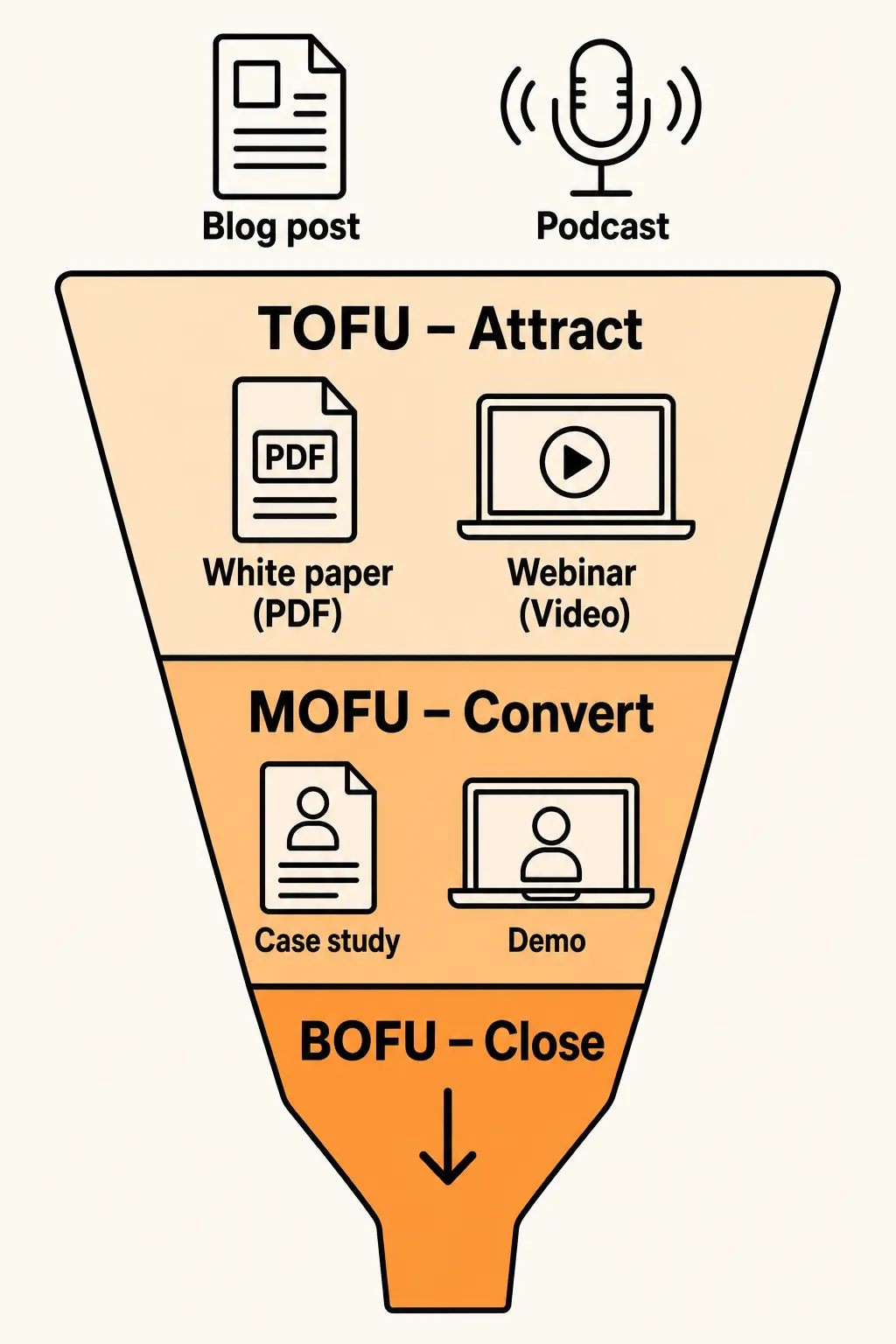
Each stage of the customer journey calls for a specific type of content:
- TOFU (Top of Funnel) - Attract: Go for informative blog posts, educational videos or infographics. These formats are designed to drive traffic and attract the attention of a broad audience.
- Concrete example: "5 simple ways to improve wellbeing when working from home"
- MOFU (Middle of Funnel) - Convert: Offer deeper content such as ebooks or webinars that nudge the prospect into becoming a lead.
- Effective example: "The ultimate checklist for choosing HR software" (download in exchange for an email)
- BOFU (Bottom of Funnel) - Close: Showcase customer case studies or product demos to win over hesitant prospects.
- Punchy example: "How our solution boosted Company Y's productivity by 60%"
Pro tip: One core piece of content can be repurposed into several formats (social posts, video, newsletter) to maximise its impact. This inbound strategy multiplies your conversion opportunities.
Structure your production with an editorial calendar
A well-designed editorial calendar turns your blog and social channels into genuine lead-generation machines. It organises your content strategy around clear goals and a deep understanding of your persona.
The backbone of your marketing, this plan brings together:
- In-depth SEO analysis to capture qualified traffic
- Identification of the topics that resonate with your target customer
- A precise publishing schedule
Discover our proven method for building a high-performing editorial calendar
The benefits are tangible:
- Measurable goals (conversions, quality leads) rather than vanity metrics
- Better anticipation of key moments (holidays, sales seasons, product launches)
- Smarter allocation of resources and deadlines
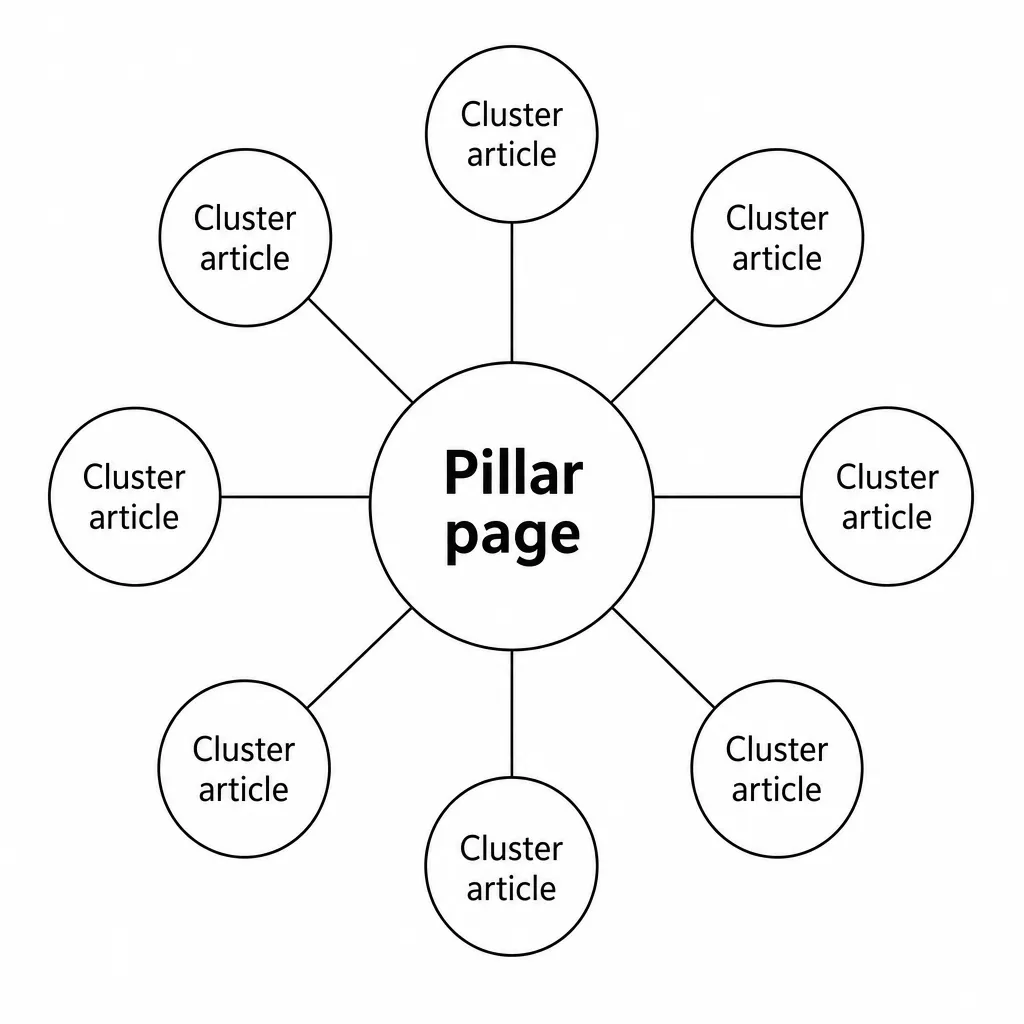
- A topic cluster structure that reinforces your authority
In practice: an editorial calendar built around your personas' search intent keeps every article tied to a real query.
Optimise your content for search engines (SEO)
Even the most polished content can go unnoticed if it doesn't rank. An effective SEO strategy is therefore essential to attract relevant, qualified traffic.
- Keyword research and intent analysis: Target specific queries suited to each phase of the customer journey: "inbound marketing definition" for early research (TOFU), "HR software comparison for SMEs" for purchase decisions (BOFU).
- On-page optimisation: Place your strategic keywords in the key spots: H1, subheadings (H2/H3), title tag and meta description. Work them naturally into the introduction too, and structure your content with short paragraphs and lists.
- Building topic clusters: Develop a comprehensive pillar page (e.g. "The ultimate SEO guide") connected to cluster articles through smart internal linking, reinforcing your topical authority.
- Advanced technical optimisation: Improve your Core Web Vitals (LCP < 2.5s, CLS < 0.1), add relevant structured data (such as Article) and eliminate orphan pages for better indexing.
This practical guide explains in detail how link juice works and shows how to strengthen your rankings through:
- Strategic internal linking
- Relevant backlinks
- Advanced technical optimisation (301 redirects, canonical tags)
You'll find hands-on techniques such as organising content into topic clusters, choosing anchor text, and managing outbound links. The guide also covers link building best practices (guest blogging, editorial partnerships) and the essential tools (Google Search Console, Ahrefs) to audit and improve your rankings.
All of these levers slot neatly into an inbound marketing strategy, turning your content into qualified traffic and then into conversions. They apply just as well to a blog as to a corporate website. Find out how to optimise your link juice to strengthen your inbound marketing.
This complete guide reveals the keys to creating high-performing SEO content in 2026, perfect for fuelling your inbound strategy:
- Applying E-E-A-T principles (Experience, Expertise, Authoritativeness, Trustworthiness)
- Precise targeting through SERP analysis
- Building well-organised topic clusters
- Deep technical optimisation (structured data, Core Web Vitals)
This complete methodology lets you attract a targeted audience and convert it over the long run, while keeping your content from going stale. Read the guide to boost your SEO and your inbound marketing.
Amplify your content reach through social media
Is your content ready to share? Social media is a great way to widen your audience, provided you use it in a targeted, strategic way.
Tip: Don't try to cover every platform. Focus on the ones where your persona actually hangs out. For B2B, LinkedIn is still a must. In B2C marketing, Instagram or TikTok may be more relevant depending on your industry.
- Tailor your message to each network: A bare link won't cut it, and the algorithms won't reward it either. On LinkedIn, write an engaging post with a question or a take. Add eye-catching visuals such as carousels, short videos or infographics to enrich the post.
- Schedule your posts: Build social posts into your editorial calendar (for example: article shared on Monday, LinkedIn carousel on Wednesday, email reminder on Friday).
- Start conversations: Reply to comments, ask your audience questions and take part in relevant groups. The aim is to build an active community, not just push content out.
- Use retargeting: Reinforce the impact of your content with targeted social ads (for example: promoting a webinar to visitors of your blog).
Convert your visitors into qualified leads: landing pages and lead magnets
Attracting traffic is good, but turning your visitors into identifiable contacts is the very essence of inbound marketing.
Build high-converting landing pages
An effective landing page focuses on a single action: downloading a guide, registering for a webinar or requesting a demo. It should be simple, persuasive and built entirely around conversion.
Checklist for an optimal landing page:
- ✅ A clear headline summing up the main benefit ("Download the 2026 SEO Guide")
- ✅ A list of concrete benefits for your visitor
- ✅ An image showing the offer (an ebook preview, for instance)
- ✅ A short form (3 to 5 fields max)
- ✅ Trust signals (customer logos, testimonials, statistics)
- ❌ No distractions (no menu, no unnecessary links)
Your calls to action (CTAs) should be explicit and compelling ("Download now" rather than "Learn more"). Place them strategically across your site.
Test everything: Experiment with different headlines, visuals, CTA wording and form lengths. A single tweak can noticeably change your conversion rate.
Offer irresistible lead magnets
A good lead magnet is a valuable resource you give away in exchange for contact details. It should address a specific need of your persona.
Examples of high-performing lead magnets:
- Industry guide ("The complete guide to marketing automation in 2026")
- Checklist ("30 things to check before launching your campaign")
- Practical tools ("ROI calculator for your inbound strategy")
- Online course ("5 steps to structure your content")
- Lessons learned ("How to double your qualified leads with inbound")
Lead nurturing and marketing automation: turning contacts into customers
A visitor who downloads a guide usually isn't ready to buy on the spot. Lead nurturing means accompanying that prospect throughout their buying journey with personalised, automated email sequences.
Build effective nurturing workflows
With marketing automation, you can automatically send emails triggered by your contacts' actions: downloads, pages visited or messages opened.
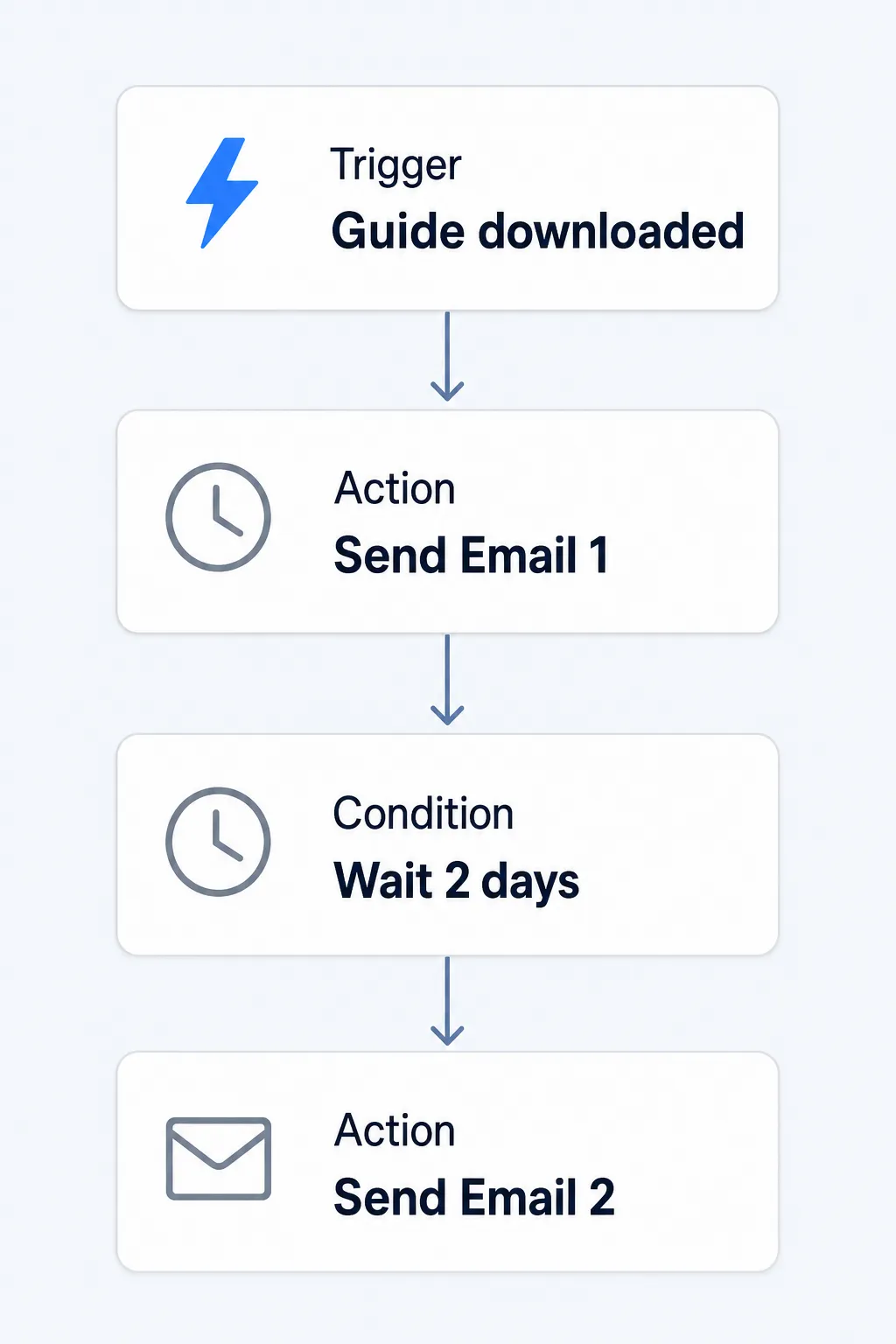
Concrete example of a nurturing workflow:
- Day 0: The prospect downloads the "HR Software Guide" and instantly receives an email with the download link and a welcome message.
- Day 2: A follow-up email suggests a related article: "3 pitfalls to avoid when choosing HR software".
- Day 5: A customer testimonial from the same industry lands in their inbox.
- Day 10: If the contact has opened the previous messages, they receive a personalised invitation to a free 30-minute demo.
These automated journeys keep the lead engaged and steer them naturally towards a buying decision, with no extra effort on your side.
Qualify your leads with lead scoring
How do you spot the most engaged prospects? Lead scoring automatically rates each contact based on their actions and attributes.
Typical lead scoring grid:
- Visit to the "Pricing" page: +15 points
- Case study download: +10 points
- Email opened: +1 point
- Email click: +3 points
- Job title: Director: +10 points
- Company with >100 employees: +5 points
As soon as a prospect crosses the set threshold (50 points, say), an alert goes to the relevant sales rep. They can then reach out with the full history in hand (pages viewed, content downloaded, emails opened), which significantly improves conversion rates and shortens the sales cycle.
Sales and marketing alignment and CRM integration
Inbound marketing makes it easier to align marketing and sales teams. Marketing generates and attracts qualified leads (MQLs, Marketing Qualified Leads) through relevant content and nurturing campaigns. Sales then take over the most engaged leads (SQLs, Sales Qualified Leads), identified through a scoring system. No more cold leads dumped on sales, no more good leads left to go cold.
The keys to getting this alignment right:
- Agree together on the criteria that separate an MQL from an SQL.
- Integrate your marketing automation platform with your CRM (HubSpot, Salesforce, Pipedrive).
- Automate the transfer of browsing and engagement data into the CRM.
- Hold regular joint marketing-sales reviews to refine processes and scoring.
- Track shared metrics: MQL-to-SQL conversion rate, close rate and average sales cycle length.
This practical guide shows how SEO serves as the foundation of an effective inbound marketing strategy: in-depth keyword analysis (long tail included), web content creation and editorial planning, technical optimisation and HTML structure, internal and external link strategy, plus setting up a conversion funnel and tracking results with tools like Google Search Console and GA4. It offers an operational roadmap to attract targeted traffic, produce content worth sharing and turn every visitor into a qualified prospect, all crucial for making your inbound strategy last. Discover our complete SEO guide to strengthen your inbound marketing.
Retain your customers and turn them into advocates
The sale isn't the end of the customer relationship, it's the start of a new phase. Keeping a happy customer costs far less than acquiring a new one, and they may well become your best promoter.
- Automated onboarding: Set up a guided email sequence (tutorials, educational webinars, expert resources) to help them get up and running with your solution.
- Responsive multi-channel support: Offer help via email, chat, phone and a knowledge base. A well-supported customer is a loyal one, and a loyal customer is far cheaper to keep than a new one is to win.
- Premium content: Give customers access to advanced webinars, practical guides or early access to new features.
- Referral programmes: Encourage customers to spread the word about your solution in exchange for perks (discounts, credits, gifts).
- User-generated content: Invite customers to share their testimonials, case studies and online reviews.
This virtuous circle, where customers become passionate advocates, is the natural outcome of a well-run inbound strategy. By retaining customers, you cut churn, raise lifetime value (LTV) and enjoy a steady flow of new leads from word of mouth.
Measuring the performance of your inbound marketing strategy
An inbound marketing strategy, or inbound strategy, can't be run on guesswork. To know what's working and keep improving, you need to track precise key metrics, and review them on a regular schedule rather than when something goes wrong.
Essential KPIs to track
- Organic traffic: Number of visitors arriving from search engines, available in Google Search Console.
- Visitor-to-lead conversion rate: Percentage of visitors who fill in a form and become leads.
- Number of MQLs and SQLs generated: Volume of qualified leads passed on to sales.
- Close rate: Share of SQLs converted into customers.
- Customer acquisition cost (CAC): Total marketing spend divided by the number of new customers.
- Customer lifetime value (LTV): Average revenue a customer generates over the whole relationship.
- Inbound marketing ROI: (Revenue generated − Marketing spend) / Marketing spend.
Essential tools for tracking and optimisation
- Google Analytics 4 (GA4): Traffic, conversion and user journey tracking.
- Google Search Console: Rankings, CTR, impressions and SEO opportunities.
- Ahrefs / Semrush: Keyword research, competitor analysis and SEO audits.
- HubSpot / ActiveCampaign / Marketo: Marketing automation, lead scoring and workflow management.
- Hotjar / Microsoft Clarity: Heatmaps and session recordings to optimise your landing pages.
Continuous optimisation process:
- Quarterly content audit to pinpoint what needs improving.
- Prioritise content sitting in positions 11 to 20 for quick wins through internal linking and refreshes.
- Systematic A/B testing of headlines, CTAs and meta descriptions to boost conversions.
- Monthly review of nurturing campaigns: open rates, clicks and conversions.
- Monthly marketing-sales check-in, essential for adjusting your inbound strategy and the overall inbound marketing strategy.
A 6-week action plan to launch your inbound strategy
Ready to get moving? Here's a step-by-step plan to embed the principles of inbound marketing in your organisation.
- Week 1: Audit and diagnosis
- Review your website, your CRM and all your existing content. Set SMART goals and choose your main performance indicators.
- Week 2: Create 2-3 buyer personas
- Run customer interviews and mine your CRM data to build precise persona profiles.
- Weeks 3-4: Content production
- Write three SEO-optimised blog posts (TOFU), create a MOFU lead magnet (ebook or checklist) and prepare a BOFU case study.
- Week 5: Site optimisation
- Design or improve two landing pages, add visible CTAs to your articles and run a technical SEO audit (Core Web Vitals, internal linking).
- Week 6: Set up marketing automation
- Configure your tool (HubSpot, ActiveCampaign, Brevo), build a first lead nurturing journey and a lead scoring system. Finally, sync everything with your CRM.
In six weeks you'll have a solid foundation to attract, convert and nurture your prospects. Results won't be instant, but you'll have switched on a powerful generator of qualified leads that keeps compounding month after month.

Automate Your SEO With AI Agents
Sedestral connects six AI agents to your website to handle content, audits, rankings, backlinks and images, without the manual grind.