This step-by-step guide shows you how to build a white paper that lands and turns your visitors into qualified leads. We'll walk through every strategic step together: defining your B2B persona, nailing the ideal structure, optimising for SEO, and the techniques that maximise downloads.
Why white papers convert
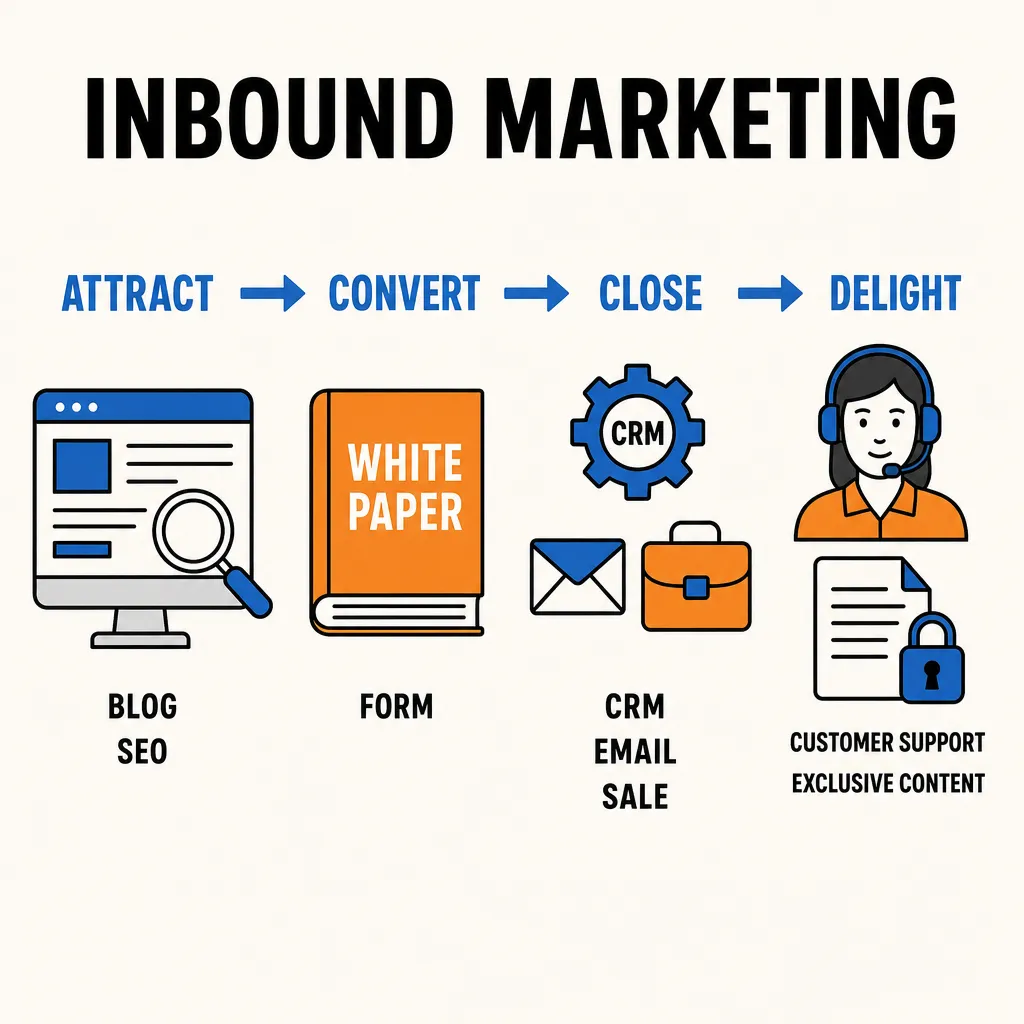
In an inbound marketing strategy, white papers are exceptionally effective MOFU (middle of the funnel) assets. This premium content lets you collect prospect data in exchange for a genuinely valuable resource. Their power lies in the content itself: an expert document packed with in-depth information fully justifies asking for contact details.
What goals for your white papers
Before you start writing a white paper, set a clear SMART goal. For example: "Increase downloads among HR directors by 30% within six months". A measurable target like this lets you tailor your content to each stage of the buyer's journey: awareness, evaluation or purchase decision.
Each goal directly shapes the nature of your content. For the awareness stage, go for an educational guide. For the evaluation stage, add comparisons and real-world feedback. For the final decision, offer ready-to-use templates and hard proof of ROI. This targeted approach keeps you closely aligned with what your prospect actually expects.
Buyer persona and content angle
A well-defined B2B persona should drive every element of your white paper. Picture "Sophie, HR Manager at a mid-sized company": she's after practical solutions she can apply straight away. Your tone should be direct, with accessible vocabulary and concrete examples.
On the other hand, "Mark, CIO at a large enterprise" expects deep technical analysis. Your content will need system architectures, detailed KPIs and cost-benefit breakdowns. Adapting your message this way significantly increases reader engagement.
The angle of your document flows naturally from these personas. A white paper called "10 steps to better employee onboarding" for Sophie will contain an operational checklist. For Mark, "Securing HR data in the cloud" will present detailed technical diagrams with implementation recommendations.
Inbound and conversion communication
White papers slot perfectly into an automation workflow. Day 0: send the document immediately. Day 2: publish a complementary article. Day 5: share a case study. Day 10: offer a personalised demo. This sequence keeps the prospect's attention and progressively sharpens their qualification.
Smart repurposing multiplies your content's impact. Turn each section into an optimised blog post, create punchy visuals for social media, or run a webinar on the key points. This content marketing approach extends the reach of your document and feeds several communication channels at once.
Standard outline for white papers
A well-organised structure makes your white paper more appealing and more credible. This flexible outline adapts to different goals while following a logical progression: identify the challenges, present solutions, provide tangible proof and close with a well-thought-out call to action. A properly paced journey naturally guides the reader towards conversion.
Ideal structure and key elements
To write a white paper that really hits home, follow this proven organisation: a striking cover, a compelling summary, a problem analysis, concrete solutions, real examples and a well-calibrated conclusion. Each part plays a precise role in your communication with the prospect.
The executive summary is crucial for grabbing attention. In a few well-crafted paragraphs, clearly present your topic, your proposals and their concrete benefits. This digest gives decision-makers an immediate view of the value your content delivers.
| Section | Recommended content | Length |
| Cover | Impactful title paired with a professional image | 1 page |
| Executive summary | Major challenges, proposed solutions and key benefits | 1 page |
| Context | Industry analysis and the main challenges to tackle | 2-3 pages |
| Solutions | Operational methods and practical advice | 5-8 pages |
| Proof | Case studies and verified customer testimonials | 2-3 pages |
| Conclusion | Summary and a well-worded call to action | 1 page |
Plan for 3,000 to 7,500 words depending on how complex your topic is. For a truly effective B2B guide, aim for around 15 pages: developed enough to explore the solutions in depth, but concise enough to hold attention. Build each part around one core idea, with "Key takeaways" boxes that make the information easier to remember.
Proof, cases and credibility
A white paper worthy of the name absolutely must rest on concrete elements to establish its credibility. Without verifiable data and authentic testimonials, your document risks coming across as a plain sales pitch.
- Hard numbers: include recent statistics, industry benchmarks and measurable results. Example: a benchmark figure from a named, dated study, quoted with its source.
- Recognised expertise: quote industry specialists with their titles and organisations. These external references considerably strengthen the credibility of your content.
- Case studies: present 2-3 real cases with specific context, actions taken and quantifiable results. These concrete illustrations prove that your proposed solutions work.
Every claim must be solidly backed up. Always cite your sources: official bodies, reputable industry studies or your own documented research. This intellectual rigour is what separates a valuable guide from a simple promotional document.
Don't hesitate to add useful appendices: detailed methodology, full bibliography, glossary of technical terms, ready-to-use templates. These extras turn your white paper into a genuine resource your prospects will keep and share.
Readable design and visual communication
A polished presentation dramatically improves the reading experience and strengthens your brand image. Use a clear visual hierarchy (H1 to H3 headings that are easy to tell apart), an interactive table of contents and a layout with plenty of white space. This well-thought-out organisation guides the reader intuitively through your content.
Add relevant visuals: summary infographics, explanatory diagrams, data charts, annotated screenshots. These varied supports help clarify complex points while breaking up the monotony of the text. Optimise your images in WebP format and always fill in the alt attributes to improve your SEO.
Our inbound marketing guide shows you how inbound marketing transforms lead capture through quality content, where the white paper plays a central role in the customer journey (MOFU). It details 4 key stages: capture attention, convert visitors, close the sale and build loyalty. You'll learn why defining your personas is fundamental before you write a white paper, how to optimise for SEO and how to build high-performing landing pages (with catchy headlines, benefits highlighted, an impactful visual, a stripped-back form and a strategic call to action) to maximise downloads. The guide also covers lead nurturing techniques, scoring and automation to qualify your prospects. Discover our methodology for creating effective white papers and fitting them into a coherent marketing strategy.
SEO and distribution of white papers
Organic search is essential to make your white papers visible online. Without a solid SEO strategy, even the best content will stay invisible. The approach rests on three levers: identifying relevant keywords, technical optimisation and link building.
Keyword research and on-page
Before you start writing, study what your prospects are searching for. Combine broad terms ("ecommerce SEO") with long-tail phrases ("how to optimise Shopify SEO in 2026"). This mix attracts different reader profiles and widens your audience.
Work these keywords naturally into your main title, subheadings and introduction. The goal: keep the text flowing while respecting SEO best practices. Your guide must give concrete answers to your target audience's questions.
Optimise your PDF's metadata: descriptive title, author, summary and keywords. Go for a descriptive file name ("ecommerce-seo-guide-2026.pdf"). These details strengthen your document's visibility in search results.
Landing page and conversion
Design your landing page with care: a punchy headline, benefits up front, a preview of the content, a minimal form and testimonials. Remove distractions so visitors head straight for the download.
Schema.org markup (for example Article on the landing page) helps search engines understand your content, but CreativeWork and Report do not generate any Google rich result.
Promotion and link building in communication
Effective distribution is crucial to amplify the reach of your white paper. Publish articles on specialist blogs with links back to your page. Create visuals that sum up your key points - perfect for social sharing.
Reach out to journalists and influencers in your industry. Offer them exclusive insights drawn from your data. This relationship-driven approach earns quality mentions and reinforces your credibility.
Here's a step-by-step guide covering the SEO essentials to boost your white paper's visibility: mastering crawling and indexing (via sitemap and robots.txt), choosing the right keywords (especially long-tail queries), organising your HTML with a logical H1/H2/H3 hierarchy, optimising on-page elements (titles, meta descriptions, images with alt attributes), polishing internal linking, setting up a link building strategy to gain authority, and using the right tracking tools (Search Console, Analytics, PageSpeed). Optimising your white paper: a step-by-step SEO guide reveals the best practices to maximise your organic visibility.
Process for creating white papers
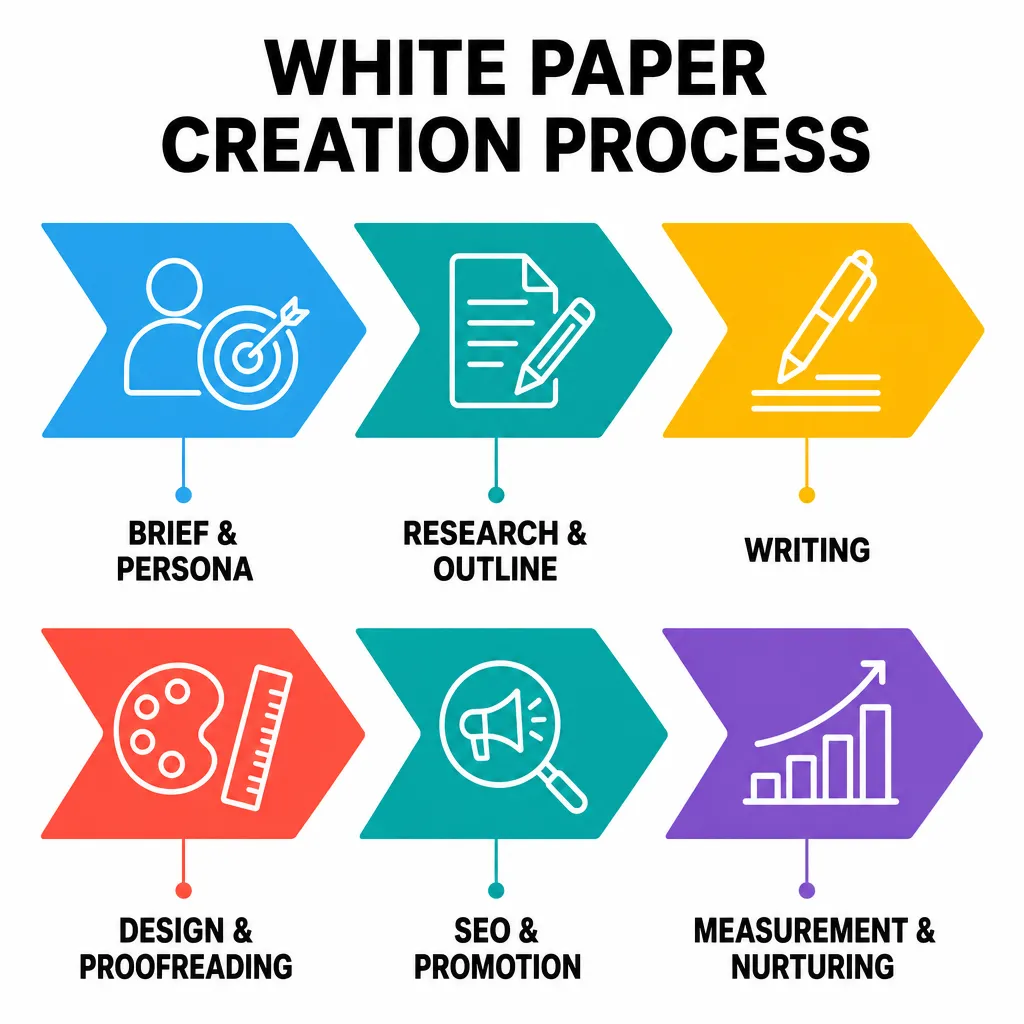
Producing a white paper relies on a rigorous 6-step methodology. This approach guarantees quality content, deadlines met and resources used wisely. Each phase is signed off before moving on to the next.
Brief and editorial governance
A clear brief is the foundation of success. To create a white paper that matches your goals, spell out: the target persona, the value delivered, the key messages per section, the sources to draw on, the case studies to include, plus the technical and editorial constraints. This upfront framing saves you endless back-and-forth.
- Persona definition: job title, industry, company size, level of expertise, major challenges, preferred communication channels.
- Editorial angle: central problem, tangible benefits, desired tone (technical or educational), expected level of detail.
- Available resources: experts to interview, usable internal data, relevant external studies, allocated budget.
- Expected deliverables: final format (PDF, page count), useful appendices (checklists, templates), deadlines, sign-off criteria.
Schedule interviews with your subject-matter experts to gather precise technical information and verify the accuracy of the content. These conversations enrich your argument with exclusive insights that set your white paper apart.
Writing, proof and actionable content
The MOFU methodology puts the emphasis on providing useful information rather than self-promotion. Build each part around a concrete problem and applicable solutions. Include checklists, templates to download and practical steps that help the reader move to action.
Back up your recommendations with solid data: industry statistics, study results, customer testimonials with real figures. This fact-based approach strengthens your credibility and justifies the exchange of contact details.
CTA, measurement and ongoing communication
Place relevant calls to action throughout the document: resource download, demo request, webinar sign-up. These CTAs extend engagement beyond the reading itself and feed your sales pipeline.
Define clear KPIs: download volume, landing page conversion rate, qualified leads, demo requests. This tracking lets you adjust your strategy and prove the ROI of creating a white paper.
Examples of effective white papers
See how some companies have turned these principles into tangible results. We're sharing several industry-specific use cases that reveal the ingredients of success and let you adapt them to your own context. They'll inspire you without you having to copy anyone.
Industry outlines and tables of contents
To design a white paper that makes a difference in your industry, study the structures that get results. In human resources, favour practical guides with actionable lists. In technology, include technical diagrams and risk analyses. In marketing, offer turnkey methodologies illustrated with testimonials backed by numbers.
- HR guide: "Improving onboarding in 10 steps" → Operational context, Diagnosis, Concrete actions, Follow-up checklist, Ready-to-use templates.
- IT white paper: "Protecting your cloud data" → Current challenges, Proven solutions, Technical recommendations, Field feedback, GDPR compliance check.
- Marketing study: "Next-generation B2B content marketing" → 2026 trends, Industry benchmarks, Winning strategies, Toolkit, Operational calendar.
Adjust the length to the complexity of your topic and the expectations of your reader. A practical 15-page memo is enough for immediate advice. An in-depth study may need 50 pages with full analysis and technical appendices.
Case studies and proof in numbers
Concrete examples make abstract concepts real. Present 2-3 customer cases detailing: the starting situation, the actions taken, the results achieved with precise indicators. This approach grabs the prospect's attention by proving your solutions actually work.
Always include data that speaks for itself: "-15% churn rate in 6 months", "2.2x organic traffic in one year", "-30% cost per lead". These metrics clearly demonstrate the business impact for your audience.
Vary your proof formats: video testimonials, annotated screenshots, trend charts, comparison matrices. This diversity keeps readers engaged and suits different ways of consuming content.
Repurposing and multichannel communication
Maximise your ROI by adapting your content to several formats. Turn each chapter into an SEO-optimised blog post pointing to your dedicated landing page. This content marketing strategy reinforces your credibility.
Create content tailored to each network: LinkedIn infographics, X threads, Instagram stories. This white paper distribution widens your reach and naturally attracts qualified leads.
Host a dedicated webinar, guest on podcasts to share your insights, quote your data at conferences. This expert communication positions you as the go-to reference while generating qualified traffic.
Optimising white papers to convert
To effectively turn your downloads into qualified leads, you need a global optimisation strategy. The key? A winning combination of a high-performing landing page, regular testing and meticulous post-download follow-up.
Landing page and social proof
When you write a white paper, pairing it with an optimised landing page is crucial. Strip the page right back, removing anything distracting, so the prospect focuses on a single goal: completing your form.
- Catchy headline: Lead with concrete benefits like "Grow your revenue by 30% with this guide" rather than a plain "Marketing white paper".
- Visible benefits: List 3 to 5 strengths of your content as bullet points for quick scanning.
- Social proof: Add download statistics or testimonials to build credibility with your reader.
Always offer a free excerpt of your content. This teaser lets prospects judge the quality before downloading.
A/B testing and tracking
Run continuous A/B tests on your landing page: try different versions of the headline, the visuals and the form placement. Sometimes a simple change of button colour can boost your conversions.
Set up a precise tracking system with Google Analytics 4 to measure every step of the download journey. Create custom events like "form_submitted" to pinpoint exactly where to improve.
Nurturing and post-download communication
Build a multi-step post-download communication strategy:
- Immediate email with the white paper
- Complementary content over the following days
- Final demo offer
Put a scoring system in place that rates lead engagement (download, email interactions and so on). This lets you hand off to the sales team at exactly the right moment.

Automate Your SEO With AI Agents
Sedestral connects six AI agents to your website to handle content, audits, rankings and backlinks, without the manual grind.