Guest blogging is one of the most reliable ways to boost your organic rankings while putting your name in front of a brand new audience. This smart link building technique lets you publish guest posts on relevant partner sites, earning quality backlinks that lift your visibility in search. In this guide, we walk you through how to run an effective guest post campaign, how to pick the right partner blogs and how to measure the real impact on your rankings.
Guest blogging and SEO value
Guest blogging is a particularly effective SEO strategy because it combines visibility and credibility in one move. Unlike artificial link schemes, this natural method consists of writing genuinely useful content for third-party platforms, which creates value for readers and search engines alike. Done properly, it builds your reputation, but Google's spam policies count links with optimised anchor text in guest posts as link spam, so keep anchors natural and use rel="sponsored" or rel="nofollow" when a post is paid for.
Definition and goals
The idea behind a guest post is simple: you offer a quality article to a host blog in exchange for exposure to its audience. It's a win-win. The host site gets fresh content, and the author gets targeted exposure. For example, an SEO specialist might write a guide on SEO best practices for a blog that covers digital marketing.
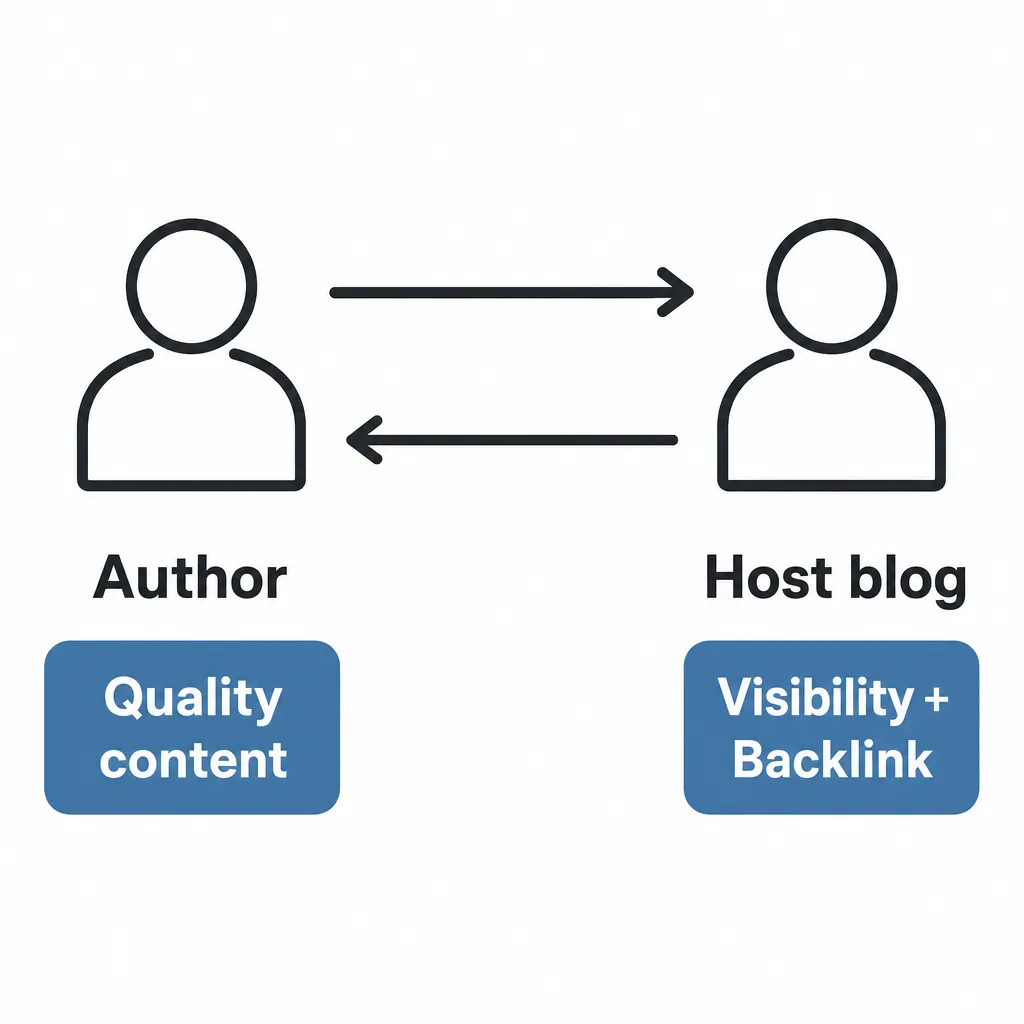
- Targeted visibility: reach readers who already care about your area of expertise
- Stronger authority: associate your brand with platforms your industry already trusts
- Network building: forge lasting relationships with influencers in your niche
As this guide to link building strategies explains, every guest post should fit into a coherent editorial approach. The primary goal isn't just to get links, it's to offer content that's genuinely useful to the community you're targeting.
What makes a good backlink
The quality of the backlinks you earn through guest blogging depends on a few key criteria. A relevant link should come from a site that's topically close to yours, carry solid authority and sit naturally within the content. For example, a link from an e-commerce blog to your guide on optimising online stores is worth far more than a link dropped on a general-interest site.
Topical fit is essential. A contextual link placed inside an article about related subjects passes more authority than an isolated one. Placement matters too: a link inside the body copy is far more effective than one buried in a footer or sidebar.
The anchor text should look natural. Rather than over-optimised phrases like "best SEO expert", go for organic wording like "this in-depth analysis" that flows with the surrounding text.
Why quality beats quantity
Piling up low-quality links can damage your backlink profile and trigger penalties. A single link from an authoritative site in your sector has far more impact than dozens of links from directories or sites unrelated to your business.
This focus on quality lines up perfectly with Google's E-E-A-T criteria (Experience, Expertise, Authoritativeness, Trustworthiness). A guest post published on a recognised platform strengthens these key signals and helps establish your online credibility for the long haul.
Strategy and editor relationships
To succeed at guest blogging, you need a methodical approach that mixes finding the right targets with building lasting relationships. Good planning helps you spot the best publishing opportunities and create editorial partnerships that pay off for both sides over the long term.
Set goals and targets
Every effective link building strategy starts with clear goals. Do you want to strengthen your domain authority on certain keywords? Drive qualified traffic to specific pages? Or establish yourself as an expert in your field? These choices will directly shape your targets and how you approach each site.
There are several ways to find the best blogs for your guest posts:
- Analyse your competitors' backlinks with tools like Ahrefs or Semrush
- Use specific Google search operators ("write for us" + your topic)
- Evaluate each opportunity on content quality, topical relevance, site reputation and audience engagement

Build lasting relationships
Building good relationships with editors is a real asset: it makes your contributions easier to get accepted and opens the door to other collaborations (interviews, events and more). To stand out from the crowd:
- Personalise every single request
- Show that you know their editorial line
- Pitch topics that genuinely fit their readership
Prioritise and plan
To get the most out of your efforts, focus first on sites that combine topical relevance, authority and openness to outside contributors. A scoring system (like the one in the table below) will help you rank your prospects.
Set up a publishing calendar spanning several months to build a cumulative effect. This gradual approach lets you refine your strategy as feedback from editors comes in.
| Evaluation criterion | Weighting | How to measure it |
| Topical relevance | 40% | Review of recent content |
| Domain authority | 30% | Domain Rating / Domain Authority |
| Audience engagement | 20% | Comments, social shares |
| Openness to contributors | 10% | "Write for us" page, past guest posts |
Winning pitches and guest posts
Two things make or break a guest post: personalising your approach and delivering content that matches exactly what the host blog expects. Your pitch needs to showcase your expertise while proving you really understand the target audience. Here are our tips for improving your hit rate.
Write a convincing pitch
Effective outreach starts with a careful, relevant first contact. Your pitch should be concise, personalised and focused on the value you bring to the blog. Ditch the templated messages and show instead how your article will genuinely enrich their community.
The winning recipe: a brief introduction, a mention of a recent post on the blog that inspired you, then 2-3 topic ideas with catchy headlines. To wrap up, share links to your best published work to establish your credibility.
Tailor the title and outline
A good pitch suggests headlines that will grab the audience while bringing a fresh angle. Look at the blog's best-performing content (tutorials, case studies and so on) and align your proposals with those editorial preferences.
A detailed outline with your H2/H3 subheadings shows professionalism and reassures the editor about the quality of the content. Mention the resources you'll use (data, examples, visuals) to make approval easier.
Agree the terms
Once your topic is accepted, clarify every expectation: length, tone, formatting and link policy. This crucial step avoids misunderstandings later on.
Get the SEO side right: link type (dofollow/nofollow), relevant anchors and useful destinations. Favour links that add value over commercial ones. It's better for SEO and better for the reader.
Set a realistic timeline and deliver a ready-to-publish article (technically optimised) to make the editor's job easier and speed up publication.
Writing and optimising your guest post
Creating an effective guest post means balancing writing quality with SEO optimisation. Your content has to win over the host blog's readers and follow sound SEO principles at the same time, so it grows your visibility and widens your audience.
Editorial best practices
To get the most out of your contribution, structure your text with clear headings and a logical progression. Your H2 and H3 tags should organise the reading experience and work your keywords in naturally. That improves the reader's experience and your search rankings at the same time.
- Clear structure: use a visual hierarchy with headings that make reading and indexing easier
- Punchy writing: keep paragraphs short (3-4 sentences max) for comfortable reading
- Relevant visuals: back up your text with meaningful images and optimised alt text for accessibility and SEO
Stick closely to the host site's editorial line: tone, technical level and the kind of sources it cites. Content that blends naturally into the host blog is far more likely to hook readers and get shared.
Links and anchors under control
Use links sparingly and always with the reader in mind. Your main link should point to a high-quality complementary resource: a tutorial, a concrete example or a practical solution. That approach adds value to your article while sending relevant traffic to your site.
Vary your anchor text wisely to avoid over-optimisation. Alternate between natural phrases, brand mentions and plain URLs depending on the context. For example: "our SEO methods", "ourdomain.com" or "this in-depth SEO analysis".
Don't forget a few relevant external links (to recognised studies or tools) and internal links to other posts on the host blog. That reinforces your expertise and keeps relationships with the editor on good terms.
Amplify your reach
Once the post is live, run an active promotion plan to maximise the impact of your guest post. Share it on your social channels with a message that highlights what your audience will get out of it. That boosts traffic and shows the partner blog you're invested.
Feature the post in your newsletter and across your other channels. Reply to comments to keep engagement going and open up opportunities with new contacts.
Measure and sustain the gains
To make the benefits of your guest blogging last, you need rigorous evaluation. By analysing the impact of each post precisely, you can gradually sharpen your SEO strategy. A handful of KPIs will help you understand how your articles influence your visibility, your traffic and your online authority. Regular tracking lets you spot what works best and refine your approach.
KPIs and attribution
To evaluate your guest posts properly, set up a precise tracking system. Using dedicated UTM parameters (utm_source=blog_name&utm_medium=guest_post&utm_campaign=campaign_name) in Google Analytics 4 will help you separate the traffic coming from each post.
- Qualified referral traffic: track visitors, session duration and conversion rate to judge the quality of the audience you're reaching
- Ranking movements: monitor how your target pages rank for your strategic keywords in Google Search Console
- Backlink acquisition: check not only the links you placed but any additional natural links that follow
- Engagement metrics: analyse social shares, comments and reading time to identify your most engaging content
Accurate attribution gives you a clear view of the ROI of each collaboration. Identify the blogs that generate the most qualified leads so you can target similar platforms next time.
Centralise all the data in a dedicated dashboard covering dates, performance and lessons learned. Building up that record makes future campaigns easier. To go further, this guide to sustainable alternatives to PBNs covers responsible link building methods.
Continuous optimisation
Reviewing your metrics regularly will reveal your strengths and the areas that need work. Spot the topics, formats and platforms that perform best to sharpen your editorial strategy and your choice of partners.
To extend the impact of your best guest posts, plan updates or follow-up articles. This keeps your relationships with editors warm while protecting the quality of your backlinks over time.

Rank Higher Without the Manual Work
From technical audits with Nox to competitor monitoring with Marc, Sedestral's AI agents cover every layer of SEO so your team doesn't have to.