Competition online isn't slowing down, so picking the right content format has become essential if you want to reach your target audience and actually hit your marketing goals. This guide walks you through the types of digital content that perform best depending on your strategy, and shows you how to tailor them to your needs and to what your audience really wants.
Which content formats for marketing
The types of digital content keep evolving to keep pace with new consumption habits. Each content format has its own strengths and serves a specific purpose in your marketing strategy. Getting a proper grip on those differences helps you squeeze more out of every piece you publish.
Articles, video and podcasts under the microscope
The blog article is still the backbone of any solid content strategy. This format is particularly effective for SEO and for establishing your expertise on a topic. A well-optimised 1,200 to 2,000 word piece on something like "how to choose a CRM" can bring in qualified traffic for years while steering prospects towards your solutions.
Video changes the engagement game entirely. A product video helps visitors understand your offer faster and can keep them on the page longer. A short 2-minute product demo on your homepage can lift your conversions considerably.
- Short videos (15-60 seconds): Ideal for social media, they showcase your product's strengths in seconds
- Tutorials (8-15 minutes): Perfect for YouTube, they build credibility while pulling in relevant traffic
- Webinars (30-60 minutes): Powerful tools for qualifying leads through sign-ups and live Q&A
The podcast builds a special bond with your audience thanks to a format that fits around multitasking. A weekly 20 to 40 minute episode with guest experts cements your position as an authority. Transcripts and optimised episode summaries also give your organic rankings a boost.
Long-form content and proof to convert
White papers and ebooks are particularly effective at generating qualified leads. These types of digital content let you collect contact details while positioning your business as the reference in its sector. A 15 to 25 page ebook titled "The digital marketing ROI playbook", for instance, can generate hundreds of prospects every month.
Case studies and customer testimonials bring decisive credibility, especially in B2B. A write-up detailing "a 30% cost reduction for client X", with a clear methodology, key figures and direct quotes, has a real influence on buying decisions. This kind of content is crucial in the final stages of the customer journey.
Build a mix around the goal
Your content strategy needs to adapt to every stage of the customer journey. For the awareness stage, go for SEO-optimised blog posts, short videos and easily shareable infographics. These formats are great at pulling new prospects into your digital ecosystem.
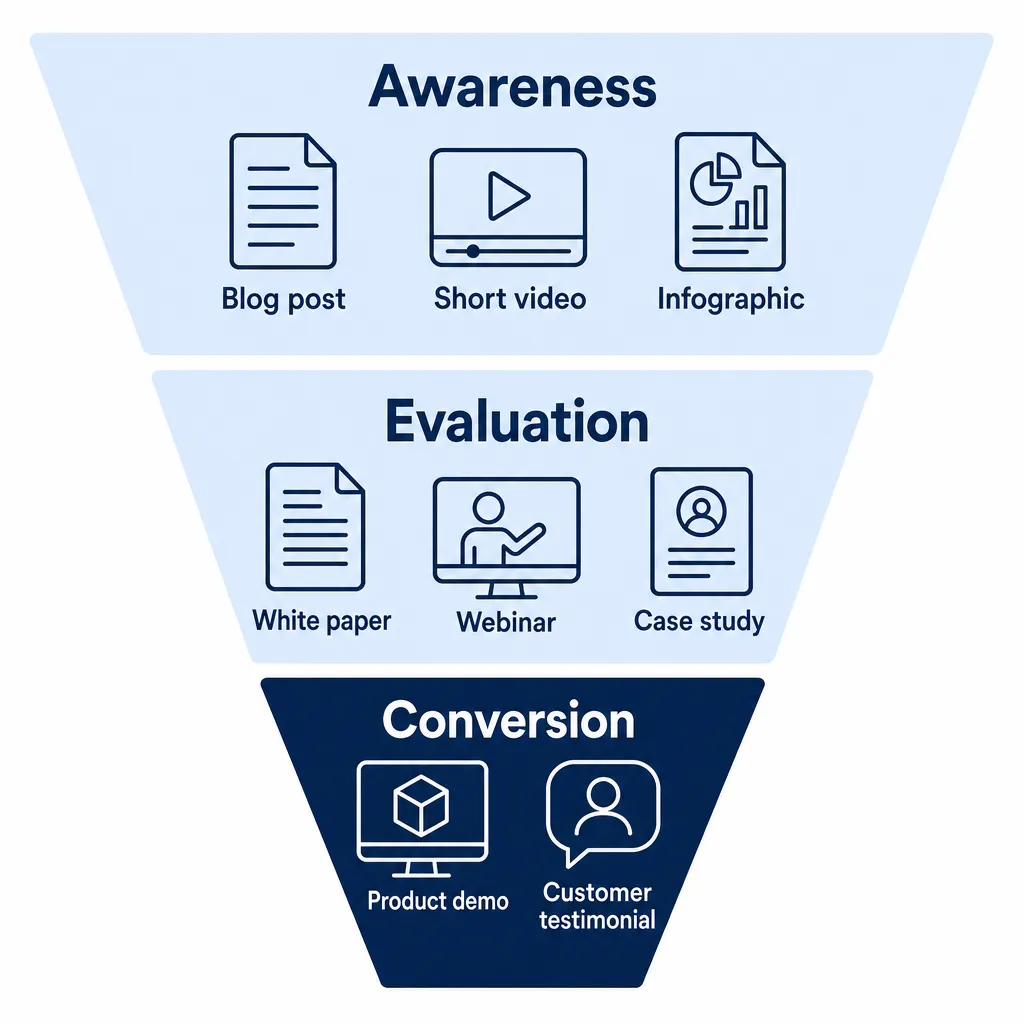
During the evaluation stage, offer more in-depth content: comparisons, webinars or white papers. These content types answer prospects' specific questions while proving your expertise. For conversion, product demos, case studies with hard numbers and detailed topic pages are particularly effective.
Successful content marketing rests on a careful balance between these different content formats. By combining articles, videos, podcasts and white papers, you cover the whole customer journey while maximising your visibility on social media and in search engines.
This practical guide lays out a 5-step method for building a content strategy that performs. You'll learn how to pick the most relevant content formats (blog posts, infographics, video, podcasts or white papers) based on your target audience. The approach covers: defining personas, researching strategic keywords, organising content into topic pillars, editorial planning and SEO optimisation. The guide puts particular emphasis on matching formats to the customer journey, optimising internal links and tracking performance rigorously (traffic, conversions, engagement), with regular adjustments to push the content that works best. Discover the most effective content formats
How to align format and strategy
The success of your marketing efforts depends directly on how well your content formats line up with your overall strategy. A methodical approach stops you spreading yourself thin across channels that don't fit your goals or your audience.
Analyse intent and audience
Start by looking closely at the Google results (SERP) for your strategic keywords. For example, if a query like "how to set up Shopify" mostly returns video tutorials, lead with that format and back it up with a detailed article with screenshots. This method guarantees you're giving searchers exactly what they expect.
- Informational need: Go for in-depth articles, practical guides and educational videos for technical questions
- Looking for solutions: Offer comparisons, hands-on reviews and demos to support decision-making
- Purchase intent: Create optimised product pages, customer testimonials and dedicated landing pages
Always adapt your content to your readers' profile. Beginners appreciate simple formats (lists, short video tutorials), while experts look for deeper analysis (white papers, technical webinars). This segmentation should drive every editorial decision you make.
Create, then repurpose smartly
One quality piece of core content opens up countless spin-offs. A webinar on SEO can become: a summary blog post, video clips for LinkedIn, a recap infographic and a series of themed newsletters. This technique maximises your visibility while tailoring the message to each channel.
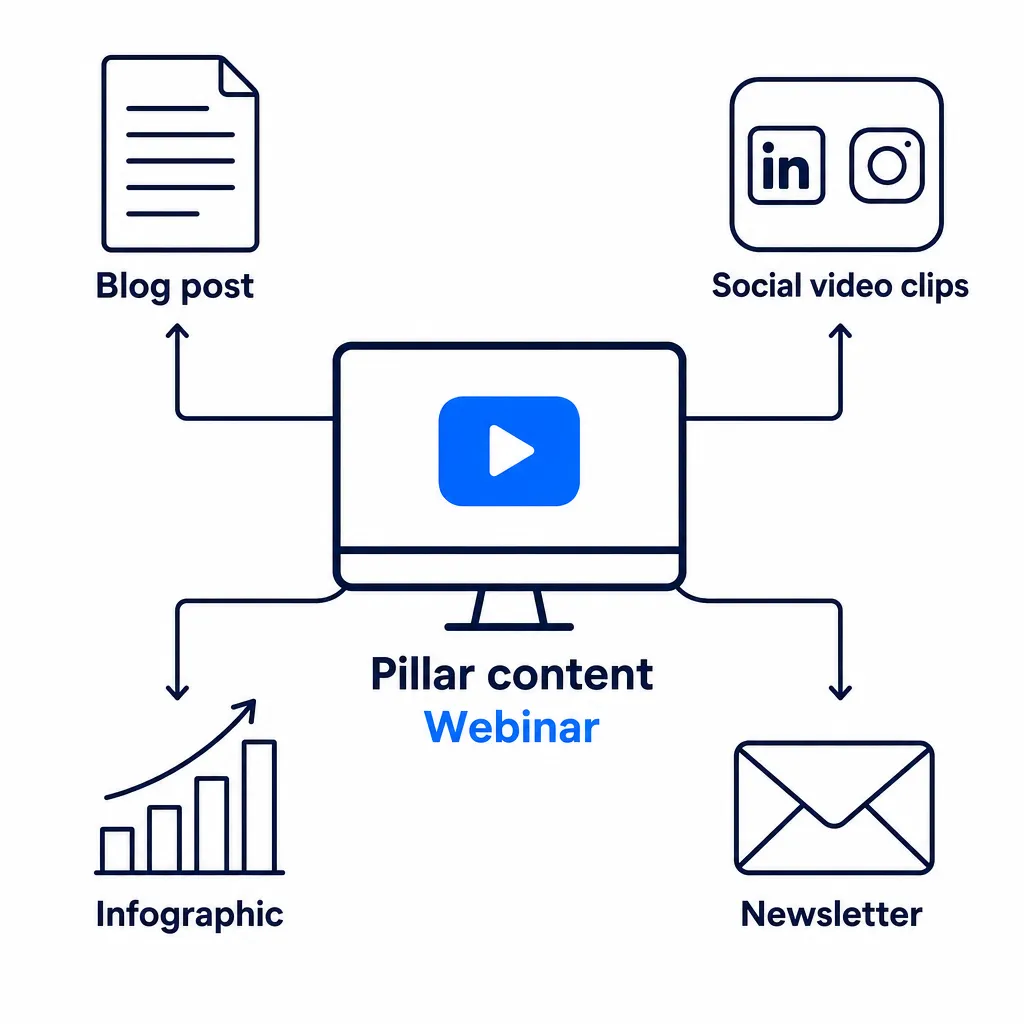
Structure your publications around central themes. A complete guide to content marketing can branch out into specialised sub-topics (writing, video, social media, data analysis). This topic cluster architecture showcases your expertise while improving user experience and your SEO rankings.
Measure, test, optimise
Assign specific metrics to each content type: reading time and traffic for articles, engagement for videos, open rates for newsletters. Tools like GA4 and Search Console give you all this valuable data.
Run A/B tests regularly on various elements (headlines, visuals, call-to-action buttons) to identify what works best. These incremental adjustments noticeably improve your results. Schedule quarterly audits to refresh, expand or redirect your content based on how it's performing.
To pick the right content format, start by analysing the search results (SERP) to spot the formats that dominate, whether that's long-form articles, listicles, videos or product pages. Then build your content structure (headings, Hn tags, metadata) while answering the search intent precisely. Optimise your media with modern formats (WebP/AVIF) and add subtitles to your videos. Also think about adding structured data (such as Article or, for product pages, Product schema) and organising your architecture into topic pillars to strengthen your credibility and meet E-E-A-T principles. Find out how to choose the best content format for your SEO, step by step.
Real examples of content that works
Here are some practical cases showing how different content formats can boost your marketing performance. They'll help you adapt these strategies to your own context.
Articles and video for acquisition
A training provider built an acquisition strategy around detailed career guides. Each article answering queries like "how to become a web developer" can attract steady organic traffic for years thanks to a clear structure and targeted calls to action, turning readers into leads along the way.
On social media, the provider also publishes short visual content on Instagram and LinkedIn. These one-minute videos grab the attention of career changers and point them back to the full guides.
To maximise impact, each article is repurposed as an infographic, a quiz or Instagram stories, multiplying the touchpoints with the target audience.
Podcasts and white papers for brand awareness
An SEO agency launched a weekly podcast featuring interviews with industry experts. Each episode digs into a topic like "the impact of AI on search rankings", reinforcing the agency's expertise.
The episodes are transcribed into blog posts, which give each episode a second life in search results. A white paper drawn from those insights can then keep generating leads for months.
Webinars and newsletters to drive engagement
A SaaS company runs monthly webinars and follows up with the attendees who show buying intent. The sessions are then cut into clips for LinkedIn and YouTube.
A weekly newsletter rounds out the approach, nurturing its subscribers and sending regular traffic back to the blog, all reinforced by interactive polls and well-optimised SEO.
Distribute and amplify your marketing content
Producing relevant content isn't enough. Strategic distribution is what determines its real impact. With a structured approach, you multiply the visibility of everything you create while keeping your costs under control.
Build a calendar and repurpose
Put together a balanced editorial schedule that alternates short and long formats depending on your goals. Plan a monthly flagship piece (like a webinar or an in-depth study) that will serve as the base for multiple adaptations. This method keeps you consistently present on your channels while strengthening your position as an expert.
- Monthly in-depth content: A webinar, detailed analysis or white paper that showcases your expertise
- Weekly themed articles: Practical tips and industry analysis to feed your blog and improve your SEO
- Daily social posts: Key excerpts, eye-catching visuals and messages tailored to each platform
- Regular newsletters: A spotlight on your best content, enriched with exclusive extras
Well-built content offers plenty of spin-offs: a single YouTube video can produce several clips for Instagram, a summary infographic, LinkedIn posts and material for your newsletters. This smart recycling maximises your return on investment.
Adapt by channel and by audience
Every social network has its own quirks. LinkedIn favours professional content and lessons learned, while Instagram is all about striking visuals and dynamic stories. Your social media content type needs to match precisely what your target audience expects.
Always adapt your output to the technical constraints of each platform. A single video can become:
- Stories for Instagram
- A LinkedIn carousel
- Short clips for X
This technical optimisation ensures better visibility across all your social channels.
Target your audiences wisely, based on their consumption habits:
- B2B professionals generally prefer LinkedIn and newsletters
- Younger audiences consume more short-form content on Instagram or YouTube
These insights set your distribution priorities.
Optimise CTAs and performance
Choose relevant calls to action based on the format and the customer journey. An informational article can lead to a white paper, while a video demo is more likely to prompt a free trial. This smooth logic noticeably improves your conversion rate.
On the technical side, optimise every element:
- Favour WebP images
- Enable lazy loading
- Structure your content with the right tags
These technical optimisations improve both your SEO and the user experience.
Analyse your performance methodically with the right KPIs:
- Reach and engagement for social media
- Organic traffic for your blog
- View-through rate for videos
This precise data helps you fine-tune your content strategy.
A method for creating the right format
To produce content that performs, take a structured approach that aligns your goals, your target audience and your resources. This methodical approach makes the most of your resources while amplifying the impact of every publication.
Brief and article production
Every piece of writing starts with a detailed brief specifying the main keyword, the search intent, the target reader profile and the objectives. This initial framing determines the ideal content format: complete guide, concise list or comparative analysis. A rigorous brief cuts down on revisions and keeps the article on point.
- SERP analysis: Identify the dominant formats, the angles already covered and the related topics worth developing
- Source selection: Pick 3 to 5 reliable, up-to-date references to back up your points
- Technical optimisation: Weave in keywords, internal links and structured data naturally
Production usually involves a content strategist, a writer and sometimes a designer, depending on the complexity of the format. A standard blog post mainly calls for SEO writing skills, while an infographic also demands design and data visualisation talent.
| Format | Time | Resources | ROI |
| Article (1,500 words) | 6-8h | SEO writer | Organic traffic |
| Video (10 min) | 15-20h | Scriptwriter + editor | Engagement |
| Infographic | 10-12h | Graphic designer | Social shares |
| Podcast (30 min) | 8-10h | Host | Loyalty |
Performance-driven video and podcasts
To create videos that land, favour authenticity over technical perfection. A recent smartphone and a decent mic are enough to produce engaging content, especially for social media. Only invest in pro gear once you've confirmed your audience is interested. This type of content consistently generates more interaction than text formats.
Structure your videos with: a punchy hook in the first 5 seconds, a clear body and a precise call to action. Subtitles are essential for mobile viewing with the sound off. This one good habit can noticeably improve your completion rate.
Strategy, resources and measurement
Split your budget with 70% going to proven formats and 30% to testing new content. This strategy balances immediate results with innovation. Master 2-3 formats first before diversifying your output.
Set up rigorous tracking through Google Analytics 4, Search Console and the analytics built into the social platforms. Build simple dashboards grouping KPIs by format: SEO rankings for articles, social reach for your networks, conversion rate for lead magnets. This visibility lets you optimise your strategy and adjust where you invest.

Rank Higher Without the Manual Work
From technical audits with Nox to competitor monitoring with Marc, Sedestral's AI agents cover every layer of SEO so your team doesn't have to.