Building an effective newsletter strategy is no longer optional for businesses that want a lasting relationship with their readers. This guide walks you through how to design, personalise and optimise your email campaigns to boost engagement and grow your visibility.
Build a goal-driven newsletter strategy
To create an effective newsletter, you need a structured approach built around concrete goals. Instead of sending generic messages, focus on targeted content tailored to each email you send.
Set clear goals and KPIs
A newsletter succeeds or fails on the strength of its SMART goals, the kind you can actually measure. Every campaign needs a specific mission if it's going to make an impact.
- Set precise targets: Pick concrete goals such as "increase webinar sign-ups by 20%" or "generate qualified leads". That makes performance far easier to evaluate.
- Choose the right type of newsletter: A promotional newsletter and an educational one call for different treatments. Match the content to what your readers need.
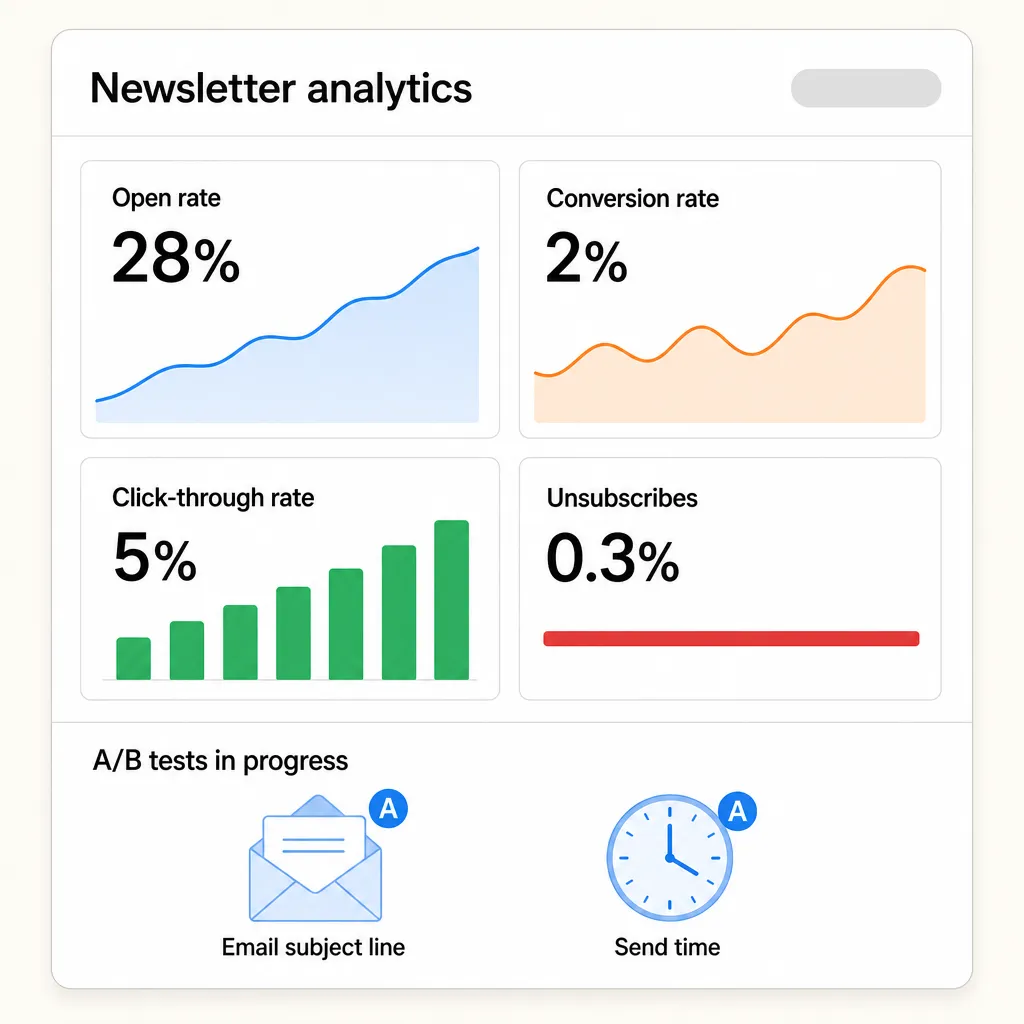
- Compare yourself to industry benchmarks: In B2B, a good open rate sits between 25% and 30%, with an ideal click-through rate of 4-6%. These figures help you refine your newsletter strategy.
- Tie the newsletter to business results: Systematically correlate actions (clicks, downloads) with real conversions to measure how effective your campaigns really are.
This method turns your newsletter into a powerful strategic lever. For example, promising "3 tips to boost your productivity" creates a tangible expectation and drives engagement.
The key is aligning your metrics with your marketing goals: if you want to generate leads, optimise your links to landing pages first rather than obsessing over the open rate alone.
Send at the right frequency for your audience
Sending frequency has a direct impact on how well your newsletter performs. Adjust it to your audience and you'll maximise reach without wearing out your subscribers.
For B2B, Tuesday to Thursday mornings work best. For B2C, evenings and weekends often deliver better results. A monthly rhythm suits in-depth features, while a weekly edition is ideal for sharing news.
Content driven by data and AI
Analytics and artificial intelligence are changing how newsletters get made. Identify the best-performing pages on your site and mine them for relevant topics.
This data-driven approach gets more value out of the content you already have. Group complementary articles into themed series to improve their visibility and build an effective newsletter.
Personalisation and segmentation are the foundations of a newsletter that genuinely performs. Rather than sending identical content to every subscriber, you need to adapt your message, your tone and your offer to the specifics of each group of recipients.
Create personalised content for the right segments
Smart segmentation turns a plain subscriber list into several distinct audiences, each receiving perfectly targeted communications. This approach significantly increases campaign effectiveness while building trust with your prospects.
Build actionable personas
Successful dynamic segmentation starts with detailed profiles that go well beyond basic demographics. Identify the professional challenges, preferred channels and formats that speak most to each persona.
- Marketing manager, 30-45: Loves practical guides and case studies. A monthly newsletter offers them concrete strategies with links to demos or webinars.
- Small business owner, 40-55: Prefers quick, digestible summaries. A short format sent around midday, laying out 5-7 key points, suits them perfectly.
- Student or junior, 20-30: Responds especially well to eye-catching visuals and interactive quizzes. Light, playful content keeps them engaged.
- Technical expert, 35-50: Wants deep expertise. Monthly themed newsletters with in-depth analysis meet their expectations precisely.
This segmentation lets you adjust not only the content you send, but also the sending frequency and the communication style. A business owner gets concise, results-focused messages, while a student needs detailed, step-by-step explanations.
To set up effective multichannel strategies, check out our 5-step guide to creating an effective content strategy, which explains how to optimise your email campaigns by repurposing key content.
Send relevant automated sequences
Automation lets you personalise your communications at scale without sacrificing relevance. Design journeys that adapt dynamically to each subscriber's actions to deliver a truly tailored experience.
Among the most effective automations: 3-email welcome sequences, follow-ups after a page visit, re-engagement campaigns after a period of inactivity, and deeper follow-up after several interactions on one topic. For example, a subscriber showing interest in SEO automatically receives an expert guide or an invitation to a personalised demo.
Content and CTAs by buying stage
Matching your message to the stage of the customer journey dramatically improves conversion rates. A new prospect needs general information, while a decision-maker in the buying phase wants precise details about your solutions.
Awareness stage: lean on infographics and practical tips. Consideration stage: offer detailed case studies. For decision-makers: put product comparisons and tailored demos front and centre. This progressive approach guides your prospects naturally towards a purchase without ever hounding them.
For a newsletter to really work, three key elements have to fit together perfectly: quality content that delivers value, clean formatting that makes reading easy, and carefully chosen send timing. Even the most relevant message is likely to flop if it's poorly presented or sent at the wrong moment.
Create engaging content and send it at the right time
A high-performing newsletter takes a rigorous approach that combines editorial excellence with technical optimisation. Every detail counts - from the choice of topic through to the call to action - to spark your subscribers' interest and maximise their interaction with your content.
Create a clear, readable format
A well-built editorial format makes for pleasant reading while reinforcing your brand image. Favour a logical architecture that naturally guides the reader to the essential information and the actions you expect.
A proven template always includes: a header with your logo and clear navigation, a punchy introduction (50 to 100 words), three short news items, a curated selection of your best content under a "Don't miss" banner, and a single, well-highlighted call to action. This consistency in form builds reading habits among your subscribers and steadily improves your performance.
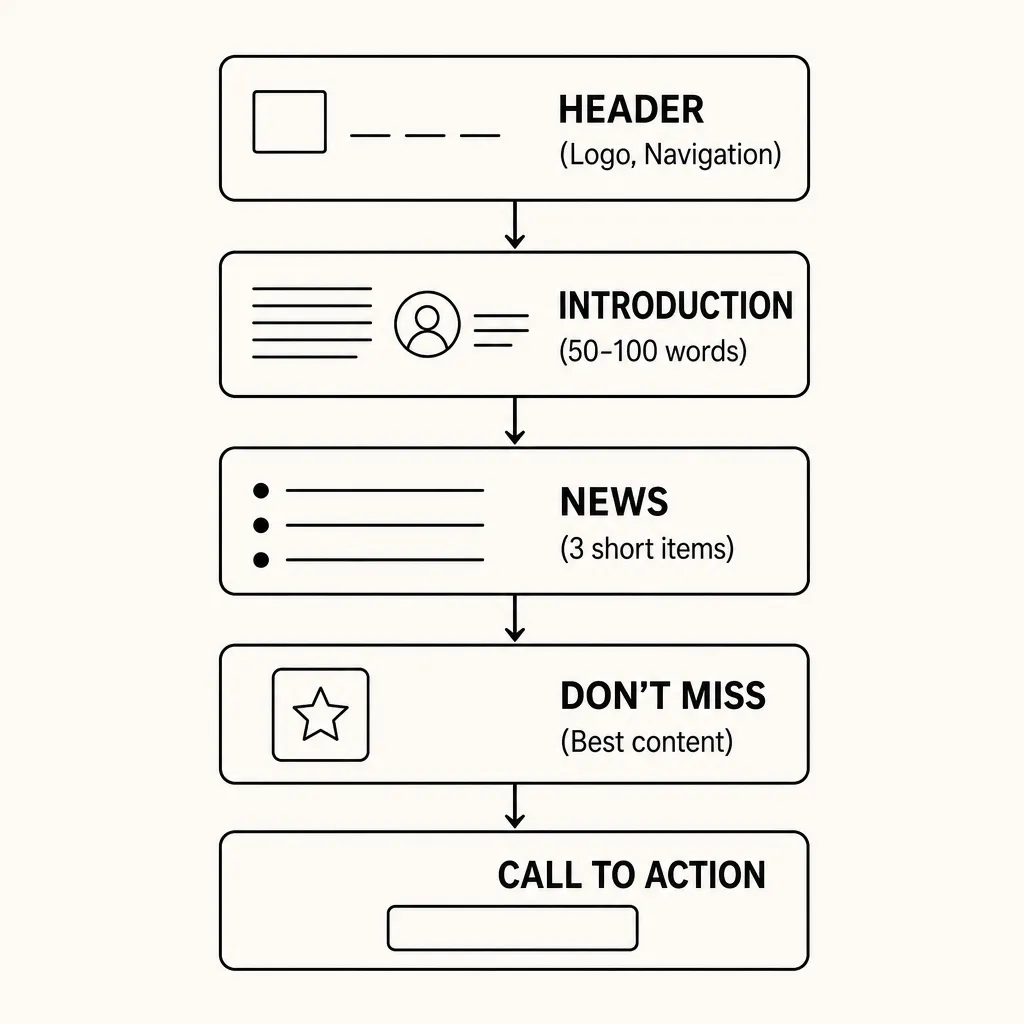
Adapt the format to your goals to diversify your editorial offer. A lunchtime digest condenses the news into 5 to 7 strategic points, perfect for busy professionals. A premium morning edition offers in-depth analysis and exclusive content. And monthly themed newsletters (sustainability, tech, creator economy) keep specialist audiences loyal with tailor-made expert content.
Send with an effective subject line and CTA
Your copywriting skills make or break your sends. The subject line, which you should keep to 40-60 characters, has to spark curiosity without the excesses that could damage your readers' trust.
The best-performing subject lines skilfully blend concrete interest with a measured sense of urgency: "3 SEO techniques we tested for you" or "Your marketing round-up - 1pm sharp". Systematically cut the words likely to trigger spam filters ("exceptional offer", "act now") and the excessive punctuation that undermines deliverability.
The preheader - that short preview text - reinforces your hook. Use it either to highlight the customer benefit ("Save 3 minutes a day with this read") or to complete the subject line. A well-crafted subject/preheader pairing can lift your open rate: A/B test it on your own list to measure the gain.
To develop a solid, measurable editorial line, apply the principles laid out in this complete guide to web editorial strategy, which explains how to turn premium content into targeted newsletters and find the optimal frequency to maximise engagement.
Create and send to acquire and retain, compliantly
Growing a solid base of engaged subscribers while complying with GDPR (and CAN-SPAM in the US) is the key to a high-performing newsletter strategy. Combine strong subscriber acquisition with rigorous management of their data and you'll build a lasting relationship with your brand.
Create a clear sign-up system
Attracting subscribers comes down to transparency and usefulness. Your form should clearly state: the sending frequency, the format of the content on offer and the concrete benefits.
Double opt-in (two-step confirmation) guarantees the quality of your list while establishing a first bond of trust. The welcome message lets you engage your contacts immediately, for instance with a special welcome offer.
Send GDPR-compliant campaigns
Every email campaign must comply with GDPR to give your subscribers' data maximum protection. Document each consent with its date, source and proof, so you have a perfect audit trail.
Your privacy policy, visible on every form, should explain precisely how data is used, how long it's kept and what rights subscribers have. A preference centre lets everyone update their choices or request deletion of their information.
Valuable content that converts gently
Favour a newsletter strategy built on trust rather than purely commercial messages. By regularly offering useful content, you strengthen your brand's credibility.
The best newsletters strike the right balance between practical information and relevant suggestions. Each send typically contains:
- One tip you can apply straight away
- One inspiring case study
- One useful free resource
- One clear but low-key offer
This approach creates well-informed leads who are already convinced of your value.
Optimising a newsletter strategy takes a methodical approach that combines data analysis, controlled tests and gradual adjustments. Experimentation and tracking of key metrics deliver tangible, lasting improvements.
Create, send, measure and optimise your newsletter strategy
A good newsletter strategy keeps improving thanks to the lessons learned from every campaign. This virtuous cycle of analysis and adjustment gradually sharpens your approach to maximise the impact of each send.
Set goals and track the right KPIs
Performance measurement starts with defining metrics aligned with your business goals. Prioritise the ones that genuinely reflect how effective your campaigns are.
- Open rate and deliverability: Protect your deliverability by staying out of the spam folder, keeping bounces under control (below 2%) and safeguarding your sender reputation.
- Click-through rate and engagement: CTR reflects the quality of your content and the effectiveness of your CTAs. Studying which areas get clicked reveals the topics your audience cares about most.
- Conversions and ROI: Analyse the full journey, from the click in the email to the final action, to accurately assess the value created.
These metrics set your optimisation priorities. For example, a falling open rate with a stable click-through rate tells you to test the subject line rather than the content.
To simplify performance analysis and content creation, we use a recommended AI platform that combines SEO, an audit of your top-performing pages and content tracking to deliver tailored recommendations.
Send, test and iterate continuously
A/B testing is your main lever for improvement. Always test a single element at a time to isolate its real impact and better understand your audience's preferences.
Priority tests cover: the subject line (impact on opens), the send time (optimal visibility) and the CTAs (better click-through). Run each test on meaningful sample sizes and for long enough to be statistically valid.
Every quarter, build on your tests to evolve your newsletter strategy: analyse top-performing content, update key pages, adjust sending frequency and refresh your personas. This routine keeps your newsletter relevant as the market shifts.

Rank Higher Without the Manual Work
From technical audits with Nox to competitor monitoring with Marc, Sedestral's AI agents cover every layer of SEO so your team doesn't have to.