Producing content that makes an impact and ranks well in search engines takes more than stuffing in keywords. Modern SEO copywriting combines editorial strategy, an understanding of how the algorithms work, real attention to what users need, and technical know-how.
Whether you're a freelance writer, a digital manager or a marketing specialist, this guide walks you through a 5-step method to create articles that bring in relevant traffic, answer what your audience actually wants, and drive conversions that last.
Why SEO copywriting still matters in 2026
Organic search is the cornerstone of any digital strategy built to last. Unlike paid search (PPC), it delivers a steady flow of organic visitors, builds your topical credibility and earns your visitors' trust.
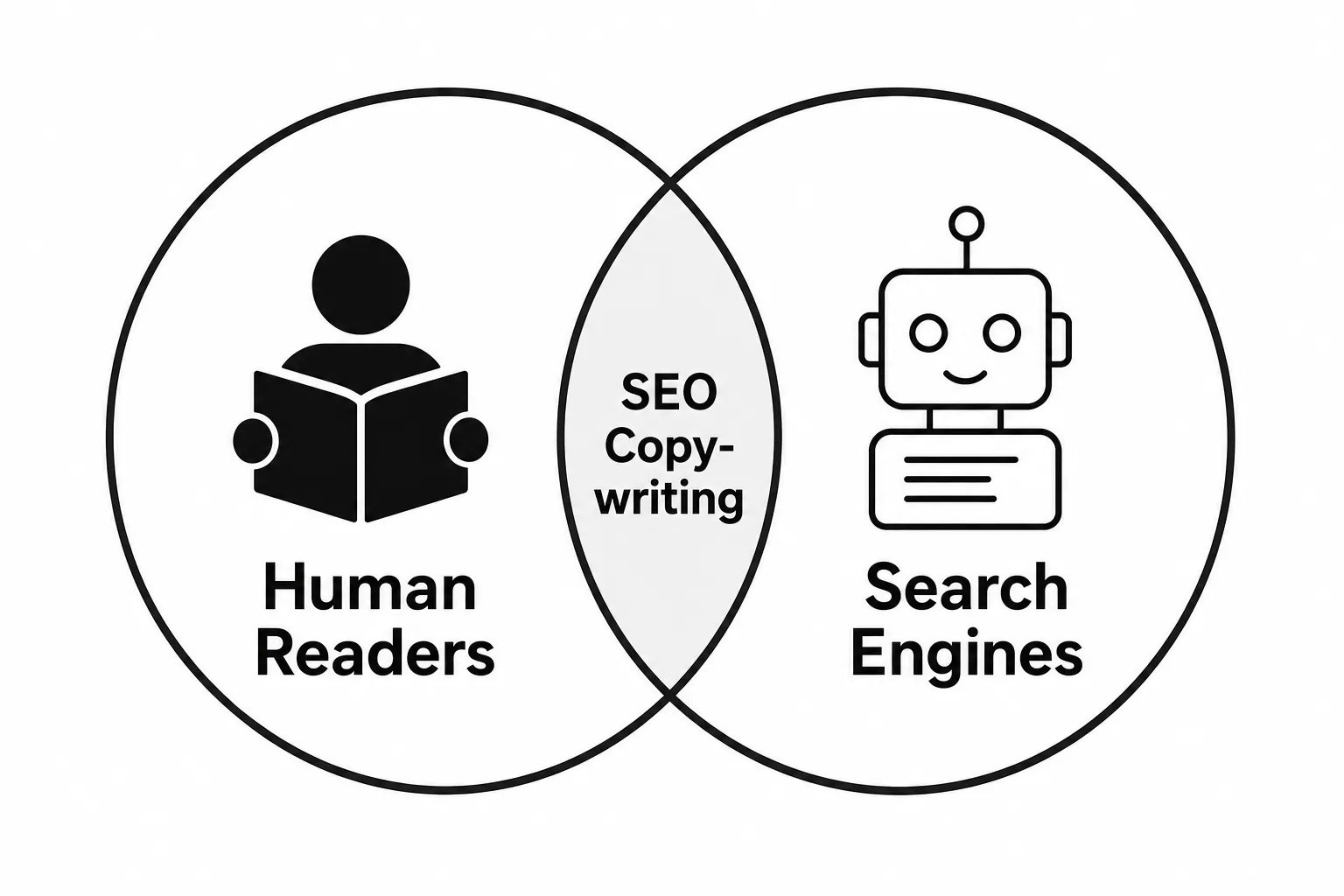
Every piece of content that performs starts with a precise reading of search intent:
- Informational: the user wants an explanation, a tutorial or a practical guide
- Commercial: they're comparing products before making a decision
- Transactional: they're ready to buy or subscribe right now
- Navigational: they want to reach a specific brand directly
An optimised article answers that intent perfectly while meeting the E-E-A-T criteria (experience, expertise, authoritativeness, trustworthiness) Google rewards. To dig deeper into these concepts, read our in-depth guide to SEO for beginners.
A 5-step method for creating SEO content that performs
To build SEO content that works and keeps working, you need a structured approach. Here's our proven method, one that meets what search engines expect today while giving readers what they came for.
Step 1: Analyse the SERP and decode search intent
The first, non-negotiable step before you start writing content: study the top 10 results Google returns for your target query. Note the dominant formats (guide, comparison, tutorial, and so on) and spot elements like featured snippets or People Also Ask boxes.
This analysis shows you what Google considers the ideal answer. Align your content with that model: add an FAQ if it's needed, include a clear summary, or build a comparison table depending on what you see.
To go further on this crucial step, our guide to search intent explains how to match your content to every type of query.
Step 2: Build a semantic core and pick the right keywords
Start by choosing your primary keyword, then round it out with relevant long-tail keywords (4+ words). These specific queries bring in more qualified traffic with less competition.
Group these keywords by theme (for "running shoes", say: comfort, durability, comparisons). This semantic approach strengthens your expertise and makes internal linking between your pieces much easier.
Use tools like Semrush or AnswerThePublic to identify common questions and related terms. Work that vocabulary into your text naturally to enrich the content without it feeling forced.
Step 3: Structure the page for user experience and SEO
Each page should target a single primary keyword. Place it strategically in:
- The URL
- The H1 title
- The first 100 words
- The alt text of one key image
Structure your content carefully with:
- A punchy H1 (max 60 characters)
- H2s for the main sections
- H3s for sub-points
- Short paragraphs (3-4 lines) to optimise mobile reading
Pay special attention to your SEO title tag and your meta description: keep both concise, since Google sets no fixed character limit and truncates them to fit the screen. For example: SEO copywriting in 2026: the complete guide to ranking. These elements have a direct effect on your click-through rate in the results.
To organise your SEO content production over the long term, check out our guide to building an effective editorial calendar.
Step 4: Optimise media and technical performance
Visuals (images, videos and infographics) enrich the visitor's experience and increase time on page. Go for lightweight formats like WebP or AVIF to cut file sizes. Give them descriptive file names (for example: minimalist-zero-drop-running-shoes.webp) and always fill in the alt attribute with a detailed description.
Remember to set the width and height attributes on your <img> tags to avoid layout shifts (CLS), and enable lazy-load for visuals lower down the page. For videos, provide text transcripts and use VideoObject markup to help them get indexed.
These technical optimisation measures feed directly into Core Web Vitals, essential criteria Google evaluates. A fast, stable site improves user engagement and boosts your organic rankings.
Step 5: Weave a strategic internal and external linking structure
Internal linking redistributes authority (PageRank) across your pages while guiding readers towards complementary content. Add two or three relevant internal links per article, favouring descriptive anchors over generic phrases like "click here".
Include a few external links to trustworthy sources too (academic studies, official data, specialist guides). These references strengthen your credibility and demonstrate your expertise in Google's eyes.
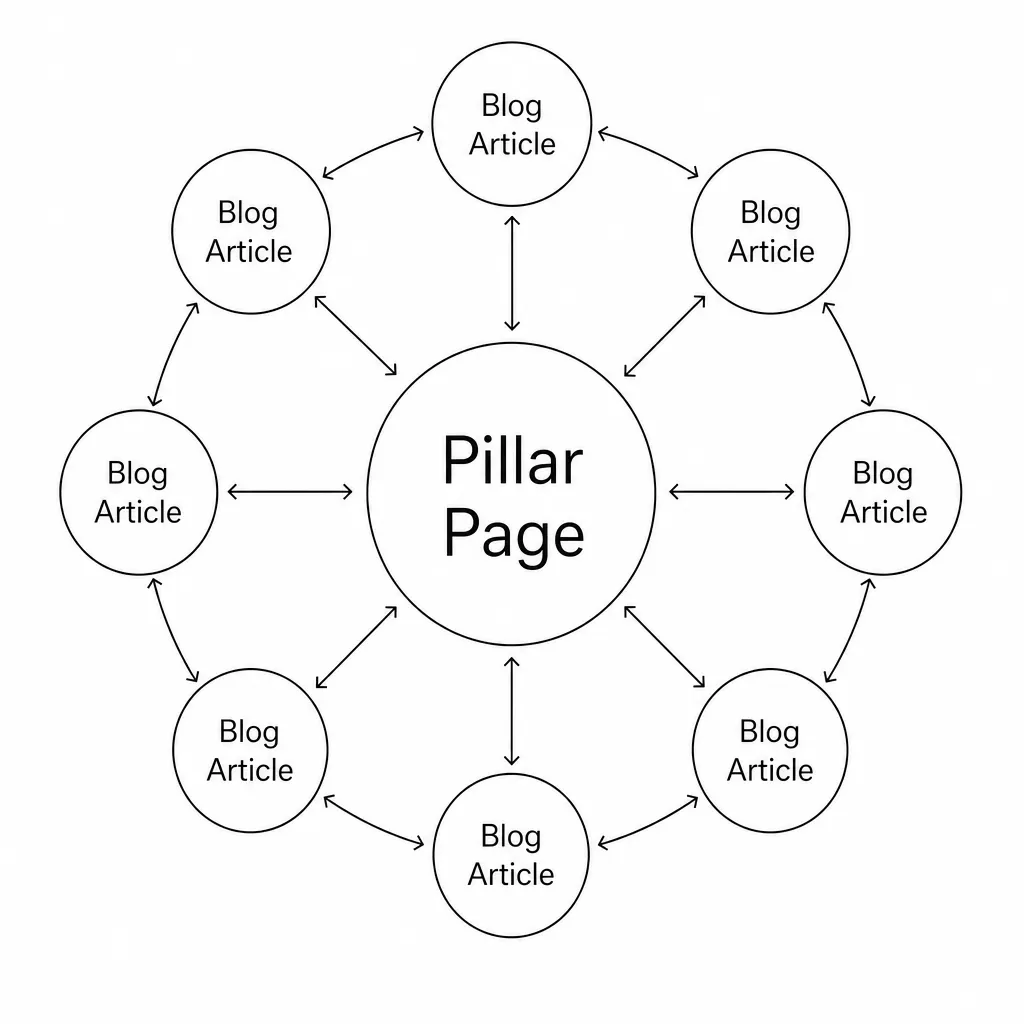
Structure your content strategy in silos or topic clusters: a central pillar page linked to satellite articles that go deeper into related themes. This thematic organisation helps search engines understand your site and optimises its SEO across the web.
Editorial planning: building a coherent content strategy
Publishing content without a method rarely delivers long-term results. To improve your organic visibility for good, we recommend building a structured editorial calendar covering 3 to 6 months. It should include SMART objectives, well-defined personas and coherent topic groups.
Set measurable business objectives
Define precise targets such as "+20% qualified leads within six months" or "rank on page one for ten strategic queries". These benchmarks will guide your editorial choices and make it easier to measure the ROI of your SEO content strategy.
Know your personas in detail
Pin down the pain points, expectations and consumption habits of your target audience. An e-commerce manager aged 30-45, for instance, will favour LinkedIn and specialist newsletters. Adapt your writing style, your visuals and the depth of information accordingly.
Analyse the competition to find a different angle
Spot the topics your competitors have barely touched. Bet on long-tail queries and neglected sub-topics to establish yourself quickly in niches. The classic example: if nobody is covering "minimalist running shoes for winter marathons", grab that editorial opportunity.
Structure in topic clusters to build authority
Organise your publications around central pages (exhaustive guides) linked to satellite articles (tutorials, Q&As, first-hand experience). This thematic linking improves the user experience while signalling your overall expertise to Google, which makes your SEO content far more effective.
Measure and adjust continuously
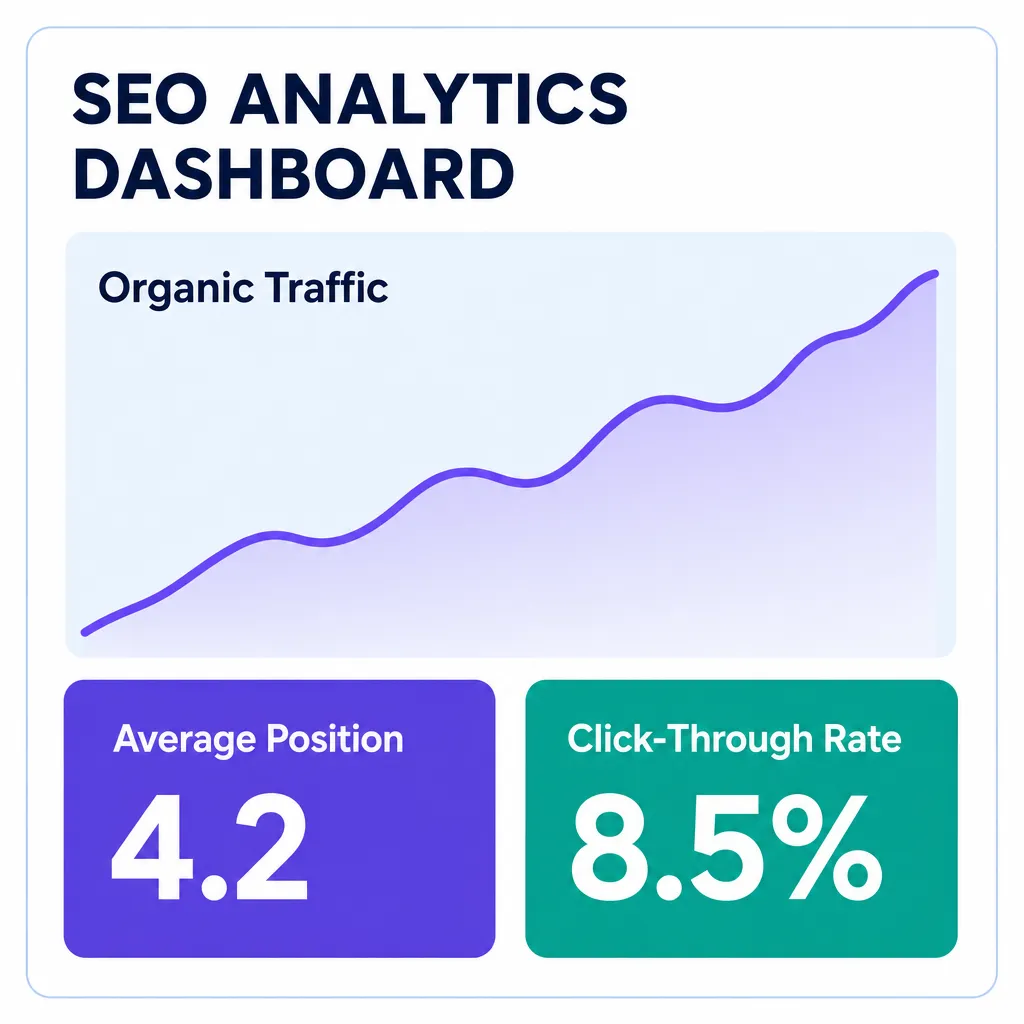
Track your performance with Google Search Console, Google Analytics and tools like Semrush or Ahrefs. Regularly review traffic, average position, conversion rate and production time. Adjust your plan to favour the formats that perform best.
Technical excellence and fighting content decay
Even high-performing content can gradually lose its impact if it isn't updated regularly.
This phenomenon, known as content decay, often hits older pages or pages that competitors have overtaken.
Quarterly audit of declining pages
Use Google Search Console to detect pages whose performance has declined for three consecutive months.
Cross-reference that data with your rank tracking tool to target the articles that urgently need an update.
Targeted corrective actions
Several options are available depending on the case:
- Refresh: add recent data, new practical examples and modernised visuals
- Merge: combine several thin pieces into one complete guide (with a 301 redirect) to improve rankings and reduce bounce rate
- Delete or redirect: remove outdated content that serves no purpose, pointing to a more relevant resource
Concrete example: an online store merged three basic product pages into one detailed comparison, climbing sharply in the rankings and cutting its bounce rate.
Schedule regular updates
Build twice-yearly or quarterly reviews into your editorial calendar.
Enrich your pages with new sections (FAQ, customer feedback, statistics), broaden the semantic field and check the state of every link (internal and external).
E-E-A-T and user-centred content: people at the heart of SEO
Google now rewards content that demonstrates genuine experience, expertise, authoritativeness and trustworthiness (E-E-A-T).
To get there, pair artificial intelligence with human expertise: the AI produces a draft and analyses the top results, while an expert checks, enriches and adds context before publication.

For example, an AI can analyse hundreds of semantic and structural signals on the results page, then suggest a detailed outline with a first draft.
The writer then adds industry expertise, real cases, customer testimonials and exclusive data.
This partnership produces quality content, optimised for SEO, that performs technically and is genuinely useful to readers.
Prove your expertise
- Introduce the author clearly with a detailed biography
- Cite reliable, up-to-date sources
- Include case studies or quantifiable results
- Add verified customer testimonials
Adapt the content to each segment
A beginner wants clear explanations with examples, whereas an expert wants technical analysis and precise data.
Structure your article in segments or offer different reading levels (summary/detailed version) to meet these varied needs.
Tools, workflows and content amplification
To optimise your content production, you need to set up clear processes, pick the right tools and organise strategic distribution across several channels.
Choose the right tools for your team size
- Getting started: Google Sheets or Excel to plan your first articles
- Growing: Trello, Asana, Monday or Airtable to manage a team of contributors
- Scaling: custom setups combining a CRM, a CMS and tracking tools like Semrush or Ahrefs
Define roles, processes and SLAs
Set precise deadlines: for example, a brief written within five days, a review in two days and layout in three days.
This discipline prevents delays and keeps production regular.
Create reusable templates
Standardise your working documents: SEO briefs, checklists and editorial calendars.
These templates make life easier for your writers, maintain quality and speed up onboarding for new team members.
Atomise and amplify your content
Turn each article into multiple complementary formats:
- A LinkedIn carousel of 8 to 10 slides
- An X (Twitter) thread summarising the key points
- A downloadable infographic
- A slot in your newsletter
- A script for a short video (1 to 2 minutes)
This atomisation strategy maximises your visibility and attracts qualified traffic from different channels (social media, email, video).
Plan distribution and measure ROI
Use tools like Buffer or Hootsuite to schedule your posts.
Then analyse engagement (reactions, shares) and the traffic generated.
Focus your efforts on the formats and channels that perform best.
Training and going professional in SEO copywriting
Becoming a professional content writer today calls for a varied skill set: flawless written English, the basics of HTML or a CMS like WordPress, solid keyword research, a talent for copywriting and constant intellectual curiosity.
Essential technical skills
- Carry out in-depth semantic analysis and keyword research with tools like Semrush, Ahrefs or AnswerThePublic
- Master on-page optimisation (HTML tags, content structure, internal linking and managing links between pages)
- Adapt your writing to maximise conversion (relevant calls to action, storytelling techniques)
- Use generative AI tools (ChatGPT, Jasper, Copy.ai) intelligently as a complement
- Analyse performance with Google's tools (Google Analytics and Search Console)
Recommended training path
Favour courses that combine theory and practice, with specific modules on SEO, content strategy and client relationships, plus hands-on exercises. Personalised coaching and access to a professional network will speed up your progress considerably.
Build your portfolio and land your first clients
- Launch a personal blog to demonstrate your expertise
- Offer your services on platforms like Upwork or Fiverr to collect recommendations
- Then target direct clients through LinkedIn, word of mouth and your professional network
- Measure your results (traffic growth, ranking improvements) to showcase your work
Pricing and raising your rates
Start with accessible rates (per project or per hour), then raise them gradually as your experience and results grow. Favour recurring work (monthly retainers, for example) to stabilise your income. Over time, diversify your services: SEO audits, content strategy or training to increase your revenue.
What AI brings to content writing: towards the augmented writer
AI solutions like Sedestral, ChatGPT or Jasper are transforming the job of the content writer. These tools automatically analyse search engine results, identify semantic gaps and produce perfectly structured drafts in a few clicks.
Our role is shifting towards that of a digital conductor: we guide the AI with precise instructions, check the facts carefully, add our hands-on expertise and keep the tone consistent with the brand. This human-machine partnership lets you produce faster while preserving the quality and authenticity E-E-A-T demands.
Pre-publication checklist for flawless SEO content
Before publishing your article, check these essentials:
- Include your primary keyword in the URL, the main title (H1), the introduction and the alt text of at least one image.
- Organise a clear structure with a single H1 and logical H2/H3 subheadings.
- Broaden the semantic field with relevant synonyms and related terms.
- Optimise your images (WebP format, descriptive alt text and precise dimensions).
- Create natural internal linking with 2-3 relevant links.
- Add external references to authoritative sources.
- Write a compelling, concise meta description.
- Adapt the length: 300 words minimum for a product page, 1,000-1,500+ words for a competitive topic.
- Implement appropriate structured data (Article, FAQ, etc.).
- Fix every typo with tools like Grammarly.
- Check for plagiarism.
- Place strategic calls to action.
This method guarantees content optimised for both users and search engines, boosting your rankings.
SEO trends and changes to watch in 2026
Organic search never stops evolving. Here are the key trends to build into your content strategy:
Voice search and natural language
Adopt a conversational tone and complete phrasing to answer voice queries. Add FAQs targeting common questions (who, what, how...) to capture this growing traffic.
Multimedia and interactive content
Google now favours videos, infographics and interactive content that increase engagement and time on page.
Fine-grained personalisation by segment
Adapt your approach: simple explanations for SEO newcomers, sharp analysis for experts.
User experience (UX) more critical than ever
Prioritise intuitive navigation, mobile-first design, fast load times and easily scannable content (lists, subheadings).
To go further with these techniques and optimise your SEO content production, read our complete guide: Read the complete guide to mastering SEO content in 2026. You'll find a 5-step method, practical checklists and concrete examples to create optimised content that performs in 2026.

Rank Higher Without the Manual Work
From technical audits with Nox to competitor monitoring with Marc, Sedestral's AI agents cover every layer of SEO so your team doesn't have to.