Your website looks great, you publish genuinely useful content, and yet your SEO competitors keep outranking you in the search results? It's frustrating, and we've all been there. The fix: build a proper SEO strategy on a careful analysis of the people beating you.
A thorough SEO competitor analysis is the cornerstone of any strategy that actually works. It shows you where you stand today, which SEO opportunities are sitting there untapped, and how to sharpen your on-page optimisation to get ahead.
Throughout this article we'll follow Chloe, a wedding photographer in Bristol, who wants to improve her search rankings and land in the top 3 for her main query.
Ready to turn your rivals' weak spots into levers for your own SEO strategy? Let's go. If you want solid foundations first, read our guide to getting ahead of the competition in SEO.
Step 1: identify your real SEO competitors and understand the competitive landscape
First big reveal: your business rivals aren't necessarily your real competitors on Google. In competitive SEO, you're up against every site that shows up for the same search terms, whether or not they sell anything like what you sell.
For Chloe, that means three types of competitor:
- Direct competitors: other wedding photographers based in Bristol.
- Indirect competitors: directories, niche blogs and platforms (Hitched, Rock My Wedding) that dominate the informational queries.
- New entrants: up-and-coming photographers quietly nibbling away at market share.
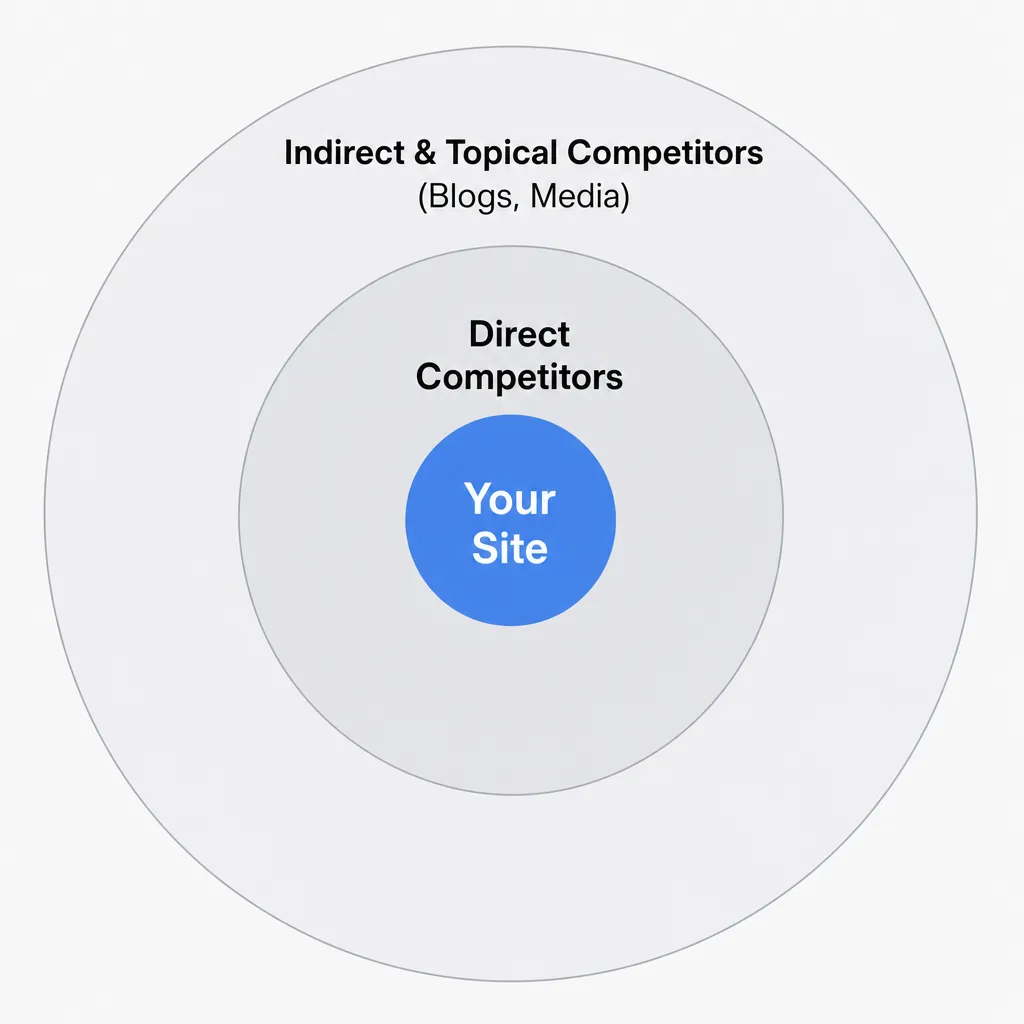
Practical action: open a private browsing window, search your 5 strategic keywords, and note the 10 competing sites that keep coming back. These main competitors are your sample for the SEO competitor analysis.
Step 2: keyword analysis with a powerful analysis tool
Finding your competitors' keywords is how you crack their strategy. With tools like Semrush, Ahrefs or our own Sedestral platform, you can see their rankings, the search volume and the relevance of every term. From there you can:
- Measure their organic traffic
- Spot the keyword gaps (queries they rank for and you don't)
- Assess the difficulty and commercial potential
For Chloe, the analysis surfaced long-tail queries like "rustic barn wedding photographer Bristol" that convert extremely well. List these target keywords, sort them by volume and difficulty, then set your priorities.
This guide shows why long-tail keywords (queries of 3+ words) make up the bulk of search queries and how to use them to get ahead of the competition: fewer competitors, better-qualified traffic and higher conversion rates. The method has 3 steps: map search intent, build topic clusters (pillar page + supporting pages) and optimise every on-page element (title, URL, tags and so on). Tools like Google Autocomplete or Search Console help you prioritise the keywords that deliver quick results. Read our complete guide to long-tail keywords
Step 3: content and structure audit to beat your competitors
A deep SEO audit of the top-ranking pages gives you key insights: content quality, heading hierarchy (H1 to H4), user experience, how fresh the data is. These pages have already proven their relevance to Google; your job is to do better.
- Enrich with FAQs, testimonials, videos and structured data
- Optimise H1/H2 tags, URLs and images (WebP format, lazy loading)
- Strengthen internal linking to your central page
That's how Chloe upgraded her "Wedding venues" guide with an interactive map and first-hand venue reviews, building a complete cluster that boosts the authority of her pillar page.
This practical guide explains how to build a winning content strategy with topic clusters: a central page covers a broad theme while supporting pages go deep on specific aspects... Master the topic cluster method for effective SEO
Step 4: SEO competitor analysis of the backlink profile
Backlinks play a decisive role in building your site's authority. Analyse your SEO competitors' backlink profiles closely, paying particular attention to the number of backlinks, the quality of the sources and the variety of anchor text. Remember: a single link from an influential site can be worth more than hundreds of mediocre ones.
- Compare quantity and quality using metrics like Trust Flow and Domain Authority
- Uncover link building opportunities: editorial collaborations, unlinked mentions, broken links
- Borrow their tactics, then do them better
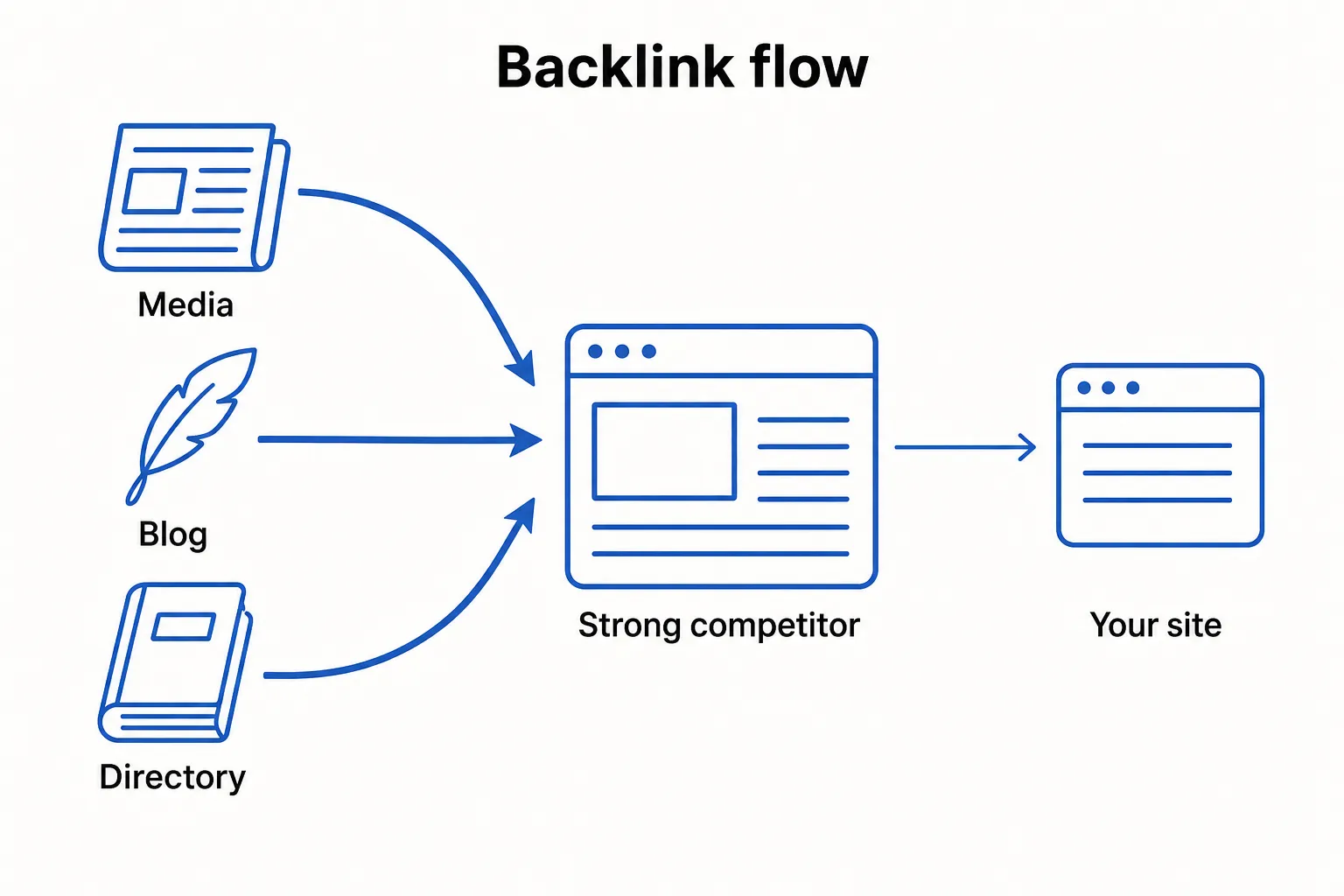
To go further with your SEO techniques and master backlink analysis, dig into our advanced methods.
Our comprehensive guide covers every crucial component of SEO: crawling and indexing, technical optimisation, HTML structure, keyword research, SEO copywriting, internal linking, link strategy and tracking with Google Search Console and GA4... Learn how to outrank your SEO competitors
Step 5: monitor your SEO competitors continuously
SEO never stands still. Set up a dashboard to track your organic traffic, your rankings and your competitors' rankings. When a rival suddenly jumps, pinpoint exactly where the gain came from (new content, a strategic backlink, a technical fix) and adjust your approach.
- Daily monitoring with tools like Semrush or Sedestral
- Instant alerts when positions move on your key keywords
- Visualisations tailored to your industry
Optimise your SEO competitor analysis and turn every opportunity into an advantage.
Conclusion: from analysis to a winning strategy
SEO analysis is about spotting opportunities, not copying: every finding should turn into a concrete action. Chloe can now roll out a clear action plan:
- Write an in-depth guide targeting the essential long-tail queries
- Identify and reach out to the sites linking to her SEO competitors
- Improve her Pricing page with an FAQ and structured data markup
Combine relevant content, a solid backlink profile and constant monitoring, and you gain a decisive edge in SEO.

Rank Higher Without the Manual Work
From technical audits with Nox to competitor monitoring with Marc, Sedestral's AI agents cover every layer of SEO so your team doesn't have to.