This guide walks you through Generative Engine Optimization (GEO), a new approach designed to get your content into the generated answers of AI assistants like ChatGPT, Claude, Gemini and Perplexity. As more and more searches end in an instant direct answer rather than a list of links, getting to grips with this new form of optimisation is essential if you want to keep your visibility online.
What Is an AI SEO Agent?
An AI SEO agent is an autonomous software module that executes a specific SEO task, such as writing content, auditing pages or tracking rankings, independently, without requiring manual input for each action.
What is Generative Engine Optimization?
Generative Engine Optimization (or GEO) is a major shift in how you optimise content, built specifically for generative search engines. Traditional SEO is mostly about showing up in search results as a link. GEO is about positioning your content as the go-to reference inside the answers these AI systems generate.
The goal is no longer just to drive traffic to your site: you now need to be cited and credited by generative AI, consistently. GEO therefore means creating content that is clear, precise, well structured and perfectly suited to these sophisticated models. It answers a real change in how people search: today they'd rather get a direct answer than open five different websites.
The end game? Making sure your expertise comes through clearly in the answers these tools give, which strengthens both your authority and your visibility. In this new environment, being mentioned by a generative AI is like a personal recommendation delivered to millions of users.
Short definition:
Generative Engine Optimization (GEO) is the practice of optimising and structuring your content so that it is recognised, valued and correctly attributed by generative AI systems, establishing your site as a reference source in their generated answers.
How AI is changing SEO today
Since late 2024, conversational assistants and generative search engines have rewritten the traditional rules of SEO. Generated answers now sit in the dominant position on the SERP, grabbing users' attention before anything else. To hold on to your visibility and your audience, classic SEO best practices are no longer enough: a GEO approach has become essential.
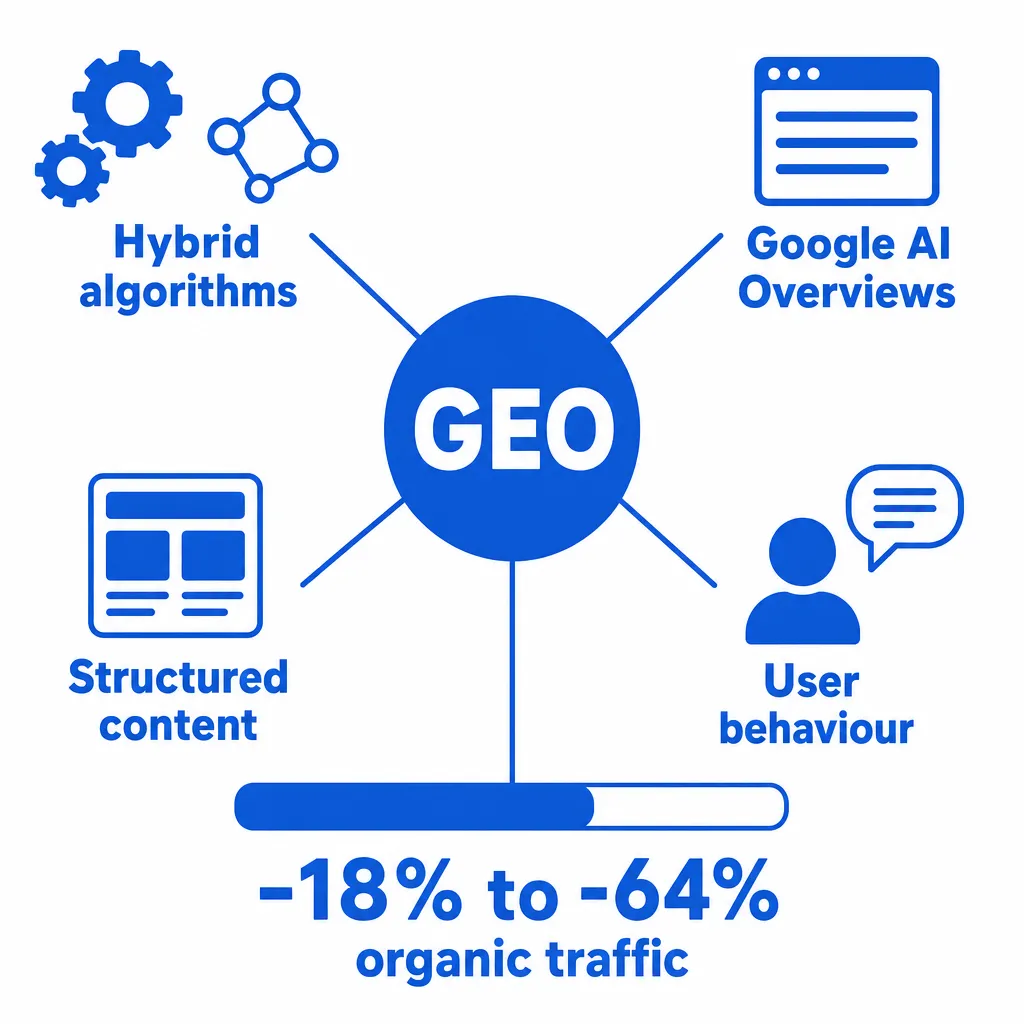
- Hybrid algorithms: Google now combines its classic systems (crawling, indexing, backlinks) with neural networks that can assess and surface well-structured content.
- Optimised content: AI models consistently favour sources with clear, organised and referenced information, the core principle behind Answer Engine Optimization (AEO).
- Changing behaviour: Users now prefer complete, synthesised answers over a list of results.
- AI Overviews: Google's AI Overviews (the successor to the Search Generative Experience, rolled out in May 2024 and followed by AI Mode in 2025) generate summaries directly on the results page, sharply reducing visits to the sites underneath.
According to recent studies covered by Forbes and Search Engine Land, generated answers could cut organic traffic by anywhere from 18% to 64% depending on the industry. That kind of impact makes one thing clear: you need a GEO strategy built for this new era of generative search, and you need it now.
Key differences between SEO and GEO
As more people turn to tools like ChatGPT and other generative engines, it's essential to understand the difference between SEO (optimising for classic search engines) and GEO (optimising for generative AI engines). The two approaches complement each other, and you need both for solid digital visibility.
SEO targets traditional search engines like Google to bring human traffic to your site, while GEO aims to get you into the answers generated by AI. Together, they let you optimise your content for the full spectrum of modern search.
Here's what fundamentally sets them apart:
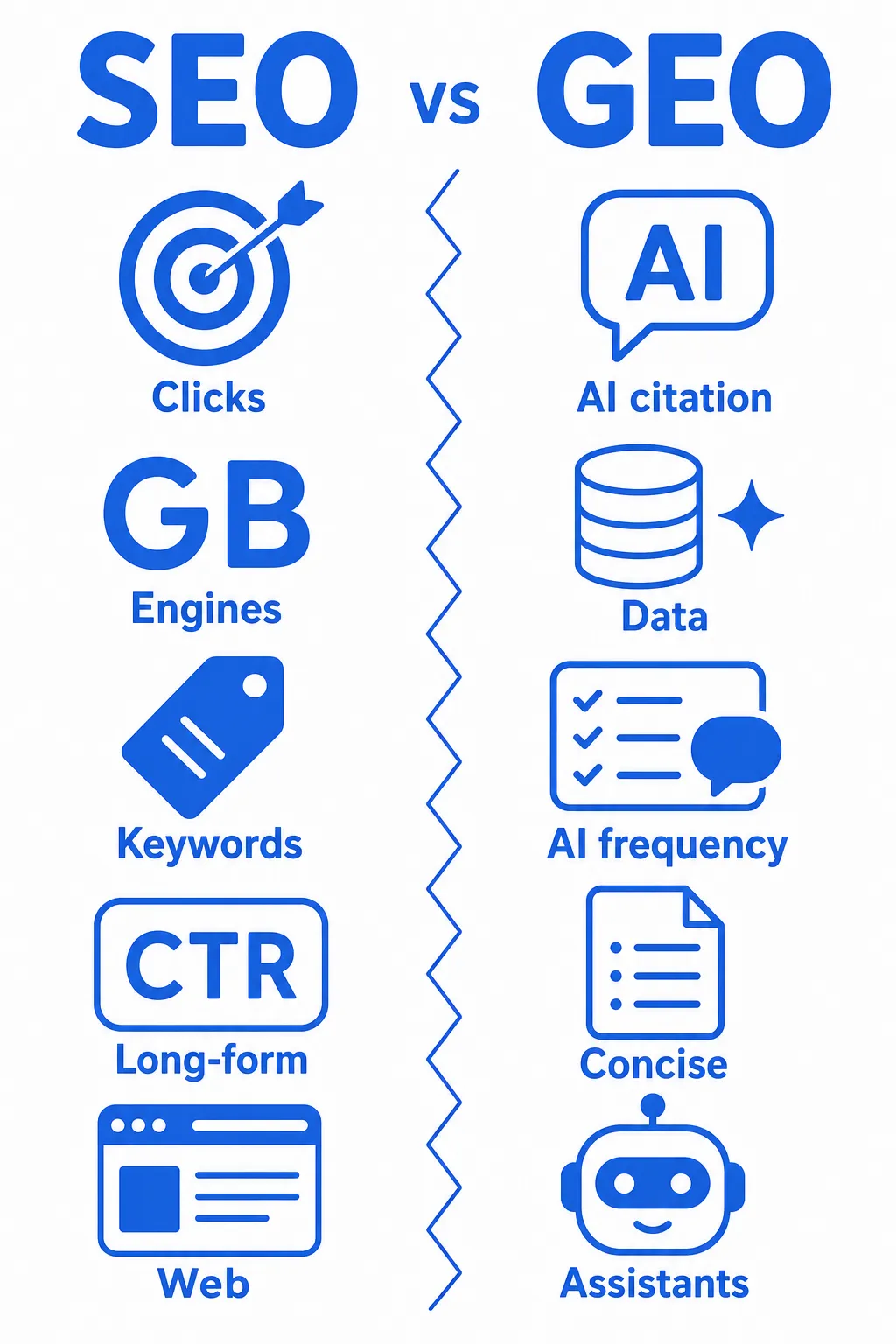
Comparison table: SEO vs GEO
| Aspect | SEO (Search Engine Optimization) | GEO (Generative Engine Optimization) |
| Main goal | Rank higher on the SERP to attract visitors. | Get cited directly in AI-generated answers. |
| Target engines | The classics: Google, Bing, etc. | Generative systems: AI Overviews, ChatGPT, Gemini... |
| Content structure | Built around keywords, links and metadata. | Favours clear data: verifiable facts, simple schemas. |
| Measure of success | Traditional: rankings, CTR, backlinks. | Citations in AI answers, use by chatbots. |
| Content approach | In-depth articles answering user queries. | Concise, structured information for AI: FAQs, lists. |
| Target platforms | Google, Bing, Yahoo... | ChatGPT, AI Overviews, Microsoft Copilot... |
| Strategic summary | Classic search ranking aimed at human searchers. | Optimisation to appear in automatically generated answers. |
In short
SEO is still the essential foundation for bringing human traffic to a website.
GEO is becoming a must if you want to stay visible in an online world increasingly dominated by artificial intelligence.
Combining SEO and GEO is the key to keeping up with how search is evolving: an internet where visibility now depends on both classic clicks and the new generated answers.
How does an advanced AI engine analyse your content?
New-generation engines like Google AI Overviews, ChatGPT and Claude rely on sophisticated natural language models (LLMs and NLP) alongside traditional algorithms to analyse your content from every angle.
Here's exactly how the process works in the context of generative search:
1. Data extraction and structuring
The AI system starts by pulling the essential elements out of your page:
- Identifying key entities (proper nouns, figures, places, dates)
- Detecting the main topics
- Analysing structured markup (schema.org, JSON-LD) to quickly understand the logic and value of the information
A page organised in a clear question-and-answer format is easier for these systems to extract and quote. For Google, no special markup is required to appear in AI Overviews or AI Mode.
2. Contextual and semantic analysis
Thanks to NLP technology, these engines decode what your content actually means:
- They understand the intent behind each query
- They assess whether your page answers it properly
- They judge the writing quality and topical relevance
A well-built guide that precisely answers a question like "how do I choose a smartphone?" has a much better chance of appearing in Google's direct answers.
3. Cross-referencing data and checking consistency
AI systems systematically compare your information against other credible sources:
- Fact-checking (against Wikipedia, scientific publications, established media outlets...)
- Checking consistency with recognised industry references
- Any inconsistency or error detected can hurt your generative search performance
A concrete example: content that includes verifiable figures and external references will naturally rank better in AI-generated answers.
4. Assessing authority and credibility
We can't say it enough: authority is critical.
- Well-sourced articles with solid references consistently perform better.
- AI algorithms always favour information from authoritative sources (as the E-E-A-T criteria show).
5. Synthesising and delivering answers
Today, engines answer users directly:
- Instant answers for basic questions
- Detailed explanations for complex searches
- Clearly cited sources, which boosts the visibility of the content they reference
To succeed in the era of generative search optimisation, three golden rules:
- Structure your information meticulously with the right HTML markup
- Provide precise, verifiable data
- Produce premium content that fully answers users' queries
This approach ensures your content integrates smoothly into AI results, and optimises your position in a digital environment that keeps on shifting.
Building a GEO strategy that works with SEO
With generative engines like Google AI Overviews and Microsoft Copilot transforming online search, it's essential to combine the principles of GEO (Generative Engine Optimization) with a traditional SEO approach. Here's how to build an effective content strategy designed for both classic search engines and generative AI models.
Understand and target search intent precisely
Whether it's SEO or GEO, a successful strategy rests on a thorough analysis of user intent:
- Classify queries by type: informational, transactional, navigational, etc.
- Spot the questions a generative AI could answer directly: specific requests, definitions, comparisons, guides...
- Improve your content to deliver precise, succinct and reliable answers, boosting your chances of being cited by an AI.
This approach lets you meet search intent perfectly, whether people are using classic engines or conversational assistants.
Learn more about search intent
Structure your content with rich, readable data
Good structure is crucial if you want to satisfy both search engines and AI:
- Use semantic markup (Schema.org, JSON-LD structured data) to enrich your content.
- Organise your text logically into distinct sections: FAQs, lists, steps, callouts, summaries...
- Favour digestible formats such as comparison tables, bullet lists and direct answers.
The payoff: content that is clear, understandable and easy for every type of engine to use. This kind of organisation also improves the user experience across all platforms.
Make your content "LLM-friendly" (suited to generative AI)
Generative AI models (LLMs) like ChatGPT analyse billions of pages to deliver synthesised, reliable answers. For your content to be interpreted correctly by these systems, you need to optimise its machine readability without compromising its quality for human readers.
Here's how to adapt your writing to the way they work:
- Create a clear information hierarchy with meaningful headings and subheadings, enriched with relevant keywords. Every section should have an identifiable purpose (explaining a concept, laying out steps, detailing benefits or answering common questions).
- Break your text into digestible chunks: go for short paragraphs (2 to 4 lines), bullet lists or summary tables. This increases the likelihood that generative engines will pick up and reproduce your content effectively.
- Demand clarity in your sentences: cut out ambiguity, unnecessary metaphors and convoluted constructions. Use natural language that flows and carries information.
- Feed your text semantically by varying your terms, using synonyms and slipping in secondary keywords where they fit. You boost your SEO while making analysis easier for generative AI models.
- Favour formats suited to conversational queries: FAQs, step-by-step procedures, visual tutorials... These structures are handled particularly well by AI systems like Google Gemini.
Strengthen your E-E-A-T (Experience, Expertise, Authoritativeness, Trustworthiness)
With so much data online, your credibility becomes a decisive asset, for classic algorithms and AI-generated answers alike. Google's E-E-A-T framework is also becoming the benchmark for judging which content generative AI can rely on.
A method for maximising each dimension:
- Experience: Illustrate with real situations, hands-on feedback or concrete demonstrations. Verifiable content inspires more trust in humans and machines alike.
- Expertise: Have your content written or reviewed by identifiable specialists (name, credentials, field). Showcase their skills to underpin the legitimacy of what you publish.
- Authoritativeness: Cultivate mentions on reference sites and inbound links from institutions. Prove that your work carries authority in your niche.
- Trustworthiness: Always cite your sources with URLs, flag updates and keep your data current. Traceability and freshness reassure the whole digital ecosystem.
Strategic note: generative AI models favour content they can cite safely. Documentation that is sourced, signed and well structured multiplies your chances of appearing in generated answers.
Diversify your formats to cover every use case
A high-performing approach at the intersection of SEO and GEO relies on complementary formats. Each type of content plays a distinct role for traditional algorithms and generative engines alike.
A strategy for a balanced mix:
1. Long, in-depth articles (SEO pillars)
These are the essential foundations of your classic SEO strategy. They serve three purposes:
- Covering a topic in depth and exhaustively;
- Structuring your site's internal linking effectively;
- Strengthening your authority on the subject.
For the best results, this content should include:
- A clear heading hierarchy (using
<h2>,<h3>tags and so on); - An intuitive navigation menu;
- Strategic use of relevant secondary keywords.
2. Short, targeted, structured content (generative AI friendly)
Generative engines like Google AI Overviews favour concise formats that are easy to parse. Focus on:
- Well-organised FAQs (no special schema is needed to appear in AI Overviews);
- Short, precise definitions;
- Easy-to-scan practical lists;
- Direct answers to users' common questions.
3. Visual formats and rich media
They make your content more appealing while making it easier for AI to process:
- Infographics to simplify complex data;
- Optimised images (with descriptive alt text, a relevant file name and the right size);
- Short videos with a text transcript;
- Audio clips to diversify your content types.
4. Rich, reusable blocks
Create standalone elements that generative engines can easily extract:
- Punchy summaries (in "Key takeaways" boxes);
- Clear, intuitive comparison tables;
- Well-structured expert quotes or definitions.
Tip: think mobile-first. An AI reads your content like a mobile user, with limited attention and very little scrolling.
Measure, adjust and iterate continuously
An effective SEO/GEO strategy is a moving target: it has to adapt to changes in search engines, user behaviour and how your content performs. Put a process of constant improvement in place.
1. Keep an eye on how the engines evolve
- Stay up to date with algorithm updates (Google AI Overviews and AI Mode, Microsoft Copilot, etc.);
- Analyse how generative AI answers queries: which content formats does it favour?
- Identify the new formats being pushed forward (rich snippets, cited sources, etc.).
2. Track separate GEO and SEO KPIs
- For GEO: how often you appear in AI answers, click-through rate after a citation, visibility in AI Overviews or Copilot interfaces;
- For traditional SEO: keyword rankings, click-through rate on the SERP, on-page engagement.
3. Optimise continuously
- Clarify and simplify passages that are confusing or rarely cited so they're easier to understand.
- Reorganise the text (for example, turn a dense paragraph into a clear list).
- Test original formats (spec sheets, infographics, visual summaries).
- Remove or merge repetitive or outdated information (apply "content pruning").
- This continuous optimisation helps you refine your combined SEO and GEO approach in real time, keeping pace with search engines as they evolve, whether they run on classic algorithms or generative systems.
Recap: the 6 levers of a GEO-compatible SEO strategy
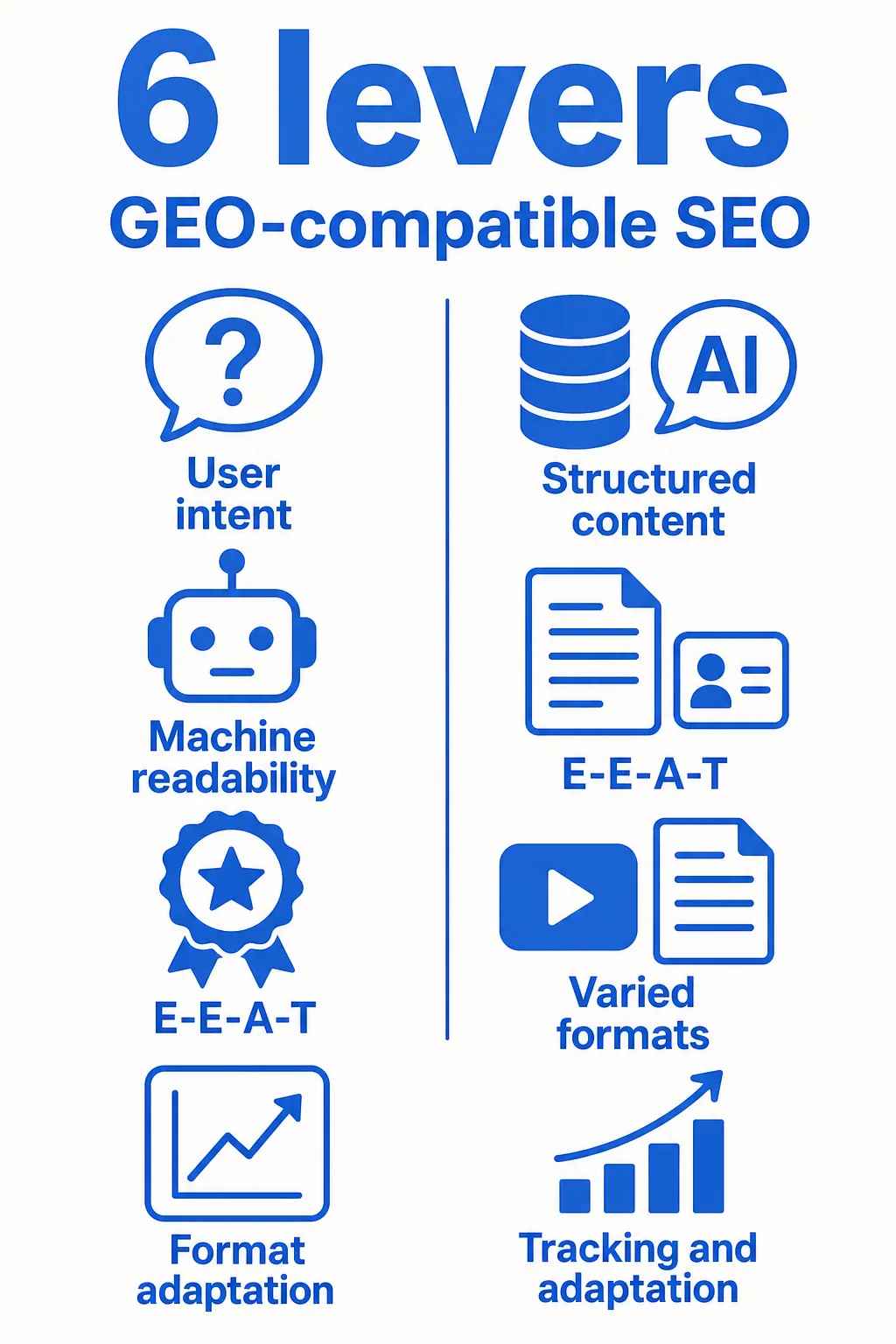
| Action | GEO target | Classic SEO target |
| User intent | Precise questions handled by AI | High-intent keywords |
| Structured content | Rich data, JSON-LD, FAQs | Heading tags, title tags, hierarchy |
| Technical readability | Concise, easy-to-extract format | User experience optimisation |
| E-E-A-T | Verified sources, proven expertise | Backlinks, site authority |
| Format diversity | Short, relevant snippets | In-depth articles, topic pages |
| Continuous analysis | Tracking AI mentions | SEO tracking (traffic, rankings) |
By combining SEO best practices with a GEO approach, you maximise your visibility in classic results (the SERP) and in generated answers alike. This dual strategy, rigorous and forward-looking at the same time, strengthens your credibility (authority) while delivering an excellent user experience through content that precisely answers every question.
Key takeaways for your strategy
The era of generative search engines and conversational assistants has profoundly reshaped the digital world. It's no longer just about adapting, it's about anticipating what comes next. Generative Engine Optimization (GEO) has become the indispensable complement to traditional SEO methods. This approach goes well beyond simply driving traffic from organic results: it aims to establish your content as a reference source in the answers generated by platforms like AI Overviews, ChatGPT and Perplexity.
The new algorithms, which combine structured data, advanced language models and semantic analysis to produce complete, tailored answers, have redefined the rules of the game. Conventional optimisation for the classic SERP is now only part of the equation. It's becoming crucial to develop content designed specifically for these systems, built on unimpeachable sources, crystal-clear data structure and flawless factual reliability.
This shift calls for deep optimisation: adopting writing methods that work for AI, doubling down on the E-E-A-T criteria, and consistently prioritising the relevance and quality of your information. The challenge is no longer just to satisfy users, but to create content that AI systems can cite and use with confidence.
Organic search is evolving: still fundamental, it's adapting to these new engines where visibility depends less on backlinks and more on being recognised as an authoritative source in generated answers.
To get the most out of your performance, combine the techniques of traditional SEO with the demands of GEO, intelligently. This hybrid strategy is the key to protecting your visibility, credibility and competitiveness in a digital ecosystem where AI is taking centre stage.
Let AI Handle Your Content Publishing
Alya researches keywords, writes and publishes content directly to your CMS, WordPress, Shopify, Wix and more, on autopilot.