Voice search is reshaping SEO strategies and opening up new ways to reach your audience. This guide shows you how to optimise your site for voice search by targeting the queries people phrase in conversational language and natural language, so you can improve your visibility in voice search results.
Key takeaways
- Write the way people talk: shape your content to answer full, natural questions, exactly as people phrase them when they use voice search.
- Aim for position zero: open your paragraphs with a clear answer (30 to 60 words) so voice assistants can pick it up.
- Structure with method: use H1, H2 and H3 tags logically and turn your subheadings into the questions people actually ask.
- Go local: fill in your Google Business Profile thoroughly, because the majority of voice searches have a local angle.
- Nail the technical side: a fast site, built for mobile, with structured data in place is still the foundation.
Why voice search is changing the rules of SEO
The rise of voice interactions is quietly rewriting the rules of SEO. Thanks to better speech recognition and the growing adoption of voice assistants like Google Assistant, Siri and Alexa, people now ask search engines questions out loud. The reason is simple: saying a query is more intuitive and faster than typing it, especially on the go.
Many people now use voice search as part of their daily routine. Smart speakers like Google Nest and Amazon Echo have gone mainstream, changing how we get to information.
Understanding voice search SEO and what makes it different
Voice search optimisation, also called voice SEO, means adapting your content to the specific way people search when they speak rather than type.
That means getting comfortable with the nuances of conversational language: people usually ask complete questions (like "What's the best Italian restaurant near me that's open after 10pm?") rather than typing short keywords (say, "italian restaurant london").
The fundamental difference lies in how results are delivered: traditional SERPs show several links, whereas voice assistants usually read out a single spoken answer.
That's why position zero becomes so strategic: it's the featured snippet the voice assistant will read aloud in reply to the query.
Our JavaScript guide explains in detail how JavaScript directly affects the indexing and visibility of your pages, which matters a lot for voice SEO, where content needs to be fast, well structured and fully indexed.
You'll find an explanation of how Google renders pages (crawling, queuing, rendering, then indexing), advice on using server-side rendering (SSR) or prerendering so your headings, metadata and structured data sit in the initial HTML, and why solid optimisation of Core Web Vitals (LCP, INP, CLS) and tight control of third-party scripts are non-negotiable.
It also covers technical best practices (crawlable URLs, SEO tags present in the source code, handling redirects and blocked resources) and audit methods (Search Console, PageSpeed Insights, Screaming Frog) to check that your JavaScript content stays reachable for voice assistants and featured snippets.
Read our complete guide to optimising JavaScript and boosting your presence in voice search
Capturing position zero with the right strategy
To give voice assistants the best chance of reading out your content, structure it smartly.
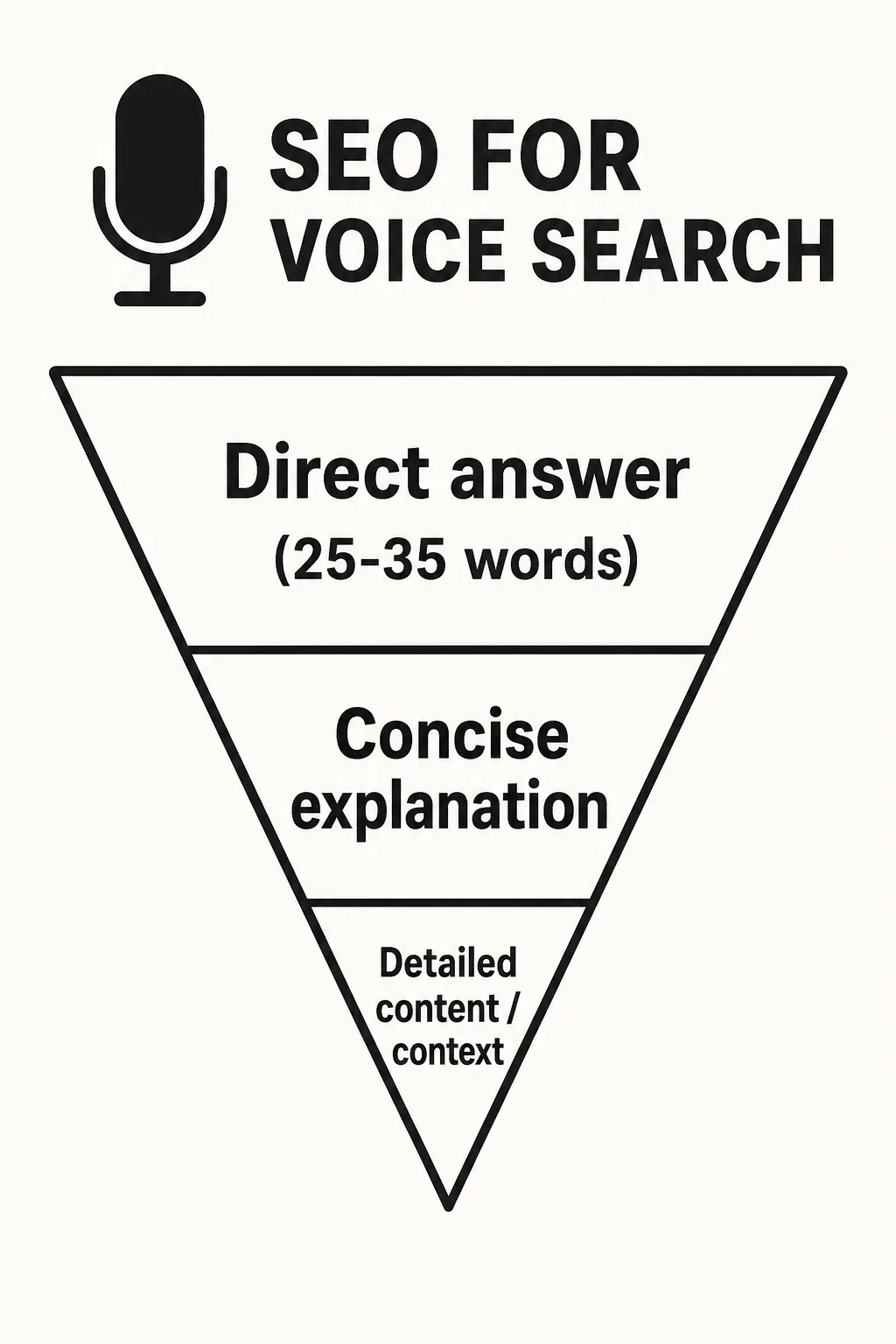
The most effective technique in voice SEO is the inverted pyramid:
- Give a concise answer first (30 to 60 words maximum).
- Then expand with fuller, more detailed information.
This works because Google's algorithms favour short, precise answers for the snippets read out by voice.
A few best practices to optimise your results:
- Instant answer: give the key information right at the start.
- Crystal-clear structure: phrase your H2/H3 headings as questions in natural language.
- Optimal presentation: use lists, steps and short definitions.
Research confirms a strong link between voice queries and local search intent. In a 2018 BrightLocal survey of US consumers, 58% said they had used voice search to find local business information in the previous 12 months. That's a golden opportunity to boost your local SEO.
Mastering natural language for conversational search
Optimising for voice search calls for a conversational, natural style.
Build question words into your content (who, what, when, where, how, why) so you answer the real questions people ask. This conversational search approach changes the way you create web content from the ground up.
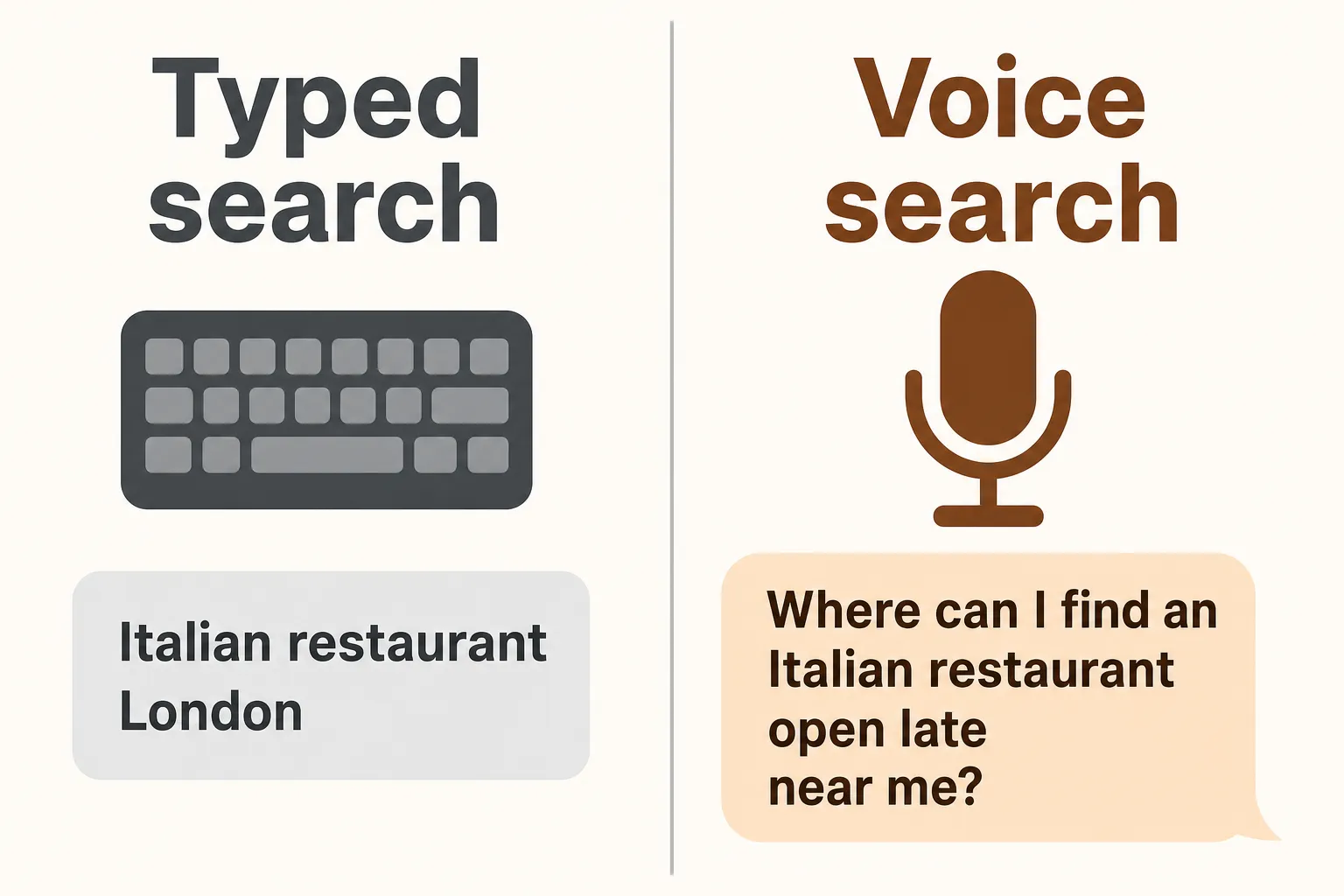
This strategy requires a sharp understanding of search intent. Some concrete examples:
- Informational intent: "How do I fix a leak under the kitchen sink?" calls for a practical how-to guide.
- Local buying intent: "Where can I buy fresh flowers near Covent Garden?" signals an immediate, location-specific need.
- Comparison intent: "What's the difference between the iPhone 16 and 17?" calls for a well-organised comparison content piece.
Structuring content effectively with the FAQ method
To make your content a perfect fit for voice search, structure it as a well-organised FAQ. Create sections of 8 to 15 questions and answers, phrased naturally, the way someone would talk to a voice assistant. Keep answers concise (30 to 60 words) so they're easy to read aloud, and link to more detailed explanations where needed.
Our complete SEO glossary gives you all the tools to optimise your presence in voice search: understanding search intent, targeting conversational queries, organising your content with question-based headings, implementing structured data to land featured snippets, and improving your visibility on mobile. It also covers the technical side (URL optimisation, redirects), natural keyword strategy, internal linking and analysis tools like Search Console and GA4 to sharpen your voice SEO. Explore the SEO glossary and optimise your voice SEO
Recommended structure:
- Question (H2/H3): phrase it the way you would in a real conversation with an assistant.
- Immediate answer: give the key solution in the very first paragraph.
- Full explanation: then expand with practical details and examples.
A concrete example for the query "How do I clean white leather trainers properly?":
H3: How do I clean white leather trainers properly?
Direct answer: Wipe them with a slightly damp cloth and mild soap, apply a nourishing cream made for white leather, then protect them with a dedicated waterproofing spray.
Details: Doing this monthly keeps the colour and suppleness of your trainers. Avoid harsh products that could dull the leather...
This approach works especially well for e-commerce sites. A question like "Which waterproof Bluetooth speakers are best for the beach?" deserves a fully dedicated, optimised page.
Using structured data to speak Google's language
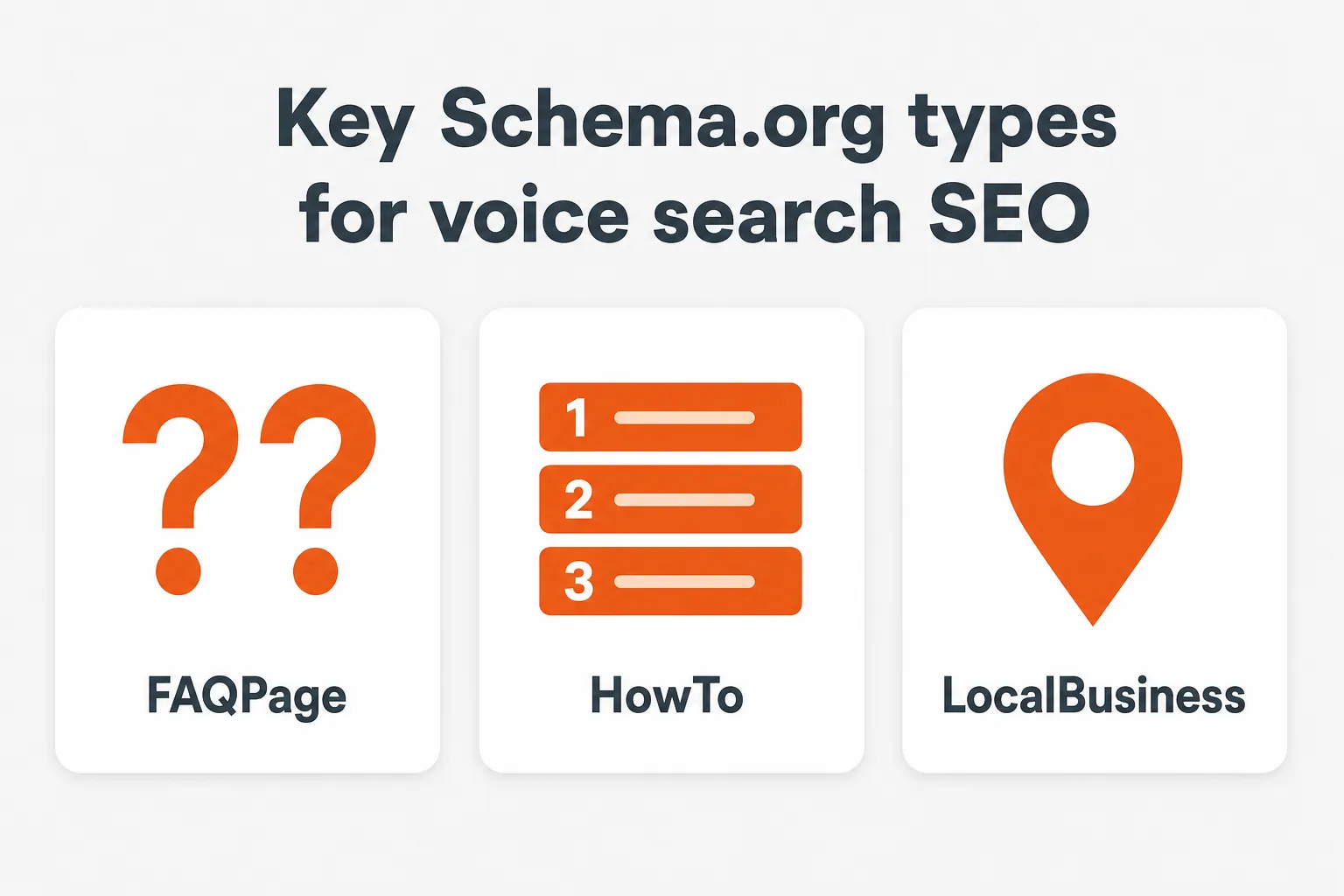
Structured data is a powerful way to help Google's algorithms understand what your content means. For SEO, and more specifically for a voice optimisation and voice SEO strategy, a few schemas matter most:
FAQPage: still valid to describe your questions and answers, but Google no longer shows FAQ rich results in its search results.HowTo: Google retired HowTo rich results in September 2023, so this markup no longer changes how your tutorials appear in its results.LocalBusiness: essential for surfacing your local details (address, opening hours, contact).ProductandReview: crucial for e-commerce and the credibility of customer reviews.
Speakable markup lets you flag the passages best suited to being read aloud, but Google still lists it as a beta feature for English-language news publishers, used by Google Assistant on Google Home devices in the US.
For best results, implement these tags as JSON-LD directly on the server side. That helps optimise indexing and keeps performance strong on mobile:
{ "@context": "https://schema.org", "@type": "FAQPage", "mainEntity": [{ "@type": "Question", "name": "How do I optimise my website for voice search?", "acceptedAnswer": { "@type": "Answer", "text": "To optimise your website for voice search, create conversational content structured as an FAQ, implement Schema.org structured data, and make sure mobile performance is excellent." } }] }
Targeting conversational long-tail keywords intelligently
Voice queries are generally longer and more natural than typed searches, often four words or more. To rank well, you need to work the SEO long tail carefully, favouring complete, conversational phrasing.
There are several effective ways to find these promising queries:
- Google's autocomplete suggestions
- The "People also ask" box in the results (SERP)
- Tools like AnswerThePublic
- Search Console data, filtered on question words
- Analysing the searches people run on your own site
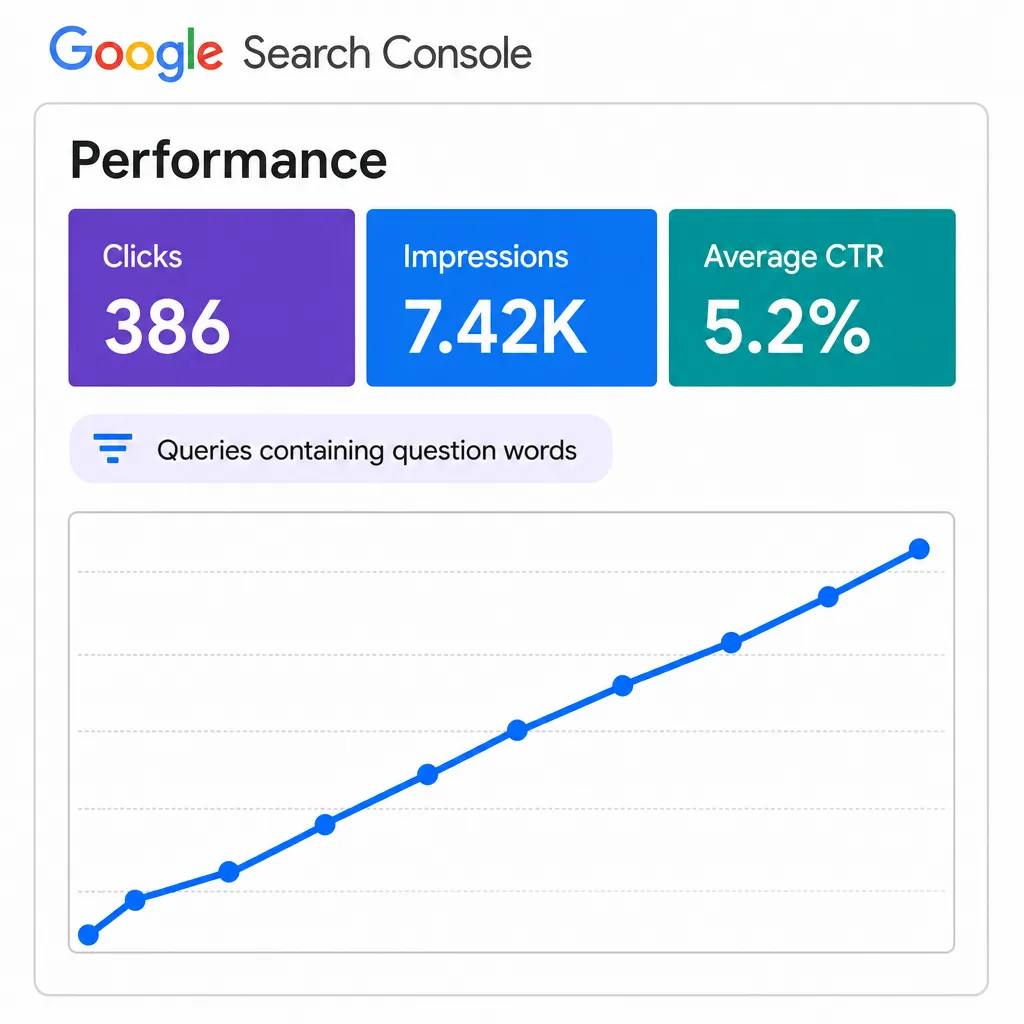
Looking at the questions your customer service team receives is also extremely useful. It reveals the exact vocabulary your customers use, which makes it easy to create content that's ideal for voice search.
Dominating local voice search
For local searches on mobile, voice assistants have become unavoidable. Good optimisation is essential if you want to stay visible.
Perfecting your Google Business Profile and local presence
Your Google Business Profile (formerly Google My Business) is the go-to source for Google's voice assistant. Its optimisation needs to be flawless.
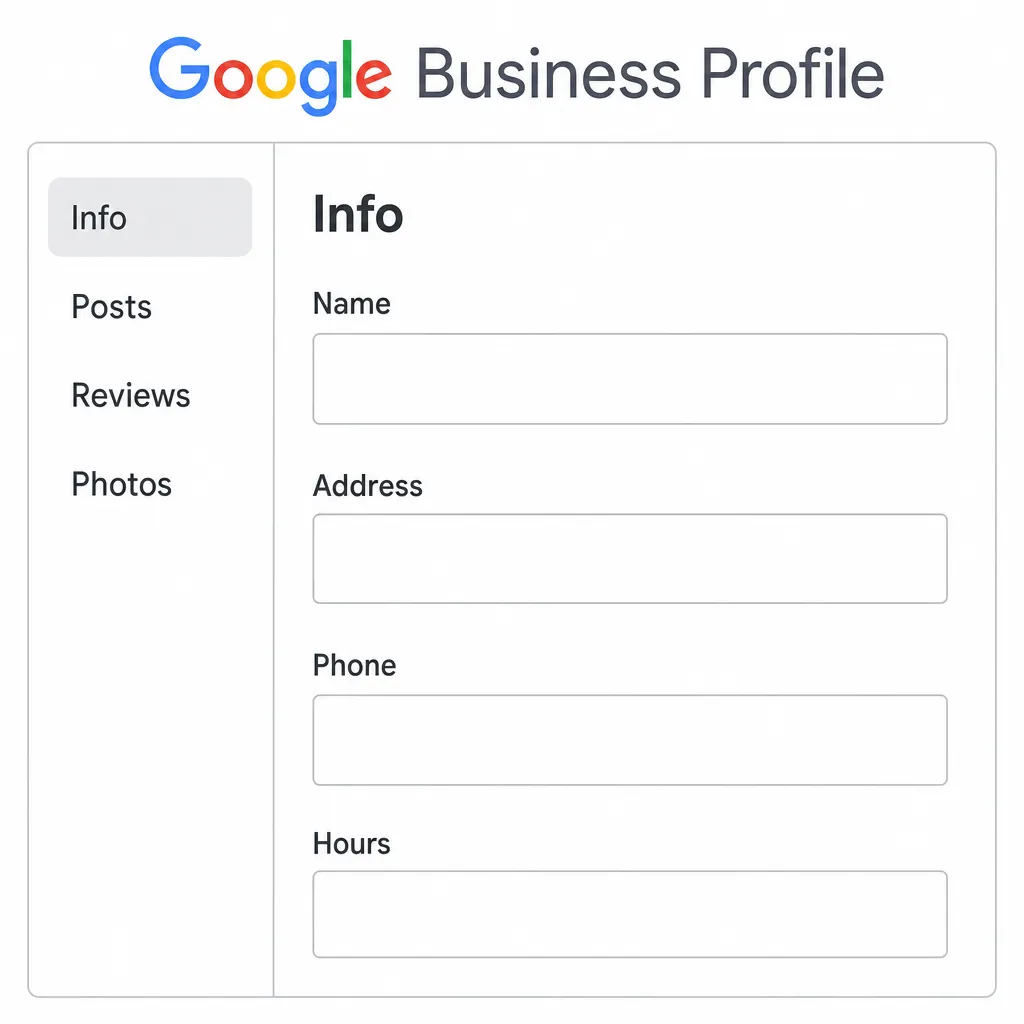
Here's what you absolutely need to check:
- NAP data (Name, Address, Phone): it must be identical everywhere on the web
- Opening hours: accurate, including for bank holidays and special days
- Professional photos: of your premises, products and team
- Review management: reply to every review, politely
- Categories: choose them carefully, primary and secondary
Also consider creating dedicated pages for each area you serve, with practical information (exact GPS location, service areas, clear calls to action).
Understanding where voice assistants get their data
Each voice assistant draws on different sources of information:
- Google's assistant (Gemini, which Google announced in March 2025 would replace Google Assistant on most mobile devices) mainly uses Google Maps and the structured data it finds online.
- Siri relies on Apple Maps and the data you provide through Apple Business Connect.
- Alexa aggregates information from Bing and other specialised external sources.
A consistent, well-optimised presence across these platforms is a key strategy for maximum visibility. Adding rich LocalBusiness markup (GPS coordinates, precise hours, service areas) makes it easier for these systems to index you.
Excelling at technical performance for voice assistants
Flawless technical performance is essential. Voice assistants consistently favour sites that are fast, stable and technically reliable.
Mastering Core Web Vitals for voice search
Take a mobile-first approach and aim for optimal load times, sticking closely to the Core Web Vitals:
- LCP (Largest Contentful Paint) < 2.5 seconds: the main content must appear almost instantly.
- INP (Interaction to Next Paint) < 200ms: interactions must stay smooth.
- CLS (Cumulative Layout Shift) < 0.1: the page layout must stay stable while loading.
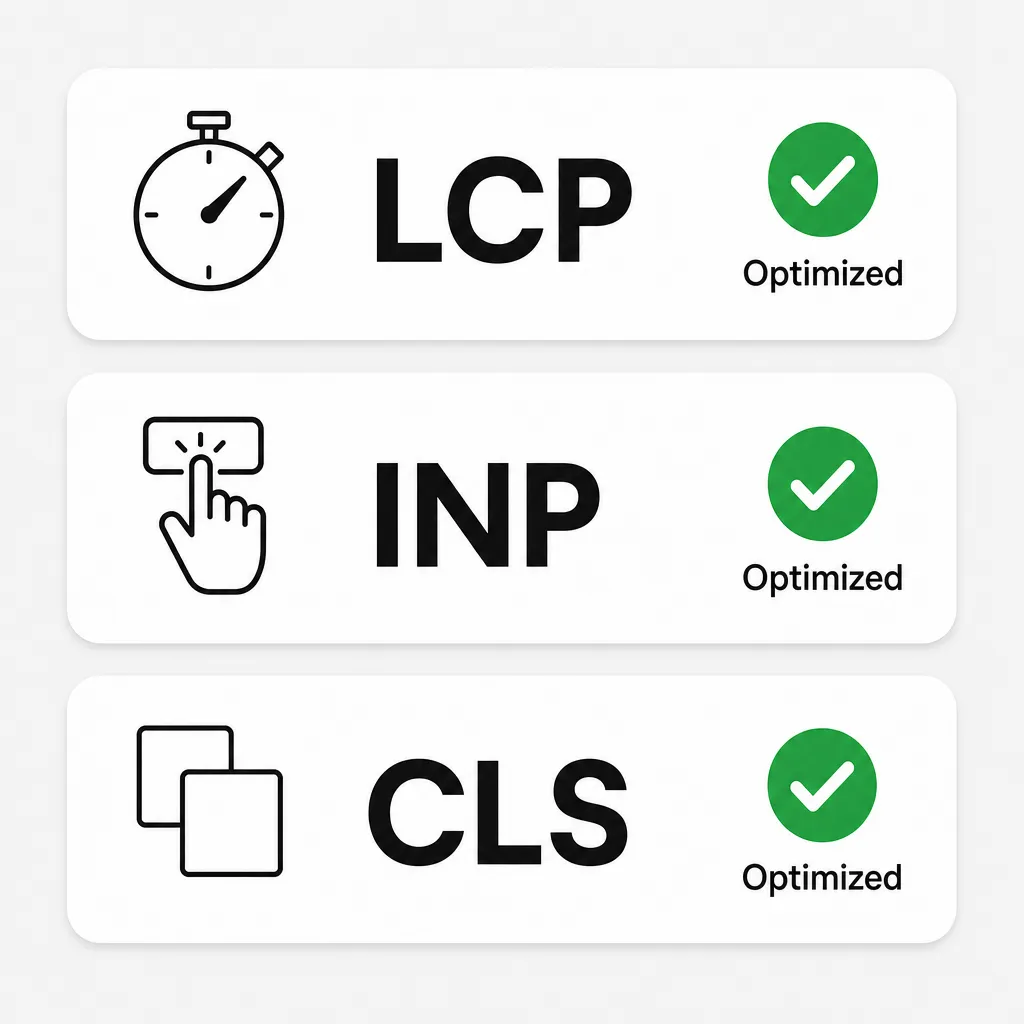
Recommended optimisation strategies:
- Media optimisation: favour modern formats (WebP/AVIF), enable lazy loading and size your images correctly.
- Code optimisation: compress and minify CSS/JS files, limit third-party scripts and use defer/async.
- Solid infrastructure: use an effective CDN, set up robust caching and tune your server.
Semantic HTML structure, with a single H1 per page and a logical H2/H3 hierarchy, also helps Google's crawlers understand and extract the organisation of your content for spoken answers.
A worked example: voice optimisation for a financial advice site
Here is how the method above applies to a financial advice website that wants to capture spoken queries.
Context and challenges identified:
The typical problem: the site struggles for visibility on financial queries phrased naturally, like "how much are closing costs on a house" or "what's the best savings account for my kids".
Its content, while technically sound, is too formal and doesn't match the spontaneous phrasing of voice search users.
Actions to take:
- In-depth query analysis: list the financial queries people actually speak to their assistant to identify natural phrasings.
- Content restructuring: FAQ sections built around real questions like "How much does a $300,000 mortgage cost?"
- Technical optimisation: relevant structured data in JSON-LD (for example FinancialProduct) on strategic pages.
- Mobile improvements: bring LCP under 2.5 seconds by optimising scripts and images.
What to track after 3 to 6 months:
- Impressions on question-and-answer queries (source: Search Console)
- Featured snippets won on high-value financial queries
- Calls through the "Call" button on the Google Business Profile
- Average position on the targeted long-tail queries
The principle behind it: aligning voice search intent with the content you offer is essential.
Aim for pages that answer the question directly in the first few lines, before expanding the information in an organised way.
Here's a voice assistant app that illustrates how voice search works in practice: it returns relevant results despite approximate pronunciation, gets regular updates and good user feedback, but deserves a closer look on privacy (data sharing, encryption of exchanges, limits on deleting your information). A useful resource for optimising your content for natural phrasing and pronunciation errors, while respecting what users expect in terms of data protection. Discover the voice search assistant
Measuring and analysing voice SEO performance
Measuring the impact of voice SEO is still tricky, because voice assistants often deliver answers without generating a click. To do it properly, here are the main indicators to watch:
| Metric | Voice goal | Measurement tool |
| Featured snippets won | Reach position zero | Semrush, Ahrefs, Search Console |
| Conversational queries | Top 3 for long questions | Search Console ("how", "where" filters) |
| Mobile CTR | Steady improvement | Google Analytics 4, Search Console |
| Core Web Vitals | LCP < 2.5s, INP < 200ms | PageSpeed Insights |
| Phone calls | Regular increase | Google Analytics, Business Profile |
Run practical tests on your own phone regularly. Try something like "OK Google, find an Italian restaurant open now" to check whether your content shows up in voice search results.
To set up voice commands on Android or iOS: open the Google app, enable "Hey Google" in the settings (Voice > Voice Match on Android; Settings > Voice Search on iOS), record your voice model and allow always-on access. You can then run searches, manage reminders or check the weather hands-free, which is exactly the kind of usage a good voice SEO strategy targets. Full tutorial for enabling OK Google
Keep a particularly close eye on your rankings for local queries ("near me", "open now") and informational ones ("how to"), since they make up the bulk of searches made by voice command on mobile.
Anticipating the future of voice SEO
Optimising for voice search (voice SEO) is evolving fast, driven by advances in AI and natural language processing. Voice assistants, now powered by generative AI models like Gemini and the new Siri, keep getting better at understanding context and giving personalised answers.
Here are the key trends to watch:
- Multilingual voice search: optimisation tuned to different languages and regional accents is becoming essential.
- Contextual intelligence: queries are now interpreted in light of search history and individual preferences.
- E-commerce integration: direct voice purchases and tailored recommendations are going mainstream.
- Visual voice search: combining spoken instructions with image recognition opens up new possibilities.
To stay competitive, you need to keep up with the technology and continually adapt your strategy to algorithm changes and new user habits.
Conclusion: making your voice transformation a success
Voice SEO isn't just a trend. It's a genuine shift in how people access information. The key to success? Understanding precisely the search intent behind each conversational query and answering it with clear, concise, well-structured content.
By adopting an authentic conversational style, sharpening your local strategy and guaranteeing excellent technical performance, you'll position your site as a go-to source for voice assistants. The investment in time and resources is real, but the payoff in visibility and qualified traffic is considerable.
The future of voice search is heading firmly towards ever more natural, contextual interactions. Businesses that anticipate this shift and adapt their digital presence now will hold a major competitive advantage. It's time to embrace the voice revolution and put your brand at the heart of tomorrow's conversations.

Automate Your SEO With AI Agents
Sedestral connects six AI agents to your website to handle content, audits, rankings, backlinks and images, without the manual grind.