How did Dropbox go from 100,000 to 4 million users in 15 months with almost no advertising budget? How did Airbnb take on the hotel giants by exploiting a simple loophole on Craigslist? The answer fits in two words: growth hacking.
If you want to know how the fastest-moving companies multiply their growth, you're in the right place. This complete guide breaks down the key strategies behind this approach. No abstract theory here: we'll show you concretely how to apply the founding principles, put the growth techniques that actually work into practice, and adopt the right mindset to grow your business sustainably.
What is growth hacking? Defining a revolution
Growth hacking is a radical break from traditional marketing. This approach, sometimes called growth marketing or simply growth, combines creativity, data analysis and rapid experimentation to achieve exponential growth with limited resources.
Its creator, Sean Ellis, defines it like this:
"A growth hacker is a person whose true north is growth ."
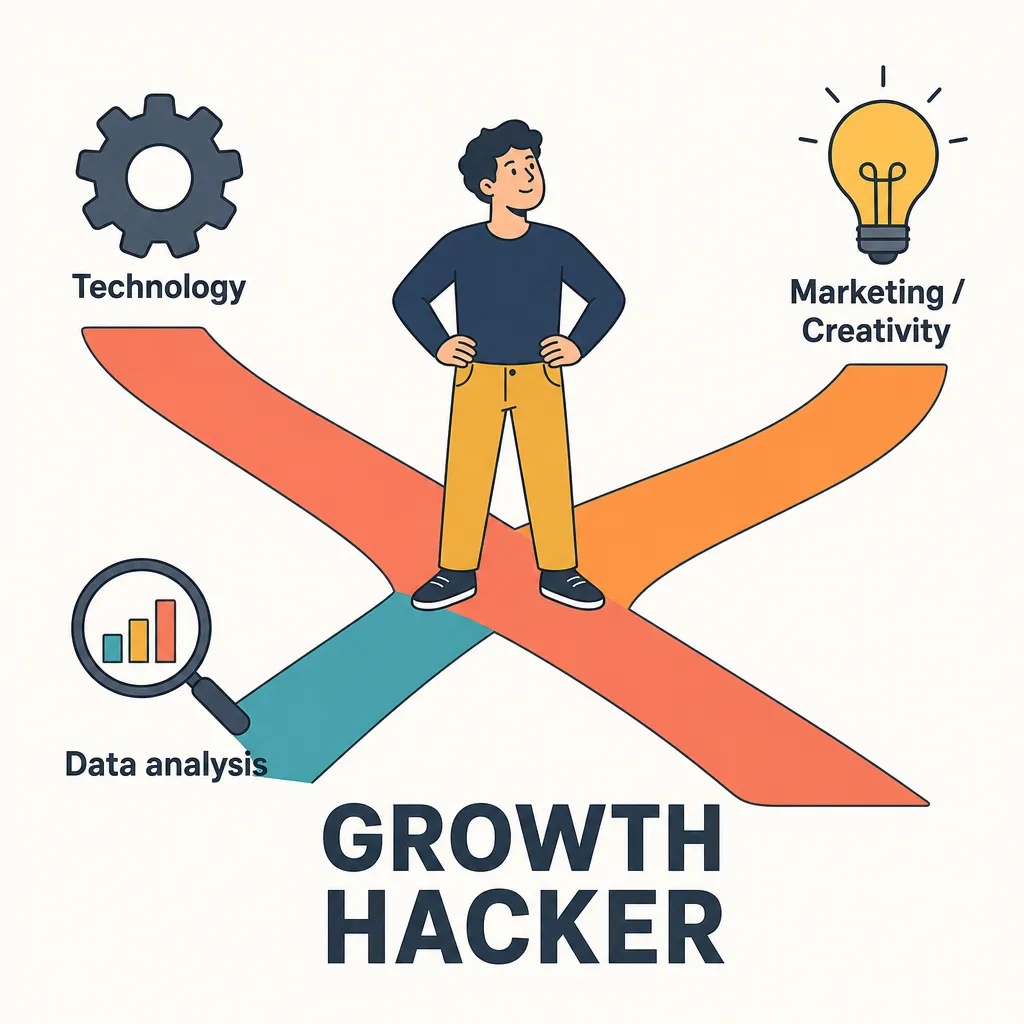
That obsessive focus on growth changes everything. The main goal is to multiply revenue or the user base through data-driven experiments. The strategy runs on a permanent cycle: form hypotheses, test, analyse the results and optimise.
The method rests on 4 fundamental pillars:
- Experimental approach: Continuous A/B testing to validate every idea before rolling it out at scale.
- Data-driven culture: Every decision is backed by objective, quantifiable metrics.
- Resource optimisation: Chasing maximum impact with budgets that are often tight.
- Fast execution: Short cycles (sprints) to find out what works as quickly as possible.
The best practitioners build growth mechanisms directly into the DNA of their product. They create organic viral loops and optimise every customer touchpoint.
Growth hacker vs. digital marketer: a clash of methods
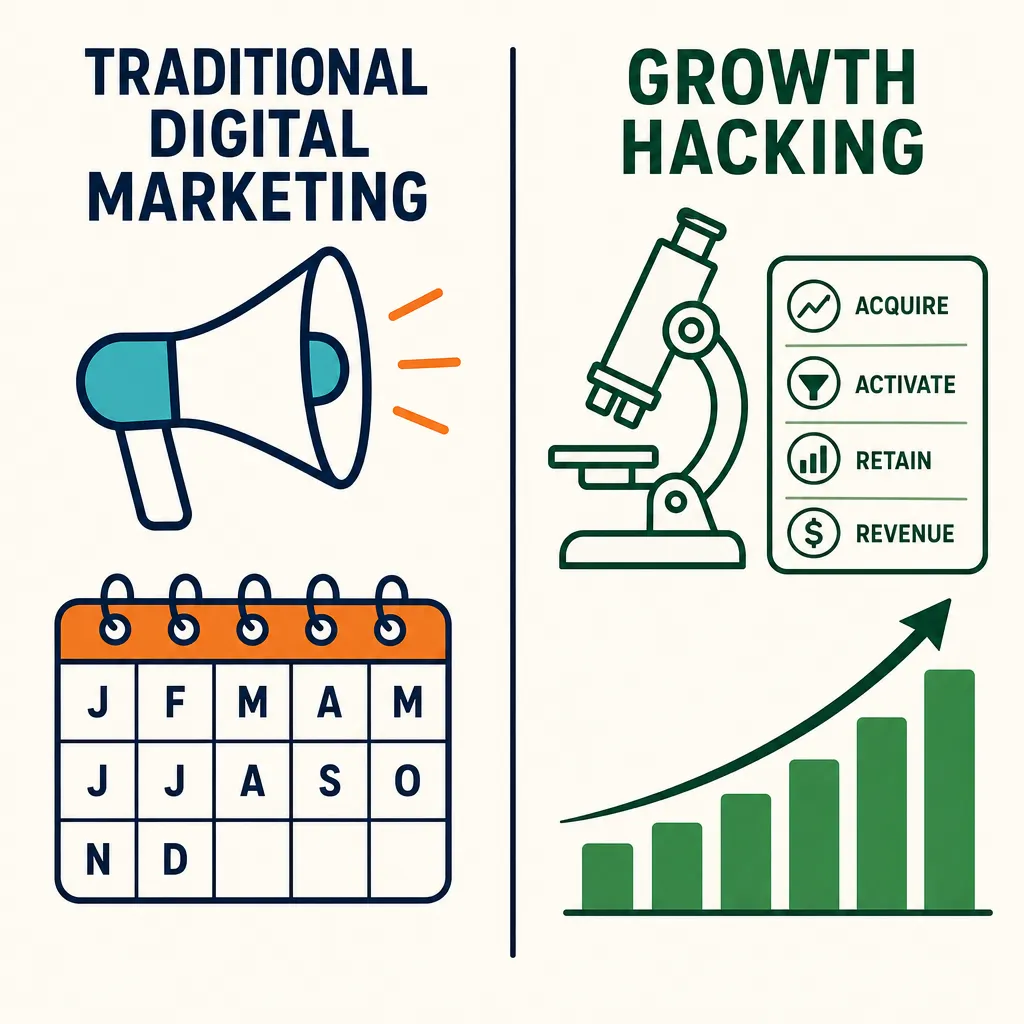
Where classic digital marketing or online marketing bets on long-term campaigns, growth hacking prefers fast, measurable actions. To make the difference clear, here's a comparison table.
| Criteria | Classic digital marketing | Growth hacking |
| Main goal | Awareness, brand image, leads | Growth (users, revenue) |
| Scope | Mostly acquisition (top of the funnel) | The entire customer journey |
| Method | Campaign planning, fixed budgets | Rapid experiments, iterations |
| Skills | Specialised (SEO, PPC, content) | Cross-functional (marketing, tech, data) |
| Speed | Long cycles (quarters, years) | Short cycles (weeks, days) |
The growth philosophy encourages cross-functional collaboration between marketing, product and engineering teams so that growth levers are built directly into the user experience.
The AARRR framework: the growth hacker's compass
To give this quest for growth some structure, growth hacking relies on a framework that models the ideal conversion funnel. It breaks the customer lifecycle down into 5 key stages. The growth hacker's job is to optimise each one to maximise the value generated.
1. Acquisition: Attracting the right visitors
How do your future users find you? The challenge is to master the right acquisition channels.
- Levers: Strong SEO on long-tail keywords, inbound marketing strategies, a relevant presence on social media, and hyper-targeted ad campaigns are the keys to successful customer acquisition.
- Famous example: Airbnb "hacked" its early customer acquisition by letting hosts automatically cross-post their listing to Craigslist, reaching a huge audience without spending a cent.
2. Activation: Turning a visitor into a convinced user
Does the visitor get a memorable first experience that makes the value of your product click (the "aha moment")?
- Levers: A simplified user experience from the very first contact, optimised forms, and an onboarding flow that leaves a mark on new customers.
- Famous example: Facebook discovered that users who added 7 friends in 10 days were far more likely to stay active. Its entire onboarding process was then optimised around that conversion target.
3. Retention: Bringing users back
Do your users come back regularly? Keeping them loyal is often the most profitable lever of all.
- Levers: Relevant automation (emails, notifications), gamification, and product tweaks based on close analysis of user behaviour.
- Famous example: Duolingo uses gamification and smart push notifications to nudge users into coming back every day.
4. Referral: Turning users into ambassadors
Are your users so happy that they recommend your product to the people around them?
- Levers: Double-sided referral programmes (rewarding both the referrer and the friend), sharing features woven organically into the UX.
- Famous example: Dropbox gave away 500 MB of extra storage for every referred friend who signed up. That simple mechanic was the main engine of its growth.
5. Revenue: Monetising usage
How do you increase the financial value of your users?
- Levers: Targeted premium offers (freemium), contextual upsell techniques, dynamic pricing tests.
- Famous example: Amazon excels at revenue optimisation with its "Customers who bought this item also bought" recommendations, which significantly increase average order value.
The experimentation process: the heart of the engine
A high-performing growth hacking strategy runs on tight experimentation cycles in 4 phases:
- Ideation & hypothesis: Brainstorm ideas and formulate a clear hypothesis ("Changing X will increase Y by Z%").
- Prioritisation: Score each idea on its Potential, Importance and Ease of implementation (the PIE model).
- Testing: Run the experiment on a representative sample using a rigorous methodology (an A/B test, for instance).
- Analysis: Review the results with statistical significance in mind to decide whether to roll out, adjust or drop the idea.
Without precise tracking fed by solid analytics tools, there's no way to steer this machine. The quality of your decisions depends directly on the quality of your data.
Conclusion: more than a technique, a mindset
Growth hacking isn't a collection of magic "hacks" but a rigorous discipline and a mindset built around experimentation. Growth hacking techniques evolve, but the method stays the same: understand your users deeply so you can optimise every interaction.
The real secret isn't copying Dropbox's or Airbnb's trick, it's adopting their method: test, learn and iterate relentlessly. Start small, pick a single metric to improve, and launch your first experiment today.
Frequently asked questions
How do you explain growth hacking in simple terms?
It's a marketing approach focused on growth that uses rapid tests to find the most effective ways to acquire and retain users, often by building marketing directly into the product. To do growth hacking, you first need to be obsessed with data and results.
What skills do you need to become a growth hacker?
The growth hacker job calls for a versatile profile. To become a growth hacker, you need a grounding in marketing, a good understanding of data, some notions of user psychology and basic technical skills. Mastering social media is a plus. It's an exciting growth role that never stops evolving.
What are the benefits of growth hacking?
The main benefits of growth hacking are fast results on often limited budgets, a better understanding of user behaviour thanks to data, and greater agility to adapt to the market. This strategy lets you focus only on what produces a measurable impact.
Is growth hacking only for startups?
No! Although it was popularised by Silicon Valley startups and scale-ups, large companies are increasingly adopting this agile mindset to drive innovation.
Let AI Handle Your Content Publishing
Alya researches keywords, writes and publishes content directly to your CMS, WordPress, Shopify, Wix and more, on autopilot.