You publish a new page, it shows up high on Google surprisingly fast, and then a few days or weeks later it slips back. Plenty of SEOs have watched this happen and gave it a name: the Google honeymoon period.
The name is catchy, but it describes something people observe in their tools, not a documented mechanism. Google has never confirmed that it gives new pages a boost, and its spokespeople have publicly explained why they don't see things that way. This guide separates what people observe, what Google actually says, what the public documents really show and what you can do when the ranking of a new page moves around a lot.
What is the honeymoon period in SEO?
In SEO jargon, the Google honeymoon period is the stretch after a piece of content goes live (or a site launches) during which it seems to rank better than it will later on. The page climbs quickly for some queries, sometimes onto page one, then drops back before settling into a steadier position.
In practice the term covers two quite different situations:
- A new page on an established site: a freshly published article or product page ranks well, then loses ground,
- A brand-new site: the first pages pick up some visibility, then the whole domain slides back.
It is often presented as the opposite of the Google sandbox, the other theory that says Google deliberately holds young sites back before giving them a chance. Both are labels practitioners put on curves they see in their rank trackers. No Google documentation describes a test phase or a bonus reserved for recent content, and nobody can seriously quote a "normal" duration: every page, query and market moves at its own pace.
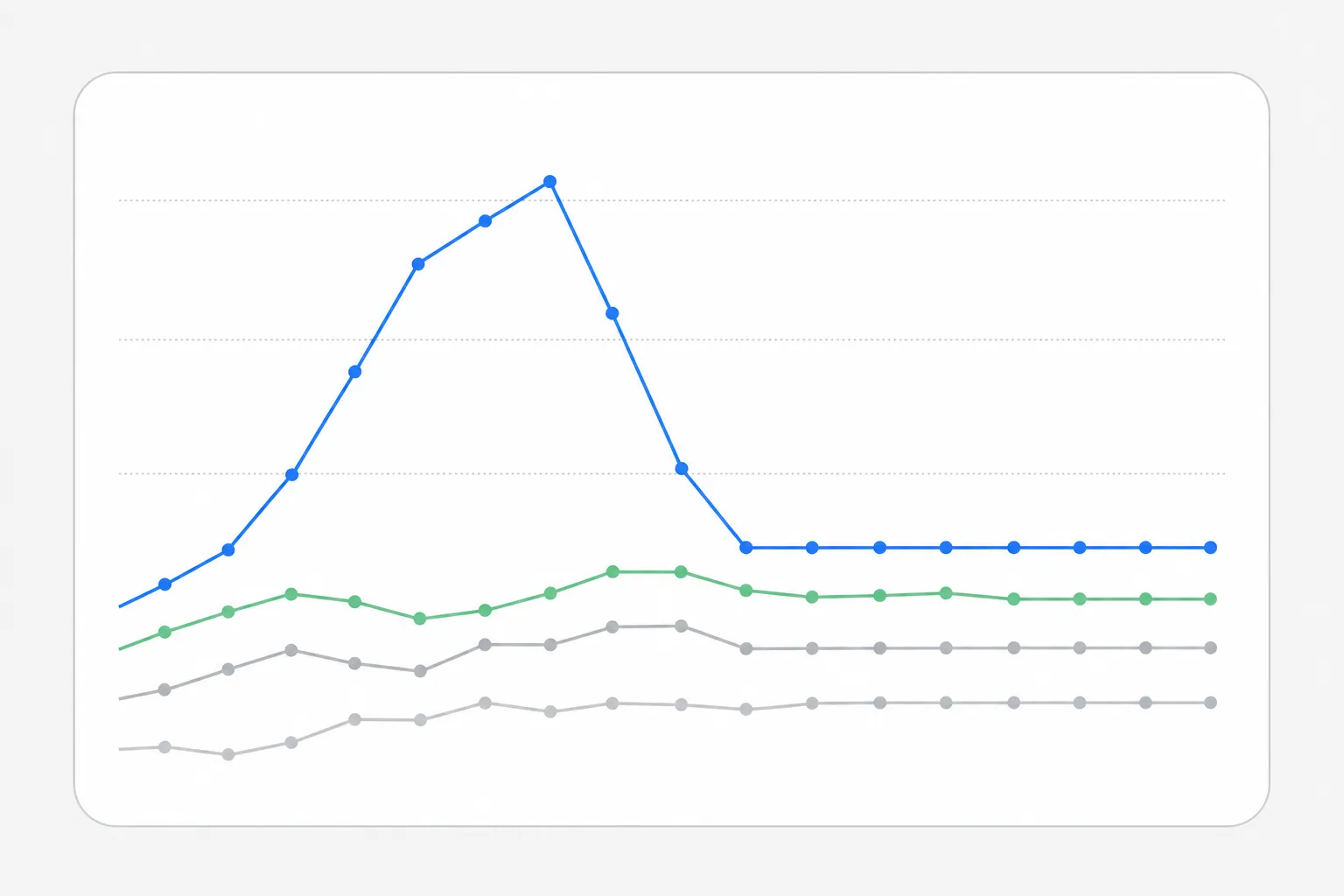
This chart is an illustration, not real data. It shows the shape most accounts describe, a line that rises, falls back and levels off, while other pages tracked over the same period move more steadily. In reality, many pages never get that early peak, and some do the exact opposite.
What Google actually says about the honeymoon period
The most direct comment on the subject comes from John Mueller, Search Advocate at Google, during the Google Search Central SEO office-hours of May 28, 2021. Asked about a new page that ranked well and then dropped, he brought up both theories himself. In substance, he explained that:
- the sandbox, seen as a brake applied to new pages, isn't what Google does,
- the honeymoon period, seen as a deliberate promotion of new content, isn't what happens either: Google isn't trying to purposely promote or demote new content,
- for a new page, Google has very few signals yet, so its systems have to make assumptions, for example that the page is probably in line with the rest of the site,
- those assumptions are sometimes on the generous side and sometimes on the cautious side, so the page can end up settling lower or, just as well, higher than where it started.
In other words, Google acknowledges the visible effect (a starting position that isn't the lasting one) but not the story SEOs often attach to it (a bonus given on purpose to test the page).
The official documentation points the same way without ever mentioning a honeymoon. Google's SEO starter guide notes that every change takes some time to be reflected in Search, a few hours for some and several months for others. And the page on debugging drops in Google Search traffic states that small fluctuations in position can happen at any time, including moves back up that don't require you to do anything.
Why a new page can move so much: the hypotheses
With no official mechanism to point to, all we can offer are plausible explanations. They aren't mutually exclusive, and none of them can be proven for a given case.
Few signals at the start
This is the explanation that rests on Google's own words. A page that has just been indexed has no history yet: few or no inbound links, no track record of how searchers respond to it, and an unclear place in the site's architecture. Ranking systems still have to put it somewhere. They do it based on what they know about the site and the content itself, then adjust as more information comes in. A first ranking that was too optimistic, followed by a correction, looks like a honeymoon from the outside.
Freshness for some queries
Google's guide to its ranking systems mentions "query deserves freshness" systems, built to show more recent content when the query calls for it, such as news or a film that has just come out. On searches like these, a brand-new page can legitimately be shown prominently, then give way when even newer content appears or interest fades. This isn't a bonus for every new page: it only applies to queries where recency matters to the searcher.
Ordinary fluctuations
Google's results move all the time: system updates, new competitors, shifts in what people search for, seasonality. A new page is exposed to these movements like any other, and because you watch it closely right after publishing, you notice its swings far more than those of an older page.
A measurement effect
In Search Console, the average position of a new page is based on few impressions, often spread over just a handful of queries. If it briefly shows up high for a secondary query, the average shoots up. If it then appears for other, less favourable queries, the average drops, even though its position for the main query has barely changed. Before concluding that "the honeymoon is over", look at the data query by query.
What the DOJ trial and the 2024 leak reveal
Two recent sources are often quoted as "proof" of the honeymoon period. They do shed real light on how Google works, but neither describes a test phase reserved for new pages.
The antitrust case against Google
In the case brought by the US Department of Justice against Google, Judge Amit Mehta issued a detailed opinion in August 2024 that summarises the testimony heard. It states that Navboost is a ranking signal that memorises user click data to match queries with documents, that Google executives described it as very important, and that, according to Pandu Nayak's testimony, it has been trained on 13 months of data since 2017, down from 18 months before that.
These points confirm that Google takes into account how people interact with its results. They don't say that Google deliberately places a new page near the top to measure its clicks, or how long such a phase would last. All the thresholds you sometimes read (a minimum click-through rate, an ideal visit length, a delay before re-evaluation) are extrapolations, not part of the court record.
The 2024 documentation leak
In May 2024, internal API documentation related to Google Search became public and was widely discussed in the SEO community. Asked by The Verge, Google spokesperson Davis Thompson warned against drawing inaccurate conclusions from information that is out of context, outdated or incomplete. The same article points out that the documents list data Google has access to, without saying which of it is actually used for ranking or how much weight it carries.
Caution is therefore in order: these documents show that certain attributes and systems exist, not their exact role in how a new page is ranked. Articles that describe a timed sequence of tests, re-evaluations and filters based on the leak present an interpretation as if it were fact.
How to track a new page in Search Console
The best way to avoid telling yourself stories is to look at the data. The Search Console Performance report gives you four metrics (clicks, impressions, CTR and average position) that you can filter by page, query, country, device and date range.
- Filter on the page URL to isolate its data from the rest of the site,
- Open the Queries tab to see which searches it actually appears for, and follow the queries that matter to you rather than the overall average,
- Compare equivalent periods with the date filter, keeping in mind that a very recent page has little history,
- Look at impressions before positions: a page whose impressions are growing is gaining ground, even if its average position looks unstable,
- Check indexing with the URL Inspection tool if the page disappears entirely, to rule out a technical problem.
For engagement on the page itself, you need an analytics tool such as Google Analytics 4 (engagement time, page views, conversions). Search Console doesn't measure time on page, and how quickly a searcher returns to the results is only visible to Google.
How to react when the position drops
Whether you call it a honeymoon period or a simple adjustment, the right response is the same: give it time, then improve what can be improved.
Give it time before drawing conclusions
A page that drops after a strong start isn't being penalised. Don't rewrite the content from top to bottom or change its URL at the first dip: you would only add noise to a situation that is already hard to read. Wait until you have enough data to tell a trend from a fluctuation, then act.
Better match the search intent
If the page settles lower than you hoped, the useful question is simple: does it answer what the searcher wants better than the results ranking above it?
- Search for the target query and study the top results: format (guide, list, product page, comparison), angle, level of detail,
- Check that your page addresses the dominant intent (someone ready to buy isn't looking for a definition),
- Add what is genuinely missing: concrete examples, practical details, answers to the questions your customers actually ask,
- Rework the title and meta description if the page gets impressions but few clicks.
Read the complete guide to producing SEO content that lasts
Strengthen internal linking
Google points out that the vast majority of the new pages it finds every day are discovered through links. Link the new page from your closest existing content, with descriptive anchor text, and make sure it doesn't stay isolated. It is also how you show where it fits in your site.
Read the complete guide to mastering link juice and securing your rankings
Earn quality links over time
Links from other sites in your field help Google understand where your page belongs. Go for relevant, natural links rather than volume: one link earned because your content is useful is worth more than a batch of artificial links bought in a hurry to "save" a position.
Read the complete guide to solidifying your link building
Look at what competitors are doing
If several pages on your site drop at the same time on the same topic, the explanation may lie with the competition: more thorough new content, better-linked sites, offers that fit the need more closely. Regularly analysing the pages that outrank you keeps you from looking for the cause only on your own side.
Read the SEO competitor analysis guide
Mistakes to avoid
- Treating the honeymoon period as a rule: it isn't a documented mechanism, and building a strategy around a window that may not exist for your page leads to poor decisions,
- Believing in precise durations and thresholds: no reliable source sets the length of this phase or a click-through rate or reading time to reach,
- Panicking at the first drop: a dip after a strong start is part of the normal fluctuations Google describes,
- Rewriting everything over and over: constantly changing a page makes it impossible to know what works,
- Inflating clicks artificially: generating fake clicks or automated visits serves no real need and counts as a manipulative practice,
- Reading only the average position: without the query-level detail, it can tell a misleading story,
- Forgetting other causes: seasonality, a technical issue, a Google update or a more relevant competitor often explain a drop better than the supposed end of a honeymoon.
Where Sedestral can help
Sedestral doesn't control Google's rankings, and no tool can. What the platform does is help you keep doing, week after week, the work that matters once a page is live. Six SEO agents share the job: Alya writes your blog articles, Rémi suggests optimisations for your existing content, Maya handles backlinks, Nox monitors indexing and runs technical audits, Marc analyses your competitors and Louise creates your visuals. You can start on the free plan, then move to a paid plan, from €119 a month and shown in your local currency, if it fits your needs.
Conclusion: a useful observation, not a rule
The Google honeymoon period, as SEOs call it, describes something many people see: a new page that starts strong and then slips back. Google, through John Mueller, says it is neither a bonus nor a penalty, but assumptions made with few signals that get corrected over time. The DOJ trial documents and the 2024 leak confirm that Google takes user behaviour into account, without describing any test phase specific to new pages.
For you, the course of action stays simple:
- Track the page query by query in Search Console rather than by its average position alone,
- Let the data build up before drawing conclusions,
- Better match the search intent if the page settles too low,
- Connect the page to the rest of your site and look for relevant links over time,
- Keep an eye on the competition and on the other possible causes of a drop.
It is less exciting than a "window to exploit", but it is what actually helps a page find its place and keep it.
Let AI Handle Your Content Publishing
Alya researches keywords, writes and publishes content directly to your CMS, WordPress, Shopify, Wix and more, on autopilot.