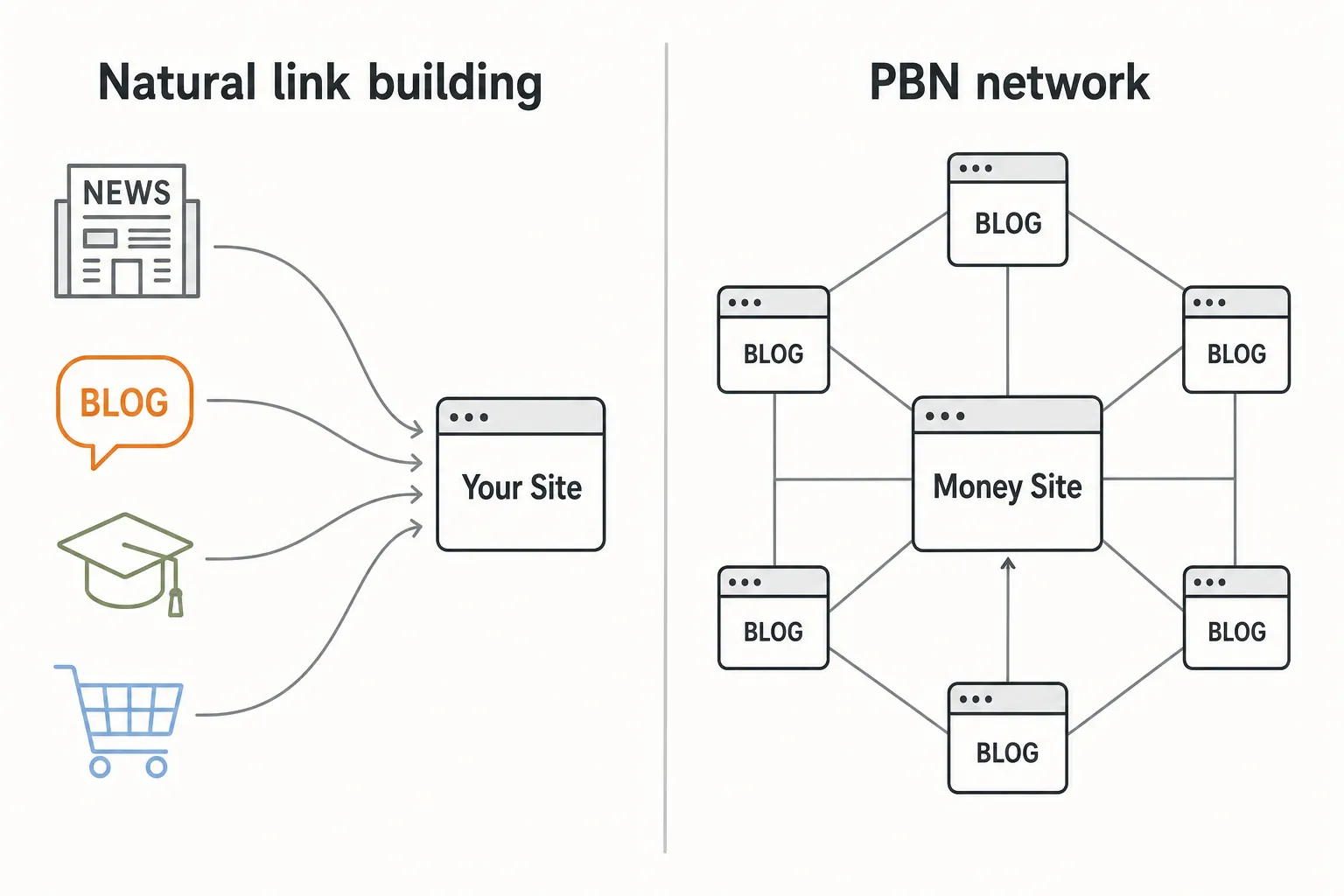
A PBN in SEO (Private Blog Network) means running several websites under the same ownership with one goal: generating artificial backlinks to a main website, also called the money site.
This link building tactic is controversial, but the principle is simple: quickly pick up inbound links from a range of domains to boost the authority and Google rankings of the target site.
It can deliver visible results in the short term, but it carries a high risk of a Google penalty, one that can wipe out all your organic SEO efforts and damage your visibility for a long time.
This guide walks through how a PBN works, the techniques used to fool the algorithms, the potential upside, and the real-world consequences of this black hat approach.
We'll also show you effective white hat alternatives that build a solid, lasting online presence without putting your reputation, or your brand's, on the line.
What is a PBN and how does it actually work?
A Private Blog Network (PBN) involves buying or building several satellite websites, often on expired domains, in order to push a main website through links pointing to it.
Because these old domains sometimes keep part of their authority and their old backlinks, they can pass "link juice" to the money site within a few weeks. The idea is to exploit the history and popularity of expired domains to artificially speed up the rankings of the main website.
The basic principle of a blog network
A blog network has three main objectives:
- Controlling anchors and the publishing schedule: every link is placed strategically with an optimised anchor and a calendar designed to mimic natural growth.
- Cashing in on the history of expired domains: by buying a quality expired domain, you inherit its existing link profile, which makes indexing easier and strengthens the transfer of authority.
- Hiding what the sites have in common: using different hosts, varied IP addresses, anonymous WHOIS records and a mix of CMSs so that Google doesn't spot similarities between the private sites in the network.
In theory, the network should look like a set of independent websites. In reality, they're all controlled by the same entity whose only aim is to improve the rankings of the target site. The approach tries to simulate natural link building while keeping total control over the link strategy.
How authority gets transferred
Every website in your blog network acts like a strategic recommendation. The links placed in the articles (or redirected through a 301) pass part of the domain's authority to your money site.
The stronger the source domain's backlink profile, the bigger the transfer of SEO power, right up until Google spots the manipulation. The mechanism piggybacks on the way search engines judge a website's popularity based on the quality of the links it receives.
Results can be fast: a keyword stuck on page 5 can jump into the top 3 in a matter of weeks. But this meteoric rise usually comes with permanent instability and greater exposure to algorithm updates, especially those targeting link manipulation.
How to build a PBN: technical architecture and concealment tactics
Building an effective PBN demands absolute technical discipline to minimise detectable traces (the famous "footprints"). Everything counts: hosting, content, link profile, right down to the design. The goal? Every website in the private network has to look independent and credible.
Selecting and acquiring expired domains
The performance of a private blog network rests mainly on the quality of the domain names you pick:
- A thorough history audit: review the old content on the Wayback Machine (Archive.org), examine the backlink profile (Trust Flow, Citation Flow, Domain Rating) and look for any penalties or traces of spam.
- Topical consistency: a domain that used to cover health will be far more relevant for building links to a nutrition website than an unrelated generic domain.
- Gradual acquisition: buying twenty expired domains at once looks suspicious. Spread purchases over several weeks or months to muddy the trail.
This is how operators dig up authority sites whose history makes the network more credible in the eyes of search engines.
Hiding technical footprints
For a PBN to stay invisible to Google, every shared footprint has to go:
- Multi-provider hosting: spread the websites in your network across different hosts with varied IP addresses, ideally on separate C-class blocks for better cover.
- WHOIS privacy or diversification: turn on WHOIS privacy or register each domain under a different owner so Google can't connect your websites.
- Mixing up CMSs and templates: alternate between WordPress, Joomla or static websites, and vary the themes, plugins and external resources to avoid glaring similarities.
- Unique identifiers: never reuse the same Google Analytics account, Search Console property or "author" meta tag across several websites in your network.
Even with all these precautions, Google runs advanced systems (Penguin, now baked into the core algorithm, and the AI-based SpamBrain) that analyse hosting, link structure and publishing frequency to spot artificial blog networks. With machine learning, detection keeps getting sharper.
Content strategy and link placement
For every blog in the PBN to look genuine, it needs unique content and a consistent editorial line:
- Quality content: write 800 to 1,500-word articles, produced by hand or with a capable AI, and enrich them with a variety of visuals.
- A natural publishing schedule: publish two to four articles a month on varying dates to avoid any suspicious regularity.
- Balanced outbound links: include external links to authority sources (Wikipedia, official websites) to make the site look credible.
- Anchor variety: favour natural anchors (70-80% branded or generic) and keep optimised anchors to a minimum (20-30% at most).
With this method, you can create the illusion of a natural blog while precisely controlling the links pointing to your main website. The aim is to avoid an over-optimised link profile that would trigger the algorithms.
This guide explains how to use a complete SEO tool to run an effective link building strategy: detailed analysis of links and backlinks (DR/UR, anchors, dofollow/nofollow), monitoring of new links for you and your competitors, detection of suspicious profiles and PBN signals, broken link management and the disavow procedure when needed. You'll also find tips on setting up alerts, using the Content Gap feature to uncover new link opportunities, and combining a technical audit with on-page optimisation (Core Web Vitals, markup, structure) to get the most out of your backlinks. Read the full guide on detecting PBNs and optimising your link building
Benefits and advantages of a private blog network
Despite the very real risks, plenty of SEO professionals still use a PBN for reasons that make strategic sense to them. Understanding those motivations helps pin down the situations where a PBN can deliver a temporary edge, particularly in ultra-competitive sectors.
Total control and scalability
A private blog network gives you absolute control over every aspect of your link building:
- Complete freedom over anchors and target pages: you can freely test different combinations of optimised anchors without relying on outside providers.
- Fast deployment: adding new backlinks takes a few hours, versus several weeks for a traditional editorial partnership.
- Instant scale: buying 10, 20 or 50 expired domains immediately multiplies your link sources, with no external negotiation.
That total control over the link strategy is one of the main draws for professionals willing to accept the risk of using a PBN. The method also lets them quickly change anchors or remove links they consider risky.
Fast ranking gains
Done properly, a PBN can produce spectacular short-term effects:
- Reaching the top 3 from the top 10 in just a few weeks on ultra-competitive keywords.
- Faster indexing: new pages on your main website get crawled within 24 to 48 hours thanks to links from domains Google visits often.
- Direct traffic: if the websites in the network still get residual traffic, part of it can be redirected to your commercial site.
That performance is why some SEO specialists accept the risk, hoping to bank quick wins before a possible penalty. But those gains are fragile and can collapse overnight with an algorithm update.
Apparent cost and short-term ROI
At first glance, a PBN looks cheaper than other strategies:
- Initial investment: buying around ten expired domains ($500 to $2,000 depending on quality), shared hosting ($100 to $300 a year) and content creation ($300 to $1,000).
- Low marginal costs: once the network is up and running, adding new links only costs writing and publishing time.
- Quick ROI: if rankings improve and generate immediate conversions, the return can look better than a traditional link building campaign.
Those sums, however, ignore the risk of a penalty and the time needed to maintain and constantly monitor the network. The real cost also includes the potential losses if you get caught.
Risks, penalties and Google detection signals
Google invests heavily in detecting and neutralising artificial link schemes. Using a PBN carries a high risk, clearly breaches Google's spam policies and can lead to heavy penalties capable of destroying your organic visibility.
Common footprints and detection methods
Here are the main things that can give away an artificial network of websites:
- Identical WHOIS data: the same email address, company or phone number used across several domains.
- Shared hosting: similar IP addresses or a common server linking all the private blogs in the network.
- Duplicated templates: the same WordPress theme, the same plugins and identical HTML structure.
- A dodgy link profile: a sudden burst of new referring domains, over-optimised anchors (> 20% exact match) and backlinks that are all dofollow and all acquired at once.
- No organic traffic: tools like Ahrefs flag domains with no natural visits that nevertheless keep producing links.
Google cross-references this information with its algorithms, then can take manual action or quietly devalue the network through automated filters (like Penguin and SpamBrain). The connections between websites are analysed with growing precision.
Consequences of a PBN-related penalty
A Google penalty can hit in several ways, often severe ones:
- Link devaluation: Google simply ignores the backlinks from the network, wiping out any SEO benefit.
- Manual action: a notification in Search Console, and you have to clean up your link profile before requesting a review.
- Deindexing: in extreme cases, the main website and/or the other websites in the PBN can vanish from search results altogether.
- Lasting damage to reputation: even after a fix, the website can take months to recover its performance, or stay penalised for good.
When a penalty hits, organic traffic can collapse within days and recovery can take many months. The financial hit from those losses can be devastating for an online business.
Clean-up process and link disavowal
Once a penalty lands, the recovery procedure is long and complicated:
- Full audit: identify every suspicious link using tools like Ahrefs, Search Console and WHOIS/IP analysis.
- Removal attempts: contact the webmasters, which often goes nowhere when the private blog network (PBN) is run in-house, and document every step.
- Disavow file: prepare a list of domains or URLs to exclude, then submit it to Google through Search Console.
- Reconsideration request: explain the fixes you've made and commit to following the search engines' guidelines.
- Natural repair: gradually build (over 6 months) 10-15 quality partnerships to rebuild your authority.
In the end, the total cost (lost time, missed revenue and replacement budget) usually far outweighs the initial gains from a PBN. Investing in a sustainable strategy from day one is a much smarter move than repairing the damage afterwards.
Sustainable alternatives and white hat strategies to build your authority
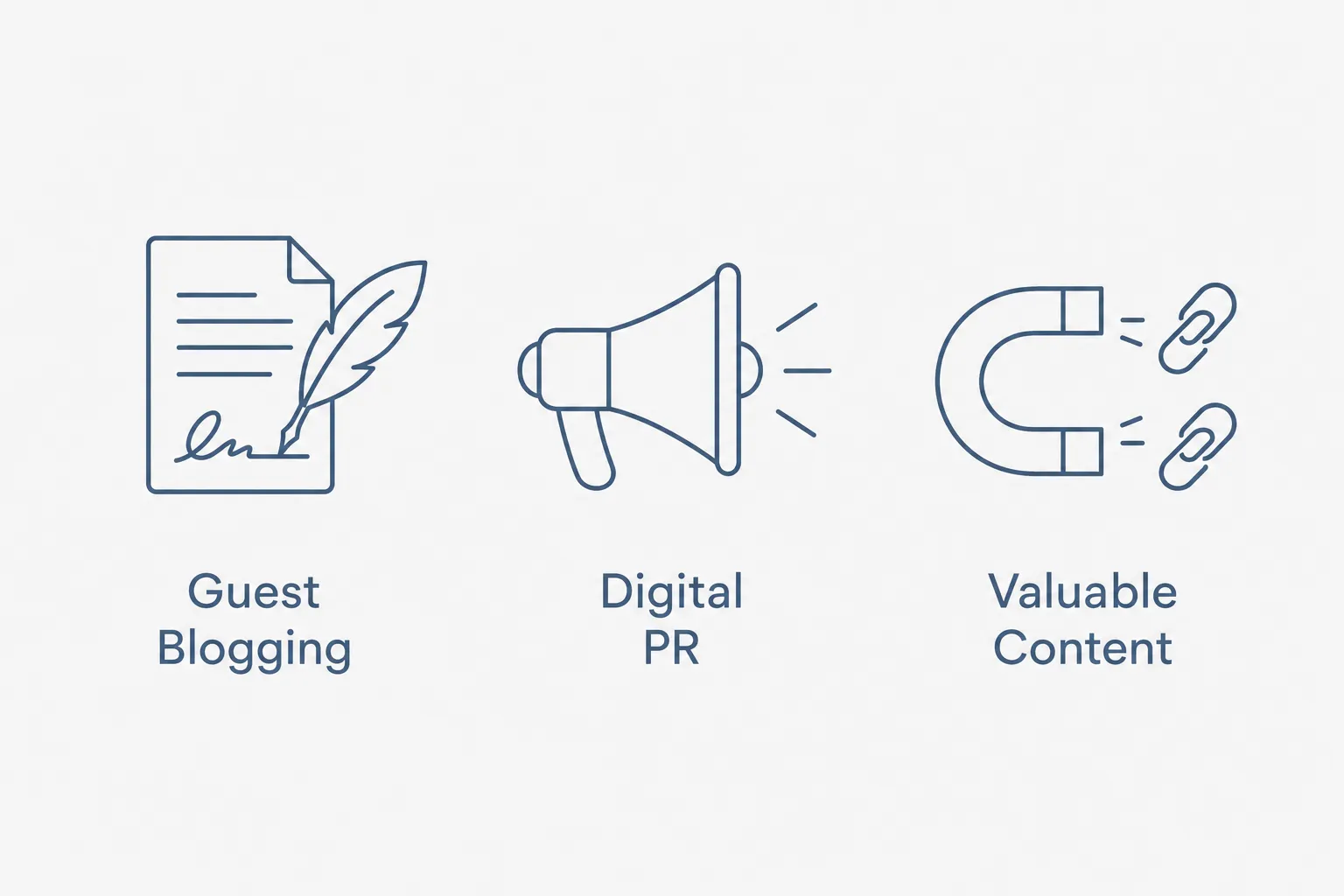
Rather than betting on a risky private blog network (PBN), we recommend safer methods to strengthen your online presence, avoid penalties and protect your reputation.
Genuine guest blogging and editorial partnerships
Publishing guest posts on influential websites remains one of the most effective strategies:
- Precise targeting: pick 10-15 blogs or media outlets with a qualified audience and a clear editorial line.
- Premium content: write in-depth articles (1,500-2,500 words) enriched with infographics or exclusive analysis.
- Organic links: slip in 1-2 relevant links without over-optimising the anchors.
- Ongoing partnership: keep the collaboration going (say, one article a quarter) for credibility and quality backlinks.
One link from an authority website is worth more than dozens from a dodgy private network. This approach also boosts your real popularity with your audience.
Digital PR and shareable content
Earn backlinks naturally by producing resources people want to share:
- Original research: publish industry analysis ("The future of SEO in 2026").
- Practical tools: offer calculators or downloadable templates that invite citations.
- Striking visuals: design infographics that are easy to share on social media.
- Media relations: target influential journalists to earn mentions.
It costs more upfront, but this method delivers lasting links, improves your visibility and durably strengthens your credibility with search engines.
Link reclamation and broken link building
Make the most of existing opportunities without having to create brand-new content:
- Reclaiming mentions: use Google Alerts to spot unlinked mentions, then politely ask for a link.
- Broken links: find dead links on quality websites and suggest your content as a relevant replacement.
- Competitor analysis: study your rivals' backlinks and approach the same sources with a more attractive offer.
These techniques build on foundations that already exist, so you get more done with less. They help you build natural links while sidestepping the risk of an artificial network.
Our complete SEO glossary covers the essentials (technical, content, popularity) and explains link building, how "link juice" is passed, internal linking strategies, search intent analysis and the on-page optimisations that matter (tags, sitemaps, and so on).
You'll find:
- The must-have tools (Search Console, GA4, etc.)
- Proven methods (topic clusters, snippet optimisation...)
- Warnings about risky practices such as site networks (PBNs)
The focus is on earning quality backlinks, diversifying anchors intelligently and running a sustainable strategy that boosts your authority and rankings. Discover our complete guide to link building and the dangers of PBNs
PBNs for e-commerce sites and competitive niches: is the risk worth it?
Some ultra-competitive sectors like gambling, online pharmacies or finance still have active PBNs in circulation. Yet even in these very specific niches, the risk far outweighs the potential medium and long-term benefits.
Real cost vs. uncertain ROI
Building a PBN involves expenses that are often underestimated:
- Upfront investment: buying premium domain names ($1,000 to $5,000 for an authority domain), multiple hosting accounts, design work and content writing.
- Ongoing maintenance: annual domain name renewals, regular article publishing, technical and security updates.
- Constant monitoring: tracking key metrics (Trust Flow, traffic), fixing anomalies and handling Search Console alerts.
- Sudden loss: in the event of a penalty, the whole investment can evaporate in days.
Compared with an ethical link building strategy (10 guest posts and 3 media partnerships over 6 months), building an effective PBN often costs the same or more, with zero guarantee of stability. Your maths has to include the risk of losing everything overnight.
Surveillance and the risk of being reported
In hotly contested markets, your competitors scrutinise your backlinks:
- Powerful tools: Ahrefs, Semrush and Majestic let them examine every link and identify suspicious patterns (identical IPs, similar anchors, domain names created at the same time).
- Reports to Google: some won't hesitate to report the PBNs they find through the spam report form.
- Advanced algorithms: Google's systems now detect patterns invisible to the human eye.
The more your network grows (good rankings and lots of inbound links), the greater the danger of being spotted. Paradoxically, the risk rises with the apparent success of the network.
How to spot a competitor's PBN (and protect yourself)
If you suspect one of your competitors might be using a PBN, here's how to check and protect yourself effectively:
- Analyse their backlinks: with tools like Ahrefs or Majestic, look for referring websites with low traffic, recent creation dates and suspicious link profiles.
- Check WHOIS data: compare registration details across domains to find overlaps (same owner, same company or same address).
- Examine the hosting: tools like BuiltWith or Hosting Checker reveal the servers used and IP addresses shared between several websites.
- Analyse content and structure: look for similarities in the articles, layout or HTML code across the different referring websites.
Once the PBN is confirmed, you have two options: report the network to Google through its spam report tool, or adopt a quality strategy that will eventually outperform their artificial advantage. The second approach is usually the most effective in the long run.
Types of PBN and their levels of sophistication
There are different kinds of PBN, and not all private blog networks are equal in quality. Some are crude and easy to spot, while others are more sophisticated and can fly under the radar for a while.
"Low-cost" PBNs or "link farms"
Main characteristics of these bottom-of-the-barrel networks:
- Poor-quality domains: bought in bulk (50 to 100 at under $10 each).
- Thin content: auto-generated or copied articles, often unreadable.
- Shared hosting: all the websites sit on the same server with the same IP.
- Zero maintenance: the websites are abandoned once created.
Average lifespan: a few weeks to a few months before detection and a penalty. These networks carry the most risk for the least benefit.
"Premium" PBNs or "topical networks"
Characteristics of these high-end networks:
- Quality expired domains: rigorous selection (TF/CF > 20, clean history, topical relevance).
- Unique, regular content: hand-written articles, spaced-out publishing and social media sharing.
- Complete technical diversification: varied hosting, anonymous WHOIS, different CMSs and unique themes.
- Careful maintenance: CMS updates, metric monitoring and constant adjustments.
Potential lifespan: several months to several years, though some risk always remains. These networks require serious investment and rigorous management.
"Tier 2" PBNs or tiered networks
Some operators build multi-level networks to make detection harder:
- Tier 1: high-end websites that link directly to your money site to maximise its authority.
- Tier 2: mid-quality websites whose job is to prop up the tier 1 links.
- Tier 3: lower-quality sources that exist purely to feed the tiers above.
This pyramid structure is meant to disguise the linking activity, but it means complex management, high costs and no protection against Google's algorithmic checks. Whatever the tier, the risk is still very much there.
Conclusion: choose sustainable growth over the risky shortcut
Private blog networks (PBNs) are a textbook case of the temptation to climb fast at the expense of authority built patiently and for the long haul.
Boosting your rankings overnight sounds attractive, but the dangers that come with it, such as a Google penalty, a traffic drop, damage to your brand image or the loss of your investment, far outweigh the fleeting gains this strategy offers.
We recommend investing instead in proven, ethical techniques: publishing on authority blogs, working with online media, creating valuable content and adopting natural strategies to earn relevant links.
These methods do take more time upfront, but they generate lasting backlinks, strengthen your credibility and protect you against future search engine updates.
The real question isn't "how do I hide a PBN?" but "how do I build an online presence solid enough to adapt to search engine changes and shifting user expectations?".
At Sedestral, we help businesses and SEO professionals with technical audits, smart content optimisation and high-performing link building strategies that deliver lasting, measurable results for your website and your wider network.

Automate Your SEO With AI Agents
Sedestral connects six AI agents to your website to handle content, audits, rankings and backlinks, without the manual grind.