How do you get your voice heard in a market where everyone is shouting? How do you attract customers without flooding them with ads they ignore in a split second? The answer isn't a bigger ad budget. It's a smarter approach: content marketing, sometimes called marketing through content.
This complete guide gives you a strategic roadmap to attract, engage and retain your audience. You'll learn how to turn your expertise into digital visibility and lasting growth, and build a competitive edge you can actually measure. A solid content marketing strategy is the foundation of all of it.
Stop "renting" your prospects' attention. Learn how to earn it for good with quality content.
What is content marketing? Definition and core principles
Content marketing is a long-term inbound approach. The idea? Create and distribute useful, informative, non-intrusive content on a regular basis to attract, engage and retain a well-defined audience. The end goal: trigger a profitable customer action, not through pressure, but through trust and added value.
Rather than hammering your prospects with promotional messages, you give them something genuinely useful first. This respectful approach, distinct from brand content (which leans on emotion and brand image), lets you:
- Build your brand's credibility over time by positioning yourself as the go-to expert
- Prove your expertise, become impossible to ignore and grow your visibility in a crowded market
- Boost your organic ranking (SEO) by creating a digital asset that gains value over time and drives qualified traffic
- Generate qualified leads - every prospect is precisely targeted - while lowering your customer acquisition cost (CAC) and raising their lifetime value (CLV)
The numbers back this up. According to the Content Marketing Institute (B2B research, Outlook for 2024), 84% of B2B marketers say content marketing helped them create brand awareness over the previous 12 months. And a Wyzowl study found that a majority of consumers say they've been convinced to buy after watching a brand's video. Content is no longer an add-on: it now shapes the entire online customer relationship.
Effective content marketing starts with a deep understanding of your audience. Build detailed personas to pin down the needs, blockers, preferred channels and objections of each target segment (e.g. "first-time marathon runner", "tech founder"). Every piece of content should answer one specific question, make a clear promise and fully satisfy the persona's search intent.
Content marketing in 3 pillars (the S.C.M. method)
To keep it simple, remember that a high-performing content marketing strategy always rests on three foundations: the S.C.M. method.
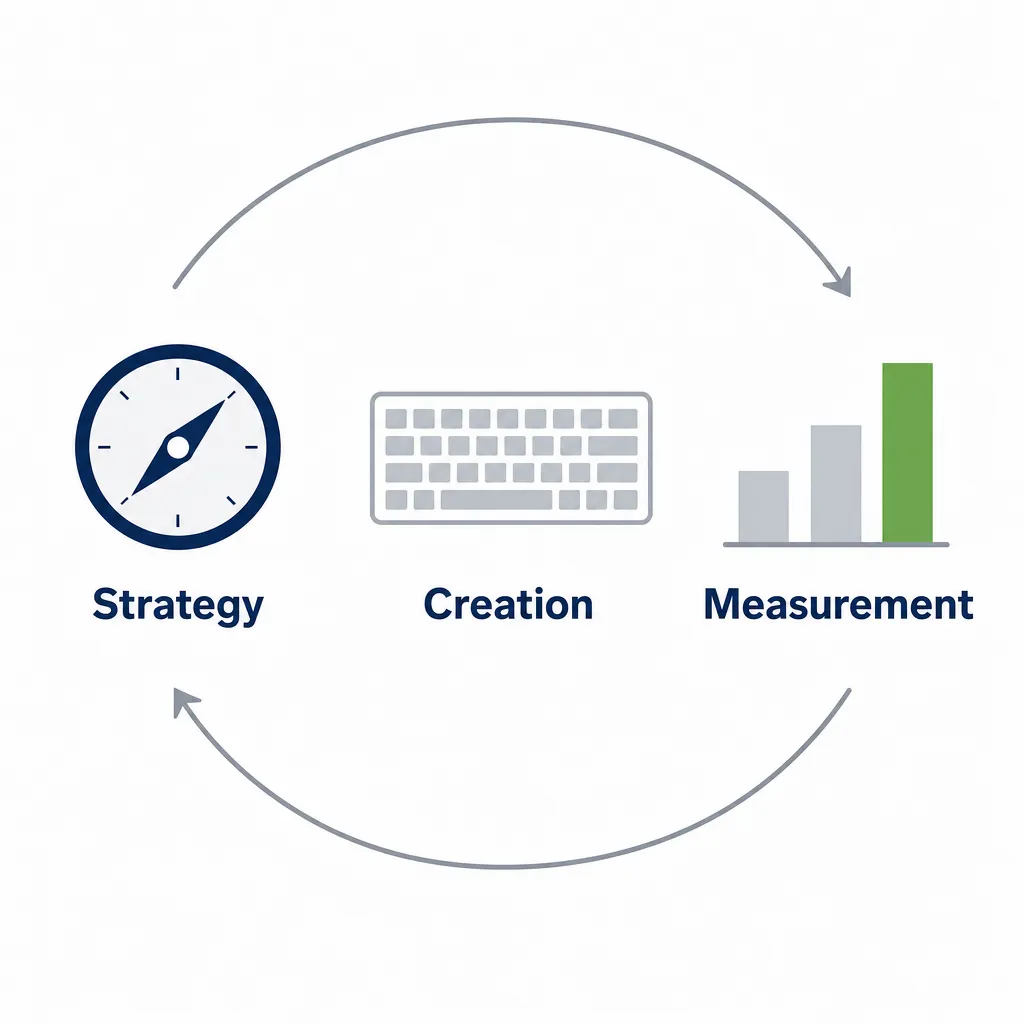
1. Strategy: set the course
- SMART goals: What concrete result do you want? (Visibility, lead generation, retention or sales.) For example: "Generate 20% more qualified leads within six months".
- Detailed personas: Do you really know your target? Pin down their challenges, ambitions and search queries so you can map their customer journey.
- Channels and formats: Where does your audience hang out? (Blog, YouTube, LinkedIn, social media...) Create relevant content for each stage of the journey: awareness = blog article, consideration = guide/comparison, decision = customer testimonial.
- SEO architecture: Organise your posts around central pillar pages linked to supporting cluster articles to strengthen your credibility and your SEO.
2. Creation: produce value
- Editorial identity: Define your tone, your core topics and your unique angle. Your brand should be recognisable at a glance.
- Quality first: Favour complete, actionable, original content (studies, in-depth guides) to maximise value and earn authority. Every piece of content should aim to be THE reference on its topic.
- Format diversity: Mix your media (articles, videos, infographics) to reach different audiences. Repurpose a flagship piece into several formats (LinkedIn post, infographic, newsletter).
- Built-in credibility: Show your proof: a named author, verifiable data, cited sources and visible update dates.
3. Measurement: steer to improve
- Key indicators: Track the metrics that matter (traffic, time on page, conversions, leads, SEO rankings) rather than vanity views.
- Close analysis: Spot what works with Google Analytics, Search Console or Semrush. Understand why some content outperforms the rest.
- Continuous improvement: Keep refining your strategy. Test different titles, refresh your best content regularly, and don't be afraid to cut what isn't delivering.
This detailed guide explains how to build an effective content marketing strategy for 2026, combining editorial creation with optimisation techniques: applying E-E-A-T principles, building pillar pages and topic clusters, analysing search intent and keywords, structuring pages, optimising media, internal and external linking strategy, with regular monitoring to prevent content decay. The method breaks down into five key steps (SERP analysis, building the semantic core, page structure, media optimisation, link building), while underlining the importance of Core Web Vitals and structured data. You'll also find a checklist and key indicators to turn every page into a lasting asset that attracts qualified traffic. Discover our practical guide to optimising your content marketing in 2026.
The number 1 mistake that kills most content efforts
Our experience keeps surfacing the same mistake: rushing into production (the "what") before nailing down the strategy (the "why" and the "for whom").
Far too many businesses start with "What should we write about this week?" instead of "What problem can I solve for my target customer?". The result: quality content that never finds its audience, doesn't rank in search engines and doesn't convert.
The fix: get to know your persona inside out. Before you write a single line, make sure you understand your audience. Your "Strategy" pillar isn't a box to tick: it's the foundation of your success. Identify your keywords and search intent clearly, and match the format (guide, list, video) to what the search results are already rewarding.
Content marketing vs. advertising: building an asset vs. renting attention
To grasp the full power of this approach, compare it with its opposite: traditional advertising. The difference for your marketing is both simple and crucial.
| Criterion | Content marketing | Traditional advertising (ads) |
| Approach | Inbound strategy that attracts the audience by delivering value. | Intrusive (outbound) approach that interrupts the user. |
| Goal | Build a lasting relationship with the audience by sharing useful knowledge. | Generate immediate conversions. |
| Lifespan | Long: a well-crafted blog article or post keeps driving traffic and leads for years. | Short: the effect stops the moment the campaign ends. |
| Asset | Creates lasting capital (content, community, expertise). | Temporary rental of space on external platforms. |
| Trust | Strengthens credibility and positions your brand as the expert. | Perceived as promotional and less authentic. |
| Long-term ROI | Organic growth with optimised acquisition costs. | Requires continuous spend to keep results going. |
Content marketing vs. brand content: usefulness vs. emotion
It's important to separate content marketing from brand content, two approaches that often get mixed up:
- Content marketing: Focuses on creating useful content for your audience that answers real needs. Its job is to inform, solve problems and make decisions easier (for example: a detailed product comparison or a step-by-step tutorial).
- Brand content: Here, emotion and brand identity come first. The goal is to create an emotional connection and build awareness (think of an ad campaign built around the company's values).
The two are complementary: content marketing delivers real value and builds the relationship, while brand content brings the brand's world and personality to life.
The origins of content marketing: a history that makes sense
Content marketing is nothing new. Its roots go back more than a century, to pioneers who had already grasped its potential:
- 1895: John Deere launches The Furrow magazine, giving farmers practical advice to improve their yields instead of pushing its tractors directly.
- 1900: Michelin publishes its iconic Red Guide. The goal was to get motorists driving more miles (and wearing out their tyres), not to sell tyres directly.
- 1987: Lego dreams up a magazine designed to spark children's creativity well beyond the building bricks themselves.
What do they have in common? They proved that useful, inspiring content is a brand's greatest asset. Giving people relevant information always reinforces expertise and loyalty.
Inbound marketing: content as the fuel
Inbound marketing is a holistic approach that aims to attract customers by offering them tailored experiences. Content is the engine at every stage. Inbound marketing relies on content marketing, SEO, customer relationships and automation to convert visitors, whereas traditional advertising tries to trigger an immediate action with a direct sales message.
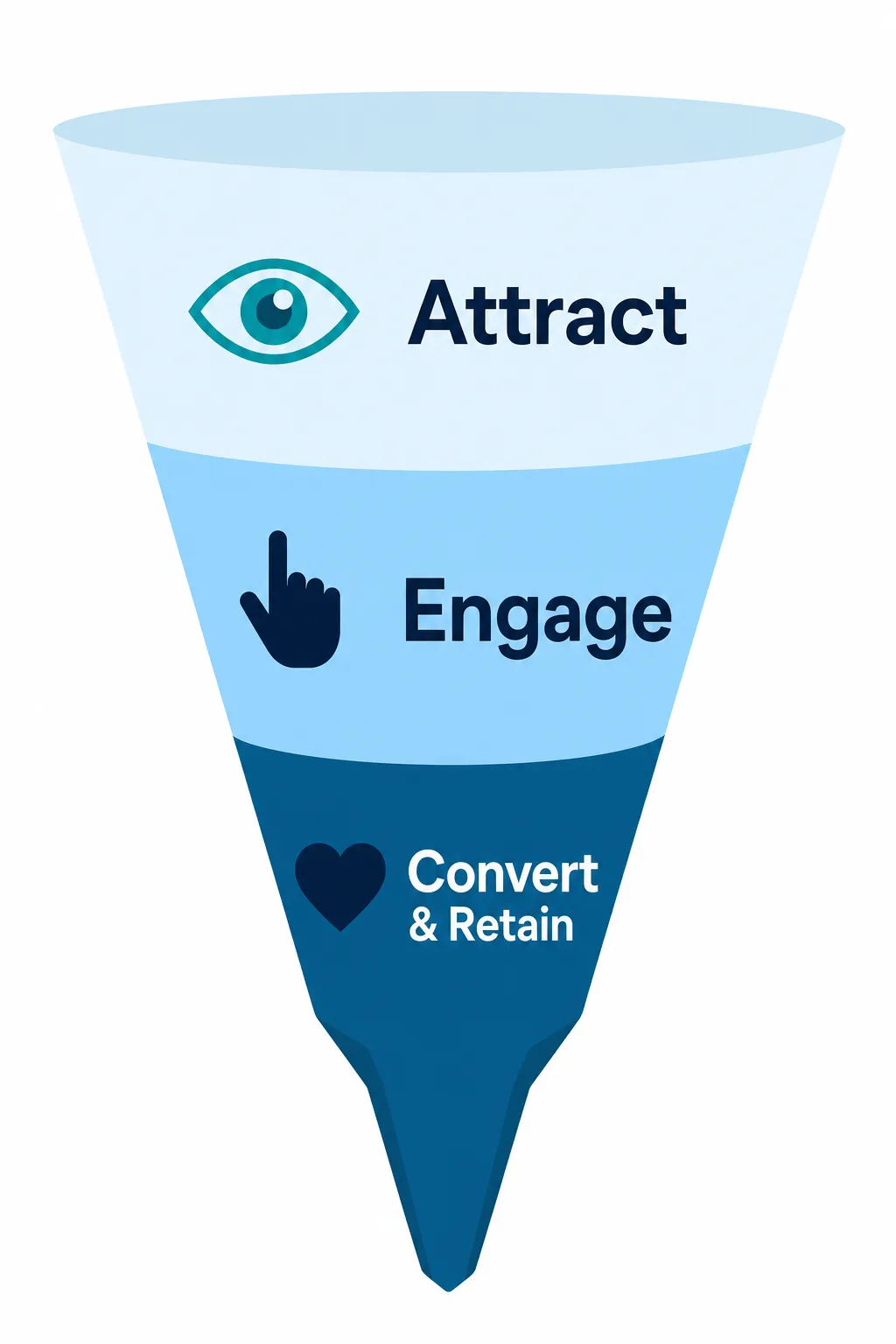
- Attract (Awareness): A user discovers your brand through SEO-optimised content that answers their query perfectly, or through your social media posts. Recommended formats: blog articles, short videos, downloadable guides.
- Engage (Consideration): The visitor, now interested, digs deeper into your brand. They might download a full guide, read testimonials or join a webinar. Ideal formats: checklists, case studies, online workshops.
- Convert & Retain (Decision & Loyalty): The prospect becomes a customer and then an advocate thanks to product demos, customer testimonials or exclusive content that confirms their choice. Effective formats: buying comparisons, customer reviews, product videos.
Inspiring content marketing examples, analysed
- HubSpot: The undisputed master of inbound. Instead of constantly pushing for the sale, the platform has become a reference by publishing a goldmine of educational resources. That approach naturally positions its software as the obvious choice, while generating a steady stream of qualified leads.
- Red Bull: Far more than a drink, Red Bull has turned itself into a genuine media company. Its Stratos project was a masterclass in expressing the brand's values, cementing its authority on the theme of pushing limits and earning exceptional visibility across the web and social media.
- Innocent Drinks: Their strength? Authentic storytelling. By generously sharing the behind-the-scenes of the company, with a playful and human tone, they built an ultra-engaged community on social media. That transparency encourages user-generated content (UGC) and massively amplifies their reach.
- River Pools and Spas: A textbook e-commerce example that generates millions in sales thanks to a rich blog and practical videos (buying guides, product tutorials, automated emails).
Building your content marketing strategy: the action plan
An effective content marketing strategy is built methodically. Here's how to go about it to maximise your results.
Step 1: build rock-solid foundations
- Set SMART goals: "Increase our organic traffic by 20% in 6 months" is a real, measurable goal, unlike a vague intention such as "get more visitors". Favour concrete business indicators: traffic, conversions, leads generated, retention rate.
- Analyse the competition (SERP): Use tools like Ahrefs or Semrush to identify strategic keywords, winning formats, common questions (People Also Ask) and featured snippets. Align your content with those insights.
- Create your personas: Build detailed profiles of your ideal customers (needs, objections, communication channels) to target your audience better.
- Keyword research and cluster architecture: Pick one or two main keywords with their variants, then organise them into topic clusters. Structure your content with pillar pages linked to supporting articles to boost your SEO and cover each topic exhaustively (example: pillar page "e-commerce SEO" + supporting articles on "canonical tags" and "link building").
This hands-on guide details how to build a strategic editorial plan for your content marketing: defining precise business goals, in-depth persona research, competitive monitoring to spot SEO opportunities, then keyword research and a cluster architecture. The method breaks down into 5 key steps (audit & goals, personas, keywords & architecture, ideation & planning, analysis & optimisation), with the must-have columns of an editorial calendar, a distribution and repurposing strategy for your content on social channels, and a selection of practical tools (Google Sheets, Trello, Asana, Airtable). You'll also find a ready-to-use template to gain consistency, efficiency and topical authority - the perfect roadmap to turn random content production into a qualified traffic machine. Discover the complete guide to creating your editorial calendar
Step 2: plan to create and produce with discipline
- Set up a solid editorial calendar: Plan the creation and publication of your content several months ahead. This key tool keeps your production rhythm going and lifts your results over the long run. Always include: title, target persona, main keyword, structure (pillar/cluster), format, distribution channel, key dates, owner, status, call to action, URL and update date. A good calendar streamlines production, prevents creative blocks and significantly improves your organic traffic.
- Vary your content formats: Don't limit your strategy to a single content type. Rework your flagship pieces (such as an in-depth article) into adapted spin-offs: social media posts, short videos, infographics, LinkedIn carousels or audio clips.
- Personalise the customer journey: Adapt your content to each stage of the buying cycle (awareness, consideration, decision) and to your specific audiences (B2B or B2C). For B2B, favour long, technical formats (white papers, webinars, LinkedIn). For B2C, go for visual, emotional and entertaining content (TikTok, Instagram).
- Put an efficient workflow in place: Ideation → Brief → Writing → SEO optimisation → Design → Approval → Publication → Promotion → Analysis (with clear owners and deadlines). Build in a multichannel strategy from day one (social media posts, newsletters, digital PR, guest blogs) to maximise the impact of every goal.
Step 3: measure to optimise relentlessly
- Choose relevant indicators: Identify the KPIs that truly reflect your primary and secondary goals: organic traffic, visitor sources, session duration, bounce rate, conversion rate into qualified leads (MQL/SQL), cost per lead, customer acquisition cost, retention, customer lifetime value and sales attributable to content. Group these metrics by goal: awareness (views, shares), engagement (time spent, interactions), lead generation (downloads) and sales conversions.
- Assess return on investment: Correlate your content with sales opportunities and the revenue it generated. Then compare production and distribution costs with the revenue earned. Bear in mind that the best results usually show up after 6 to 12 months of consistent effort.
- Analyse and improve continuously: When a piece of content underperforms, test different approaches: A/B test the title, update the data or improve the internal links. Content marketing is dynamic, so regularly shift your budget towards the channels that work best. Run a quarterly audit (via Google Search Console) to refresh, merge (301 redirects) or remove low-performing pages and fight content decay.
Your key indicators for steering performance
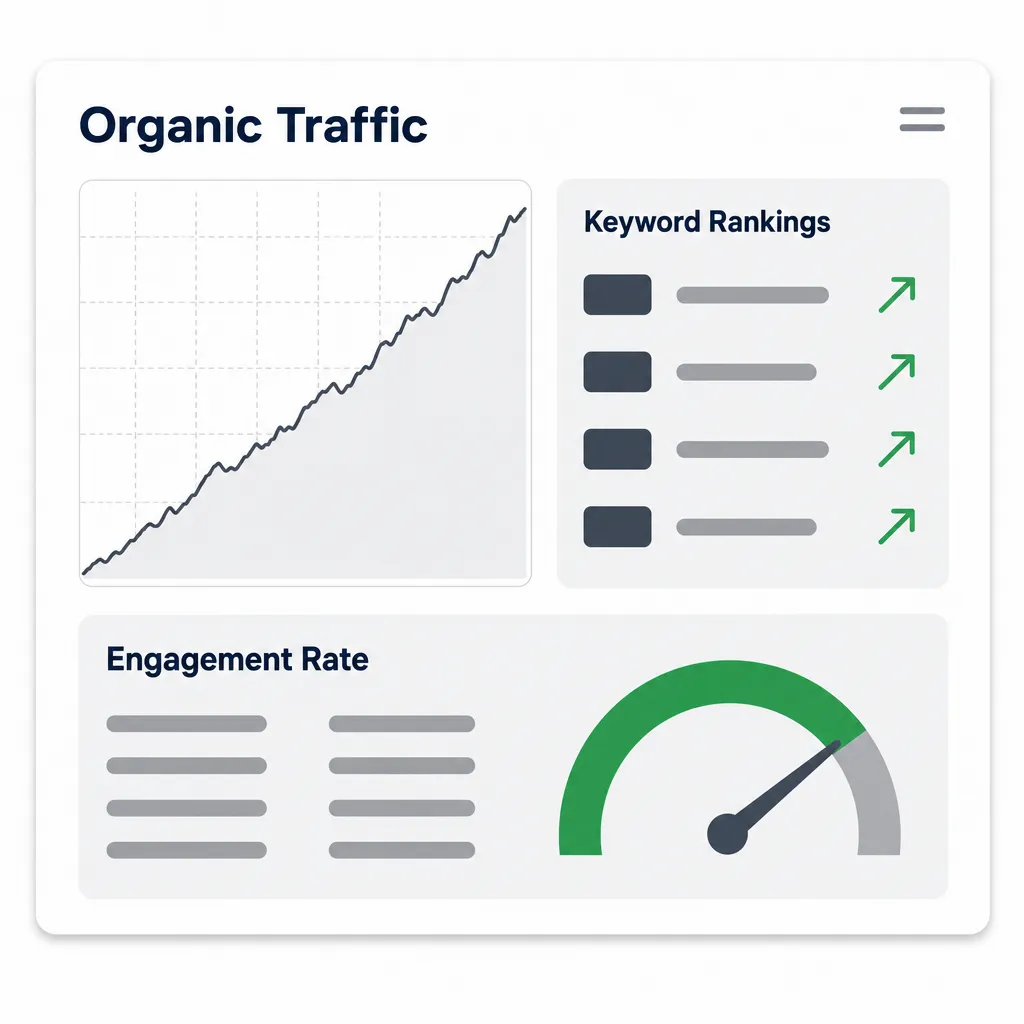
| Key indicator (KPI) | What you measure | Why it matters | Measurement tool |
| Organic traffic | Visitors coming from organic search results. | Shows how effective your SEO is and how visible you are online. | Google Analytics 4, Google Search Console |
| Leads generated | Actions such as sign-ups or contact requests. | Shows how well your content marketing converts. | HubSpot/CRM, Google Analytics |
| Engagement rate | Interactions (shares, comments) and time spent. | Key indicator of how your content lands on social media. | Google Analytics, Hotjar |
| Keyword rankings | Position in the results for your target queries. | Direct impact on your SEO and potential traffic. | Semrush, Ahrefs |
| Conversion rate | Visitors turning into leads or customers. | Measures the commercial effectiveness of your strategy. | Google Analytics, CRM |
| Core Web Vitals | Technical performance (speed, stability). | Key factor for SEO and user satisfaction. | Google Search Console |
Creating the perfect article (SEO-optimised and human)
Writing for search engines is a science; writing for human readers is an art. The key to a successful content marketing strategy is finding the right balance between the two.
Our checklist for a flawless post:
- A title people want to click: Make a strong promise, highlight a concrete benefit or ask an intriguing question. Work your main keyword naturally into the title (a single H1), the URL and the meta description.
- A punchy introduction: Open with a hook that names the problem, show you get it, then present the solution. Make sure you deliver on the title's promise and the search intent.
- A crystal-clear structure (H1, H2, H3...): Organise your subheadings logically so the reader - and Google - can scan your content quickly. Optimise the title tag and meta description too (for example: "SEO Guide 2026").
- High-value content: Offer practical solutions, verifiable data, concrete examples and above all your own point of view, grounded in your experience and expertise. Usefulness comes first: the reader must find a complete answer to their question.
- Transparency and authenticity (E-E-A-T): Cite your sources, introduce the author with a bio and let your personality show. Bring tangible proof: tests, certifications, update dates. These elements reinforce credibility (Trustworthiness). Mention legal notices, your update policy and your review process (including human checks on AI-generated content) to encourage engagement.
- Technical and media optimisation: Weave in your main keyword and long-tail phrases naturally. Use properly sized WebP/AVIF images, enable lazy loading and write descriptive alt attributes. For videos, add a transcript and VideoObject markup. Core Web Vitals targets: LCP < 2.5 s, INP < 200 ms, CLS < 0.1.
- Internal and external linking: Link to other relevant pages on your site (topic clusters, 2-3 strategic internal links with natural anchors) and to authoritative external sources. Prioritise link-building quality: topical relevance, a variety of referring domains and diverse anchors; favour partnerships and industry studies (e.g. links from respected trade publications).
- Structured data: Implement Organization, Person, Breadcrumb and Article markup to help search engines understand your pages and qualify for the rich results that still exist (FAQ rich results are no longer shown).
- Clear calls to action: Guide the reader to the next step (download a guide, read another article or book a demo).
- Striking visuals: Add images, diagrams, infographics and videos to illustrate your points and boost engagement.
This hands-on guide reveals how to maximise the impact of your content marketing strategy by optimising your " link juice": build internal linking around topic clusters, choose descriptive anchors, earn quality topical backlinks and preserve authority during migrations (301 redirects, canonical tags). You'll find concrete actions - link audits, prioritising pillar pages, redirects and monitoring via Google Search Console, plus specialised tools - so that every article or marketing page concentrates and redistributes maximum added value, giving your organic visibility a lasting boost. Optimise the link juice of your content: read the complete guide
Priority content formats and how to use them
Explore the most effective content formats depending on the stage of the buying cycle and your goals:
- Blog articles: Ideal for topic pillars, SEO optimisation and creating tutorials or FAQs. Perfect for building awareness and boosting your organic rankings.
- Videos and stories: Essential for driving engagement on social media, sharing tutorials or showing behind the scenes. Short formats work well on social, while long-form content lets you go deeper on YouTube. A great way to captivate your audience and humanise your brand.
- E-books, white papers and case studies: Powerful tools for capturing leads and convincing B2B decision-makers. They demonstrate your expertise and strengthen your credibility.
- Podcasts, webinars and interviews: Excellent for building closeness, asserting your authority and nurturing the relationship with your B2B or B2C customer. They let you explore topics in depth and forge a lasting bond with your community.
- Infographics and visuals: Perfect for simplifying complex information, encouraging shares and earning backlinks. They improve understanding and recall of your messages.
- Print content: Still relevant in some sectors such as luxury or healthcare, as magazines or guides.
Match your formats to each stage of the journey:
Awareness (articles, short videos, e-books);
Consideration (checklists, case studies, webinars);
Decision (buying guides, customer testimonials, product videos).
Go multichannel: turn an article into a social media post, then an infographic and finally a video.
Tools and governance for efficient production
To make your content marketing strategy work, equip yourself with the right tools:
- Planning tools: Start simple with Google Sheets, then move to Trello (Kanban method), Asana or Airtable to manage dependencies and automate tasks. Notion and Canva are great for creating templates and visuals.
- SEO tools: Google Search Console, Google Analytics 4, Ahrefs or Semrush will help you analyse performance, rankings, CTR and Core Web Vitals.
- Creation tools: Use a CMS such as WordPress, video editing software, design tools (Canva, Figma) and email platforms (Mailchimp, Klaviyo).
- AI governance: Use generative AI (ChatGPT, Jasper) to prepare briefs, run audits, research keywords and produce first drafts. But every publication must be reviewed by a human to guarantee quality, consistency and E-E-A-T compliance.
Distribution and promotion: amplifying your content
Producing quality content isn't enough; you also need to distribute it well to maximise its reach and influence:
- Owned media: Your website, blog, newsletter or private community - you keep full control over your audience.
- Earned media: SEO, collaborations, PR or user-generated content bring you organic visibility thanks to the relevance of your content.
- Paid media: Sponsored campaigns (targeted ads, retargeting) let you boost content with strong commercial potential.
- Integrated editorial calendar: Plan your distribution across every channel (social media, email, guest posts) right from the moment the content is created.
- Engagement and virality: Encourage your audience to interact and to produce content that showcases your brand.
Effective writing and methods: AIDA and SEO optimisation
To create relevant content that converts, apply the AIDA method:
- Attention: Grab attention with a compelling title and a punchy introduction.
- Interest: Hold it by answering the reader's query precisely.
- Desire: Create the want by underlining the added value and bringing concrete proof (studies, testimonials).
- Action: Guide them to the next step with a visible, persuasive call to action.
Our writing tips: Use simple, direct language, structure your ideas as an inverted pyramid (essentials first), include proof, work in your keywords naturally and, above all, always deliver on your title's promise.
Real-world content marketing examples by sector
- E-commerce: Practical buying guides (such as "How to choose your running shoes" with links to products), product tutorials and videos made for social media. Some online shops have seen sales take off thanks to a well-built blog and educational videos.
- B2B / SaaS: The winning combo: white paper, webinar, then a series of automated emails to book demos. HubSpot excels at this.
- Health brand: Educational content such as practical guides, blog articles and explainer videos.
- Restaurant: Engaging content: menu planning, exclusive recipes and behind-the-scenes videos.
- Consultancy: Sector white papers, detailed case studies and specialist webinars.
- Tech company: Product demos, customer case studies and a technical blog.
- Content repurposing: Turn a star article into an infographic, a LinkedIn carousel, TikTok videos or social media posts.
B2B vs. B2C segmentation: adapting your approach
- B2B: Favour in-depth content (white papers, webinars) on LinkedIn, with rational arguments and tangible proof, for longer sales cycles.
- B2C: Visual, emotional formats (TikTok, Instagram) with punchy storytelling for quick decisions.
- Personalisation: Use marketing automation to serve the right content at the right time, based on the customer's profile and where they are in the buying journey.
Conclusion: content isn't king, it's the kingdom
Content marketing goes far beyond SEO. It's a philosophy that puts your expertise at the heart of your marketing and turns your business into a media outlet in its own right.
Every article, every post, every piece of content strengthens your brand's credibility. By working the three pillars (Strategy, Creation, Measurement), optimising your SEO architecture and analysing your performance, you create a lasting asset that generates qualified traffic, leads and sustainable growth.
The question is no longer whether you should do content marketing, but when you'll start building your empire.
Let AI Handle Your Content Publishing
Alya researches keywords, writes and publishes content directly to your CMS, WordPress, Shopify, Wix and more, on autopilot.