Reusing content you've already published is now an essential strategy for getting more visibility out of your digital output without creating something new every week. When a small share of a site's content often drives most of its traffic, turning one piece into multiple tailored formats is a powerful way to reach different audiences across all your channels.
What content repurposing means
Content repurposing means intelligently reworking your existing content for different channels, formats and audiences, never settling for a simple copy and paste. It's a smart way to amplify your message while getting more out of the creative investment you've already made.
Why repurpose content
The proven effectiveness of this approach comes down to concrete benefits:
- Time saved: adapting an existing piece takes far less effort than creating one from scratch
- Better ROI: a single piece of content generates multiple touchpoints with your audience
- Stronger message: presenting the same idea in different ways improves recall
- Multichannel presence: spread across platforms and you depend less on any single algorithm
In practice, an in-depth article can feed your company blog, while a condensed video version brings your social channels to life. The key is to adapt each variant to the specific search intent of each channel.
Build a modular base from day one
The COPE method (Create Once, Publish Everywhere) makes content repurposing much easier. The idea? Design modular content from the start:
- Structure the information into self-contained blocks
- Plan visuals that can easily be reused
- Make the key messages easy to pull out
A well-built how-to guide can then become:
- A series of video tutorials
- A downloadable checklist
- An Instagram carousel
Think about the possible spin-offs before you even hit publish. Tools like AI can automate this adaptation while preserving the original search intent.
Measure and iterate effectively
The real impact of your strategy shows up in:
- Reach and engagement analysis
- Traffic and conversion tracking
- Performance comparisons between formats
Test different versions (headlines, visuals, CTAs) to find out what works best. Build on what you learn by creating reusable templates that scale your production while keeping quality and consistency high.
Select and prioritise content
To get the most efficiency out of your approach, focus on the pieces with the highest repurposing potential and the strongest business impact. That calls for a rigorous selection.
Identify your pillar content
Prioritise evergreen content above all: these articles stay relevant over time and keep attracting organic traffic. Their lasting value makes them ideal candidates for repurposing.
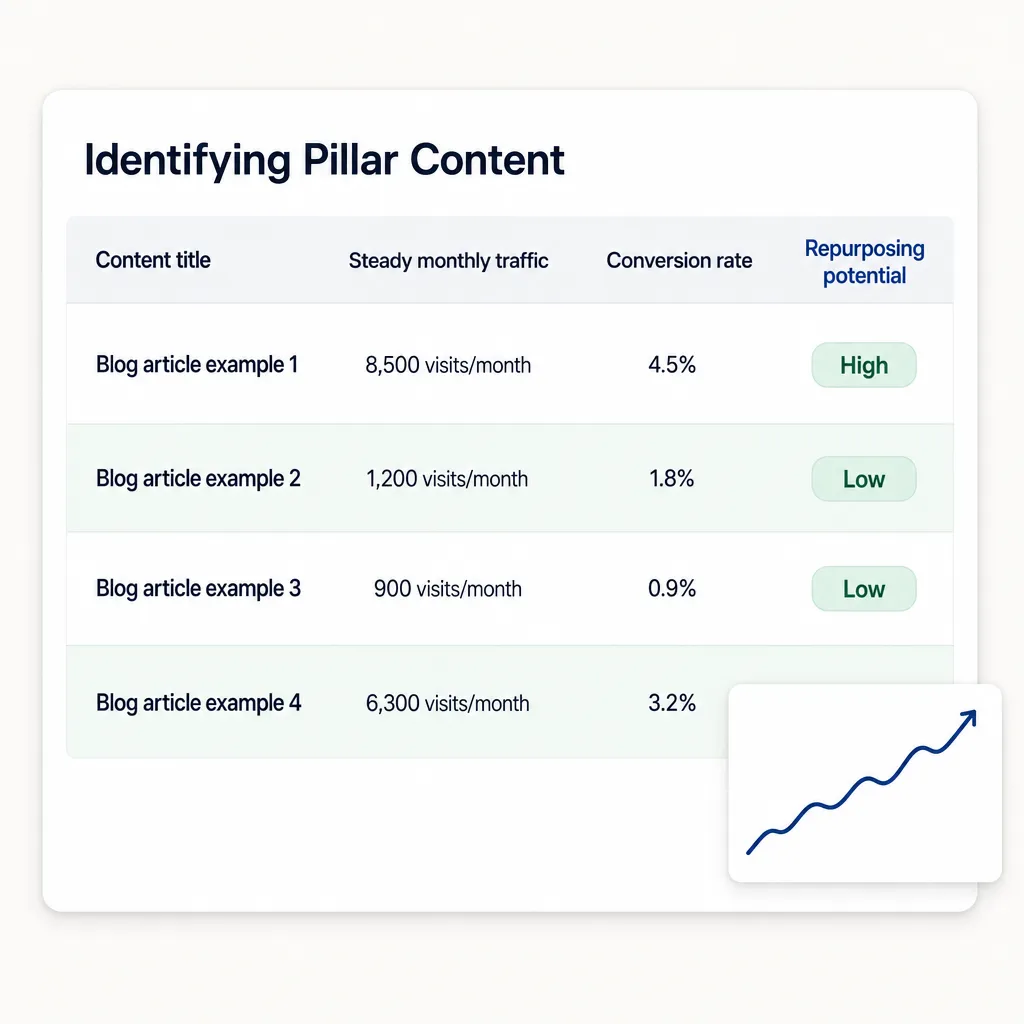
Dig into your analytics to spot:
- The steady performers: pages that have driven consistent traffic for 6-12 months
- The converters: content that regularly brings in sign-ups or enquiries
- The references: articles frequently cited by other specialist sites
- The page-turners: topics with an unusually high time on page
Back this analysis up with a qualitative judgement. A data-heavy article can become an infographic, while a customer testimonial lends itself well to video formats or short clips for your social media.
Match persona and format
You get maximum impact when the format matches your target audience's habits. Build relevant topic clusters that reinforce your expertise while answering each group's specific expectations.
Adapt to their preferences: decision-makers like visual summaries, field teams prefer practical tutorials. These insights will guide your choice of content transformations.
Structure your internal linking
Smart repurposing automatically improves your internal linking. Each new version becomes an extra entry point to your flagship content, strengthening its rankings.
Our complete guide explains how to build connected content ecosystems that support customers at every stage.
Content recycling techniques
Turning your existing content into several versions is a smart strategy for maximising its reach. Instead of always creating something new, adapt your original message to different channels while keeping its meaning and value intact.
From long-form to micro-content
Did you know a single blog post can generate dozens of social media posts? Pull out its main ideas to create:
- Punchy quotes for X (formerly Twitter)
- Engaging questions for Facebook
- Educational infographics for LinkedIn
This method lets you repurpose your content intelligently while respecting the quirks of each social network.
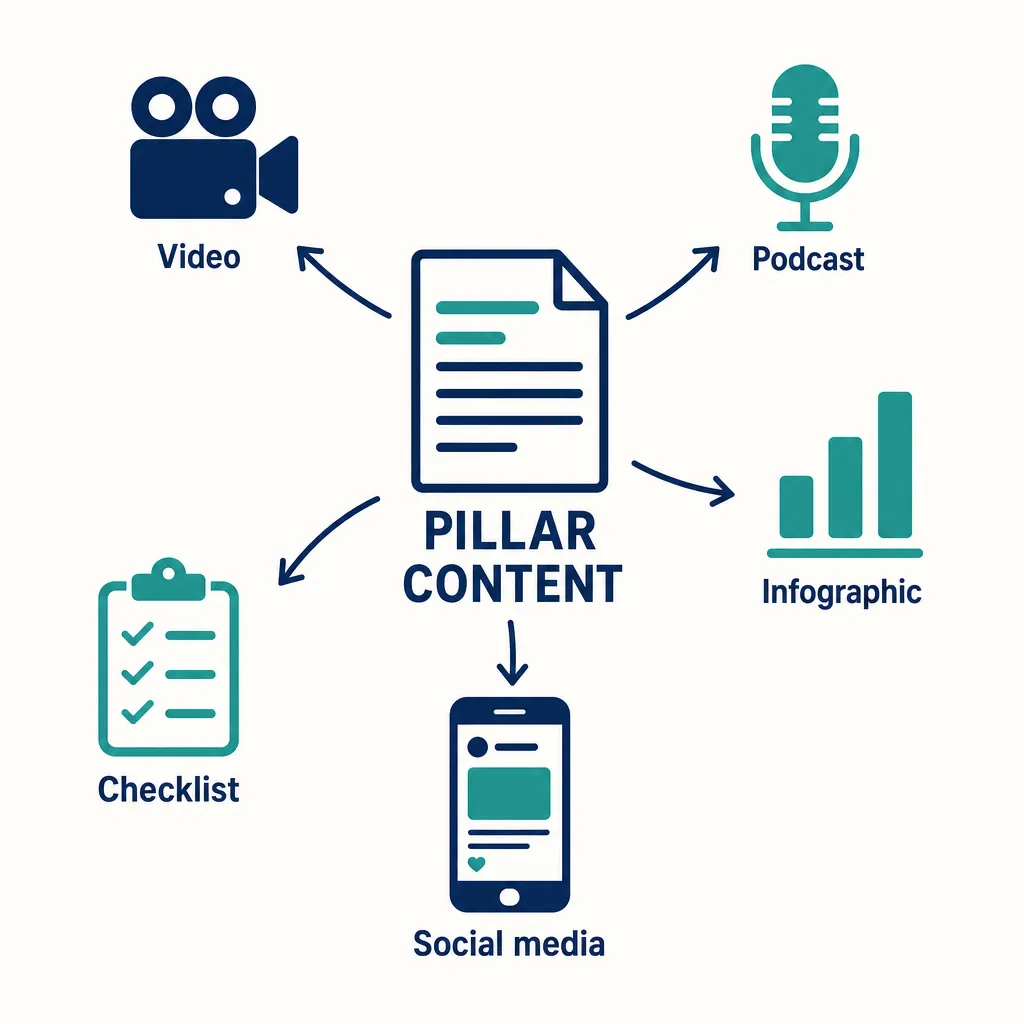
From text to visual and audio
Diversifying formats is essential if you want to reach different kinds of audiences:
- Turn your articles into podcasts for people on the move
- Create explainer videos from your written guides
- Design infographics to share on Pinterest
Recycling content into different formats (text, audio, visuals) lets you extend your reach considerably.
Video as the pivot and its spin-offs
A single video can give rise to:
- Several clips for social media
- A detailed blog post (thanks to the transcript)
- A series of educational stories
- Audio excerpts for a podcast
Always adapt the original video format to each platform: vertical for TikTok and Instagram, longer for YouTube, professional for LinkedIn.
Content recycling isn't laziness, it's a smart method for maximising the impact of every original piece. By varying formats (text, audio, visuals, video), you reach more people without having to recreate everything each time.
An AI workflow for content
Artificial intelligence is transforming content creation by making it possible to generate several versions quickly while keeping the writing consistent. It boosts your output without hiring more writers.
Toolchain and quality control
To make your AI-powered SEO strategy work, assemble a set of tools that automate each phase. Start with models like ChatGPT or Claude to identify the key ideas and draft the first versions. Then create visuals with Canva AI before scheduling publication through a tool like Buffer.
- Analysis and organisation: AI automatically ranks sub-topics by performance potential.
- Version creation: automatic generation of headlines and descriptions tailored to each format.
- Optimisation: vocabulary adjusted to the specific search intent.
Even when automated, a human reviewer is still essential to check accuracy, fit with your editorial tone and industry relevance.
Aligning with search intent
Every piece of content needs to match precisely what searchers expect. The same topic can become a detailed article on your blog, an engaging LinkedIn post and a commercial product page. This adaptation improves your rankings while fully satisfying readers.
AI excels at this contextualisation by analysing secondary keywords. A technical tutorial becomes a comparison (blog), a checklist (LinkedIn) and a sales page (ecommerce site).
This intelligent approach avoids duplication while strengthening your authority on a topic through complementary content targeting different queries.
Measurement and continuous iteration
AI also makes performance analysis easier by automatically tracking the KPIs for each format. These insights guide your editorial choices by revealing the angles that perform best.
Connect your AI tools to Google Analytics 4 and Search Console to automate rank and conversion tracking. You'll quickly identify the content that needs optimising.
Little by little, this data-driven method turns your process into a machine for generating qualified traffic. Each analysis and optimisation cycle improves the relevance of what you produce next.
Content best practices
To get the most out of your content repurposing strategy, adopt methods that keep editorial quality consistent while amplifying the impact of each adaptation. These best practices keep your branding perfectly coherent across every communication channel.
Personalise by audience
Tailor your repurposed content to the specifics of each audience to boost engagement and target long-tail keywords more effectively. Adopt vocabulary, illustrations and a level of technical depth that match your readers' knowledge. The same topic deserves different explanations depending on whether you're talking to insiders or newcomers.
- Adapt the tone: technical for experts, plain-English for the general public, strategic for decision-makers
- Industry case studies: illustrate with examples that resonate with each profession involved
- Modular approach: executive summaries for leadership, step-by-step guides for operational teams
- Targeted benefits: ROI for executives, productivity gains for managers
This differentiation lets you create tailored user journeys that reinforce your expertise and convert each customer segment better.
Prevent SEO duplication
Content repurposing demands particular vigilance against duplicate content, which hurts your rankings. Each variant must add unique value while maintaining coherent internal linking to strengthen the authority of your flagship pages.
Systematically rework your content by varying structures, angles and visuals. Use canonical tags to tell search engines which version is the original. This approach protects your SEO performance while extending your presence across multiple channels.
Standardise and govern
Put rigorous governance in place to standardise your repurposing processes and guarantee consistent quality and editorial efficiency. Formalise templates, approval workflows and selection criteria to make onboarding new team members easier and keep everyone following best practices.
Develop analysis tools that identify content to repurpose based on its performance, adaptation potential and alignment with your goals. This structure speeds up decision-making and makes the best use of your creative resources.
Our complete guide to repurposing and SEO content optimisation details a step-by-step method for implementing this governance, bringing search intent analysis, advanced techniques and results tracking together in a single unified process.

Rank Higher Without the Manual Work
From technical audits with Nox to competitor monitoring with Marc, Sedestral's AI agents cover every layer of SEO so your team doesn't have to.